Who keeps more in Spain, an autónomo or an employee?
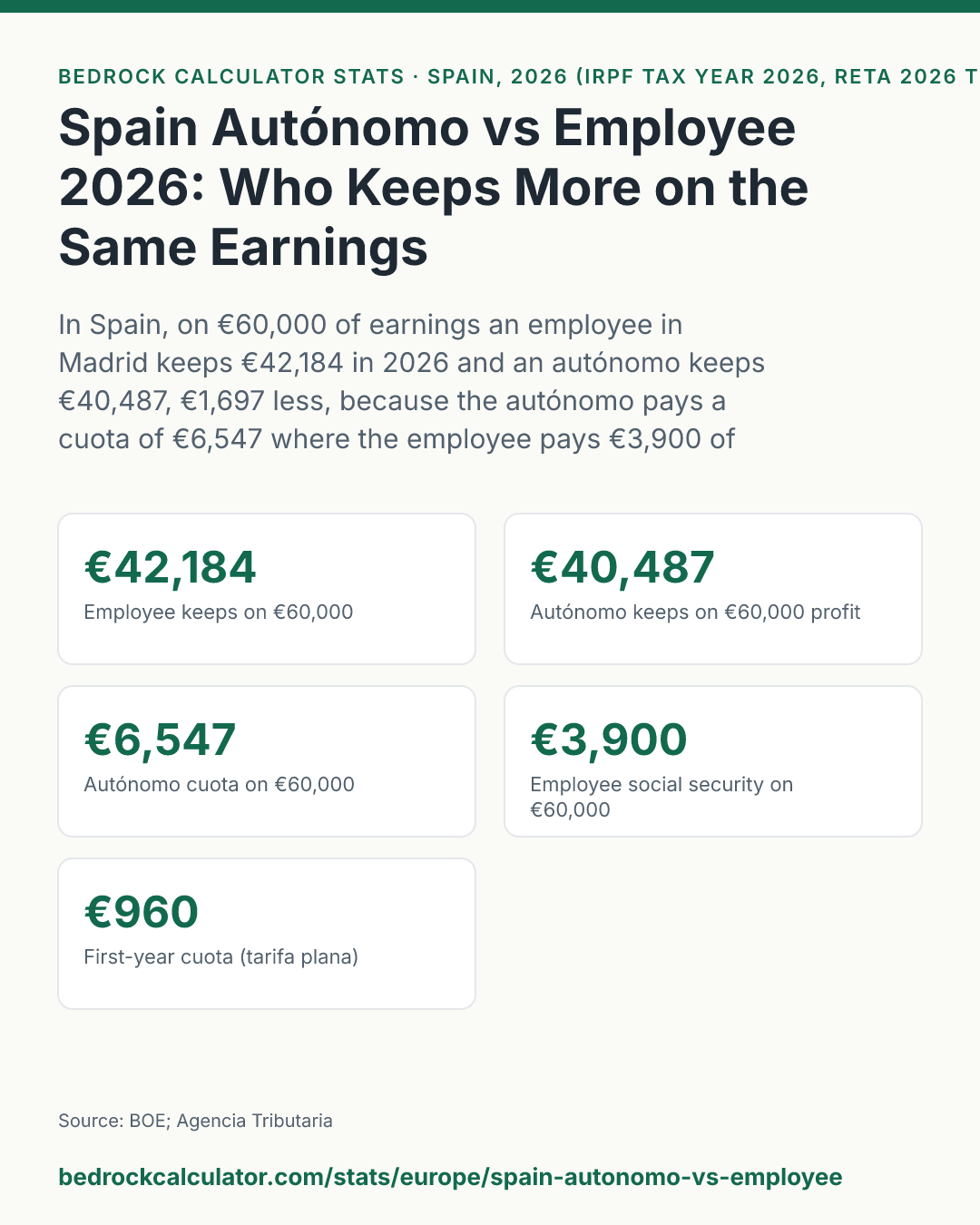
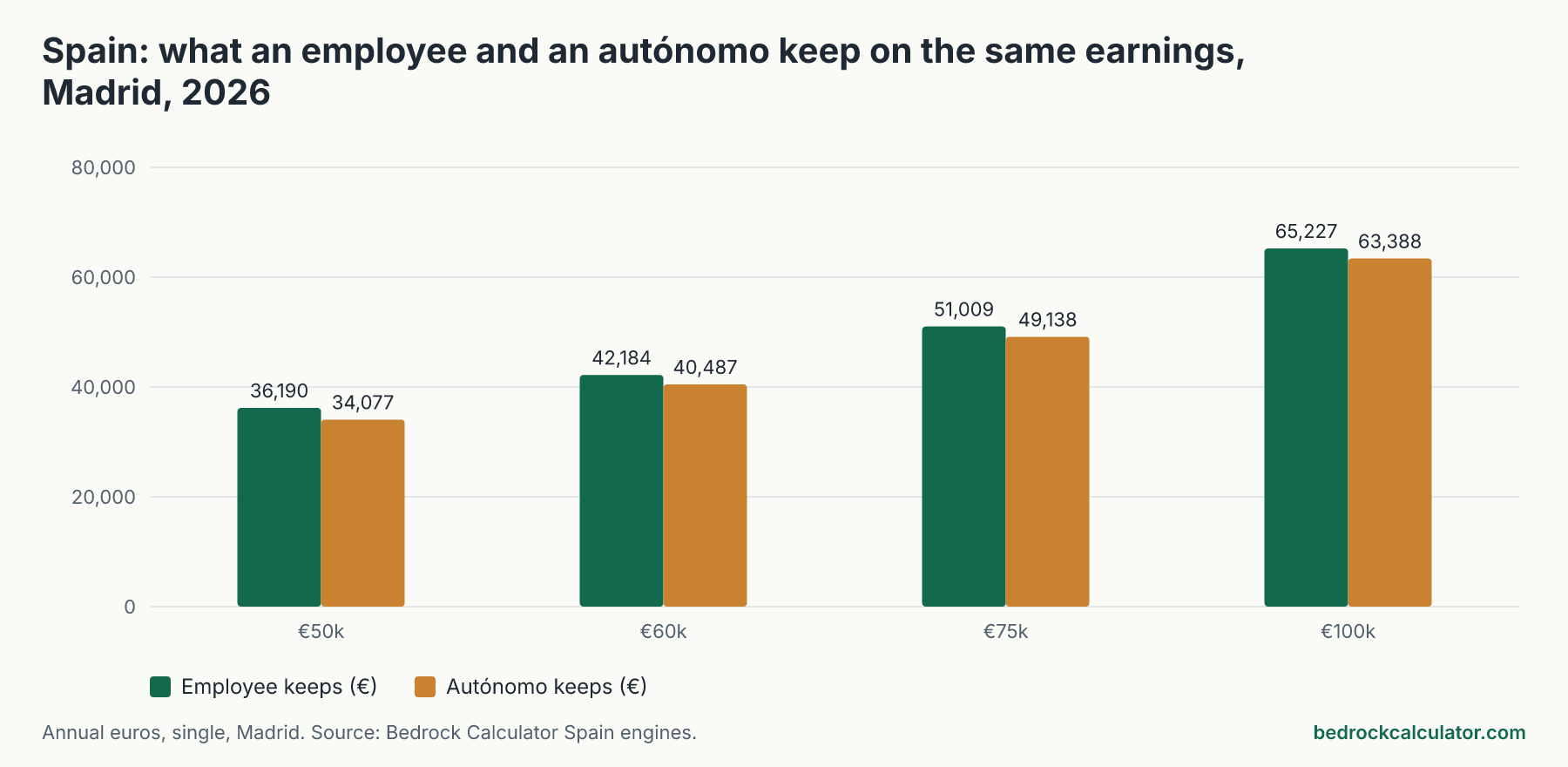
In Spain, if you earn the same amount as an employee (asalariado) or as an autónomo, the employee keeps more. On €60,000 in Madrid in 2026, an employee keeps €42,184 after social security and IRPF. An autónomo whose business makes €60,000 of profit keeps €40,487, which is €1,697 less.
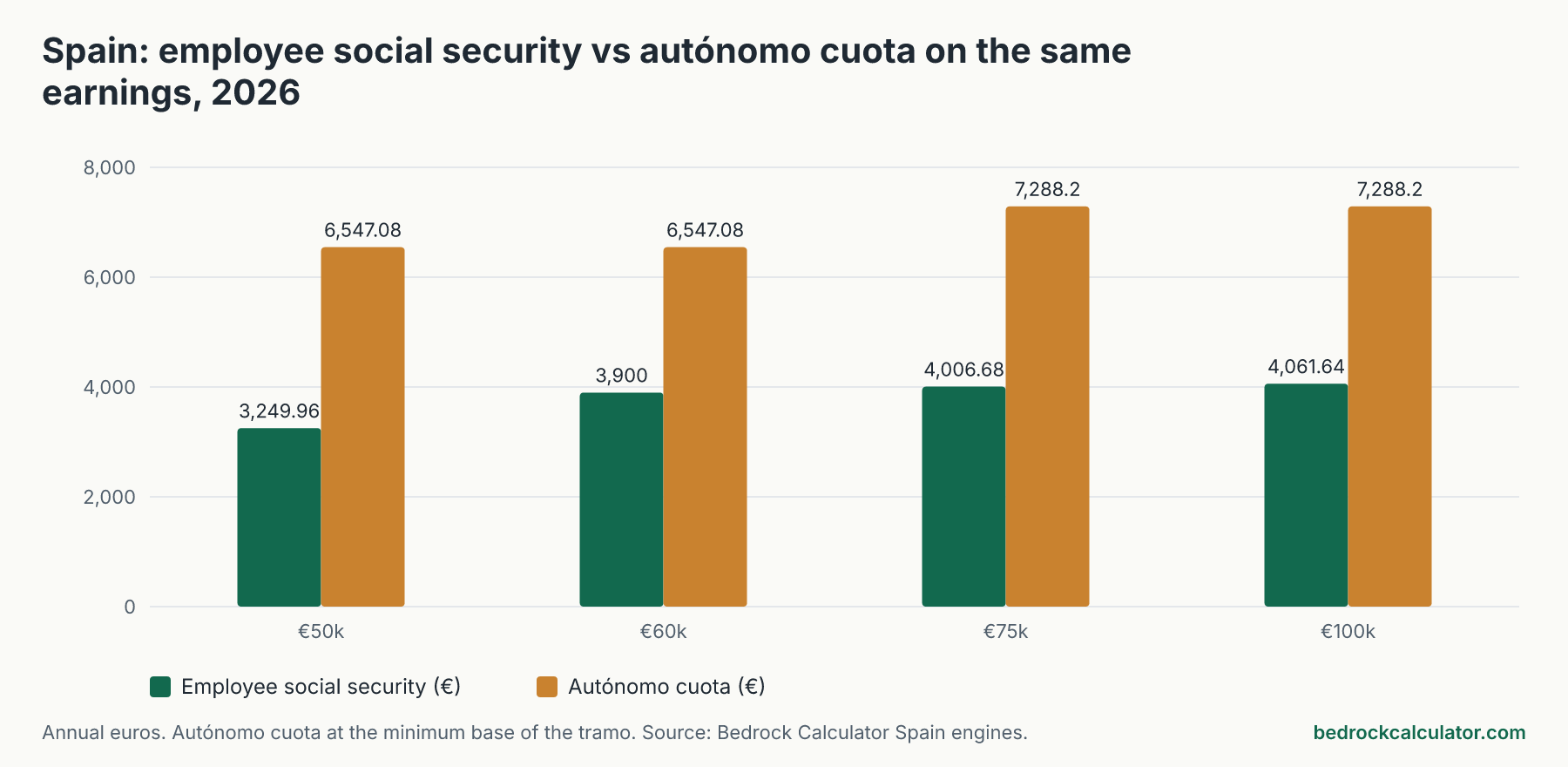
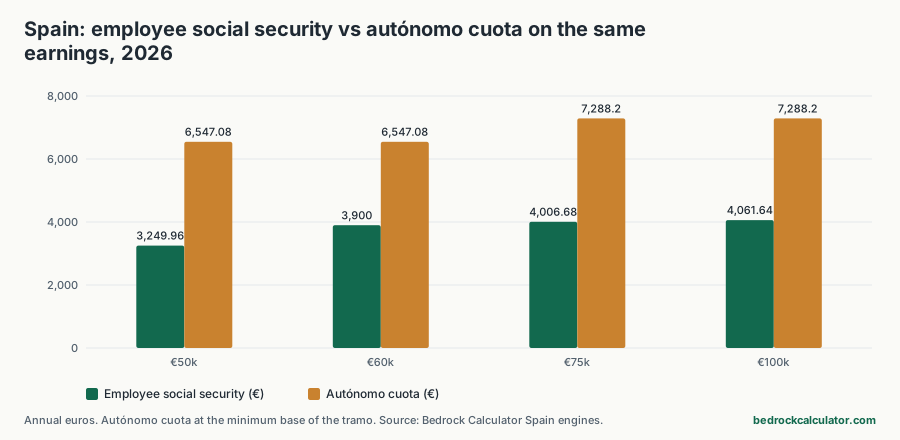
The reason is social security. The autónomo's monthly cuota adds up to €6,547 a year, while the employee pays €3,900. But that's only half the picture. Employers pay a lot of social security on top of salary, and if a client pays an autónomo what an employer would spend on an employee, the autónomo comes out ahead by €9,400.
Two ways to compare "the same money"
There are two fair questions here, and they give opposite answers.
Same earnings. You have €60,000 of gross salary, or €60,000 of business profit after expenses. Who keeps more? This is the comparison most people mean when they ask whether to go autónomo.
Same cost. A company could hire you, paying your salary plus its own social security, or pay you as an autónomo. If it spends the same either way, who keeps more? This is the comparison that matters when you're negotiating a day rate against a salary offer.
We ran both, for a single person under 65 living in Madrid.
Same earnings: the employee keeps more
Sort by any column.
Spain 2026: employee vs autónomo on the same earnings (Madrid)
Download CSVAnnual euros. Employee: gross salary. Autónomo: net profit before the RETA cuota, standard cuota at the minimum base of the tramo. Single, under 65, Madrid IRPF. Source: Bedrock Calculator Spain social security, autónomos and IRPF engines.
| €50,000 | €3,249.96 | €10,559.80 | €36,190.24 | €6,547.08 | €9,376.13 | €34,076.79 | €2,113.45 |
| €60,000 | €3,900 | €13,916.43 | €42,183.57 | €6,547.08 | €12,966.13 | €40,486.79 | €1,696.78 |
| €75,000 | €4,006.68 | €19,984.73 | €51,008.59 | €7,288.20 | €18,573.68 | €49,138.12 | €1,870.47 |
| €100,000 | €4,061.64 | €30,711.09 | €65,227.27 | €7,288.20 | €29,323.68 | €63,388.12 | €1,839.15 |
On €50,000 the employee keeps €36,190 and the autónomo €34,077, a gap of €2,113. On €75,000 the gap is €1,870, and on €100,000 it's €1,839.
The employee pays slightly more IRPF, because their taxable income is higher. But the autónomo's cuota is far bigger than the employee's share of social security, so the autónomo ends up behind.
Why the autónomo cuota is so much bigger
An employee's social security is split. The employee pays a small share, 6.5% of a €50,000 salary, and the employer pays the much larger rest. An autónomo pays the whole contribution alone.
Since 2023 the autónomo cuota is based on real net income, in 15 bands called tramos. Each tramo has a minimum and maximum contribution base, and you choose your base within it. On €50,000 or €60,000 of profit you're in tramo 14, and at the minimum base the cuota is €546 a month. From €75,000 you're in the top tramo, at €607 a month.
Because the cuota is set by tramo and most people choose the minimum base, it falls as a share of profit as you earn more: 13.1% on €50,000 and 7.3% on €100,000. The employee's share also falls at the top, because salaries above the maximum contribution base pay contributions only up to that base.
A lower cuota isn't free money. The base you contribute on sets your future pension and benefits, so an autónomo on the minimum base is building up less pension than an employee on the same pay.
Same cost: the autónomo keeps more
Now flip it. An employer paying a €60,000 salary also pays its own social security, bringing the total cost to €79,290. If a client paid an autónomo that same €79,290 as profit, the autónomo would keep €51,583, which is €9,400 more than the employee.
Spain 2026: employee vs autónomo when the client pays what an employer would
Download CSVAnnual euros. The autónomo's profit equals the employer's total cost of the employee (salary plus employer social security). Source: Bedrock Calculator Spain social security, autónomos and IRPF engines.
| €50,000 | €66,074.96 | €36,190.24 | €44,374.41 | €8,184.17 |
| €60,000 | €79,290 | €42,183.57 | €51,583.42 | €9,399.85 |
| €75,000 | €94,818.96 | €51,008.59 | €60,434.94 | €9,426.35 |
| €100,000 | €120,093.64 | €65,227.27 | €74,841.51 | €9,614.24 |
The gap is similar across the range: €8,184 at a €50,000 salary and €9,614 at €100,000. That's the money the employer would have spent on social security, minus the autónomo's cuota and the extra IRPF on a higher income.
It's also roughly what an autónomo gives up: paid holidays, sick pay from the employer, severance and unemployment protection that's easier to claim. Whether the extra cash is worth it depends on how secure the work is.
The first-year tarifa plana
New autónomos pay a flat cuota of €80 a month for their first 12 months, the tarifa plana, instead of the tramo-based amount. That's €960 for the year. On €50,000 of profit a first-year autónomo keeps €37,658, which is €3,581 more than with the standard cuota, and more than an employee on the same earnings. It's a temporary advantage, and there are conditions, such as not having been self-employed recently.
How we worked out these numbers
For the employee, the Spain social security calculator gives the employee contributions on the gross salary, and the Spain income tax calculator works out state and Madrid IRPF on what's left. For the autónomo, the autónomos calculator gives the standard cuota at the minimum base of the tramo for the monthly profit, and the same IRPF calculator taxes profit minus the cuota.
The two get different standard deductions, and the calculator applies each. An employee deducts a flat €2,000 from work income. An autónomo in the simplified direct estimation regime instead deducts 5% of net yield for hard-to-justify expenses, capped at €2,000, which reaches the cap from €40,000 of net yield.
What these numbers leave out
The RETA generic-expense deduction. For working out your tramo, Social Security lets you take a small percentage off your net yield for generic expenses. We used the profit itself, so some autónomos would fall in a lower tramo and pay a little less cuota than shown.
Other regions. IRPF is for Madrid. Catalonia and Andalucía are also in the calculator and charge more on these incomes. The rest of Spain isn't modelled.
Business costs and VAT. Profit is after business expenses. IVA, invoicing and accounting costs are not considered.
Lower earnings, families and pensions. Earnings below €50,000, joint filing, children, private pension contributions and the low-income work reduction are not modelled.
Run your own numbers
Work out your cuota in the autónomos calculator, employee contributions in the social security calculator, and IRPF in the Spain income tax calculator. For how a Spanish autónomo compares with the self-employed in the US, the UK, Germany, the Netherlands and Sweden, read our self-employed tax comparison.