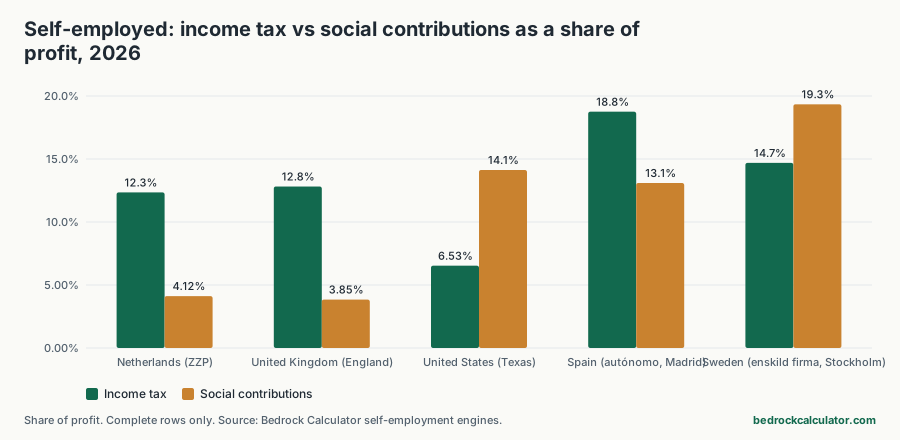
How much tax does a self-employed person pay in each country?
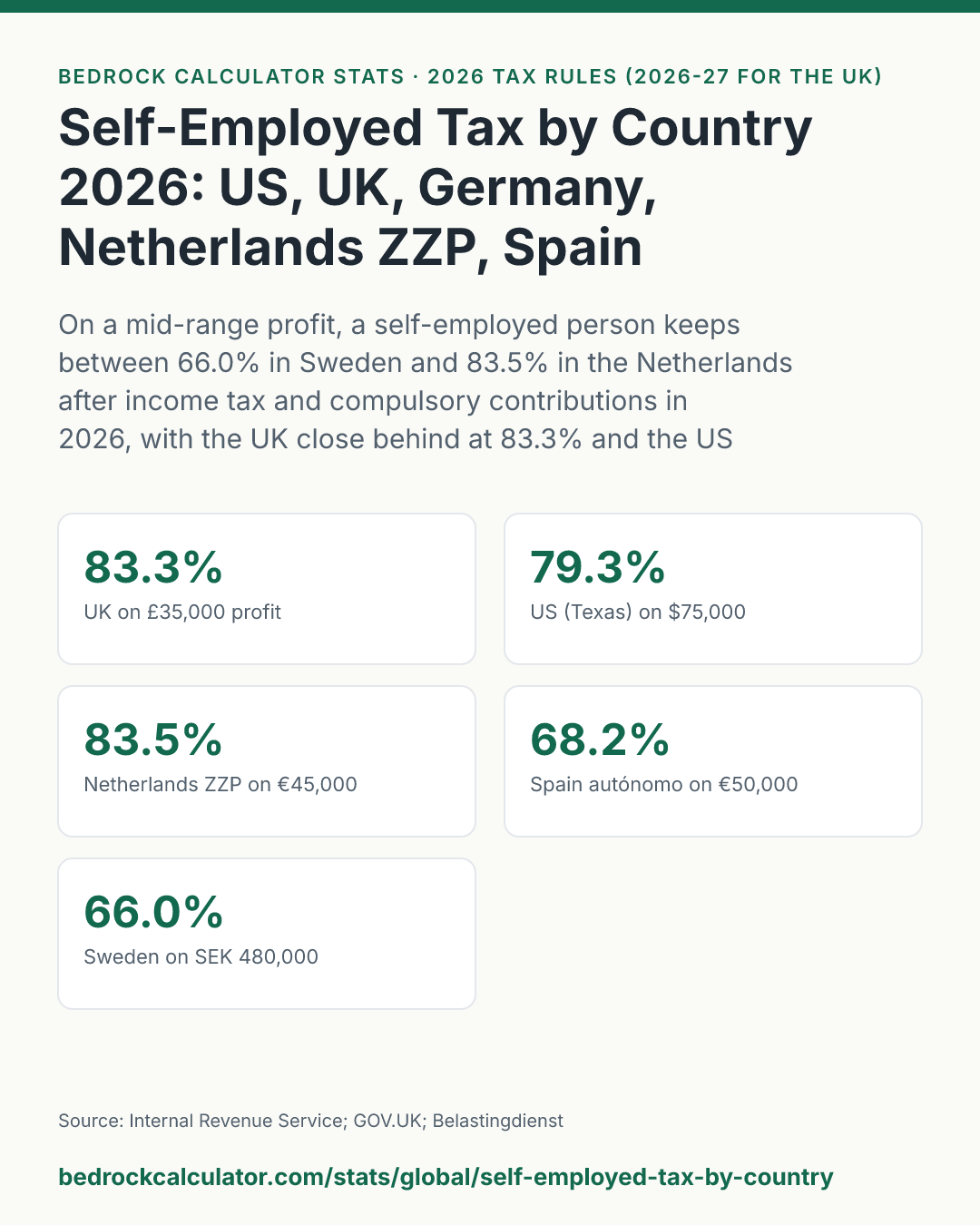
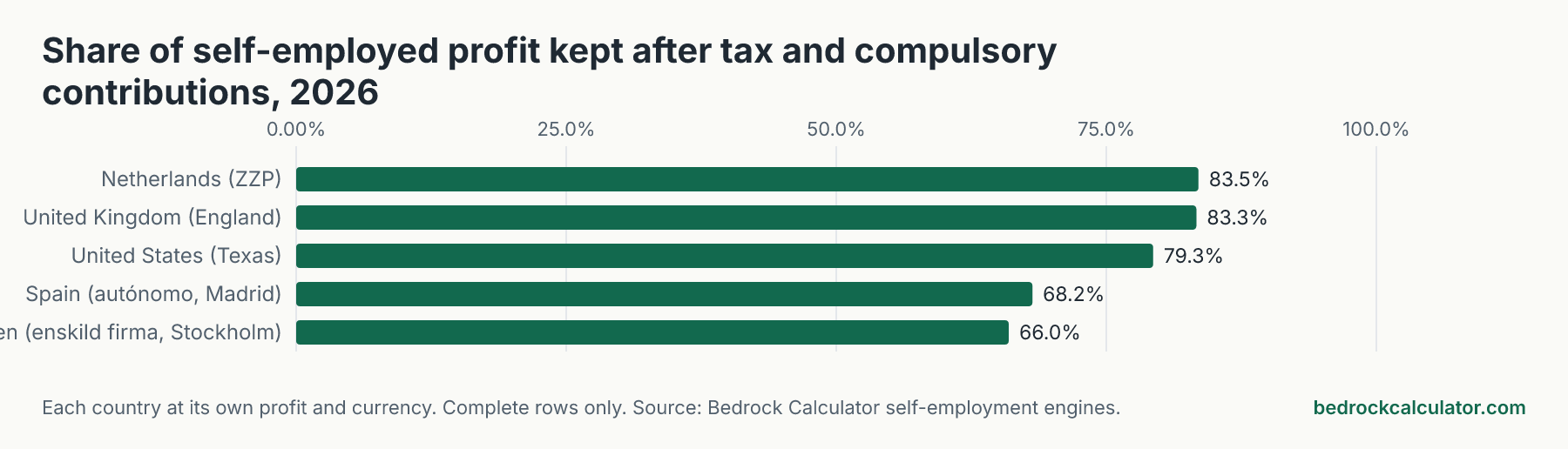
Working for yourself costs very different amounts in tax depending on where you do it. On a mid-range profit in 2026, a Dutch ZZP freelancer keeps 83.5% after income tax and compulsory contributions, and a UK sole trader keeps 83.3%. A self-employed American in Texas keeps 79.3%.
A Spanish autónomo keeps 68.2%, and a Swedish sole trader with an enskild firma keeps 66.0%.
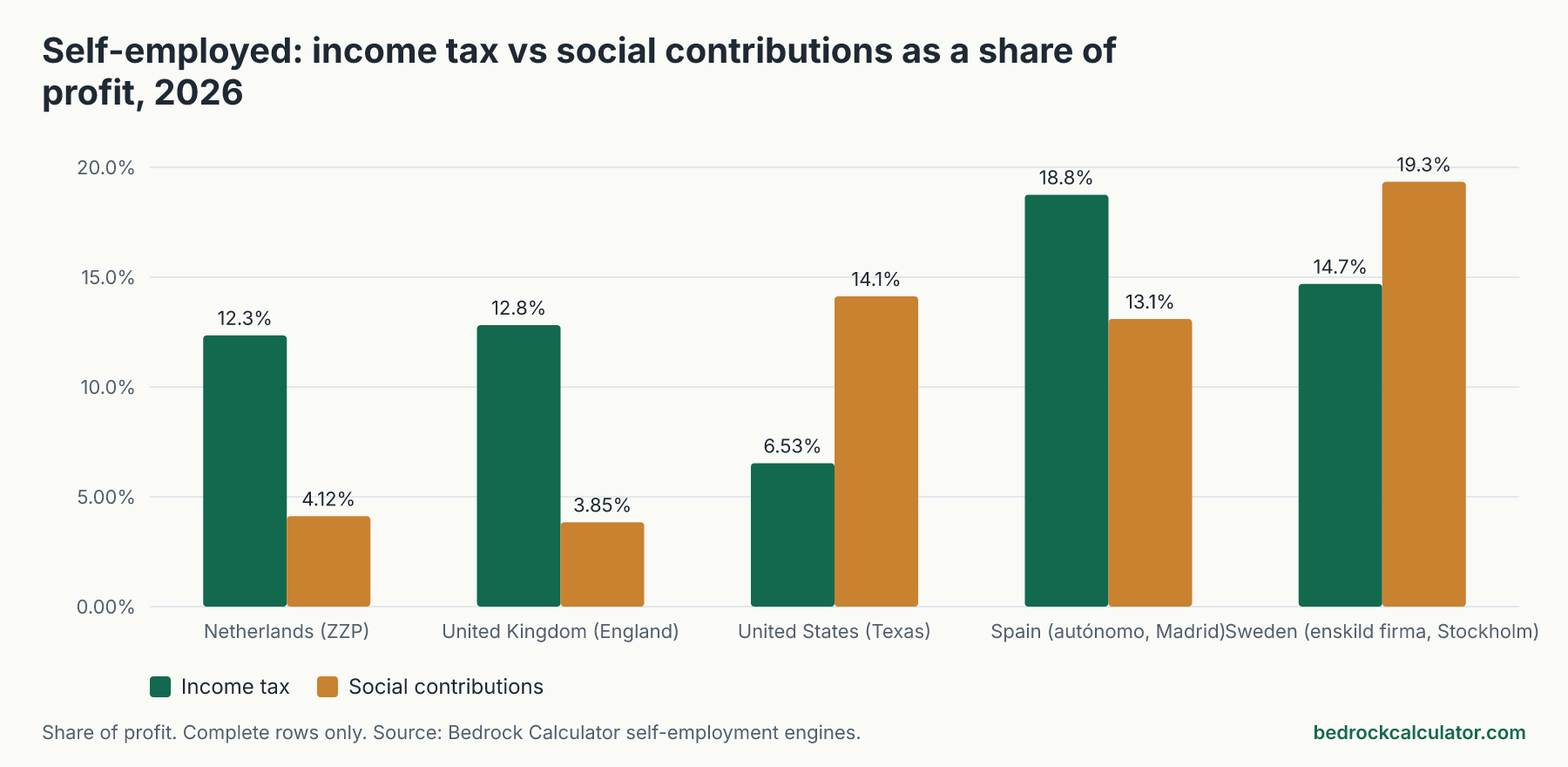
The biggest difference isn't income tax. It's the social contributions self-employed people pay on their own, with no employer to share the cost. Those take 19.3% of profit in Sweden and 13.1% in Spain, but only 3.8% in the UK.
How we compared six countries
Each country has its own calculator on this site, and we ran each one on a single mid-range profit in that country's own currency. We didn't convert anything to dollars, since that would mostly measure exchange rates. What compares across borders is the share of profit you keep, so that's what we rank.
The profits are the same mid-range figures we used in our take-home pay by country study: £35,000 in the UK, $75,000 in the US, €45,000 in the Netherlands, €50,000 in Germany and SEK 480,000 in Sweden. Spain is the exception at €50,000, for a reason we explain below. Profit means revenue minus business costs. Everyone is single, with no children, no pension contributions and no other income.
Tax and contributions on self-employed profit
Sort by any column. Amounts are in the currency shown on each row.
Tax and contributions on self-employed profit in six countries, 2026
Download CSVEach country at its own profit in its own currency; nothing converted. Single, no children, no pension contributions. Germany is partial (no health insurance) and not ranked. Source: Bedrock Calculator self-employment engines for each country.
| Netherlands (ZZP) | EUR | 45,000 | 5,557.14 | 1,854.51 | 37,588.35 | 83.5% | Box 1 income tax including national insurance premiums, after zelfstandigenaftrek and MKB profit exemption; Zvw health contribution |
| United Kingdom (England) | GBP | 35,000 | 4,486 | 1,345.8 | 29,168.2 | 83.3% | Income Tax, Class 4 National Insurance |
| United States (Texas) | USD | 75,000 | 4,897.74 | 10,597.16 | 59,505.1 | 79.3% | Federal income tax after the standard and QBI deductions, self-employment tax (Social Security and Medicare) |
| Germany (Freiberufler) | EUR | 50,000 | 10,548 | 0 | 39,452 | 78.9% | Income tax and solidarity surcharge only. Leaves out compulsory health and long-term care insurance |
| Spain (autónomo, Madrid) | EUR | 50,000 | 9,376.13 | 6,547.08 | 34,076.79 | 68.2% | RETA cuota at the minimum base, state and Madrid IRPF |
| Sweden (enskild firma, Stockholm) | SEK | 480,000 | 70,521.52 | 92,820.42 | 316,658.06 | 66.0% | Egenavgifter after the special deduction, municipal and state income tax |
Why the Netherlands and the UK come out on top
The Netherlands. Dutch ZZP freelancers who meet the hours test, the urencriterium of 1,225 hours a year, in the business get two reliefs before income tax: the zelfstandigenaftrek and the MKB-winstvrijstelling, an exemption for a slice of profit. Dutch income tax already includes the national insurance premiums for state pensions and long-term care, and the only separate charge is the Zvw health contribution, €1,855 here. On €45,000 that leaves €37,588.
The UK. A sole trader pays Income Tax and Class 4 National Insurance on profit above the Personal Allowance. On £35,000 that's £4,486 of Income Tax and £1,346 of National Insurance, leaving £29,168. Class 2 National Insurance is no longer compulsory.
The two are almost level, and at slightly different profits the order could flip.
The US: self-employment tax is the big one
A self-employed American pays both halves of Social Security and Medicare through self-employment tax: $10,597 on $75,000. Federal income tax is smaller, at $4,898, because half the self-employment tax, the standard deduction and the qualified business income (QBI) deduction, here $10,720, all come off first. In Texas there's no state income tax, so the self-employed person keeps $59,505.
In a state with an income tax the share kept would be lower. And as with employees, health insurance is a large extra cost for self-employed Americans that isn't counted here.
Spain and Sweden: contributions take the most
Spain. An autónomo pays a monthly social security cuota based on income bands, and on €50,000 it adds up to €6,547 a year at the lowest base allowed. IRPF income tax in Madrid is €9,376. That leaves €34,077. Our autónomo vs employee comparison looks at this in detail.
For Spain the IRPF calculator gives the autónomo the deduction the simplified regime allows, 5% of net profit for hard-to-justify expenses, capped at €2,000, not the employee's flat €2,000.
Sweden. A sole trader pays egenavgifter, the self-employed version of employer contributions, on profit: SEK 92,820 on SEK 480,000, after the special deduction. Municipal and state income tax in Stockholm add SEK 70,522. That leaves SEK 316,658.
Why Germany isn't ranked
German freelancers (Freiberufler) pay income tax and, above a threshold, the solidarity surcharge: €10,548 on €50,000. But they must also buy their own health and long-term care insurance, usually through the statutory scheme at the full rate with no employer share. That's a large cost, and the Germany freelancer tax calculator doesn't include it. Its figure of 78.9% kept is too high, so we show Germany in the table but leave it out of the ranking.
What this comparison leaves out
Different profits. Each profit sits in the middle of its own country's range, but not at exactly the same point. Progressive taxes take a smaller share of a lower profit.
What contributions buy. Swedish egenavgifter and the Spanish cuota fund pensions, sick pay and parental benefits. UK Class 4 National Insurance funds much less directly. A lower bill can mean less protection.
Health insurance. US and German self-employed people pay for health cover on top. Neither is counted.
Business structure and VAT. Everyone here is a sole trader, not a company. VAT, invoicing rules and accounting costs are not considered.
Regional detail. The US figure is for a state with no income tax, Spain's is for Madrid and Sweden's for Stockholm.
Run your own numbers
Use the self-employment tax calculator and the QBI deduction calculator for the US, the National Insurance calculator for the UK, the ZZP calculator for the Netherlands, the autónomos calculator for Spain and the enskild firma calculator for Sweden.