When is advance tax due in India for 2026-27, and how much is each instalment?
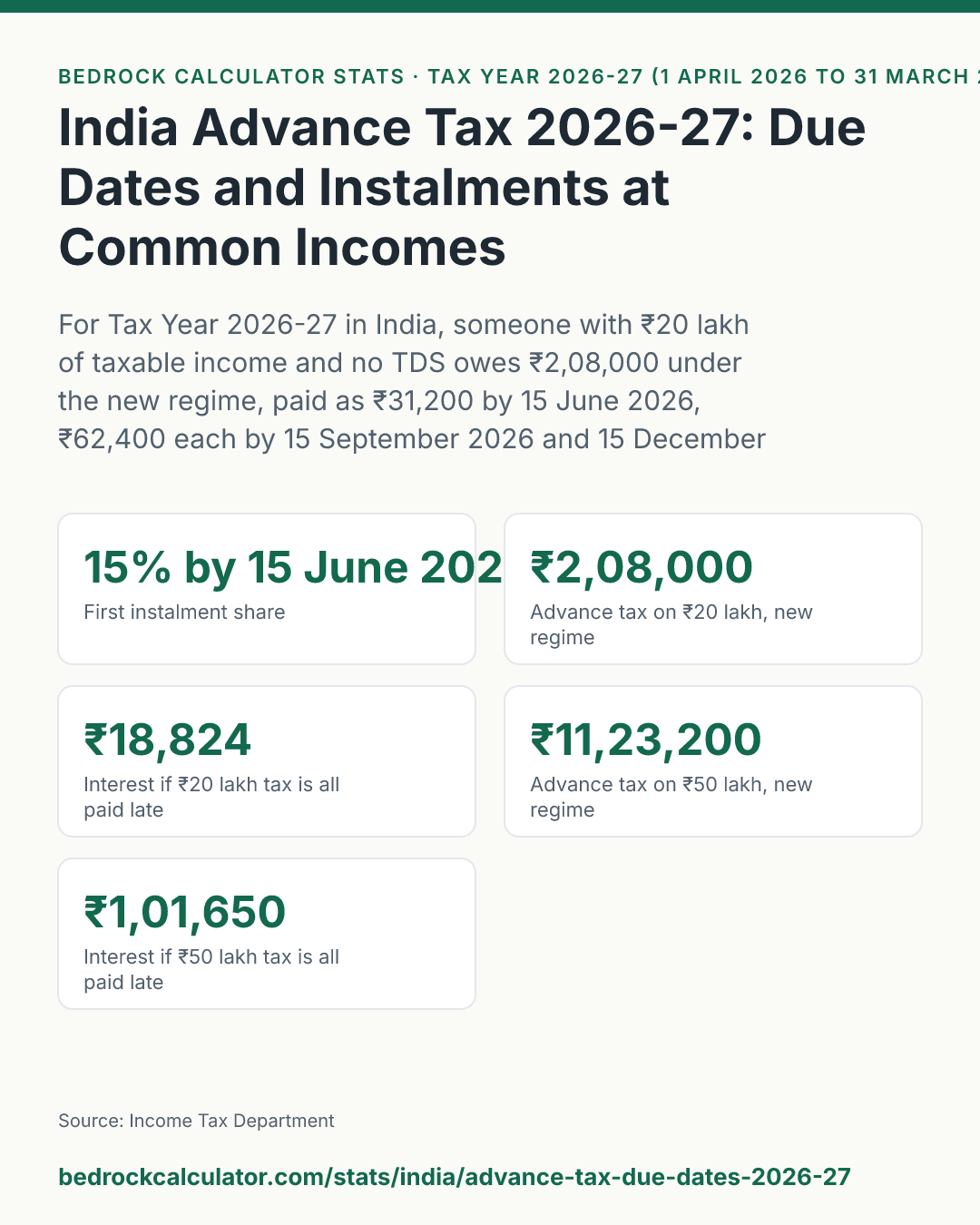
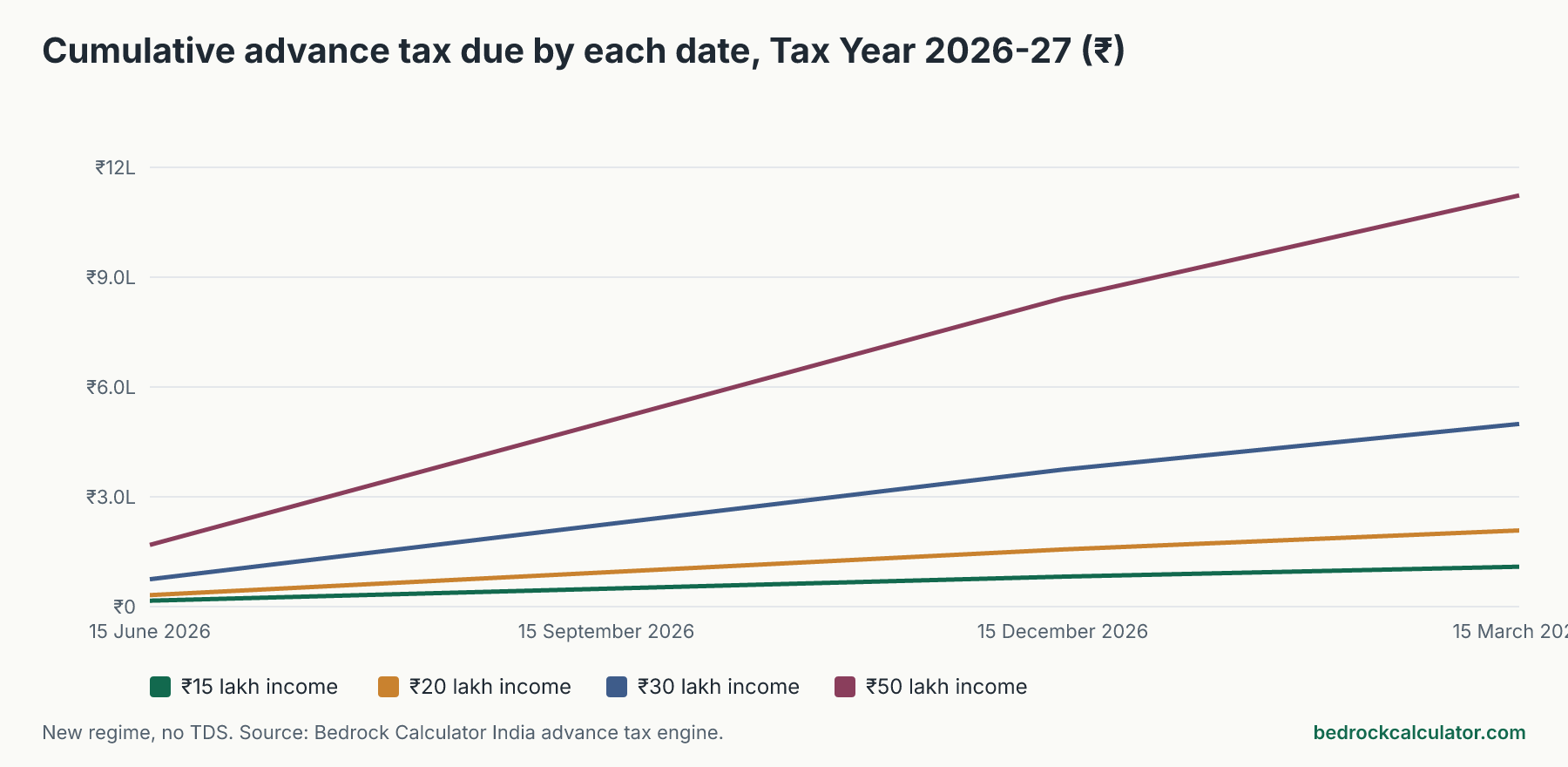
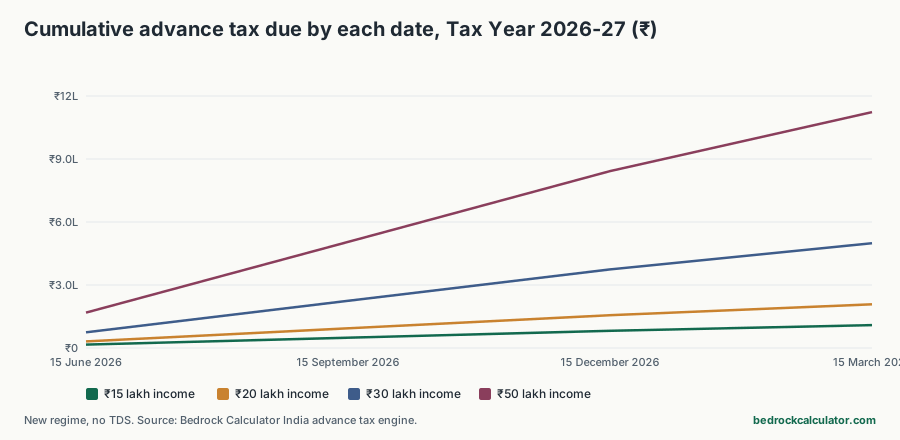
Advance tax for Tax Year 2026-27 in India is paid in four instalments: 15% of the year's tax by 15 June 2026, 45% by 15 September 2026, 75% by 15 December 2026 and all of it by 15 March 2027. Those percentages are running totals.
Take a freelancer with ₹20 lakh of taxable income, no TDS, on the new regime. The year's tax is ₹2,08,000. That means paying ₹31,200 by 15 June 2026, ₹62,400 by 15 September 2026, another ₹62,400 by 15 December 2026, and the balance by 15 March 2027. Pay nothing until 4 months after the year ends and the interest comes to ₹18,824.
Advance tax due dates for 2026-27
| Due date | Paid by this date, in total |
|---|---|
| 15 June 2026 | 15% of the year's tax |
| 15 September 2026 | 45% |
| 15 December 2026 | 75% |
| 15 March 2027 | 100% |
The amount due on each date is the difference between that running total and the one before. So the second and third instalments are the big ones, and the first and last are smaller.
How much to pay at each income
Here's the schedule at five common levels of taxable income, worked out on the new regime with no TDS. Each column is what you pay on that date, not the running total.
India: advance tax instalments by taxable income, Tax Year 2026-27 (₹, new regime, no TDS)
Download CSVInstalment due on each date, not the running total. Due dates 15 June 2026, 15 September 2026, 15 December 2026 and 15 March 2027. Tax includes surcharge and 4% cess. Interest is what the engine charges if nothing is paid until 4 months after the year ends.
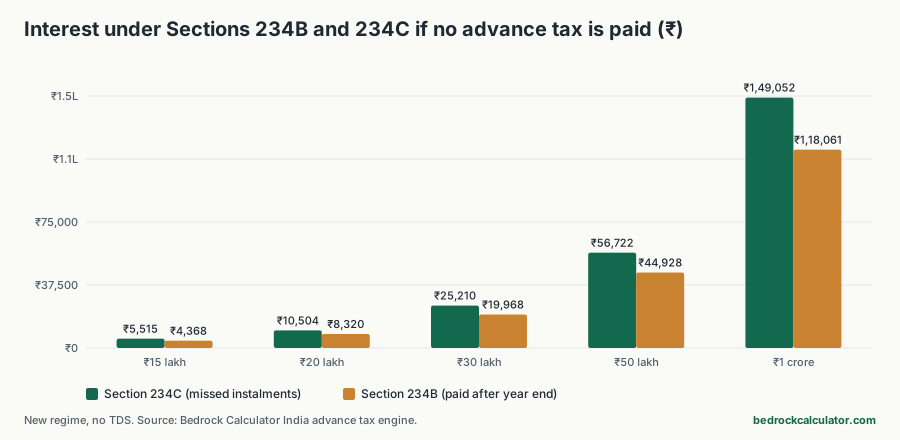
| ₹15 lakh | ₹1,09,200 | ₹16,380 | ₹32,760 | ₹32,760 | ₹27,300 | ₹9,883 |
| ₹20 lakh | ₹2,08,000 | ₹31,200 | ₹62,400 | ₹62,400 | ₹52,000 | ₹18,824 |
| ₹30 lakh | ₹4,99,200 | ₹74,880 | ₹1,49,760 | ₹1,49,760 | ₹1,24,800 | ₹45,178 |
| ₹50 lakh | ₹11,23,200 | ₹1,68,480 | ₹3,36,960 | ₹3,36,960 | ₹2,80,800 | ₹1,01,650 |
| ₹1 crore | ₹29,51,520 | ₹4,42,728 | ₹8,85,456 | ₹8,85,456 | ₹7,37,880 | ₹2,67,113 |
At ₹15 lakh of taxable income the total is ₹1,09,200: ₹16,380 in June, ₹32,760 in September, ₹32,760 in December and ₹27,300 in March. At ₹30 lakh the first instalment alone is ₹74,880, and at ₹50 lakh it's ₹1,68,480 on a total of ₹11,23,200. At ₹1 crore the total is ₹29,51,520, with ₹4,42,728 due in June.
The regime you choose matters as much as the schedule. On the same ₹20 lakh, the old regime with no deductions would put the year's tax at ₹4,29,000, so each instalment would be roughly double.
Who has to pay advance tax?
Anyone whose tax for the year isn't covered by TDS. For most salaried employees, the employer deducts enough each month that there's nothing left to pay in advance. You'll need to pay it yourself if you have:
- Freelance, consulting or business income
- Rent from a property
- Interest from deposits where the bank's TDS doesn't cover your slab rate
- Capital gains from selling shares, funds or property
If some tax is deducted at source, the calculator subtracts it first and splits only what's left.
What it costs to skip or delay advance tax
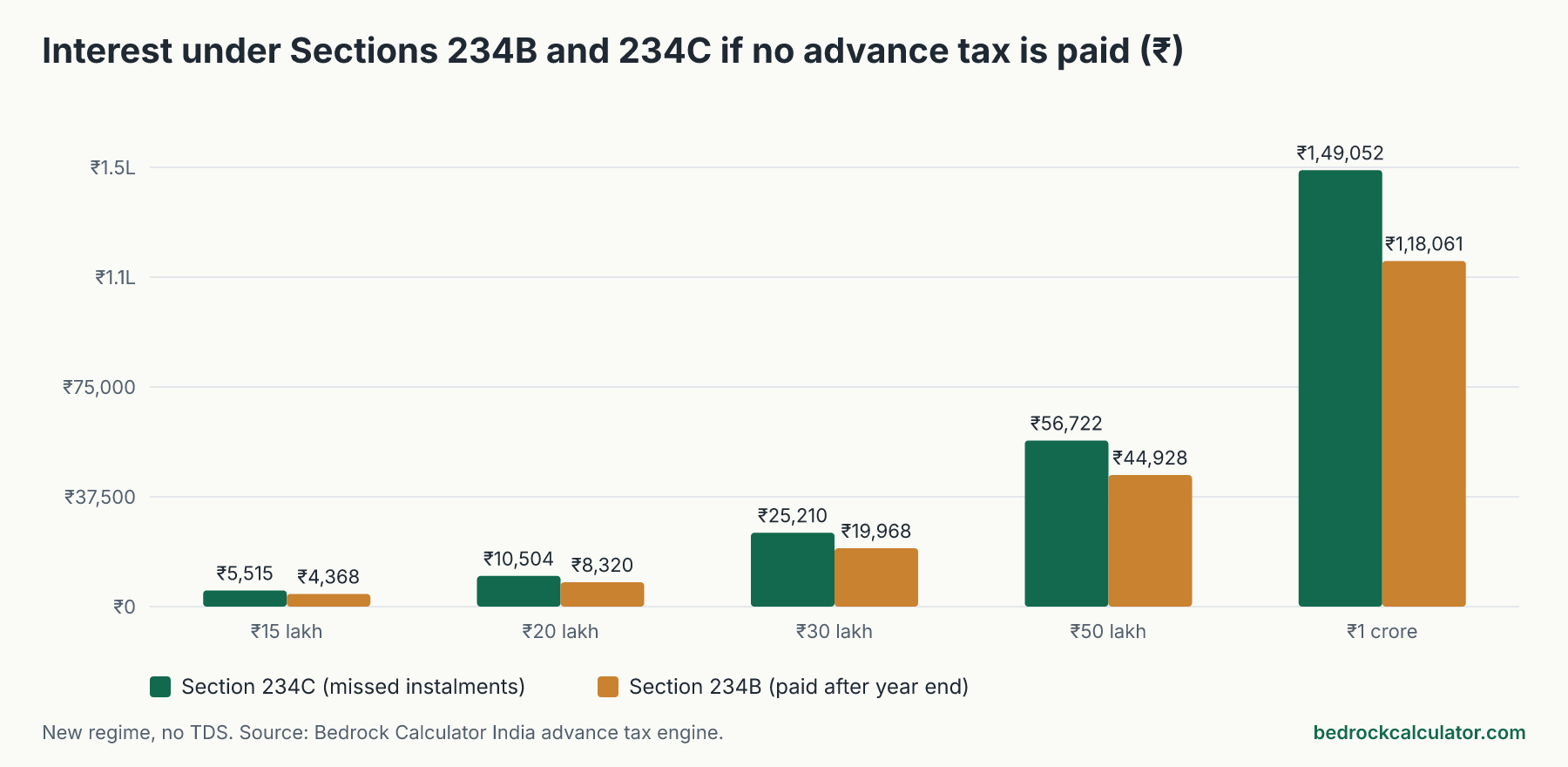
Two kinds of simple interest apply, both charged per month:
- Section 234C for each instalment you fall behind on. It's charged on the shortfall against that date's running total, for a fixed number of months per instalment.
- Section 234B if by the end of the year you've paid well short of the full tax. It runs from 1 April until you pay the balance.
On ₹20 lakh of taxable income, paying nothing until 4 months after the year ends costs ₹10,504 under 234C and ₹8,320 under 234B, ₹18,824 in all. That's about 9.1% on top of the tax. On ₹50 lakh it's ₹1,01,650, and on ₹1 crore ₹2,67,113.
Missing only the June instalment is much cheaper. If you catch up in full by 15 September 2026, the interest on ₹20 lakh of income is ₹936. So if you've missed a date, paying as soon as you can still saves most of the cost.
How we worked out these numbers
Every figure comes from the advance tax calculator on this site. It works out the year's tax on the taxable income you enter, using the slabs, the 87A rebate, surcharge and the 4% cess, then applies the four cumulative due dates and the interest rules. We cross-checked one case against the engine function directly.
The engine still uses the section numbers from the old Income-tax Act, 1961, such as 234B and 234C, which most people still search for. India's Income-tax Act, 2025, which applies from Tax Year 2026-27, keeps the same four dates and percentages.
What this leaves out
The calculator splits whatever tax it finds, however small. In practice, you only owe advance tax once the year's tax passes a minimum amount, and resident senior citizens without business income are exempt altogether. People using the presumptive schemes for small businesses and professionals (Sections 44AD and 44ADA) can pay their whole advance tax in one go by 15 March 2027, which the calculator doesn't model. It also doesn't round interest the way the department does, and it doesn't handle income that arrives suddenly mid-year, such as a capital gain, where the instalments due before it arose aren't penalised.
Work out your own instalments
Enter your expected taxable income and any TDS in the advance tax calculator to see exactly what's due on each date, and what interest you'd owe if you've already missed one. To check which regime gives the lower tax first, use the old vs new tax regime calculator. If you run a small business or practice, the presumptive taxation calculator works out the income you'd declare, and the TDS calculator shows what's already been deducted on salary, interest and rent.