How much tax is due in India on gains from shares and mutual funds?
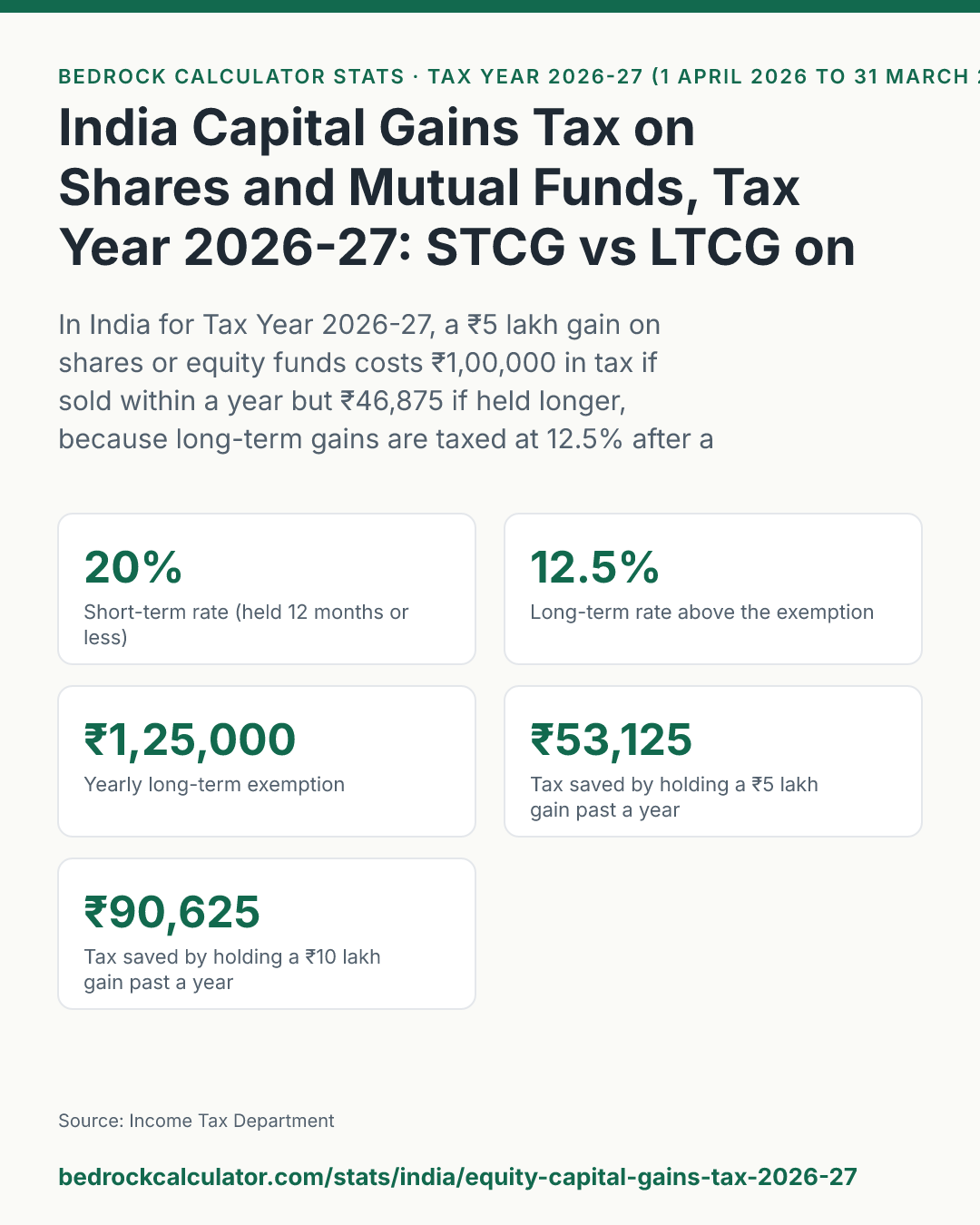
In India for Tax Year 2026-27, gains on listed shares and equity mutual funds are taxed at 20% if you sell within 12 months, and at 12.5% if you hold longer, with the first ₹1,25,000 of long-term gains each year tax free.
On a ₹5 lakh gain that's ₹1,00,000 of tax if short-term and ₹46,875 if long-term, a difference of ₹53,125. On ₹10 lakh the gap is ₹90,625. All of these figures are before the cess and any surcharge.
STCG vs LTCG: the rules in one place
Here's how the site's equity capital gains calculator treats a sale of listed shares or units of an equity-oriented mutual fund, with Securities Transaction Tax paid:
- Short-term: held 12 months or less. The whole gain is taxed at 20%. There's no exemption.
- Long-term: held for more than 12 months. The first ₹1,25,000 of long-term gains in the tax year is exempt, and the rest is taxed at 12.5%.
These rates have applied to sales since 23 July 2024. Before that, the short-term rate was 15%, the long-term rate 10% and the exemption ₹1,00,000.
Under India's Income-tax Act, 2025, which applies from Tax Year 2026-27, the engine files these as Section 196 for short-term gains and Section 198 for long-term gains. They're the same rules that most people still know as Sections 111A and 112A.
Tax on capital gains of 50,000 to 25 lakh
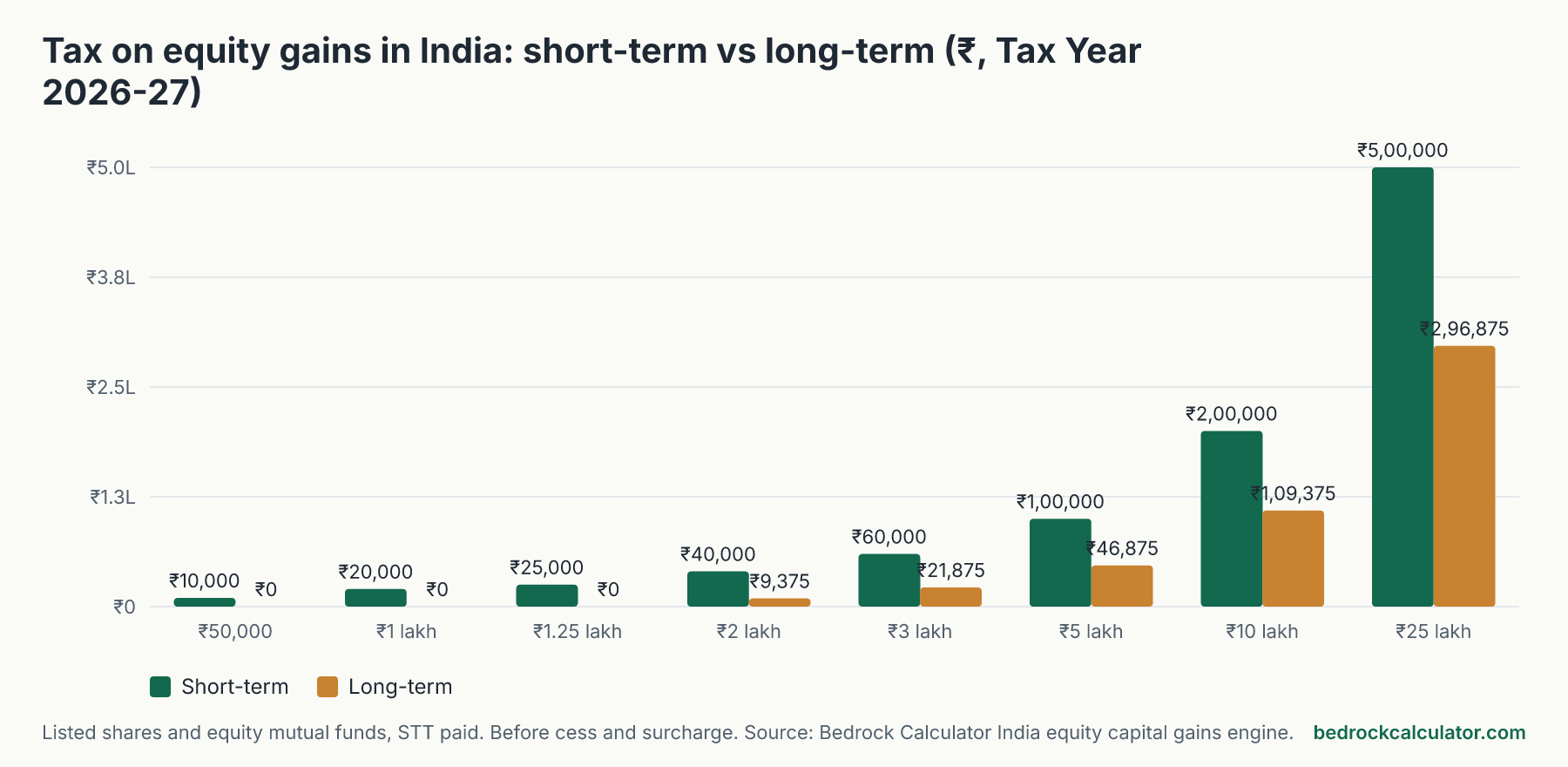
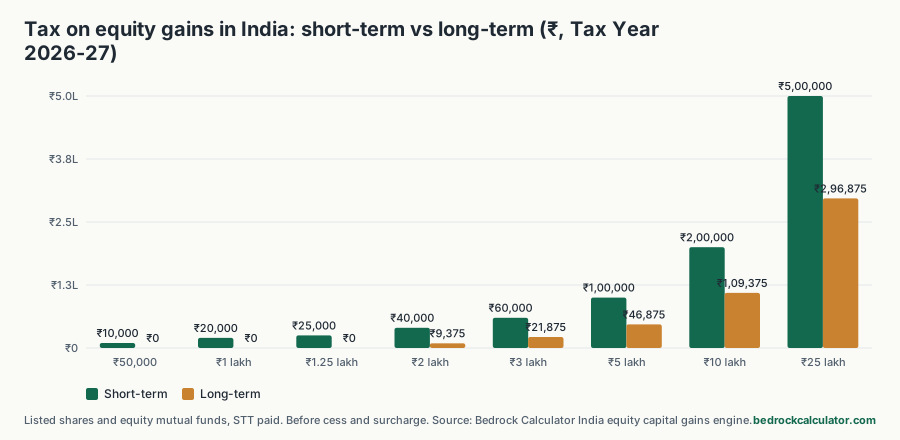
Here's the tax on common gains both ways, assuming it's your only equity gain in the year.
India: tax on listed share and equity fund gains, short vs long term, Tax Year 2026-27 (₹)
Download CSVShort-term: held 12 months or less, taxed at 20%. Long-term: held longer, taxed at 12.5% above the ₹1,25,000 yearly exemption. Before cess and any surcharge; assumes no other long-term gains in the year.
| ₹50,000 | ₹50,000 | ₹10,000 | ₹0 | ₹10,000 | 0.0% |
| ₹1 lakh | ₹1,00,000 | ₹20,000 | ₹0 | ₹20,000 | 0.0% |
| ₹1.25 lakh | ₹1,25,000 | ₹25,000 | ₹0 | ₹25,000 | 0.0% |
| ₹2 lakh | ₹2,00,000 | ₹40,000 | ₹9,375 | ₹30,625 | 4.7% |
| ₹3 lakh | ₹3,00,000 | ₹60,000 | ₹21,875 | ₹38,125 | 7.3% |
| ₹5 lakh | ₹5,00,000 | ₹1,00,000 | ₹46,875 | ₹53,125 | 9.4% |
| ₹10 lakh | ₹10,00,000 | ₹2,00,000 | ₹1,09,375 | ₹90,625 | 10.9% |
| ₹25 lakh | ₹25,00,000 | ₹5,00,000 | ₹2,96,875 | ₹2,03,125 | 11.9% |
Up to ₹1.25 lakh, holding for a year makes a long-term gain completely tax free. A ₹1 lakh short-term gain, by contrast, costs ₹20,000.
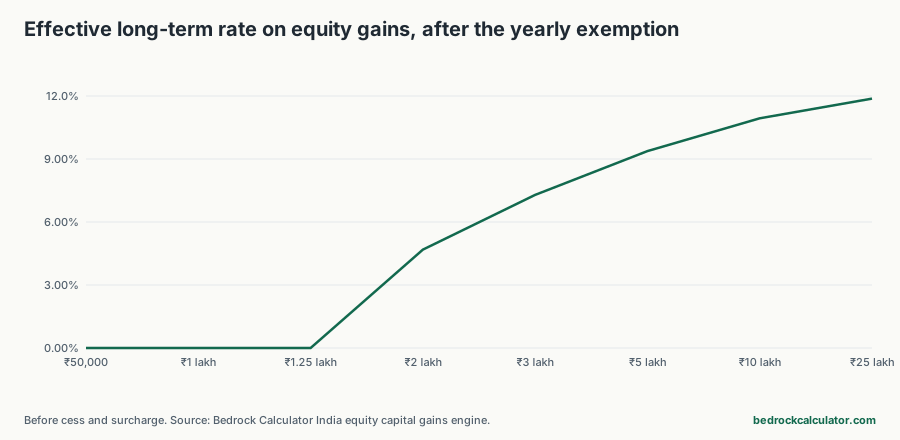
Above the exemption the long-term rate kicks in, but only on the excess. That's why a ₹2 lakh long-term gain costs just ₹9,375 against ₹40,000 short-term.
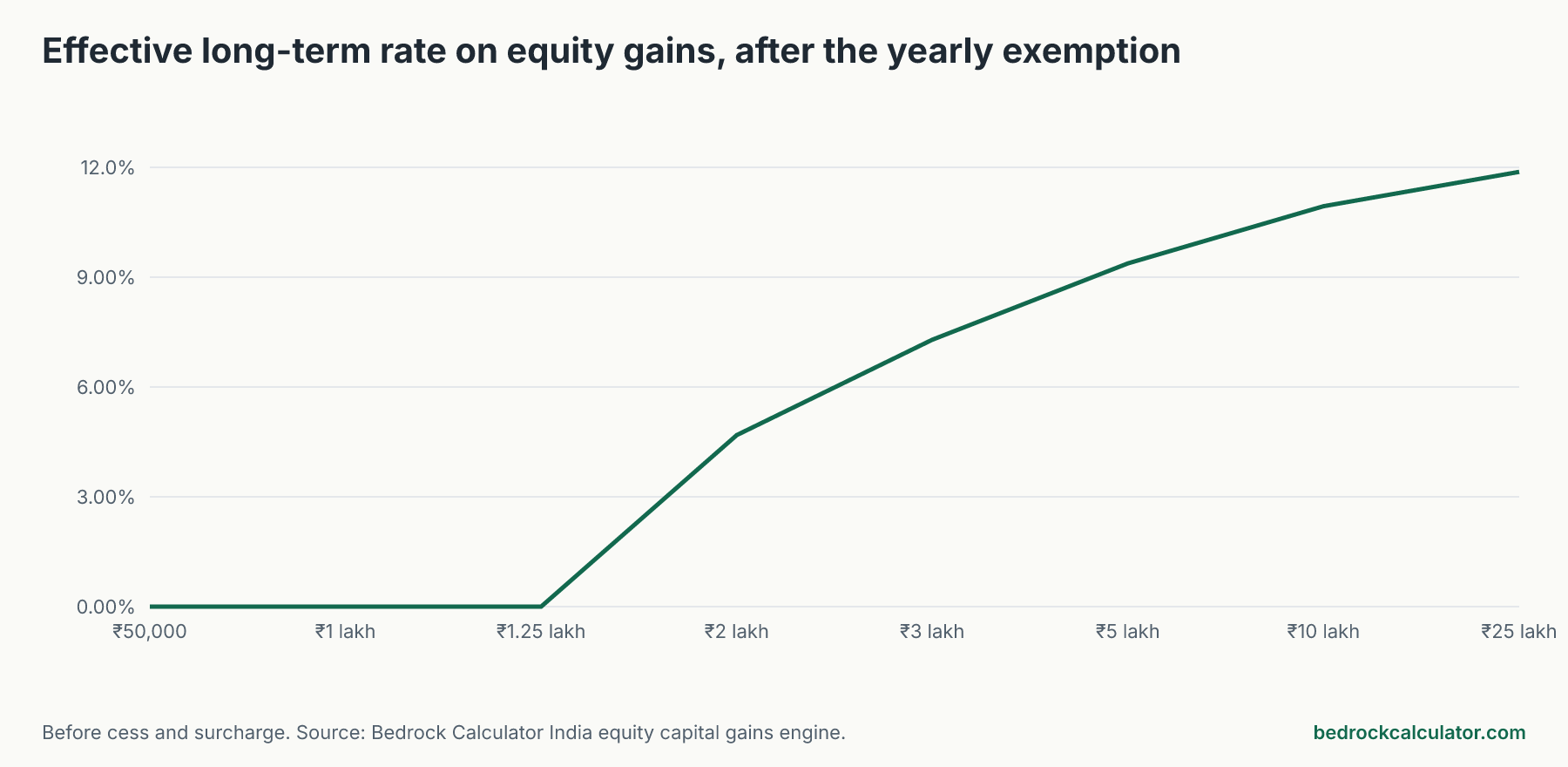
Why the long-term rate creeps up but never reaches 12.5%
Because the first ₹1,25,000 is exempt, the long-term tax as a share of your whole gain is lower than the headline rate. It's 9.4% on ₹5 lakh, 10.9% on ₹10 lakh and 11.9% on ₹25 lakh. The bigger the gain, the less the exemption matters, so the effective rate edges toward 12.5%.
The short-term rate has no such cushion. It's a flat 20% from the first rupee.
The 1.25 lakh exemption is for the year, not per sale
This trips people up. The ₹1,25,000 covers all your long-term equity gains in a tax year put together, across every broker and fund house. If one sale has already used it, a second ₹2 lakh long-term gain later in the year is taxed ₹25,000, with nothing exempt.
That makes the exemption worth planning for. Some investors deliberately sell and buy back long-term holdings each year to book gains up to the limit, which raises their purchase price for the future at no tax cost. Whether that's worthwhile depends on brokerage and your plans for the money.
When you have both kinds of gain
Short-term and long-term gains are taxed separately at their own rates. With ₹3 lakh of long-term and ₹1 lakh of short-term gains in the same year, the long-term part costs ₹21,875 and the short-term part ₹20,000, ₹41,875 in total.
Is it worth waiting 12 months to sell?
On the numbers, often yes. The saving from holding past the line is ₹30,625 on a ₹2 lakh gain, ₹53,125 on ₹5 lakh and ₹2,03,125 on ₹25 lakh. If you're a few weeks short of the 12 month mark and don't need the money, waiting can be the single biggest tax decision you make all year.
But it isn't free. The price can fall while you wait, and a drop of a few percent wipes out the tax you were trying to save. Taxes shouldn't override a decision you'd otherwise make for investment reasons.
How we worked out these numbers
Every figure comes from the equity LTCG and STCG calculator on this site. It applies the short-term and long-term rates and the yearly exemption from the site's Tax Year 2026-27 table, which this page also reads for the rates quoted above.
What these figures leave out
The calculator works out tax at the flat capital gains rates only. It doesn't add the Health and Education Cess, which applies on top, or surcharge, which starts at higher incomes and is capped lower for these gains than for salary. It doesn't use any unused basic exemption limit, which residents with small total incomes can set against these gains. And it doesn't allow for losses: short-term losses can be set off against both kinds of gain, and long-term losses only against long-term gains.
Debt mutual funds, gold funds and international funds are taxed differently and aren't covered here. Neither are unlisted shares or the grandfathering rule for shares bought before February 2018.
Work out your own tax
Put your gains into the equity LTCG and STCG calculator, entering any long-term gains you've already booked this year so it uses only what's left of the exemption. If you invest for the tax deduction, the ELSS calculator shows the lock-in and tax picture, and the REIT and InvIT tax calculator covers those units. For your salary tax, use the old vs new tax regime calculator.