Which earns more in India, an FD or an RD, and how much TDS applies?
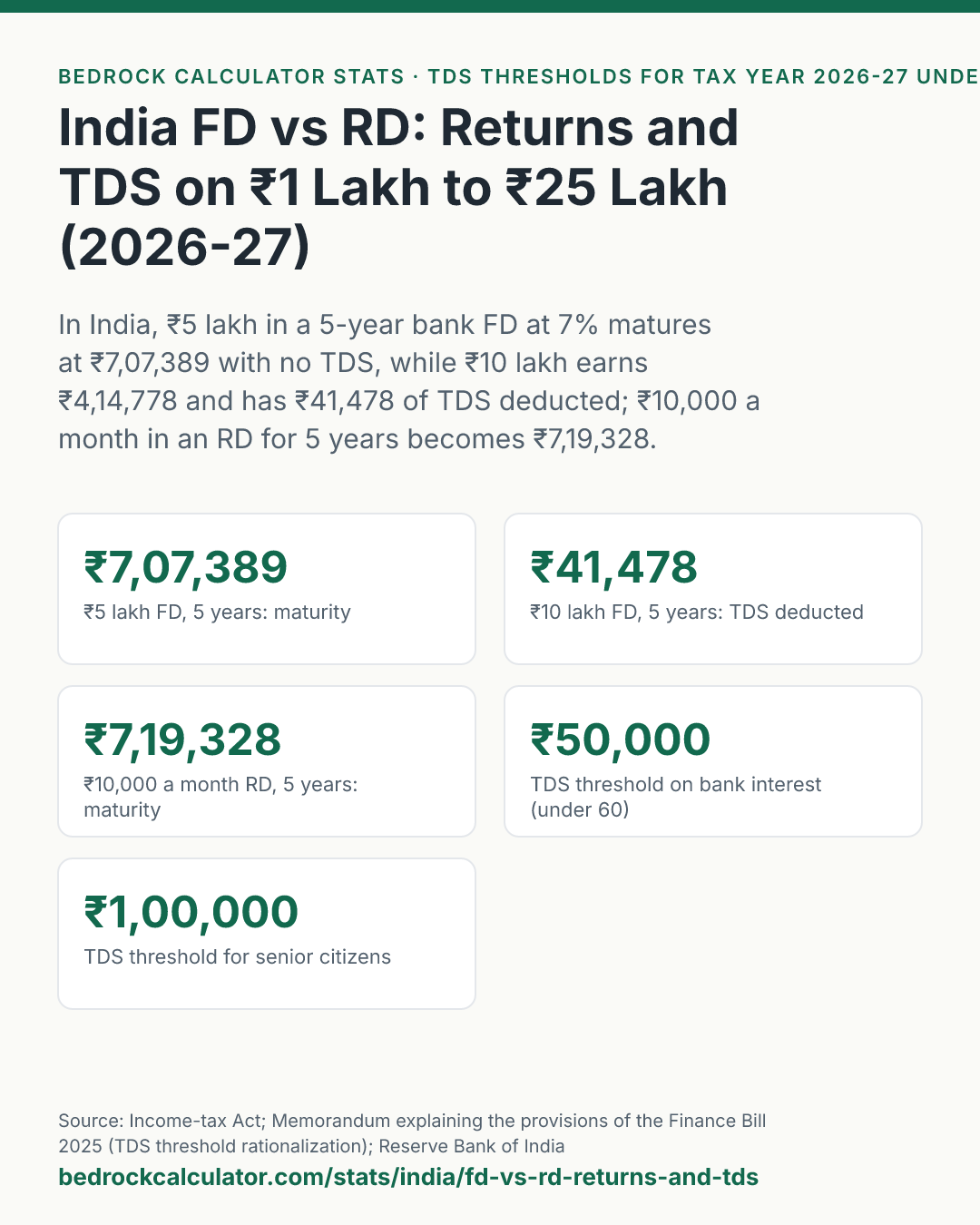
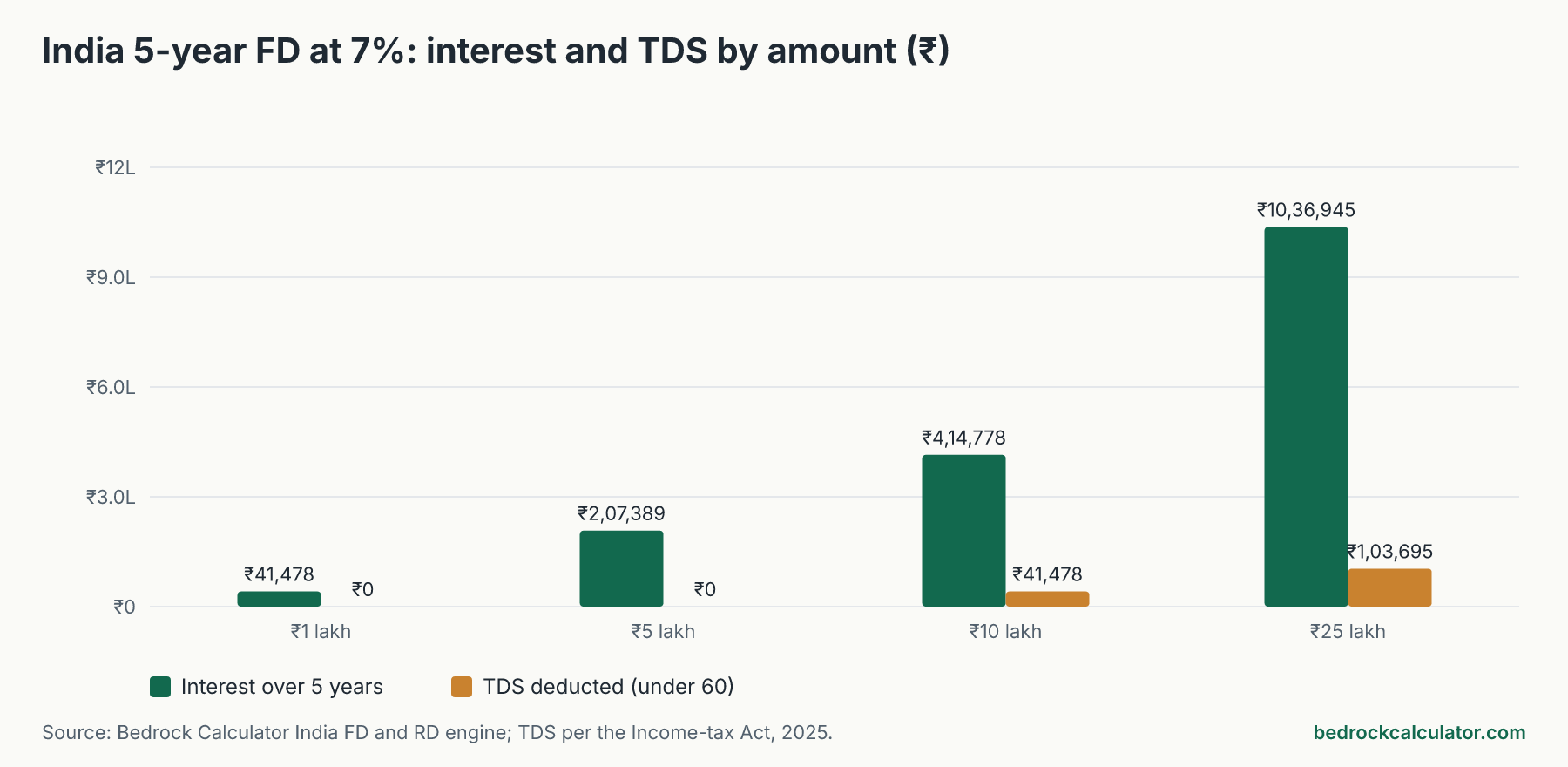
At 7% a year, ₹5 lakh in a 5-year bank fixed deposit in India matures at ₹7,07,389, and no TDS is deducted because no single year's interest reaches the ₹50,000 threshold. Double it to ₹10 lakh and the deposit earns ₹4,14,778, but the bank deducts ₹41,478 of TDS along the way.
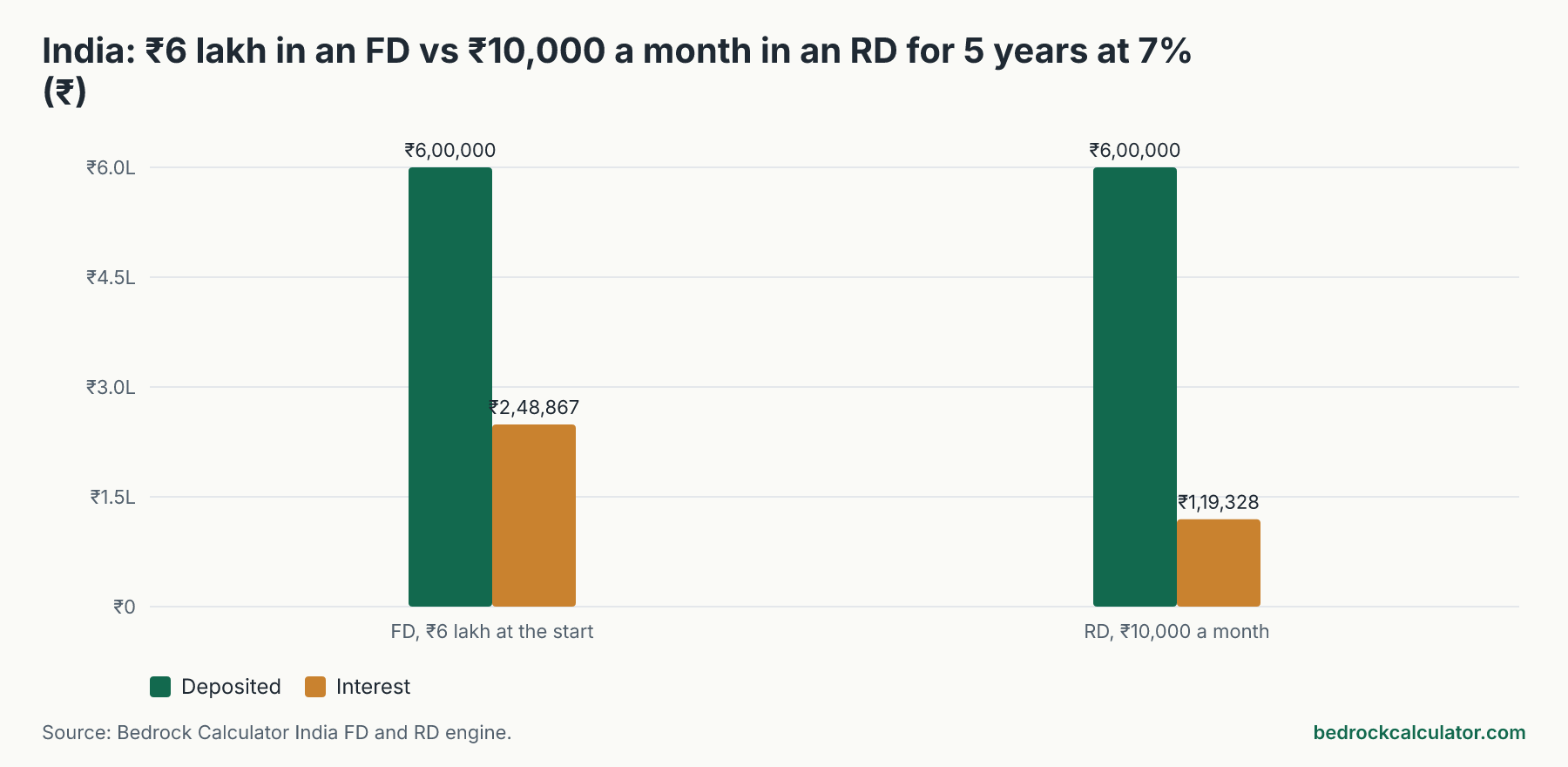
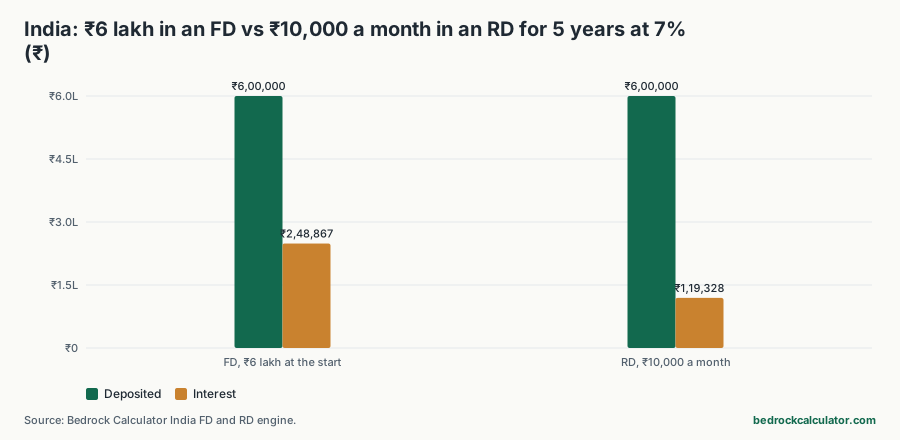
A recurring deposit of ₹10,000 a month for 5 years puts in the same ₹6 lakh as a ₹6 lakh FD, yet ends at ₹7,19,328 against the FD's ₹8,48,867. The FD earns 2.1 times the interest because all of its money is invested from day one.
How we worked out these numbers
We ran every deposit through the FD and RD calculator on this site. It assumes:
- A cumulative FD, with interest compounded every quarter and paid at maturity
- An RD with the instalment paid at the start of each month and interest compounded quarterly
- A rate of 7% a year for every tenure. That is an illustrative figure: banks set their own deposit rates, so put in your bank's rate for your tenure
- PAN given to the bank and no other deposits with the same bank
TDS follows the Income-tax Act, 2025 for Tax Year 2026-27. A bank deducts 10% of the interest once the interest it pays or credits you in a year passes ₹50,000, or ₹1,00,000 if you are a senior citizen. Without PAN the rate is 20%. The calculator tests each 12-month block of the deposit separately.
FD maturity and TDS on ₹1 lakh to ₹25 lakh
Amounts in rupees. Click a column heading to sort.
India bank FD maturity and TDS at 7%, cumulative, quarterly compounding (₹)
Download CSVPAN given, no other deposits with the same bank. TDS tested on each 12-month block of interest. Rupees.
| ₹1,00,000 | 1 | ₹1,07,186 | ₹7,186 | ₹0 | ₹0 |
| ₹1,00,000 | 3 | ₹1,23,144 | ₹23,144 | ₹0 | ₹0 |
| ₹1,00,000 | 5 | ₹1,41,478 | ₹41,478 | ₹0 | ₹0 |
| ₹5,00,000 | 1 | ₹5,35,930 | ₹35,930 | ₹0 | ₹0 |
| ₹5,00,000 | 3 | ₹6,15,720 | ₹1,15,720 | ₹0 | ₹0 |
| ₹5,00,000 | 5 | ₹7,07,389 | ₹2,07,389 | ₹0 | ₹0 |
| ₹10,00,000 | 1 | ₹10,71,859 | ₹71,859 | ₹7,186 | ₹0 |
| ₹10,00,000 | 3 | ₹12,31,439 | ₹2,31,439 | ₹23,144 | ₹0 |
| ₹10,00,000 | 5 | ₹14,14,778 | ₹4,14,778 | ₹41,478 | ₹0 |
| ₹25,00,000 | 1 | ₹26,79,648 | ₹1,79,648 | ₹17,965 | ₹17,965 |
| ₹25,00,000 | 3 | ₹30,78,598 | ₹5,78,598 | ₹57,860 | ₹57,860 |
| ₹25,00,000 | 5 | ₹35,36,945 | ₹10,36,945 | ₹1,03,695 | ₹1,03,695 |
The pattern is clear: up to ₹5 lakh in a single FD at this rate, no year's interest reaches ₹50,000, so there is no TDS for anyone. From ₹10 lakh upward, a depositor under 60 has TDS deducted every year. On ₹10 lakh the first year's interest is ₹71,859, already over the line.
Senior citizens get a much higher threshold. On the ₹10 lakh FD, a senior has no TDS at all, against ₹41,478 for a younger depositor over 5 years. On ₹25 lakh the interest is above ₹1,00,000 every year, so seniors pay the same ₹1,03,695 as everyone else.
RD maturity on ₹5,000, ₹10,000 and ₹25,000 a month
India bank RD maturity at 7% (₹)
Download CSVInstalment at the start of each month, interest compounded quarterly. Rupees.
| ₹5,000 | 1 | ₹60,000 | ₹2,311 | ₹62,311 | ₹0 |
| ₹5,000 | 3 | ₹1,80,000 | ₹20,686 | ₹2,00,686 | ₹0 |
| ₹5,000 | 5 | ₹3,00,000 | ₹59,664 | ₹3,59,664 | ₹0 |
| ₹10,000 | 1 | ₹1,20,000 | ₹4,621 | ₹1,24,621 | ₹0 |
| ₹10,000 | 3 | ₹3,60,000 | ₹41,373 | ₹4,01,373 | ₹0 |
| ₹10,000 | 5 | ₹6,00,000 | ₹1,19,328 | ₹7,19,328 | ₹0 |
| ₹25,000 | 1 | ₹3,00,000 | ₹11,553 | ₹3,11,553 | ₹0 |
| ₹25,000 | 3 | ₹9,00,000 | ₹1,03,432 | ₹10,03,432 | ₹5,794 |
| ₹25,000 | 5 | ₹15,00,000 | ₹2,98,320 | ₹17,98,320 | ₹25,283 |
RD interest is small in the early years because most of the money arrives late. ₹10,000 a month earns only ₹4,621 in its first year. Over 5 years the total is ₹1,19,328.
RDs count toward the same TDS threshold as FDs. Among these examples, the ₹25,000 a month RD crosses it in its later years: its fifth year alone earns ₹1,11,228, and TDS over the 5 years comes to ₹25,283.
FD or RD for the same money?
If you already have ₹6 lakh, an FD wins comfortably: ₹2,48,867 of interest over 5 years against ₹1,19,328 for the RD. That isn't because RDs pay a worse rate. It is because RD money sits in the deposit for, on average, only about half the term.
The RD's real job is different. It's a way to build a sum from monthly income, and it is the fair comparison for a SIP rather than for a lump-sum FD. The SIP calculator shows what the same ₹10,000 a month might do in a mutual fund, with more risk and no fixed rate.
TDS is not the tax you owe
TDS is an advance payment, credited against your income tax when you file. All FD and RD interest is taxed at your slab rate whether TDS was deducted or not. So:
- If your slab rate is above 10%, you will owe more than the bank deducted.
- If your total tax is lower than the TDS, you get the difference back as a refund.
- If the tax on your total income will be nil, you can give the bank the no-TDS declaration (Form 121 from Tax Year 2026-27, which replaced Forms 15G and 15H) and no TDS is deducted.
The threshold is per bank, across all your deposits there, so spreading money between FDs at one bank does not help. Spreading it across different banks does keep each bank's interest under its own threshold, but the interest is still taxable.
What these figures leave out
- Financial-year timing. TDS runs on April to March. The calculator uses 12-month blocks from the day you deposit, which matches only for deposits opened on 1 April.
- TDS taken from the deposit. Many banks recover TDS on a cumulative FD from the deposit itself, so slightly less compounds and maturity comes out a little lower.
- Senior citizen rates. Banks usually pay seniors a slightly higher rate. We used one rate for everyone so the TDS difference is easy to see.
- Premature withdrawal penalties and your actual income tax.
Running your own numbers
Use the FD and RD calculator with your bank's rate, tenure and payout choice, and add any other interest you get from the same bank. For post office deposits, the Post Office RD and TD calculator uses the government-notified rates, and the TDS calculator covers TDS on salary and rent as well.