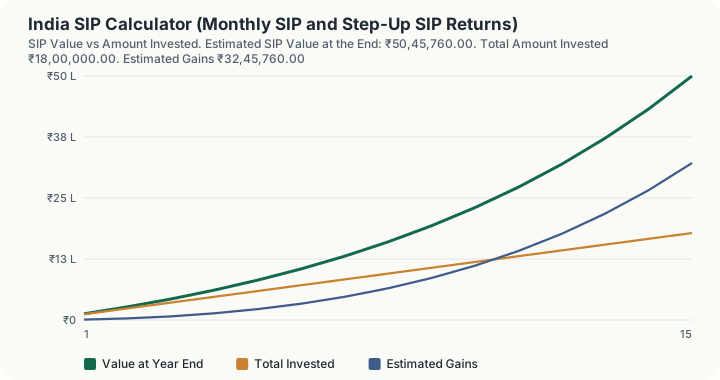
Quick Answer: A ₹10,000 monthly SIP held for 15 years at an assumed 12% a year grows to about ₹50,45,760, from ₹18,00,000 of your own money. Raise the instalment by 10% every year and the same 15 years ends at about ₹86,83,849. Both figures are projections at a return you choose, not a promise from any fund.
What does this calculator do?
A systematic investment plan (SIP) is a standing instruction to put a fixed amount into a mutual fund every month. This calculator projects where that habit could take you in rupees, using a return you enter yourself. It handles two kinds of SIP: a flat SIP, where the instalment never changes, and a step-up SIP, where you raise the instalment by a fixed percentage at the start of each new year, which is how most people's SIPs actually behave once their salary rises.
The return is the whole game, and nobody can tell you what it will be. Equity funds have had good decades and bad ones, and debt funds behave differently again. So treat the 12% default as a starting point to argue with. The scenario buttons include a 10% case for exactly that reason, and the gap between the two answers is worth more attention than either number on its own.
The calculator also restates the final value in today's rupees at an inflation rate you set, so a crore in 2041 is not mistaken for a crore today.
How is this calculated?
The calculator runs one month at a time for the number of years you enter. Each step does the same thing.
- Monthly rate. Your annual return is divided by 12. At 12% a year the monthly rate is exactly 1%. This is the nominal-rate convention most Indian SIP calculators use.
- Invest at the start of the month. Each instalment goes in on the first day of its month and earns that whole month's return. This is the annuity-due convention. The month's closing value is (previous value + instalment) × (1 + monthly rate).
- Step-up at each new year. If you set a step-up, the monthly instalment is multiplied by (1 + step-up %) at the start of years 2, 3, 4 and so on. Year 3 of a 10% step-up on ₹10,000 is ₹12,100 a month.
- Totals. Total invested is the sum of every instalment. Estimated gains are the final value minus that total.
- Today's rupees. The final value is divided by (1 + inflation) once for each year of the plan. This number is shown for context only and does not feed back into anything else.
For a flat SIP the month-by-month loop gives the same answer as the textbook closed form:
FV = P × ((1 + i)ⁿ − 1)/i × (1 + i)
where P is the monthly instalment, i is the monthly rate and n is the number of months. The step-up case has no single neat formula, which is why the calculator iterates.
Worked Example
Take the default case: ₹10,000 a month, a 12% assumed return, 15 years, no step-up.
Step 1: the monthly rate. 12% ÷ 12 = 1% a month
Step 2: the first year. Twelve instalments of ₹10,000, each invested at the start of its month and compounding at 1%, are worth ₹10,000 × [(1.01¹² − 1) ÷ 0.01] × 1.01 = ₹1,28,093.28 at the end of year 1. You put in ₹1,20,000, so the first year's gain is ₹8,093.28.
Step 3: the second year. The year-1 balance keeps compounding while twelve more instalments arrive. The value at the end of year 2 is ₹2,72,432, against ₹2,40,000 invested. The gain has already roughly quadrupled to ₹32,432, because the first year's money and its returns are both working.
Step 4: year 15. Continuing to month 180 gives ₹50,45,760. You paid in 180 × ₹10,000 = ₹18,00,000, so the estimated gain is ₹32,45,760. Gains are now close to twice your contributions.
Step 5: what it buys today. At 6% inflation, ₹50,45,760 in 15 years has the buying power of about ₹21,05,419 now. That is still more than you put in, but it is a far more sober figure than the headline.
Step 6: add a 10% step-up. Raise the SIP by 10% each year and the final-year instalment reaches ₹37,974.98 a month. Total invested climbs to ₹38,12,697.80, and the projected value to ₹86,83,849.43.
Step 7: lower the return. Leave everything else at the default and drop the return to 10%. The 15-year value falls to ₹41,79,242.66. Two percentage points of return cost about ₹8.7 lakh on the same ₹18 lakh of contributions.
Step 8: stay longer. Keep the flat ₹10,000 SIP going for 25 years instead of 15 and the projection reaches ₹1,89,76,350.92 on ₹30,00,000 invested. The extra ten years add more than the first fifteen produced in total, which is the strongest argument there is for starting early and not stopping during a bad market.
What does this calculator not account for?
- Real market returns. The calculator applies one smooth rate every month. Real funds rise and fall, and the order of good and bad years changes the outcome even when the average is the same.
- Tax on redemption. Gains from equity mutual funds held over 12 months are taxed as long-term capital gains at 12.5% on the part above ₹1,25,000 in a tax year (Income-tax Act, 2025, Section 198). Short-term gains and debt funds are taxed differently. None of this is deducted here: the figures are before tax.
- Expense ratio and exit load. Your fund's expense ratio is already inside its published returns, so if you enter a return you expect from the fund, it is net of costs. Exit loads on early redemption are not modelled.
- Stamp duty and missed instalments. The small stamp duty on mutual fund purchases and any skipped or failed instalments are ignored.
- Dates. Real SIPs run on a chosen date each month and fund NAVs move daily. The calculator works in whole months.
- Withdrawals. There is no systematic withdrawal plan (SWP) here. The projection assumes nothing is taken out before the end.
What mistakes do people make with this?
- Treating the default return as a forecast. A 12% assumption is common in Indian SIP calculators, but it is an input, not a fact. Run 8% and 10% too and plan around the lower answers.
- Comparing a SIP with a fixed deposit on headline numbers. An FD rate is contractual and the interest is taxed every year. A SIP return is uncertain and is taxed only when you sell. Compare like with like, or use the FD and RD calculator alongside this one.
- Ignoring inflation. A big future number feels like more than it is. The "today's rupees" figure is there for a reason.
- Forgetting the step-up. A SIP that never rises shrinks as a share of your income every year. Even a 5% yearly step-up makes a large difference over 15 years or more.
- Stopping in a downturn. A falling market means each instalment buys more units. Stopping then locks in the low and gives up the cheap units.
Frequently Asked Questions
How much will a ₹10,000 monthly SIP become in 15 years?
What is a step-up SIP?
Which formula does this SIP calculator use?
Are SIP returns taxable in India?
Is a longer SIP always better than a bigger one?
Sources
- Income-tax Act, 2025 (No. 30 of 2025), Gazette of India Extraordinary, 21 August 2025, Section 198 (tax on long-term capital gains on equity shares and units of equity oriented funds: 12.5% above ₹1,25,000): egazette.gov.in/WriteReadData/2025/265620.pdf
- Memorandum explaining the provisions of the Finance Bill 2026, confirming the Income-tax Act, 2025 framework and Tax Year 2026-27 rates: indiabudget.gov.in/doc/memo.pdf