Which India small savings scheme pays the most?
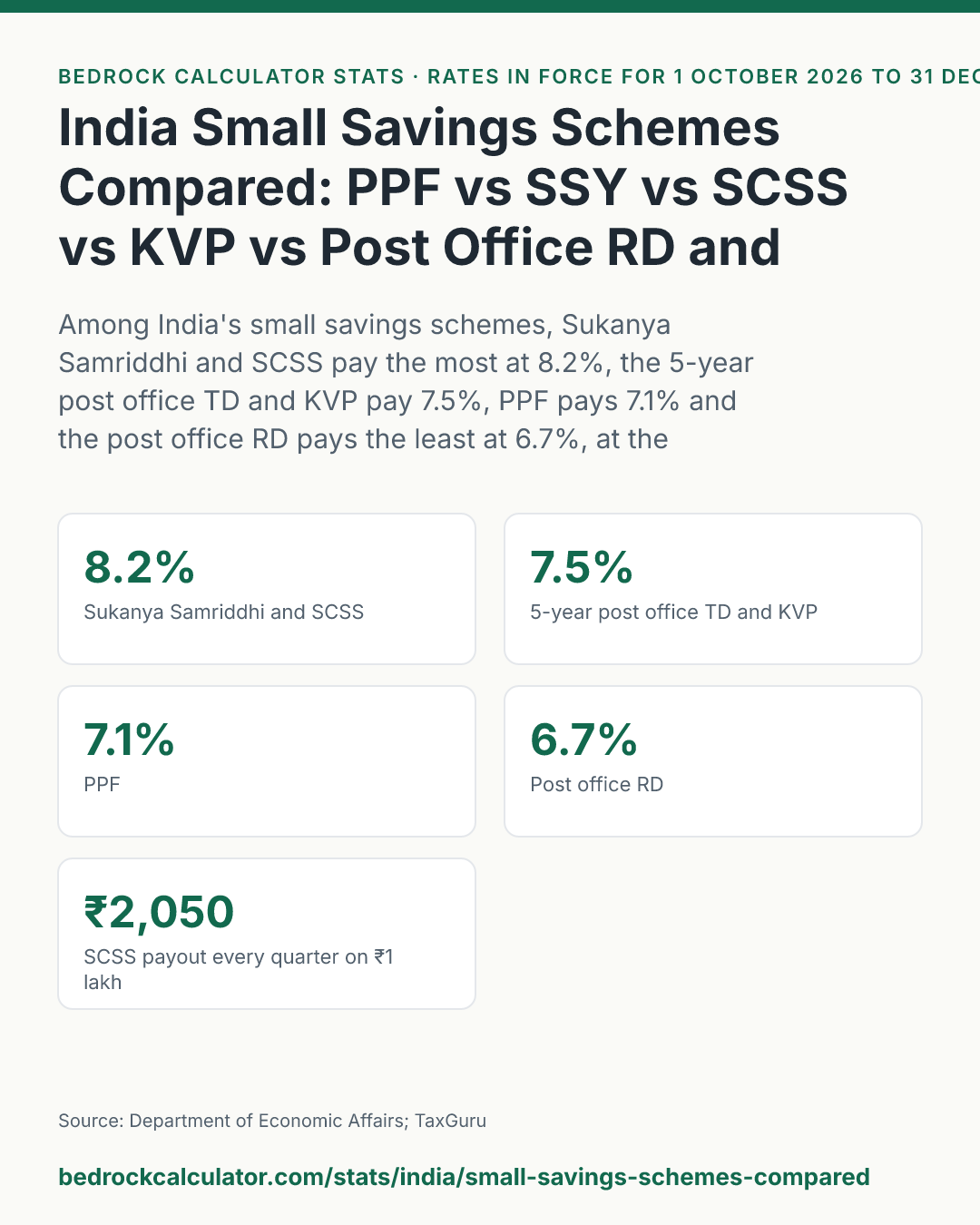
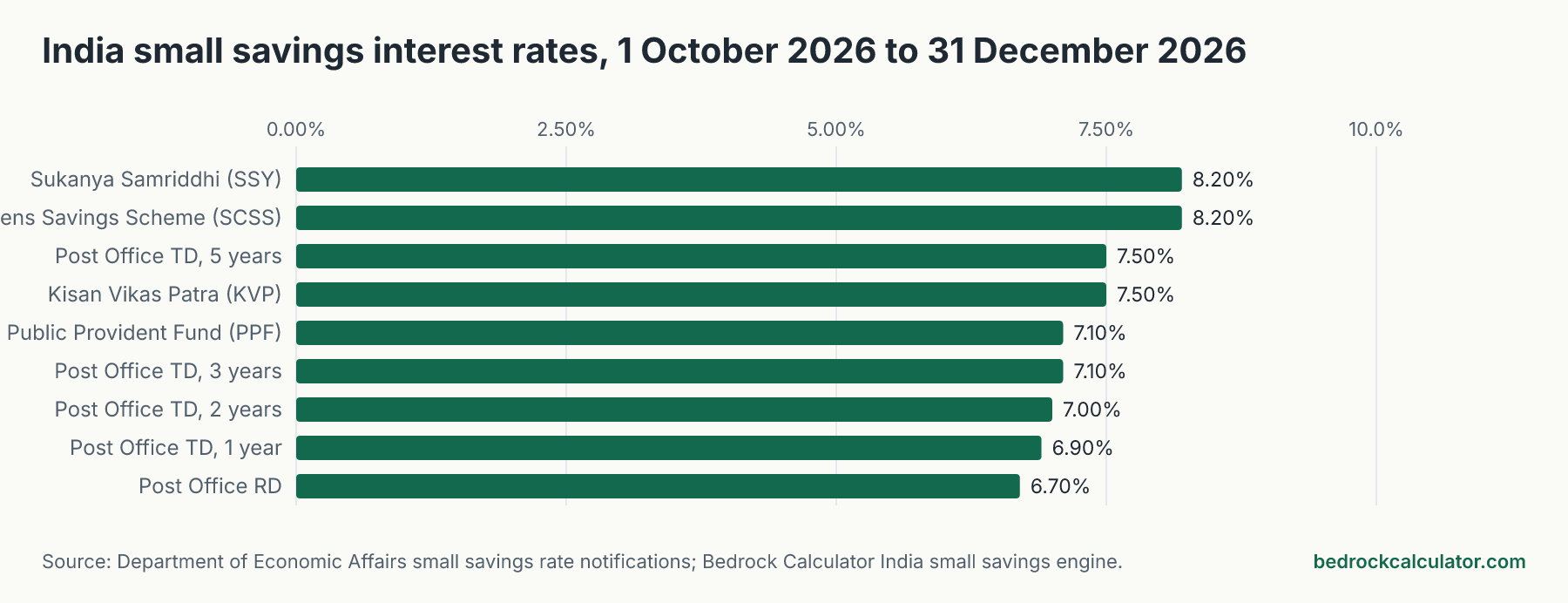
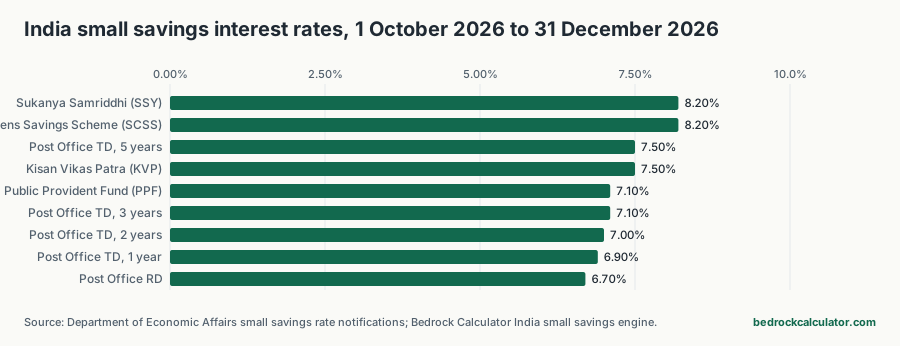
India's government-backed small savings schemes pay between 6.7% and 8.2% right now. Sukanya Samriddhi and the Senior Citizens Savings Scheme sit at the top at 8.2%. The 5-year post office time deposit and Kisan Vikas Patra pay 7.5%. PPF pays 7.1%. The post office recurring deposit pays the least, 6.7%.
These are the rates in force for 1 October 2026 to 31 December 2026. On 30 September 2026 the Department of Economic Affairs kept every one of them unchanged from July to September 2026, so they are the rates for new deposits this quarter.
How we compared them
Each scheme has its own calculator on this site, and we ran every one at the rate the engine holds for it: the PPF calculator, the Sukanya Samriddhi calculator, the SCSS calculator, the Kisan Vikas Patra calculator and the post office RD and TD calculator.
The headline rate is only half the story. The schemes differ in how long your money is locked up, how and when interest is paid, whether the deposit cuts your tax and whether the interest is taxed. The table below puts all of that side by side.
India small savings schemes compared: rate, term, payout and tax
Download CSVRates in force for 1 October 2026 to 31 December 2026, unchanged from the previous quarter. Section 80C applies only under the old tax regime.
| Sukanya Samriddhi (SSY) | 8.2% | 21 years, deposits for 15 | Compounded yearly, paid at maturity | Yes | Tax-free |
| Senior Citizens Savings Scheme (SCSS) | 8.2% | 5 years, extendable by 3 | Paid out every quarter | Yes | Taxable |
| Post Office TD, 5 years | 7.5% | 5 years | Worked out quarterly, paid yearly | Yes | Taxable |
| Kisan Vikas Patra (KVP) | 7.5% | 115 months to double | Paid at maturity | No | Taxable |
| Public Provident Fund (PPF) | 7.1% | 15 years, extendable in 5-year blocks | Compounded yearly, paid at maturity | Yes | Tax-free |
| Post Office TD, 3 years | 7.1% | 3 years | Worked out quarterly, paid yearly | No | Taxable |
| Post Office TD, 2 years | 7.0% | 2 years | Worked out quarterly, paid yearly | No | Taxable |
| Post Office TD, 1 year | 6.9% | 1 year | Worked out quarterly, paid yearly | No | Taxable |
| Post Office RD | 6.7% | 5 years | Compounded quarterly, paid at maturity | No | Taxable |
What each scheme pays on a typical deposit
Rates are easier to compare than outcomes, because the schemes don't take money the same way. PPF and Sukanya Samriddhi take a deposit every year. SCSS, KVP and the TD take one lump sum. The RD takes a fixed amount every month. So rather than force them into one shape, we ran each on a deposit people commonly make. Amounts are in rupees.
What each India small savings scheme pays on a typical deposit (₹)
Download CSVEach scheme run through its own calculator at the rate above. Rupees.
| SSY, ₹1 lakh a year, 21 years | ₹15,00,000 | ₹32,88,079 | ₹47,88,079 |
| PPF, ₹1 lakh a year, 15 years | ₹15,00,000 | ₹12,12,139 | ₹27,12,139 |
| Post Office RD, ₹5,000 a month, 5 years | ₹3,00,000 | ₹56,829 | ₹3,56,829 |
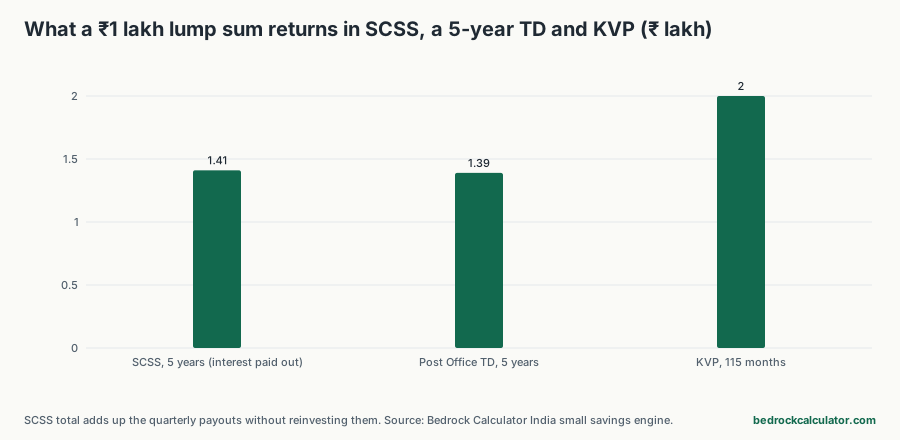
| KVP, ₹1 lakh, 115 months | ₹1,00,000 | ₹1,00,000 | ₹2,00,000 |
| SCSS, ₹1 lakh, 5 years | ₹1,00,000 | ₹41,000 | ₹1,41,000 |
| Post Office TD, ₹1 lakh, 5 years | ₹1,00,000 | ₹38,570 | ₹1,38,570 |
| Post Office TD, ₹1 lakh, 1 year | ₹1,00,000 | ₹7,081 | ₹1,07,081 |
A few things to read from this:
- Sukanya Samriddhi beats PPF on the same ₹1 lakh a year by a wide margin, ₹47.88 lakh against ₹27.12 lakh. Part of that is the higher rate. The rest is the extra years the SSY account keeps compounding after deposits stop.
- SCSS is an income scheme, not a growth one. On ₹1 lakh it pays ₹2,050 every quarter. Over five years that adds up to ₹41,000, but the payouts come to you as they're earned rather than compounding inside the account.
- KVP is the simplest. Put in ₹1 lakh, wait 115 months, take out ₹2,00,000.
- The RD suits people saving from monthly income. ₹5,000 a month for five years puts in ₹3,00,000 and returns ₹3,56,829.
Lump sum: SCSS vs 5-year TD vs KVP
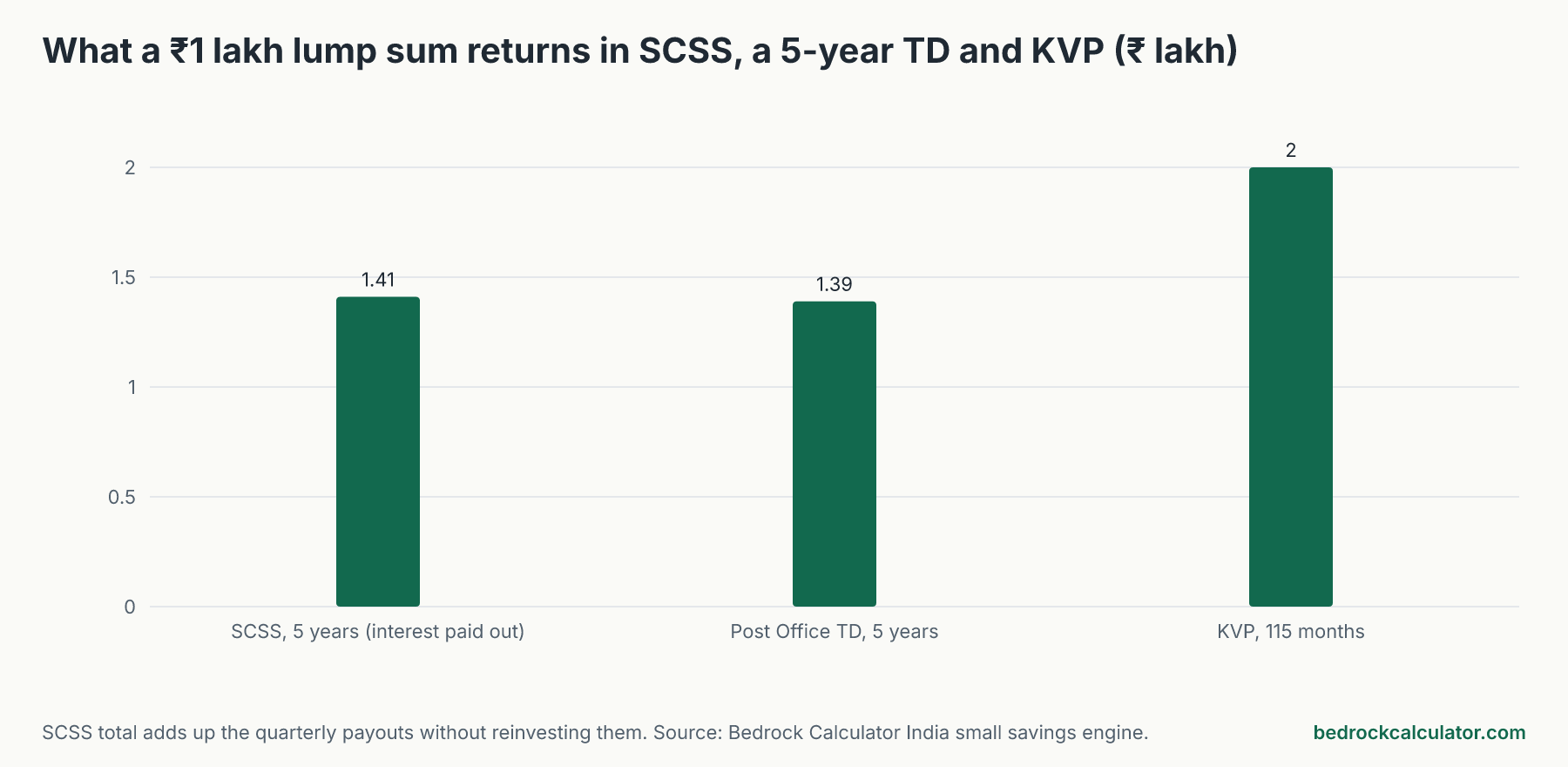
If you have ₹1 lakh to put away in one go, these are the three to compare.
SCSS has the highest rate, but its total here is only the interest it pays out, ₹41,000 over five years, with nothing reinvested. If you spend the payouts, which is what the scheme is designed for, that's exactly what you get. The 5-year TD shows ₹1,38,570: your ₹1 lakh back plus five yearly interest payouts totalling ₹38,570. TD interest is worked out quarterly but paid out once a year, so like SCSS it doesn't compound from one year to the next. KVP doubles your money but takes 9 years and 7 months to do it, so it isn't directly comparable over five years.
SCSS is only open to people aged 60 or over, with some exceptions for early retirees. For a younger saver with a lump sum, the realistic choice is between the 5-year TD and KVP, both at 7.5%. The TD gives you a Section 80C deduction under the old regime and a fixed five-year term. KVP gives you no deduction but can be cashed in early, after 30 months, at a reduced value.
Which small savings schemes are tax-free?
Only two: PPF and Sukanya Samriddhi. Their interest isn't taxed, and neither is the maturity amount. Everything else pays interest that's added to your income and taxed at your slab rate.
That changes the ranking for anyone in a high tax bracket. A tax-free 7.1% from PPF can be worth more than a taxable 8.2% from SCSS once tax is taken off the SCSS interest. The calculators show the pre-tax amounts, so you'll need to apply your own slab rate to the taxable schemes.
The Section 80C deduction on deposits is a separate question. PPF, SSY, SCSS and the 5-year TD qualify, up to ₹1.5 lakh a year across all your 80C investments, but only if you file under the old tax regime. Under the new regime, which is the default, no deposit gets a deduction.
What the calculators leave out
- Future rate changes. Rates are reset every quarter. PPF and SSY balances earn whatever rate is in force each quarter, so a long projection at today's rate is an estimate. SCSS, KVP and TD lock in the rate on the day you invest.
- Tax on interest. None of the figures take tax off the interest from SCSS, KVP, TD or RD.
- Premature closure. Each scheme has its own penalties for early exit, which aren't modelled.
- Deposit limits. SCSS takes up to ₹30 lakh per person, and PPF and SSY take up to ₹1.5 lakh a year. KVP, TD and RD have no upper limit.
Picking the right scheme
Start with who's eligible. If you're saving for a daughter under 10, Sukanya Samriddhi is the clear first choice. If you're 60 or over and want regular income, SCSS is the highest-paying option. For everyone else, PPF is the tax-free long-term choice and the 5-year TD or KVP the better rate on a lump sum. Then run your own amount through the PPF, SCSS or post office RD and TD calculator.