How much pension and lump sum will NPS pay at 60?
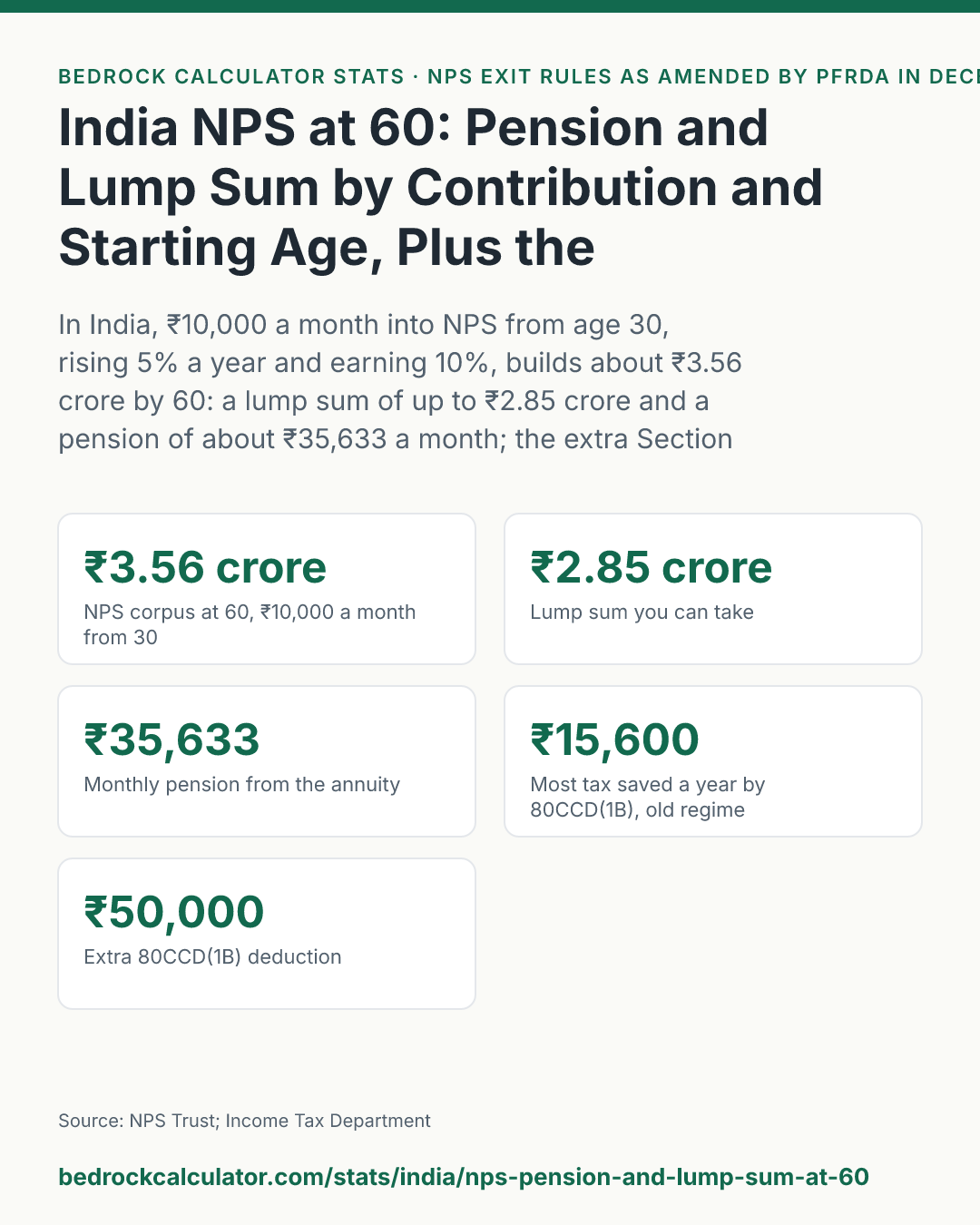
Put ₹10,000 a month into the National Pension System in India from age 30, raise it 5% each year, and if the investments earn 10% a year you'd have about ₹3.56 crore at 60. Under the current exit rules you could take up to ₹2.85 crore of that as a lump sum.
The rest, ₹71.27 lakh, buys an annuity that would pay about ₹35,633 a month at a 6% annuity rate.
The tax break is smaller than people think. The extra ₹50,000 deduction under Section 80CCD(1B) saves at most ₹15,600 a year in our examples, and only if you file under the old regime.
How we worked out these numbers
The corpus figures come from the NPS calculator on this site, run at its default assumptions:
- Contributions rise 5% a year, roughly in step with pay
- The portfolio earns 10% a year after charges, every year until 60
- You're a non-government subscriber (All Citizen or Corporate model)
- At 60 you annuitise only the minimum the rules require, and the annuity pays 6% a year
Those return and annuity rates are assumptions, not promises. NPS returns depend on how much you hold in equity, corporate bonds and government securities, and annuity rates depend on the insurer and interest rates when you retire. Change either and the figures move a lot.
The tax figures come from the old vs new regime calculator, using the same slabs, rebate, surcharge and cess as our new vs old regime comparison.
NPS pension and lump sum at 60 for every age and contribution
Corpus and lump sum are in lakh rupees, so 100 means ₹1 crore. The pension is in rupees a month. Click a column heading to sort.
India NPS at 60 by starting age and monthly contribution (₹ lakh, pension in ₹ a month)
Download CSVNon-government subscriber. Contribution rises 5% a year, 10% yearly return, 20% of the corpus buys an annuity paying 6% a year. Lakh rupees except the monthly pension.
| 25 | 20,000 | 216.77 | 1,245.81 | 996.65 | 124,581 |
| 30 | 20,000 | 159.45 | 712.67 | 570.13 | 71,267 |
| 25 | 10,000 | 108.38 | 622.91 | 498.33 | 62,291 |
| 35 | 20,000 | 114.55 | 398.26 | 318.61 | 39,826 |
| 30 | 10,000 | 79.73 | 356.33 | 285.07 | 35,633 |
| 25 | 5,000 | 54.19 | 311.45 | 249.16 | 31,145 |
| 40 | 20,000 | 79.36 | 214.72 | 171.78 | 21,472 |
| 35 | 10,000 | 57.27 | 199.13 | 159.31 | 19,913 |
| 30 | 5,000 | 39.86 | 178.17 | 142.53 | 17,817 |
| 40 | 10,000 | 39.68 | 107.36 | 85.89 | 10,736 |
| 35 | 5,000 | 28.64 | 99.57 | 79.65 | 9,957 |
| 40 | 5,000 | 19.84 | 53.68 | 42.94 | 5,368 |
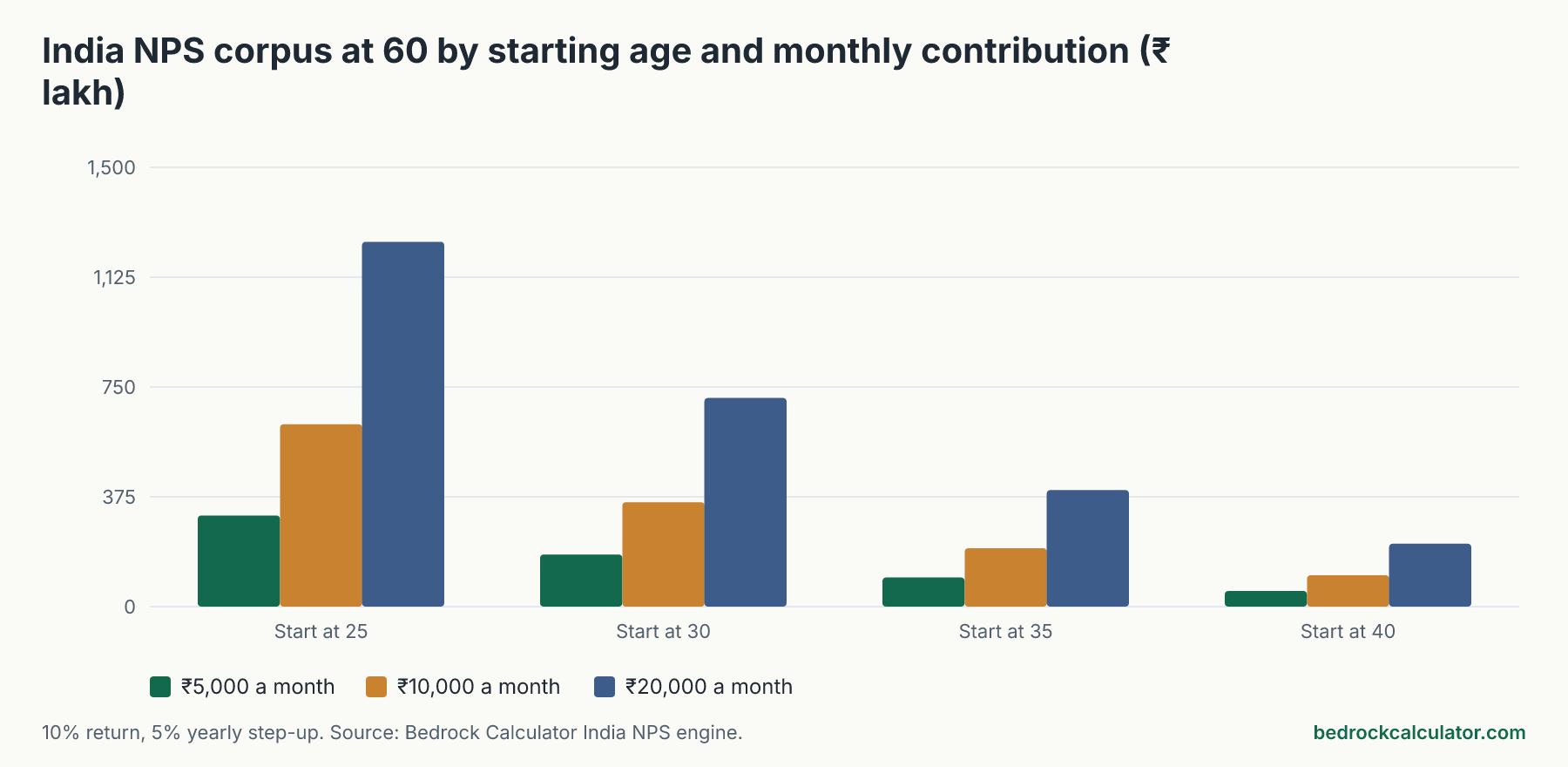
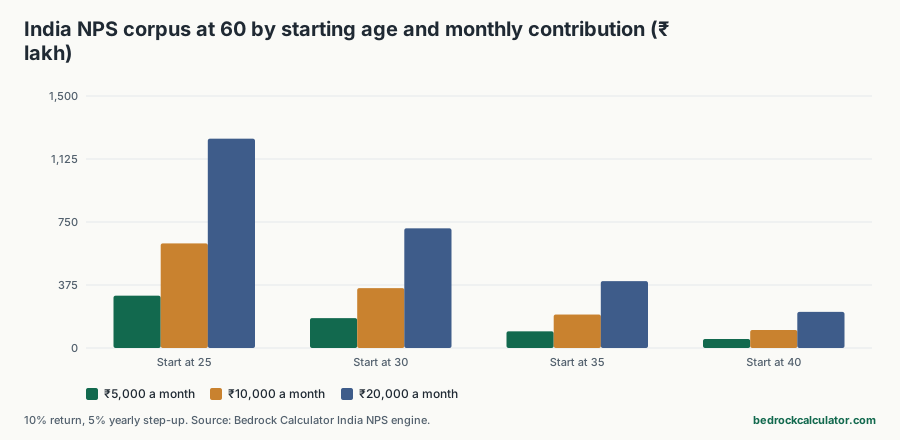
The starting age matters more than the amount. ₹5,000 a month from 25 builds ₹3.11 crore, while four times that, ₹20,000 a month from 40, builds ₹2.15 crore. On ₹10,000 a month, starting at 40 instead of 30 cuts the corpus from ₹3.56 crore to ₹1.07 crore, and the pension from ₹35,633 to ₹10,736.
How much of NPS can you take as a lump sum?
The exit rules changed in December 2025. For non-government subscribers at 60:
- Corpus of ₹8 lakh or less: you can take all of it as a lump sum
- Corpus above ₹12 lakh: you can take up to 80% as a lump sum, and at least 20% must buy an annuity
- In between: a fixed lump sum, with the rest paid out in instalments or as an annuity
Every scenario on this page ends above ₹12 lakh, so each one uses the 80% and 20% split. Government employees still have to annuitise at least 40%.
That's why the pension figures look modest next to the corpus. Only 20% is turned into income. If you want a bigger pension, you can choose to annuitise more, and the NPS calculator lets you set that.
How much does the 80CCD(1B) deduction save?
Section 80CCD(1B) gives an extra deduction of up to ₹50,000 a year for your own NPS contributions, on top of the ₹1.5 lakh Section 80C limit. The saving is the deduction times your marginal tax rate, plus cess:
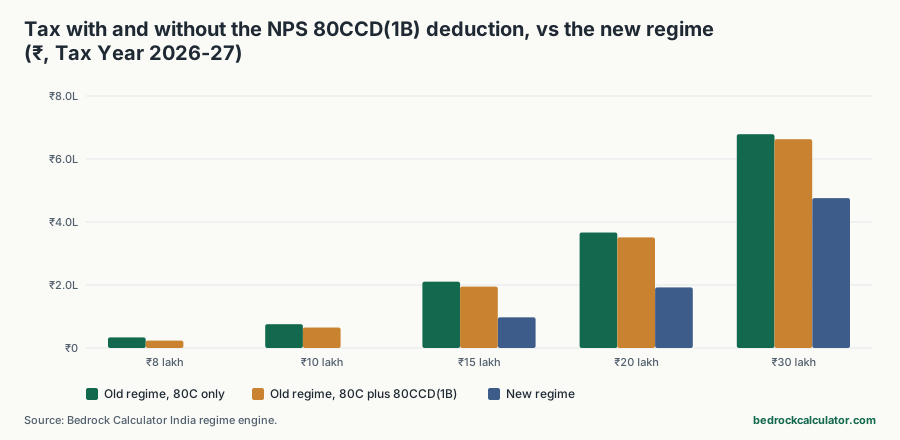
Tax saved in India by the ₹50,000 Section 80CCD(1B) NPS deduction, Tax Year 2026-27 (₹)
Download CSVSalaried, below 60. Old regime with ₹1.5 lakh of Section 80C, then with ₹50,000 more under 80CCD(1B). New regime allows neither. Includes rebate, surcharge and cess.
| ₹8,00,000 | ₹33,800 | ₹23,400 | ₹10,400 | ₹0 |
| ₹10,00,000 | ₹75,400 | ₹65,000 | ₹10,400 | ₹0 |
| ₹15,00,000 | ₹2,10,600 | ₹1,95,000 | ₹15,600 | ₹97,500 |
| ₹20,00,000 | ₹3,66,600 | ₹3,51,000 | ₹15,600 | ₹1,92,400 |
| ₹30,00,000 | ₹6,78,600 | ₹6,63,000 | ₹15,600 | ₹4,75,800 |
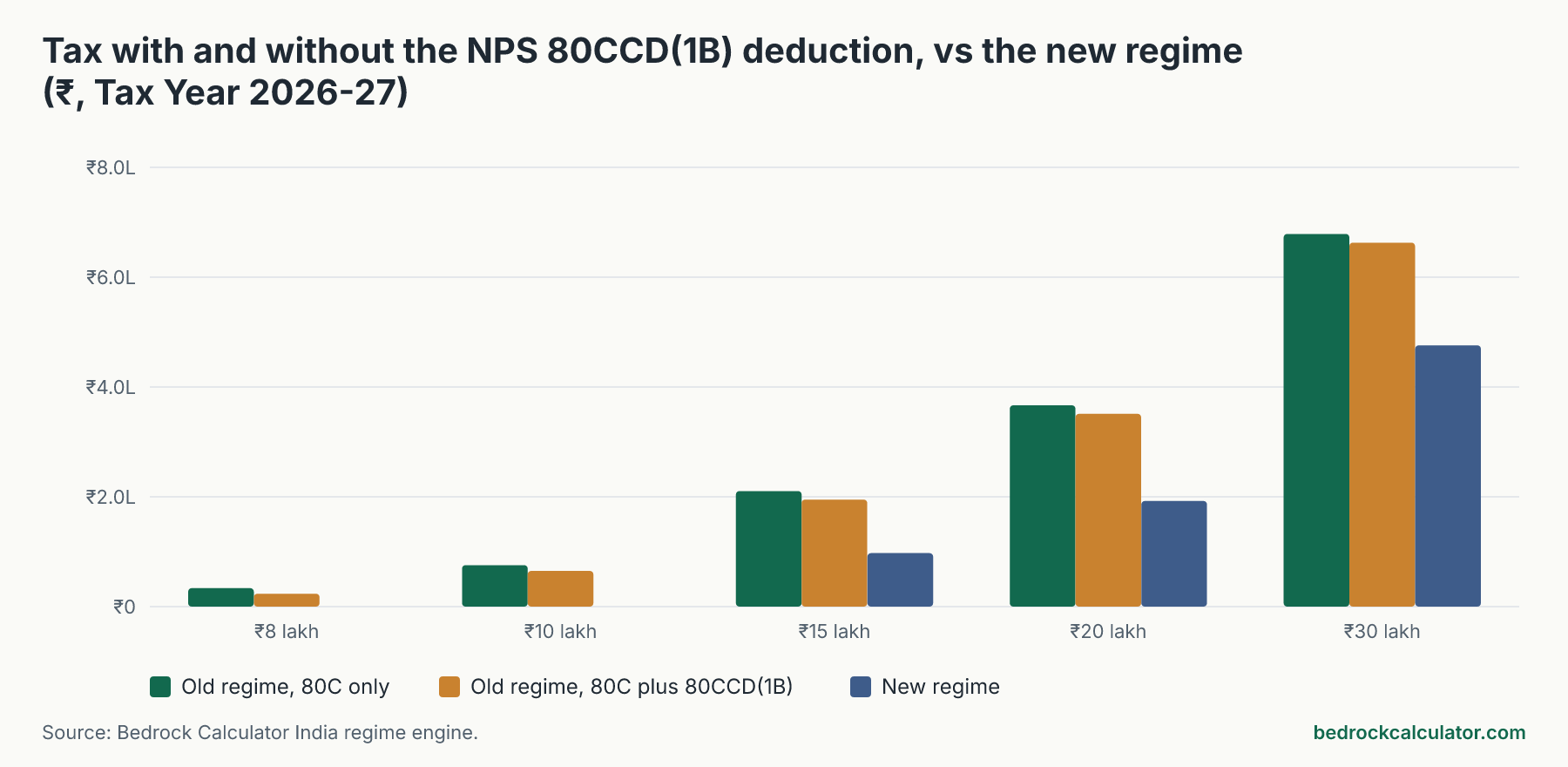
On a ₹10 lakh salary it saves ₹10,400 a year. From ₹15 lakh up it saves ₹15,600. But look at the last column. Even with the NPS deduction, the old regime costs more than the new regime at every salary we tested. At ₹15 lakh, the old regime with 80C and 80CCD(1B) charges ₹1,95,000; the new regime charges ₹97,500.
So for most salaried people the deduction on its own isn't a reason to pick the old regime or to open an NPS account. It's a bonus if you already claim enough other deductions to make the old regime worthwhile.
The employer contribution is different. Under Section 80CCD(2), what your employer pays into NPS is deductible up to 14% of basic pay in both regimes. If your employer offers it, that's usually the better tax deal.
What the calculator leaves out
- Market risk. A steady 10% return every year is a simplification. Real returns vary, and an equity-heavy portfolio can fall sharply in the years before 60.
- Annuity rates. The 6% rate is illustrative. The pension you're offered at 60 could be higher or lower, and depends on whether you pick an annuity that returns the purchase price to your family.
- The middle slab. For a corpus between ₹8 lakh and ₹12 lakh, the calculator applies the same 20% and 80% split rather than the instalment option. None of our scenarios fall in that range.
- Tax on the lump sum. The lump sum has been tax-free under Section 10(12A). Whether that exemption covers the larger 80% withdrawal now allowed wasn't confirmed when the calculator was built. The annuity pension is taxed as income each year.
- Inflation. ₹35,633 a month in 30 years will buy far less than it does today.
- Tier II accounts and partial withdrawals before 60 aren't modelled.
Getting your own NPS figure
Open the NPS calculator and enter your age, what you contribute each month, and the return and annuity rate you think are realistic. To see whether the 80CCD(1B) deduction is worth claiming, check your total deductions in the 80C and 80D deduction optimizer, then compare the two regimes in the old vs new regime calculator.