How much does a Sukanya Samriddhi account pay at maturity?
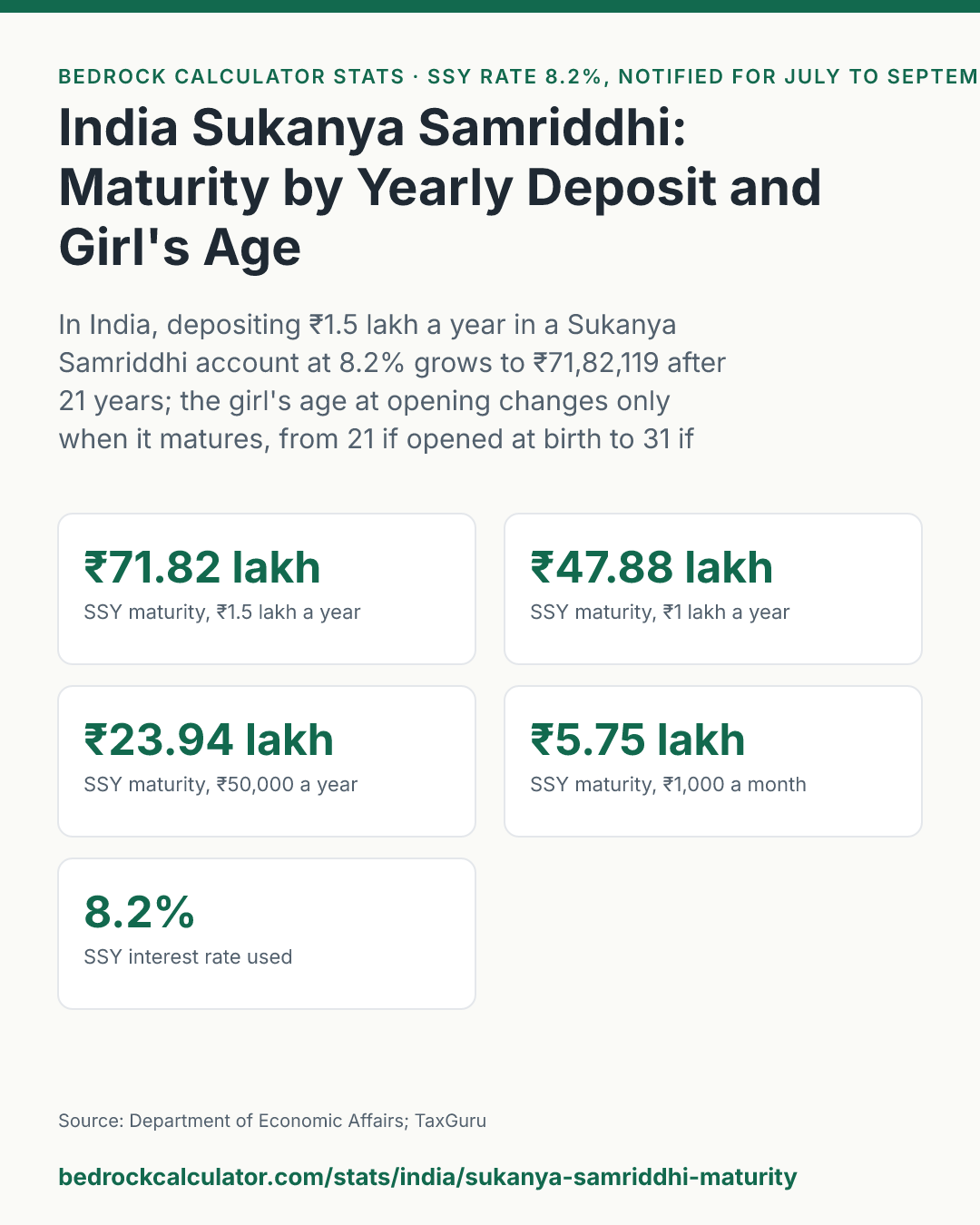
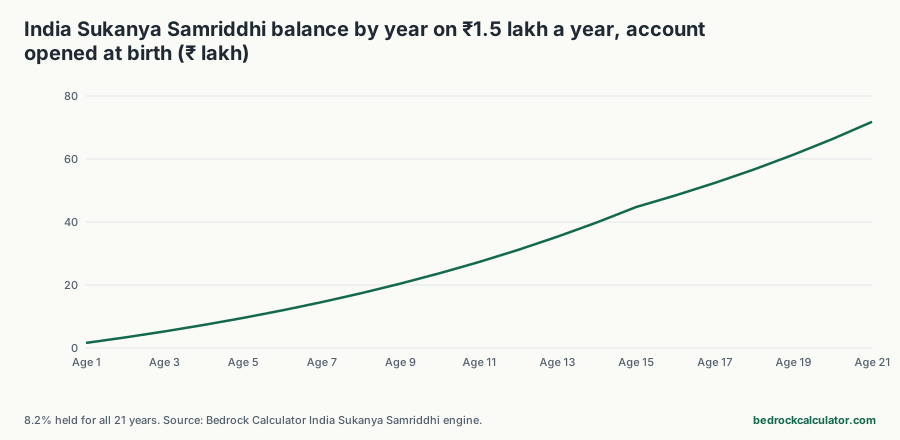
A Sukanya Samriddhi account in India that gets the full ₹1.5 lakh every year grows to ₹71,82,119 at the current 8.2% rate. ₹1 lakh a year grows to ₹47,88,079, ₹50,000 a year to ₹23,94,040, and ₹1,000 a month to ₹5,74,570. All of it is tax-free.
The girl's age when you open the account doesn't change those amounts. It only changes when the money arrives: at 21 if you open the account at birth, or 31 if you open it at 10.
How we worked out these numbers
Every figure comes from the Sukanya Samriddhi calculator on this site. It follows the scheme's structure:
- You deposit for the first 15 years of the account, the same amount each year, paid at the start of the year
- The account then keeps earning interest with no deposits until it matures 21 years after opening
- Interest is 8.2% a year, compounded once a year, for the whole 21 years
The 8.2% rate is the one notified for the July to September 2026 quarter, and the government kept it unchanged for October to December 2026. It's reset every quarter, so a 21-year projection at one rate is an assumption, not a promise.
Sukanya Samriddhi maturity amount by yearly deposit
Amounts in rupees. Click a column heading to sort.
India Sukanya Samriddhi maturity by yearly deposit at 8.2% (₹)
Download CSV15 yearly deposits made at the start of each year, account matures after 21 years, interest compounded yearly. Rupees.
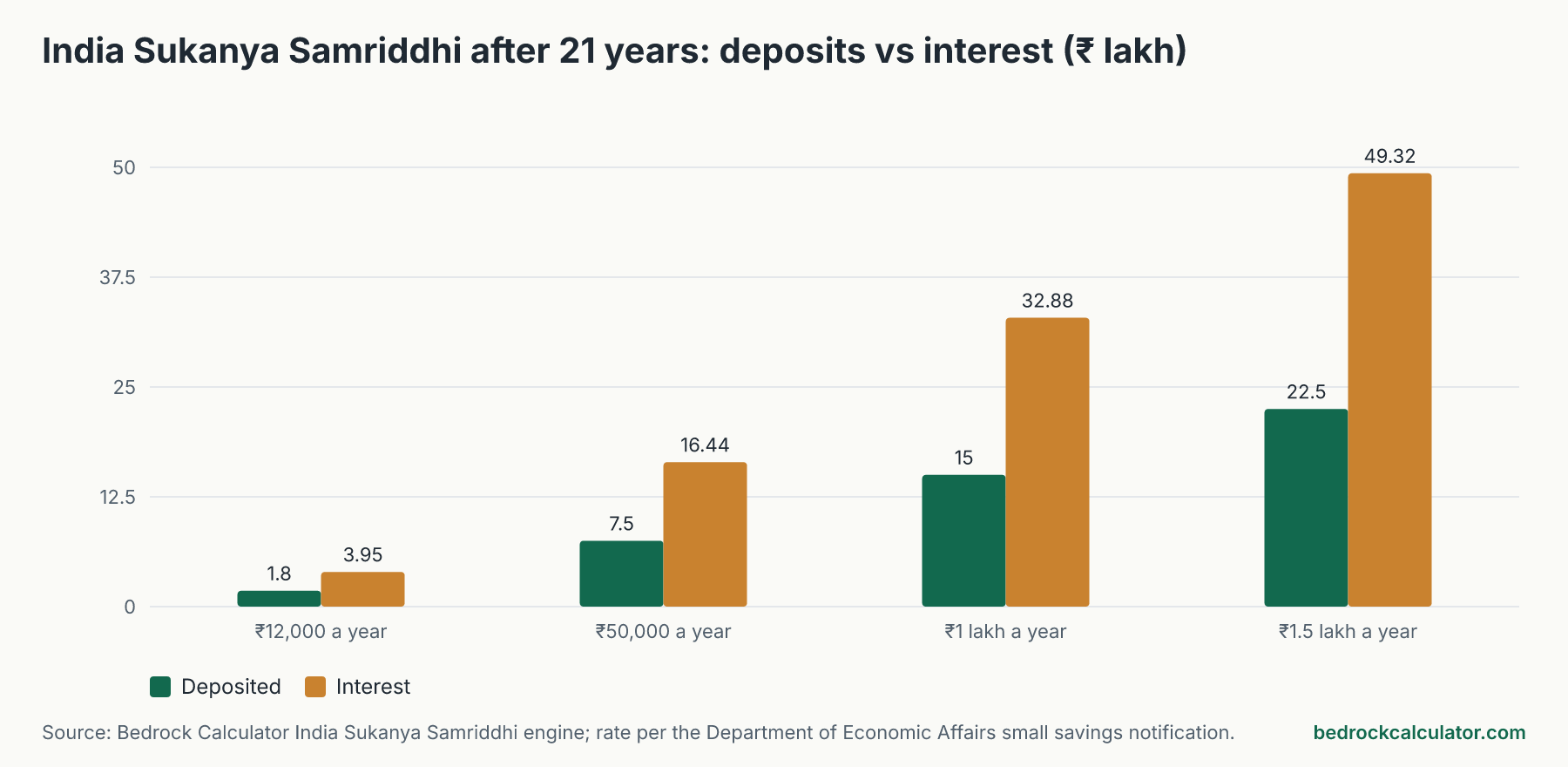
| ₹12,000 | ₹1,80,000 | ₹3,94,570 | ₹5,74,570 |
| ₹50,000 | ₹7,50,000 | ₹16,44,040 | ₹23,94,040 |
| ₹1,00,000 | ₹15,00,000 | ₹32,88,079 | ₹47,88,079 |
| ₹1,50,000 | ₹22,50,000 | ₹49,32,119 | ₹71,82,119 |
At the top deposit you pay in ₹22.5 lakh and get back 3.19 times that. Interest makes up 68.7% of the final balance, which is a much bigger share than in a 15-year PPF account. The reasons are the higher rate and the extra years at the end.
The 6 years with no deposits
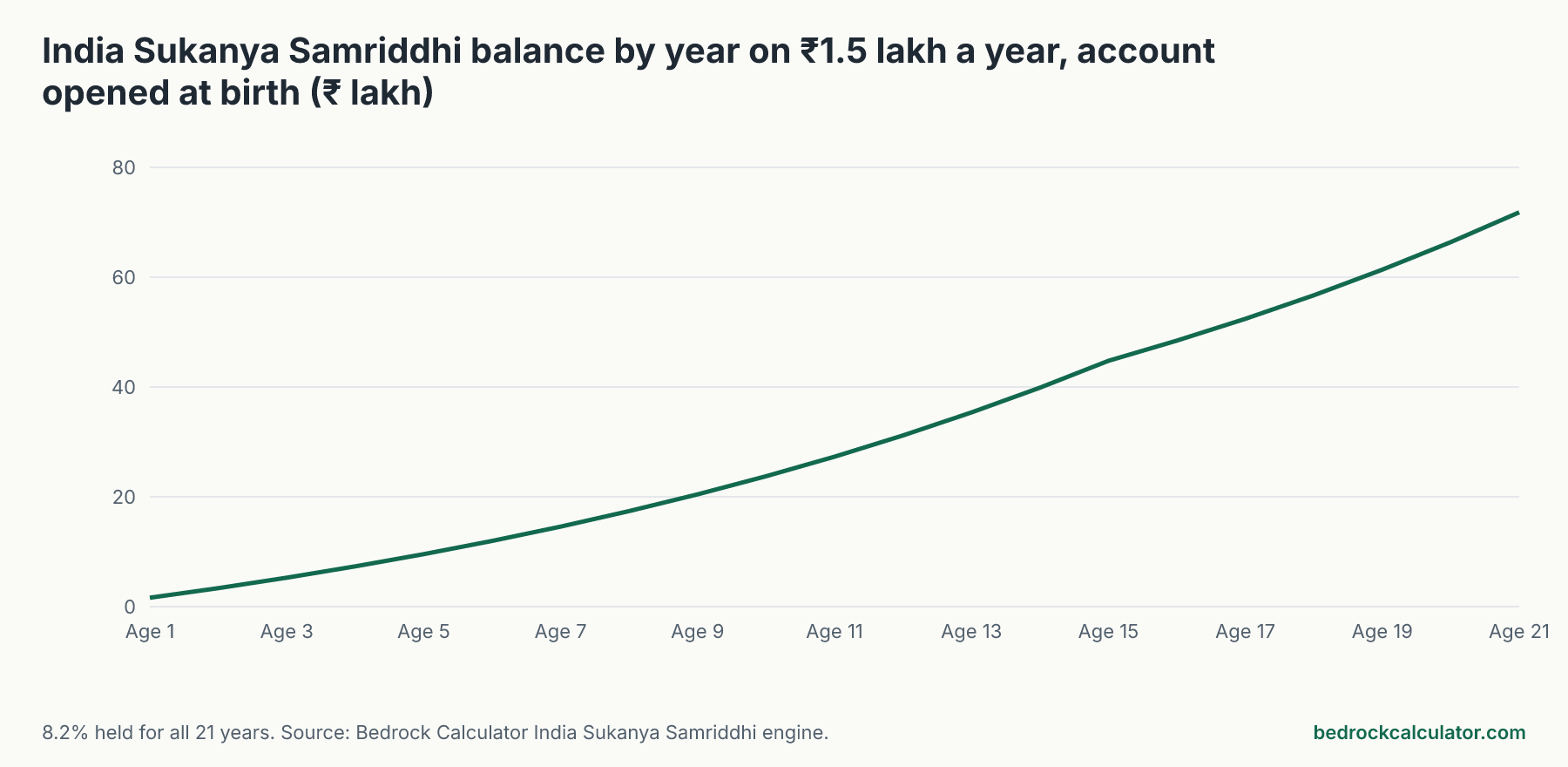
The most interesting part of Sukanya Samriddhi is what happens after you stop paying. On ₹1.5 lakh a year, the balance is ₹44.76 lakh when the last deposit has had its year of interest. Over the following 6 years, interest alone adds another ₹27.06 lakh without a single new rupee from you.
That's compounding doing its work. By then the balance is large enough that a year's interest on it is bigger than any deposit you could legally make.
Does the girl's age change the maturity amount?
No. This is the question parents ask most, and the answer surprises people. Because every account takes 15 years of deposits and runs for 21 years from opening, a girl whose account opens at 4 gets the same amount as one whose account opens at birth. She just gets it at 25 instead of 21.
India Sukanya Samriddhi: when deposits end and the account matures, by the girl's age at opening
Download CSVMaturity value on ₹1.5 lakh a year, the same at every opening age. Lakh rupees.
| 0 | 14 | 21 | 71.82 |
| 2 | 16 | 23 | 71.82 |
| 4 | 18 | 25 | 71.82 |
| 6 | 20 | 27 | 71.82 |
| 8 | 22 | 29 | 71.82 |
| 10 | 24 | 31 | 71.82 |
Two things follow from that. If you want the money ready for college, opening early matters: an account opened at 10 isn't finished until she's 31. And if you've missed the chance to open one, you can't open an account for a girl once she turns 10.
Is Sukanya Samriddhi better than PPF?
On the numbers, it currently is. SSY pays 8.2% against 7.1% for PPF, with the same ₹1.5 lakh yearly limit, and both are tax-free. Deposits in either count toward the Section 80C deduction if you file under the old regime.
The trade-off is control. The money in an SSY account belongs to your daughter and is meant for her education and marriage. You can withdraw part of it once she turns 18 or finishes Class 10, and close it early for her marriage after 18. A PPF account is yours to use for anything. Many families use both: SSY for a daughter's goals, PPF for their own long-term savings. Our PPF maturity figures show how the two compare at the same deposits.
What the calculator leaves out
- Rate changes. The figures hold 8.2% for all 21 years. The rate has moved several times since the scheme launched.
- Deposit timing. The calculator assumes each year's deposit is in at the start of the financial year. Paying later in the year earns less interest.
- Partial withdrawals and early closure. Taking money out at 18 for education, or closing the account for marriage, would leave less at maturity or end it early.
- The account limit. A family can usually open accounts for two daughters, with exceptions for twins and triplets.
- Inflation. ₹71,82,119 in 21 years will buy much less than it would today.
Getting your own Sukanya Samriddhi figure
Open the Sukanya Samriddhi calculator, enter your daughter's age and what you can deposit each year, and it shows the maturity value, the age she'll be, and the year-by-year balance. If you file under the old regime, the 80C and 80D deduction optimizer shows how much tax the deposit saves alongside your other 80C investments.