How much EPS pension will you get each month?
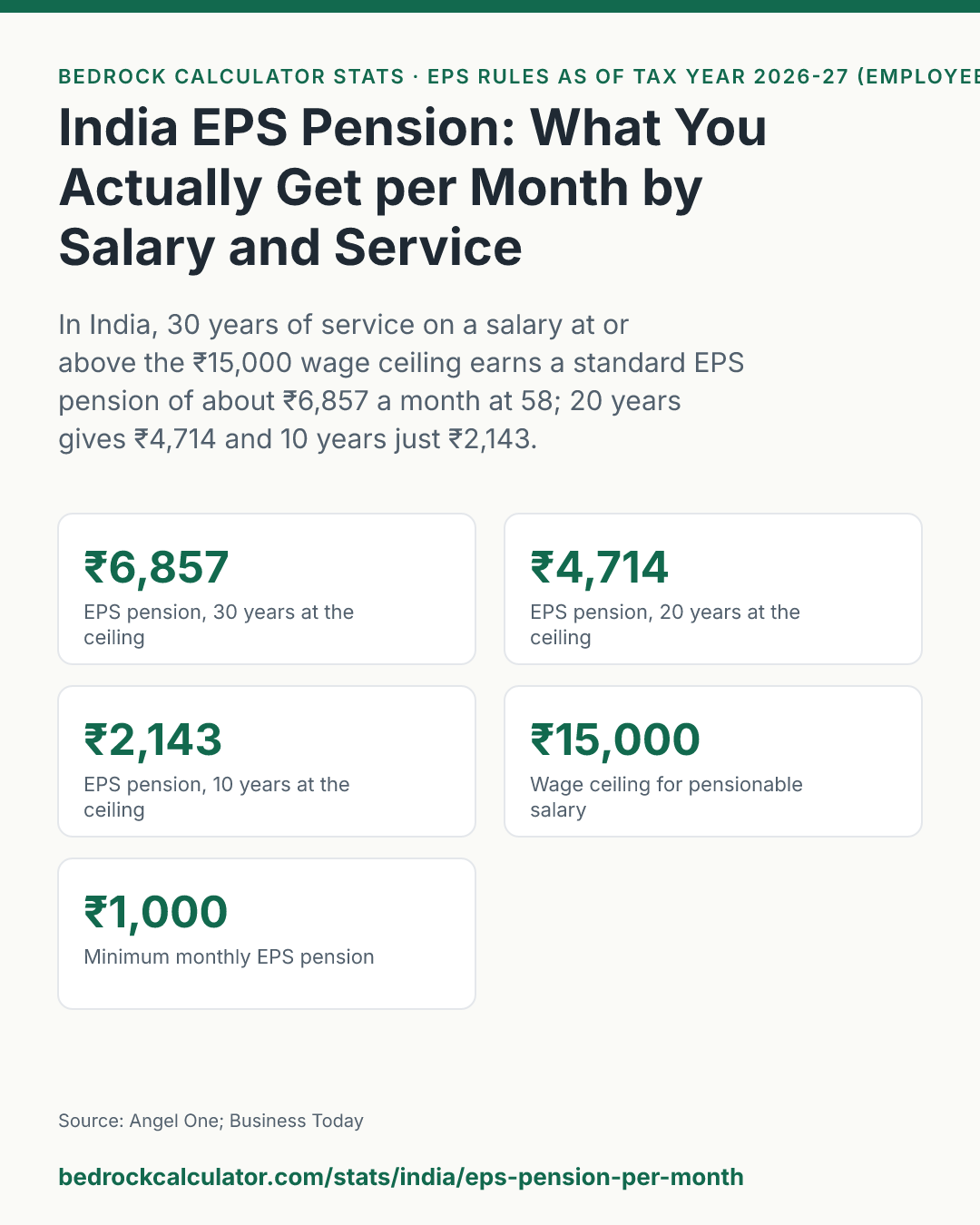
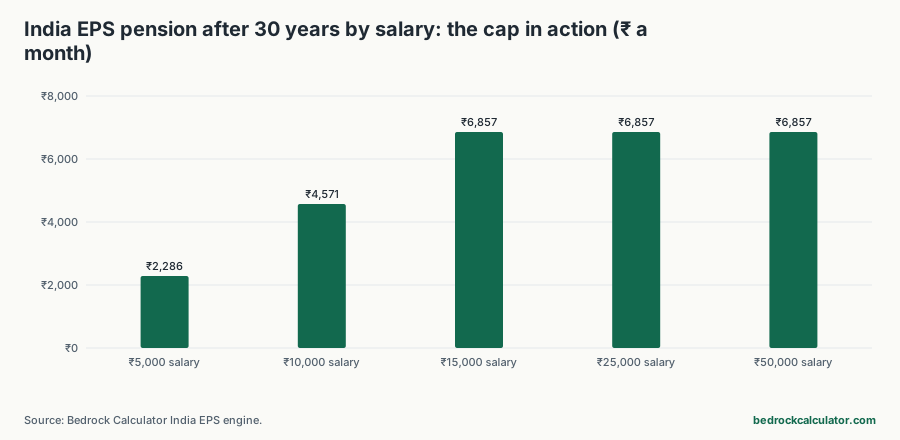
The Employees' Pension Scheme pays less than most people in India expect. Thirty years of service on a salary at or above the ₹15,000 wage ceiling earns a pension of about ₹6,857 a month at 58. Twenty years earns ₹4,714. Ten years, the minimum for any pension at all, earns ₹2,143.
The most the standard formula ever pays is ₹7,500 a month, for a full 35-year career at the ceiling.
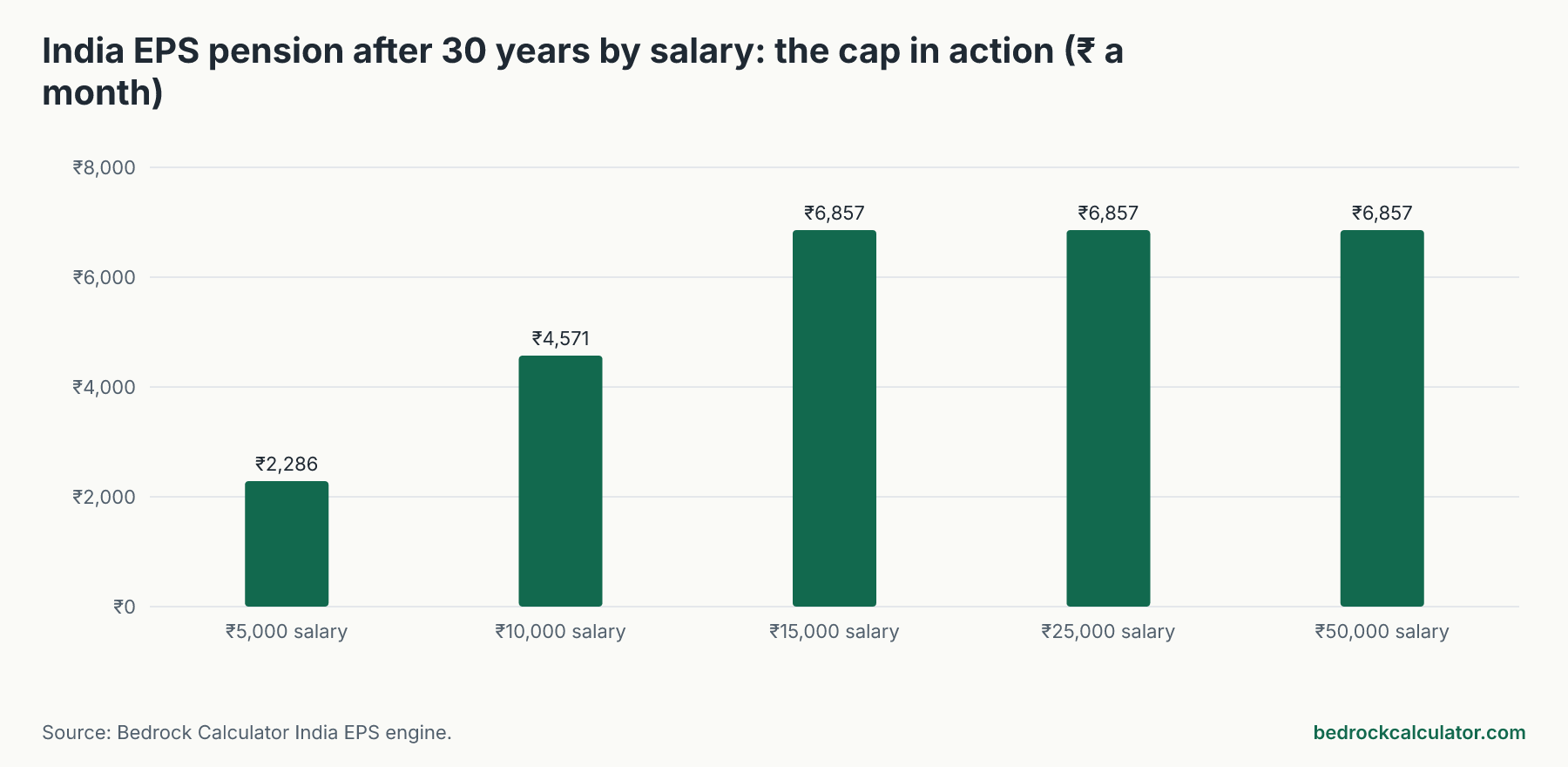
Those figures don't rise with your salary once it passes ₹15,000 a month. Someone on a ₹50,000 basic gets exactly the same EPS pension as someone on ₹15,000.
How the EPS pension is worked out
EPS is a defined-benefit pension, not a savings account. Part of your employer's PF contribution goes into a pooled fund every month, and at 58 the pension is set by a formula rather than by how much was paid in. We ran the EPS pension calculator on this site for each combination of salary and service. It applies the formula like this:
- Take your average Basic + DA over the last 60 months before you leave, and cap it at ₹15,000. That's your pensionable salary.
- Take your years of pensionable service. If you have 20 years or more and stay in covered work until 58, add 2 bonus years. Service counts up to 35 years in all, bonus included.
- Multiply the two and divide by 70.
- If the answer is below ₹1,000 a month, the minimum pension of ₹1,000 is paid instead.
That's the whole calculation. Your actual EPS contributions, the interest rate and the size of the pension fund play no part in it.
EPS pension per month for every salary and length of service
All figures are monthly pensions in rupees from age 58. Click a column heading to sort.
India EPS monthly pension at 58 by pensionable salary and years of service (₹)
Download CSVStandard EPS formula: pensionable salary (capped at ₹15,000) times pensionable service, divided by 70, with 2 bonus years from 20 years of service and a ₹1,000 floor. Monthly amounts in rupees.
| 10 | 1,000 | 1,429 | 2,143 | 2,143 | 2,143 |
| 15 | 1,071 | 2,143 | 3,214 | 3,214 | 3,214 |
| 19 | 1,357 | 2,714 | 4,071 | 4,071 | 4,071 |
| 20 | 1,571 | 3,143 | 4,714 | 4,714 | 4,714 |
| 25 | 1,929 | 3,857 | 5,786 | 5,786 | 5,786 |
| 30 | 2,286 | 4,571 | 6,857 | 6,857 | 6,857 |
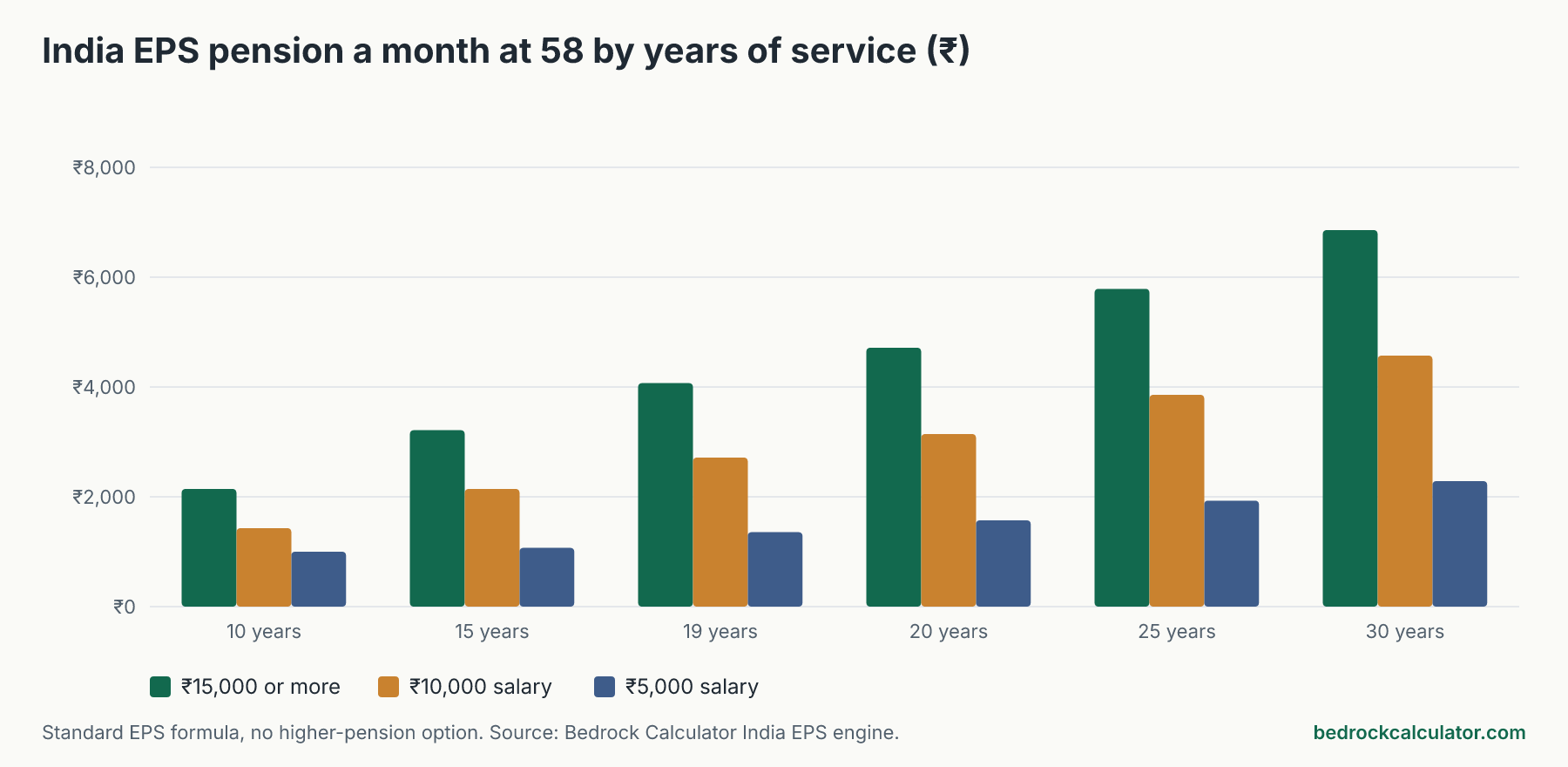
Read across any row and the three right-hand columns are identical. That's the wage ceiling at work. Read down a column and the pension climbs steadily with each year of service, with one jump in the middle.
Why 20 years of service is worth more than it looks
Nineteen years at the ceiling gives ₹4,071 a month. Twenty years gives ₹4,714, a rise of ₹643 for one extra year. The reason is the bonus: from 20 years the formula adds 2 years, so 20 years of work counts as 22.
If you are close to 20 years of EPS membership and thinking of leaving formal employment, it can pay to reach that mark first. If you change jobs, carry your EPS service across through the transfer process rather than withdrawing it, because the formula only counts service that's still on your record.
Does a higher salary increase the EPS pension?
Only up to ₹15,000. Below the ceiling, salary matters a lot: on a ₹10,000 pensionable salary, 20 years earns ₹3,143 and 30 years earns ₹4,571, against ₹4,714 and ₹6,857 at the ceiling. Above it, nothing changes.
This is the gap the "higher pension" option was meant to close. Members who contributed on their full salary, with the employer's agreement, can have their pension worked out on that higher salary. The process is employer-specific and this calculator doesn't model it.
When the minimum pension kicks in
The minimum pension is ₹1,000 a month for anyone with at least 10 years of service. On a ₹5,000 pensionable salary and 10 years, the formula gives ₹714, so the pension is lifted to ₹1,000. In our table that's the only cell where the minimum applies. Most people who reach 10 years have a pensionable salary high enough that the formula already clears it.
With less than 10 years of service you don't get a monthly pension. You get a one-time withdrawal benefit instead, which this page doesn't calculate.
What the calculator leaves out
- Early or deferred pension. You can start a reduced pension from 50, or defer it past 58 for a higher one. The calculator only shows the pension from 58.
- The higher-pension option. Covered above. If you opted in, your pension may be several times these figures.
- A higher wage ceiling. In September 2026 news reports said the government had approved raising the wage ceiling. We couldn't confirm a notified start date, so this page uses the ₹15,000 ceiling the engine holds. If the higher ceiling is notified, service after it starts could count for more.
- Leaving before 58. The bonus years only apply if you're still in EPS-covered work at 58. The table assumes you are.
- Older service rules. Service from before 1995, and some service before September 2014, can be counted under older rules that this formula doesn't reproduce.
- Family and widow pensions. EPS also pays pensions to a spouse and children after a member's death. Those aren't covered here.
Getting your own EPS figure
Open the EPS pension calculator and enter your average Basic + DA for your last 60 months and your total years of EPS service from your EPFO passbook. Because the pension is small relative to most salaries, it helps to see it next to your EPF corpus, which is where most of your PF money actually builds up, and the employer PF contribution calculator, which shows exactly how each month's employer contribution is split between EPF and EPS.