How much does a PPF account pay at maturity after 15 years?
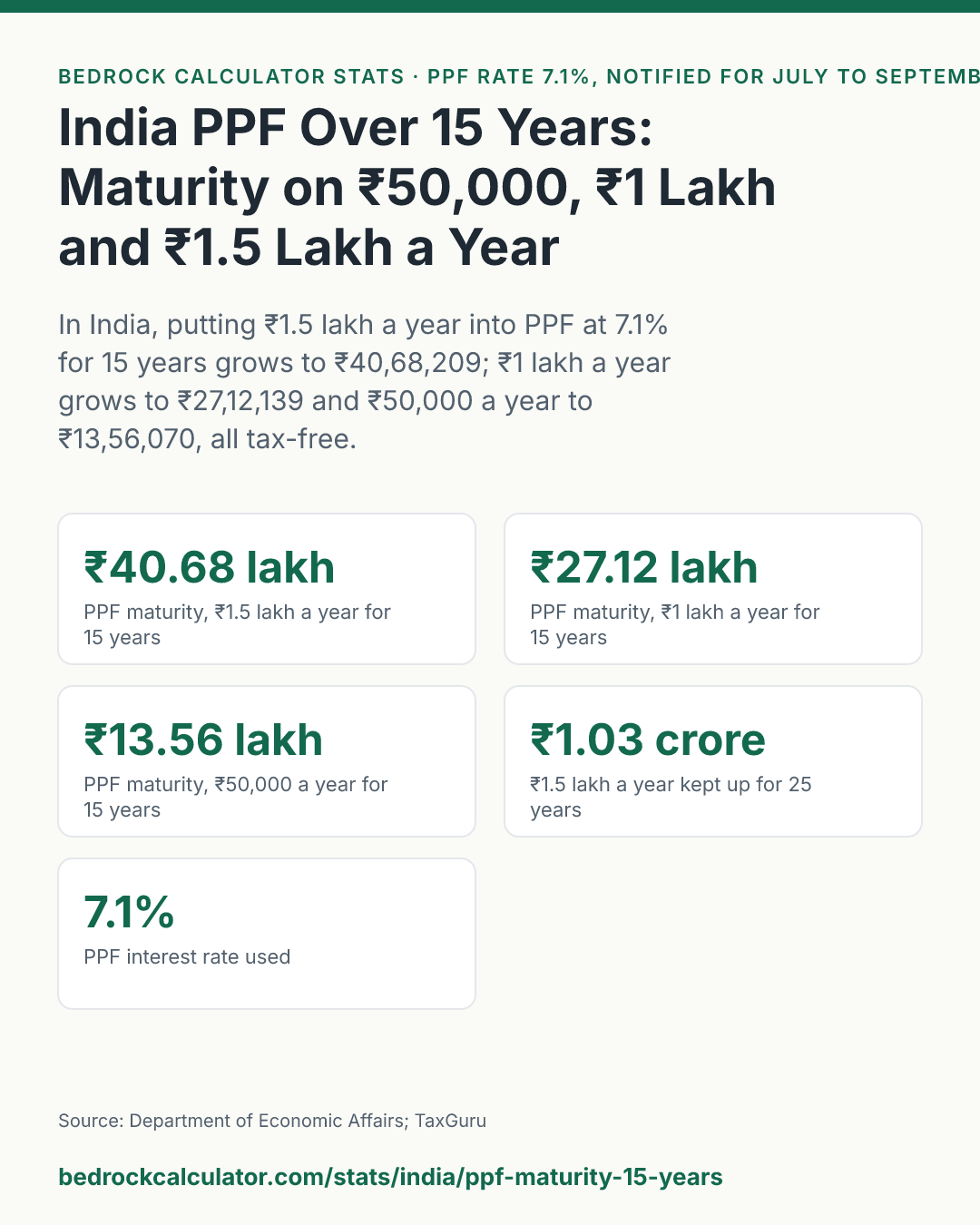
At the current 7.1% rate, putting the full ₹1.5 lakh a year into a Public Provident Fund account in India for 15 years gives you ₹40,68,209 at maturity. ₹1 lakh a year gives ₹27,12,139. ₹50,000 a year gives ₹13,56,070. None of that is taxed.
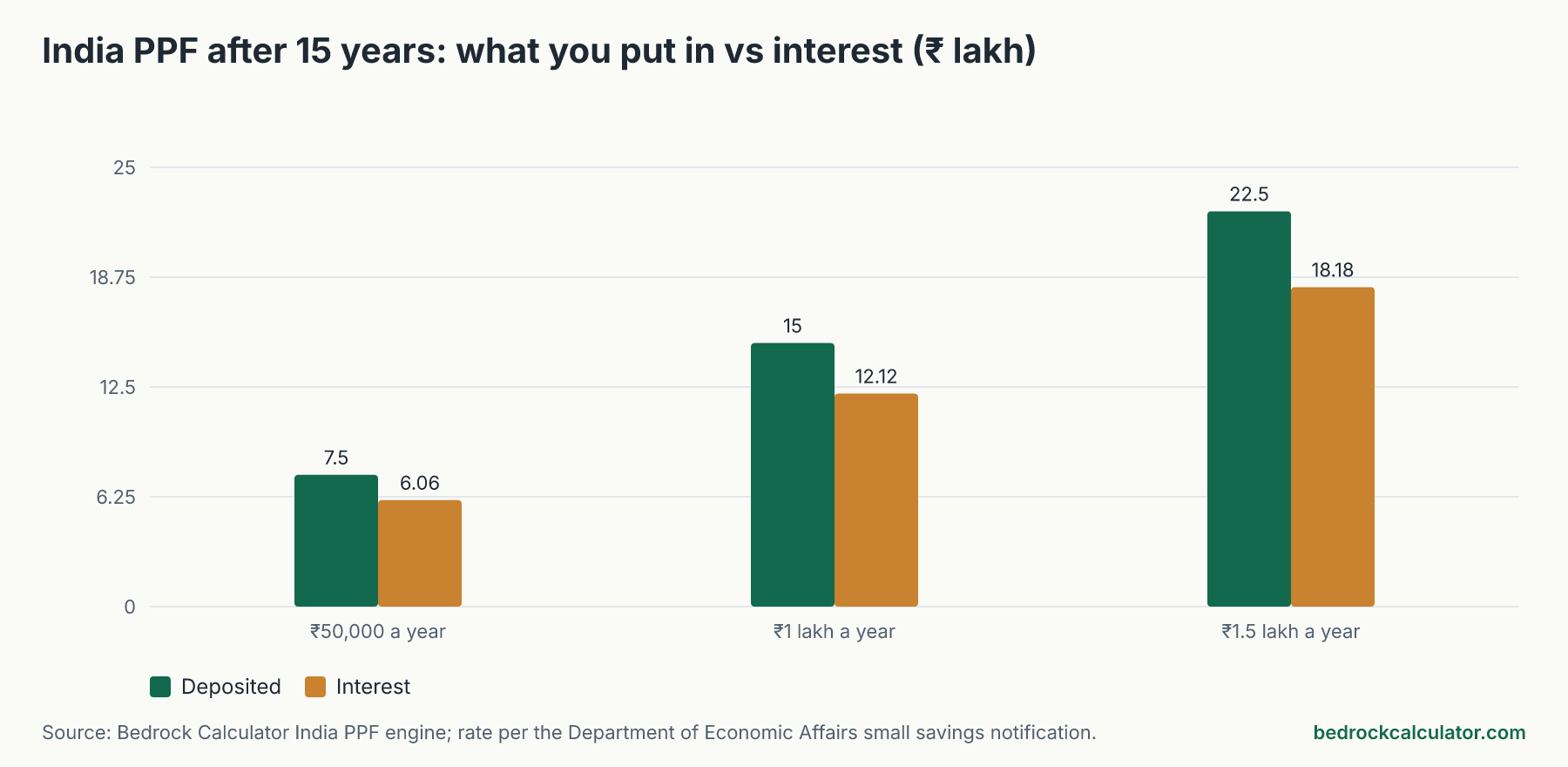
At the top amount you deposit ₹22.5 lakh in total and the account pays you ₹18.18 lakh of interest on top, so your money grows to 1.81 times what you put in.
How we worked out these numbers
We ran the PPF calculator on this site for each yearly amount. It assumes:
- The same deposit every financial year, paid at the start of the year so it earns a full year's interest
- Interest at 7.1% a year, compounded once a year, held for the whole term
- A new account with no opening balance
The 7.1% rate is the one in force for 1 October 2026 to 31 December 2026: on 30 September 2026 the Department of Economic Affairs kept every small savings rate unchanged from the previous quarter, so it is the rate for new deposits today. It is reviewed every quarter, though, and a 15-year projection assumes it never moves.
PPF maturity value on ₹50,000, ₹1 lakh and ₹1.5 lakh a year
Amounts in rupees. Click a column heading to sort.
India PPF maturity value after 15 years at 7.1% (₹)
Download CSVDeposit made at the start of each financial year, interest compounded yearly, no opening balance. Rupees.
| ₹50,000 | ₹7,50,000 | ₹6,06,070 | ₹13,56,070 |
| ₹1,00,000 | ₹15,00,000 | ₹12,12,139 | ₹27,12,139 |
| ₹1,50,000 | ₹22,50,000 | ₹18,18,209 | ₹40,68,209 |
The results scale exactly with the deposit: double the yearly amount and you double the maturity value, because the rate and the term are the same for everyone. So if you can manage ₹75,000 a year, expect a figure halfway between the first two rows.
Why the last few years do most of the work
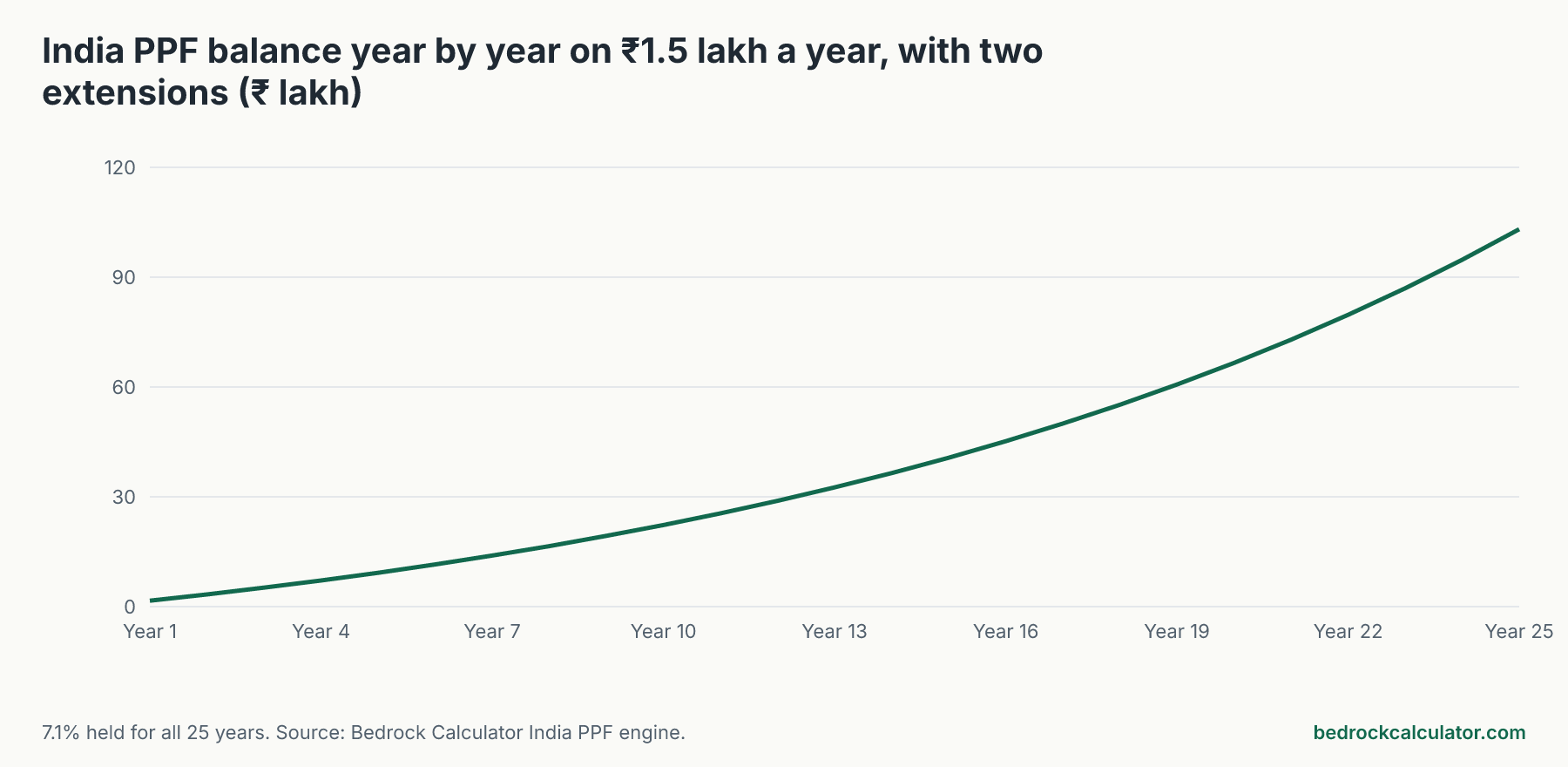
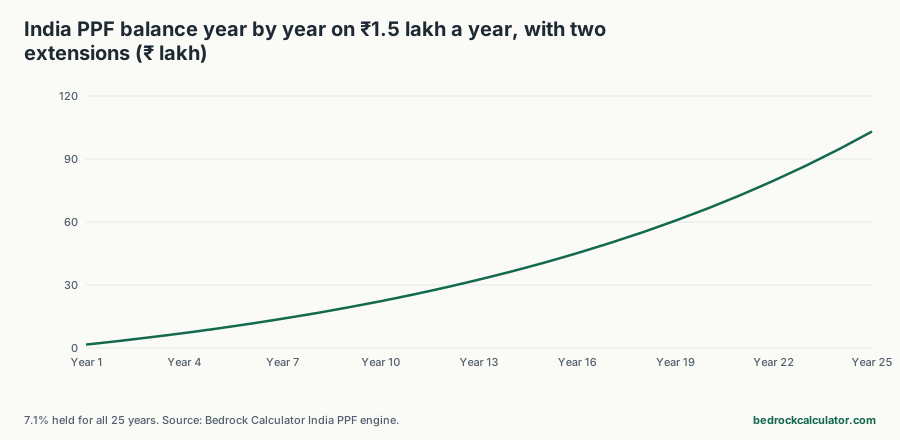
Interest is 44.7% of the final balance on ₹1.5 lakh a year, and most of it arrives late. Each year's interest is paid on everything already in the account, including all the interest from earlier years, so the yearly gain gets bigger as the balance grows. That's why the line in the chart below curves upward rather than climbing in a straight line.
It's also why the deposit date matters. PPF interest for a month is worked out on the lowest balance between the 5th and the end of the month. The calculator assumes your whole deposit is in before 5 April. If you pay in March instead, that year's money earns almost nothing for the year, and the maturity figure would be lower than the table shows.
Should you extend PPF after 15 years?
At maturity you can close the account, or extend it in 5-year blocks, with or without new deposits. If you don't need the money, extending is usually the easy choice, because the balance keeps earning the PPF rate tax-free.
India PPF after 15, 20 and 25 years, with and without deposits in the extension (₹ lakh)
Download CSVExtensions run in 5-year blocks. "Stop paying" keeps the balance invested with no new deposits after year 15. Lakh rupees.
| ₹50,000 | 13.56 | 22.19 | 19.11 | 34.36 |
| ₹1,00,000 | 27.12 | 44.39 | 38.22 | 68.72 |
| ₹1,50,000 | 40.68 | 66.58 | 57.33 | 103.08 |
On ₹1.5 lakh a year:
- Keep paying for one more block: the balance reaches ₹66.58 lakh after 20 years, ₹25.9 lakh more than at maturity.
- Stop paying but extend: it still grows to ₹57.33 lakh, a gain of ₹16.64 lakh without adding a rupee.
- Keep paying for two blocks: after 25 years you'd have ₹1.03 crore from ₹37.5 lakh of deposits, 2.75 times your money.
On ₹1 lakh a year the same two extensions take you to ₹44.39 lakh and then ₹68.72 lakh.
If you extend with deposits, you have to tell the post office or bank within a year of maturity. If you don't, the account extends without deposits by default.
How PPF is taxed in India
PPF is one of the few fully tax-free investments left. The interest isn't taxed each year, and the maturity amount isn't taxed when you take it out. Deposits up to ₹1.5 lakh a year also count toward the Section 80C deduction, but only under the old tax regime. Under the new regime, which is the default, you get the tax-free growth but no deduction for the deposit. The new vs old regime comparison shows when the old regime is worth choosing.
What the calculator leaves out
- Rate changes. The rate is reset every quarter. These figures hold 7.1% for the full term.
- The exact maturity date. A PPF account matures 15 years after the end of the financial year in which you opened it, so many people get 16 deposits rather than 15. The calculator counts 15.
- Deposits made later in the year. As above, money that arrives after the 5th of a month misses that month's interest.
- Loans and partial withdrawals. You can borrow against the account in its early years and make limited withdrawals later. Either would reduce the final balance.
- Inflation. Every amount is in future rupees.
Getting your own PPF figure
Open the PPF calculator, enter your yearly deposit and your current balance, and choose how many extension blocks you want to see. If you're saving for a daughter, compare it with the Sukanya Samriddhi calculator, which currently pays a higher rate. If you want equity exposure inside the same 80C limit, the ELSS calculator shows what a tax-saving mutual fund might do.