How much capital gains tax is due on selling a house in India?
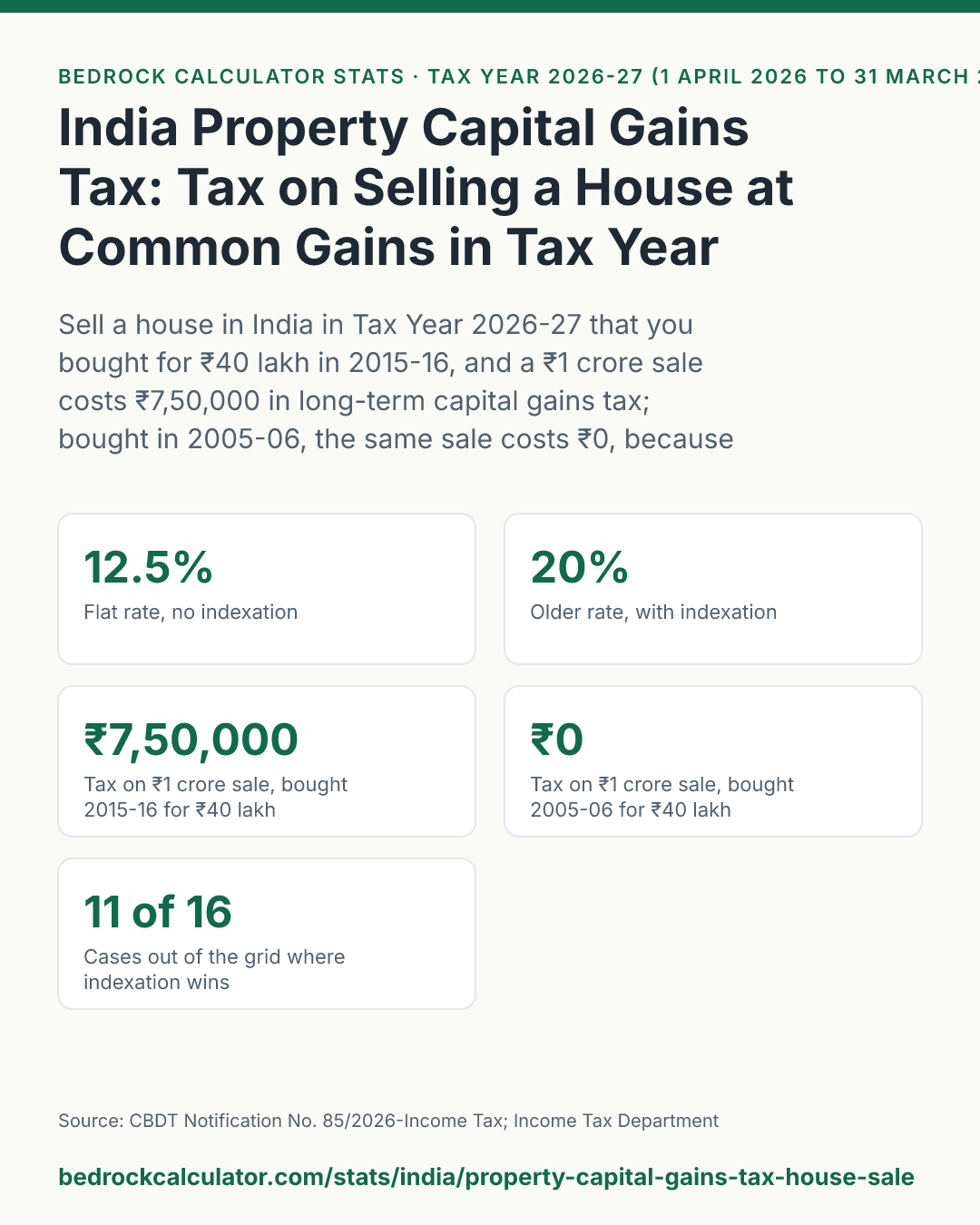
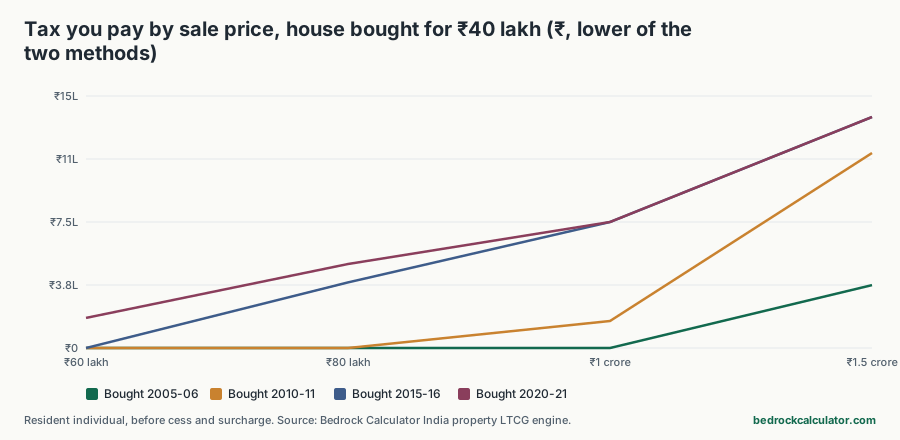
If you sell a house in India in Tax Year 2026-27 that you bought for ₹40 lakh, the long-term capital gains tax depends heavily on when you bought it. Bought in 2015-16 and sold for ₹1 crore, the tax is ₹7,50,000. Bought in 2005-06 and sold for the same ₹1 crore, it's ₹0.
The reason is the choice resident sellers still have for property bought before 23 July 2024: pay 12.5% on the plain gain, or 20% on the gain after adjusting your cost for inflation, whichever is lower. Older purchases get a much bigger inflation adjustment.
Two ways to work out the tax
A house, flat or plot held for more than 24 months counts as a long-term asset. For a resident individual or HUF who bought it before 23 July 2024, the law allows two calculations:
- 12.5% without indexation: tax on sale price minus what you paid.
- 20% with indexation: your purchase price is scaled up by the Cost Inflation Index, and the tax is on sale price minus that indexed cost.
You pay the lower of the two. Property bought on or after 23 July 2024 only gets the first method.
The index for Tax Year 2026-27 is 384, notified by the CBDT in July 2026. For a house bought in 2005-06, when the index was 117, a ₹40 lakh purchase becomes an indexed cost of ₹1.31 crore. Bought in 2015-16 (index 254) it becomes ₹60.47 lakh, and in 2020-21 (index 301) ₹51.03 lakh.
Capital gains tax on selling a house at common prices
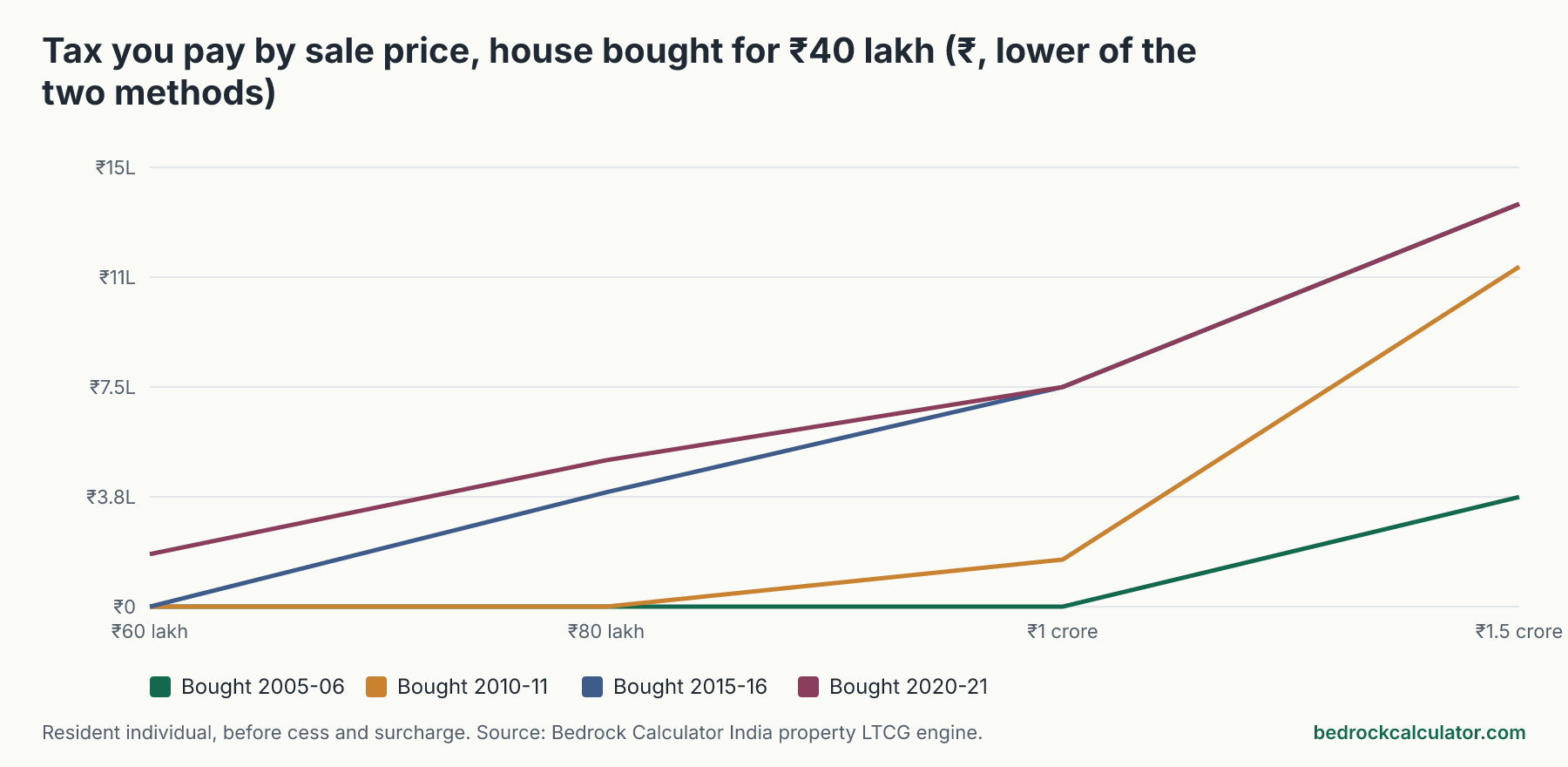
Here's every combination of four purchase years and four sale prices, all for a house bought at ₹40 lakh.
India: long-term capital gains tax on selling a house bought for ₹40 lakh, sold in Tax Year 2026-27 (₹)
Download CSVResident individual, property bought before 23 July 2024. Tax is the lower of 12.5% on the plain gain and 20% on the gain after indexation (CII 384 for the sale year). Before cess and surcharge, with no Section 54 or 54EC exemption.
| 2005-06 | ₹60 lakh | ₹20,00,000 | ₹1,31,28,205 | ₹2,50,000 | ₹0 | ₹0 | 20% with indexation |
| 2005-06 | ₹80 lakh | ₹40,00,000 | ₹1,31,28,205 | ₹5,00,000 | ₹0 | ₹0 | 20% with indexation |
| 2005-06 | ₹1 crore | ₹60,00,000 | ₹1,31,28,205 | ₹7,50,000 | ₹0 | ₹0 | 20% with indexation |
| 2005-06 | ₹1.5 crore | ₹1,10,00,000 | ₹1,31,28,205 | ₹13,75,000 | ₹3,74,359 | ₹3,74,359 | 20% with indexation |
| 2010-11 | ₹60 lakh | ₹20,00,000 | ₹91,97,605 | ₹2,50,000 | ₹0 | ₹0 | 20% with indexation |
| 2010-11 | ₹80 lakh | ₹40,00,000 | ₹91,97,605 | ₹5,00,000 | ₹0 | ₹0 | 20% with indexation |
| 2010-11 | ₹1 crore | ₹60,00,000 | ₹91,97,605 | ₹7,50,000 | ₹1,60,479 | ₹1,60,479 | 20% with indexation |
| 2010-11 | ₹1.5 crore | ₹1,10,00,000 | ₹91,97,605 | ₹13,75,000 | ₹11,60,479 | ₹11,60,479 | 20% with indexation |
| 2015-16 | ₹60 lakh | ₹20,00,000 | ₹60,47,244 | ₹2,50,000 | ₹0 | ₹0 | 20% with indexation |
| 2015-16 | ₹80 lakh | ₹40,00,000 | ₹60,47,244 | ₹5,00,000 | ₹3,90,551 | ₹3,90,551 | 20% with indexation |
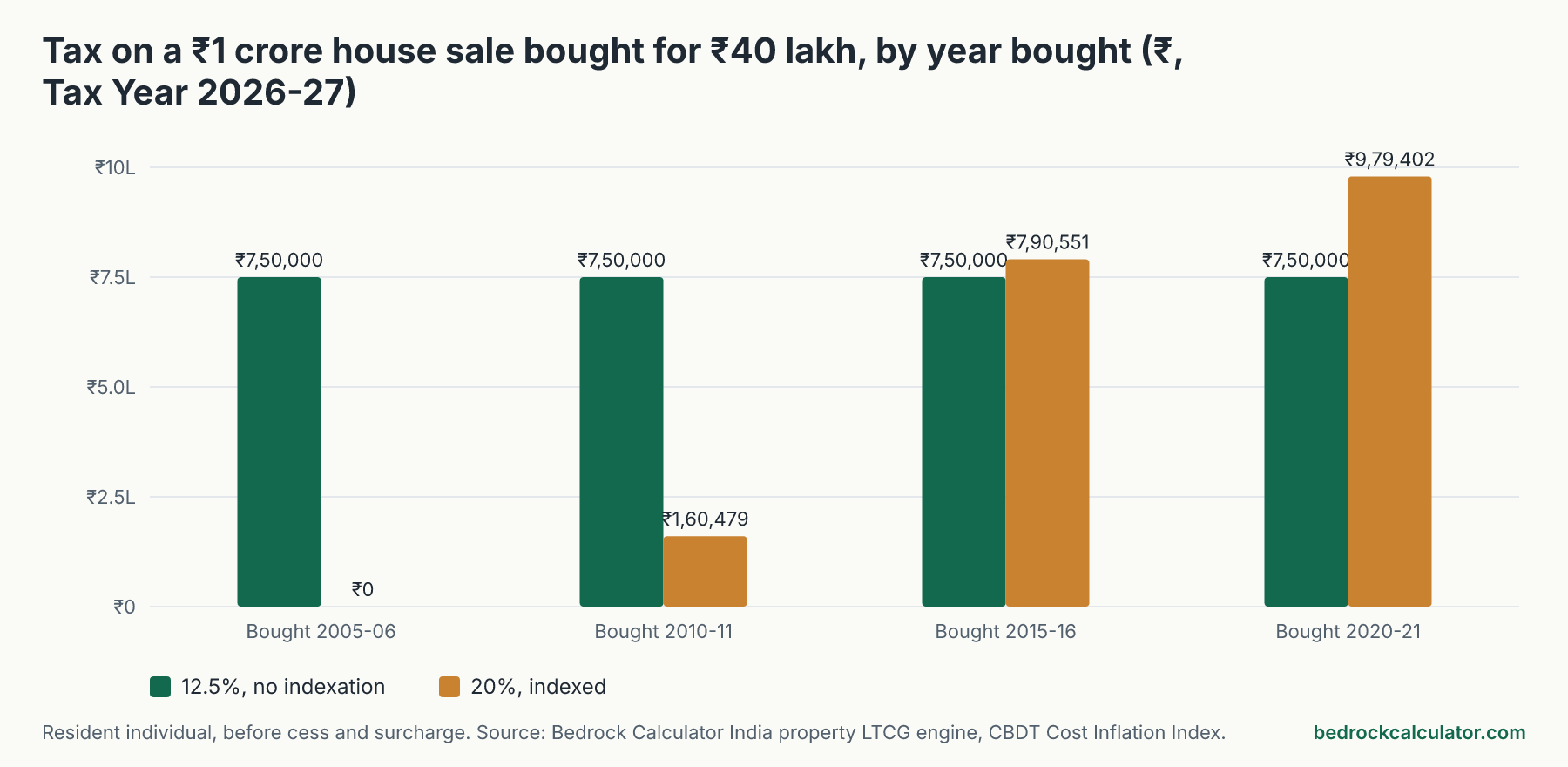
| 2015-16 | ₹1 crore | ₹60,00,000 | ₹60,47,244 | ₹7,50,000 | ₹7,90,551 | ₹7,50,000 | 12.5% without indexation |
| 2015-16 | ₹1.5 crore | ₹1,10,00,000 | ₹60,47,244 | ₹13,75,000 | ₹17,90,551 | ₹13,75,000 | 12.5% without indexation |
| 2020-21 | ₹60 lakh | ₹20,00,000 | ₹51,02,990 | ₹2,50,000 | ₹1,79,402 | ₹1,79,402 | 20% with indexation |
| 2020-21 | ₹80 lakh | ₹40,00,000 | ₹51,02,990 | ₹5,00,000 | ₹5,79,402 | ₹5,00,000 | 12.5% without indexation |
| 2020-21 | ₹1 crore | ₹60,00,000 | ₹51,02,990 | ₹7,50,000 | ₹9,79,402 | ₹7,50,000 | 12.5% without indexation |
| 2020-21 | ₹1.5 crore | ₹1,10,00,000 | ₹51,02,990 | ₹13,75,000 | ₹19,79,402 | ₹13,75,000 | 12.5% without indexation |
Indexation gave the lower tax in 11 of the 16 cases. The flat rate won in the other 5.
When indexation wins
Indexation wins when you've held the property a long time and the price hasn't run far ahead of inflation. Bought in 2005-06 and sold for ₹80 lakh, the indexed cost is already above the sale price, so the indexed gain is nil. You'd owe ₹5,00,000 under the flat rate and nothing with indexation.
Even at ₹1.5 crore, the 2005-06 buyer pays ₹3,74,359 with indexation against ₹13,75,000 at the flat rate.
When the flat 12.5% rate wins
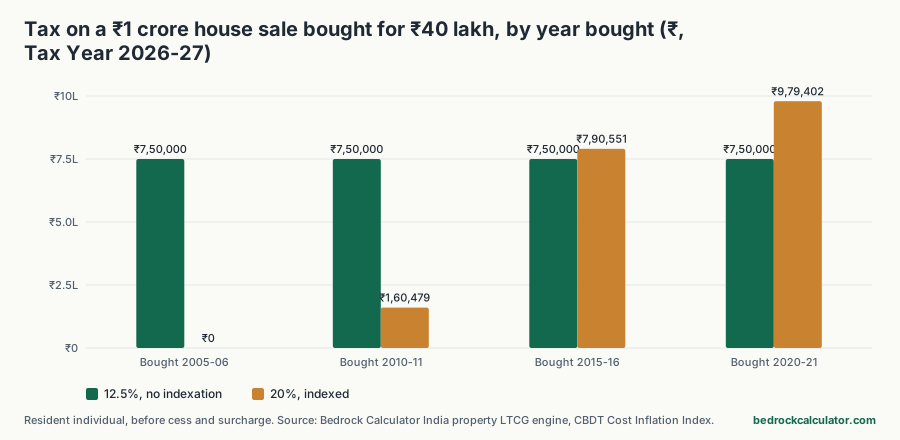
The flat rate wins when the property has grown faster than inflation, typically over a shorter holding. A house bought in 2015-16 and sold for ₹1 crore costs ₹7,50,000 at the flat rate against ₹7,90,551 with indexation. For a 2020-21 purchase sold at ₹1 crore, it's ₹7,50,000 against ₹9,79,402.
A small gain on a recent purchase can still go the other way. The 2020-21 house sold for ₹60 lakh pays ₹1,79,402 with indexation against ₹2,50,000 flat. That's why it's worth running both numbers every time rather than assuming.
Do NRIs get the indexation choice?
No. The choice is only for resident individuals and HUFs. A non-resident selling the same 2005-06 house for ₹80 lakh pays ₹5,00,000 at the flat rate, where a resident could pay ₹0. NRIs also face TDS deducted by the buyer, usually on the full sale price; our NRI property TDS calculator shows how much.
How we worked out these numbers
Every figure comes from the property LTCG calculator on this site. It computes both methods using the Cost Inflation Index from the site's Tax Year 2026-27 table and picks the lower. We assumed a resident individual who bought before 23 July 2024 and paid ₹40 lakh including stamp duty and registration.
What these figures leave out
The calculator gives the base tax only. The 4% Health and Education Cess is added on top, and surcharge applies if your income is high enough. It doesn't model the reinvestment exemptions under Sections 54, 54EC and 54F, which can cut the tax to zero if you buy another home or specified bonds within the time limits. Brokerage, legal fees and the cost of improvements aren't added to cost here, though you can add them. Property bought before April 2001 can use its 2001 market value as cost, which the calculator doesn't offer.
On larger sales the buyer also deducts TDS from the price under Section 194-IA, which affects when you pay but not how much tax you owe in the end.
Work out your own tax
Enter your purchase year, cost and sale price in the property LTCG calculator. If you're also buying, the stamp duty calculator adds the cost of the next home, and the home loan tax benefit calculator shows what a new loan saves.