What do a Post Office RD and a TD earn?
India Post's Recurring Deposit (RD) and Time Deposit (TD) are the two plainest ways to save at a post office, and they suit different people. An RD takes a fixed sum every month for five years. A TD takes one lump sum for one, two, three or five years and pays you interest every year.
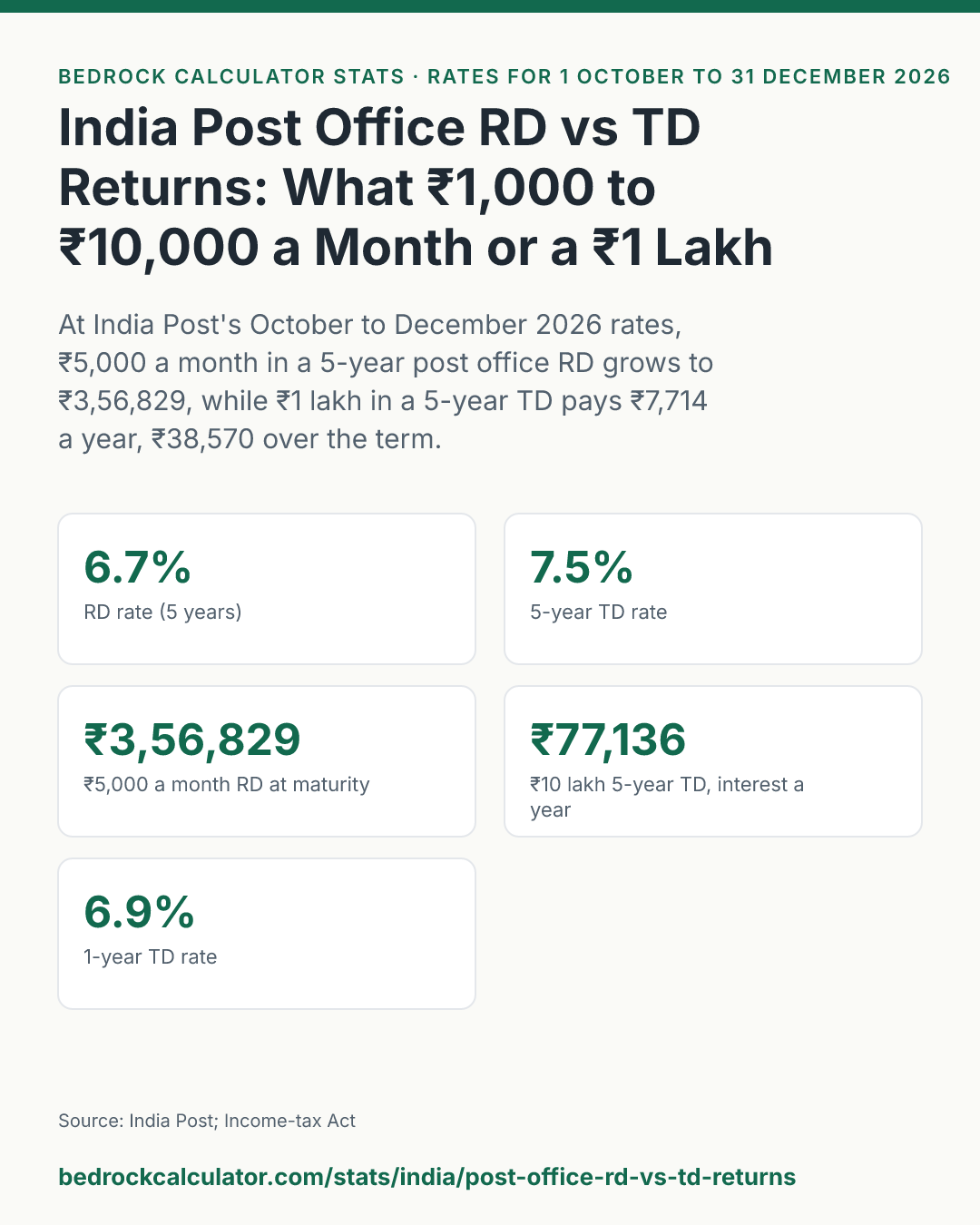
At the rates for 1 October to 31 December 2026, the RD pays 6.7%. ₹5,000 a month grows to ₹3,56,829 after five years. The TD pays 6.9% for one year rising to 7.5% for five years, so ₹1 lakh in a 5-year TD pays ₹7,714 a year, or ₹38,570 over the term.
How the RD works
You choose a monthly amount, pay it every month for 60 months, and get everything back with interest at the end. Interest is compounded every quarter on the money already in the account, so the early deposits earn the most. The post office RD and TD calculator on this site uses the standard maturity formula for monthly deposits with quarterly compounding.
India post office RD maturity after 5 years at 6.7% (₹)
Download CSVMonthly deposits made on time for 60 months, interest compounded quarterly, paid at maturity.
| ₹1,000 | ₹60,000 | ₹11,366 | ₹71,366 |
| ₹2,000 | ₹1,20,000 | ₹22,732 | ₹1,42,732 |
| ₹5,000 | ₹3,00,000 | ₹56,829 | ₹3,56,829 |
| ₹10,000 | ₹6,00,000 | ₹1,13,658 | ₹7,13,658 |
₹1,000 a month becomes ₹71,366. ₹5,000 a month, ₹3 lakh paid in over five years, becomes ₹3,56,829, of which ₹56,829 is interest. ₹10,000 a month becomes ₹7.14 lakh.
Paying on time matters. India Post treats a missed month as a default and charges a small revival fee to catch up, and after more than four defaults the account is discontinued unless revived within two months. The figures here assume every deposit is made on time.
How the TD works
A TD is a lump sum locked in for a fixed term. Interest is compounded quarterly within each year and then paid out to you once a year. If you don't withdraw it, it doesn't earn anything more inside the TD, so the totals below are simply the yearly payout times the number of years. Your deposit comes back at the end.
India post office TD: interest paid each year and over the term (₹)
Download CSVInterest compounded quarterly within each year and paid out yearly; payouts are not reinvested. Deposit returned at maturity.
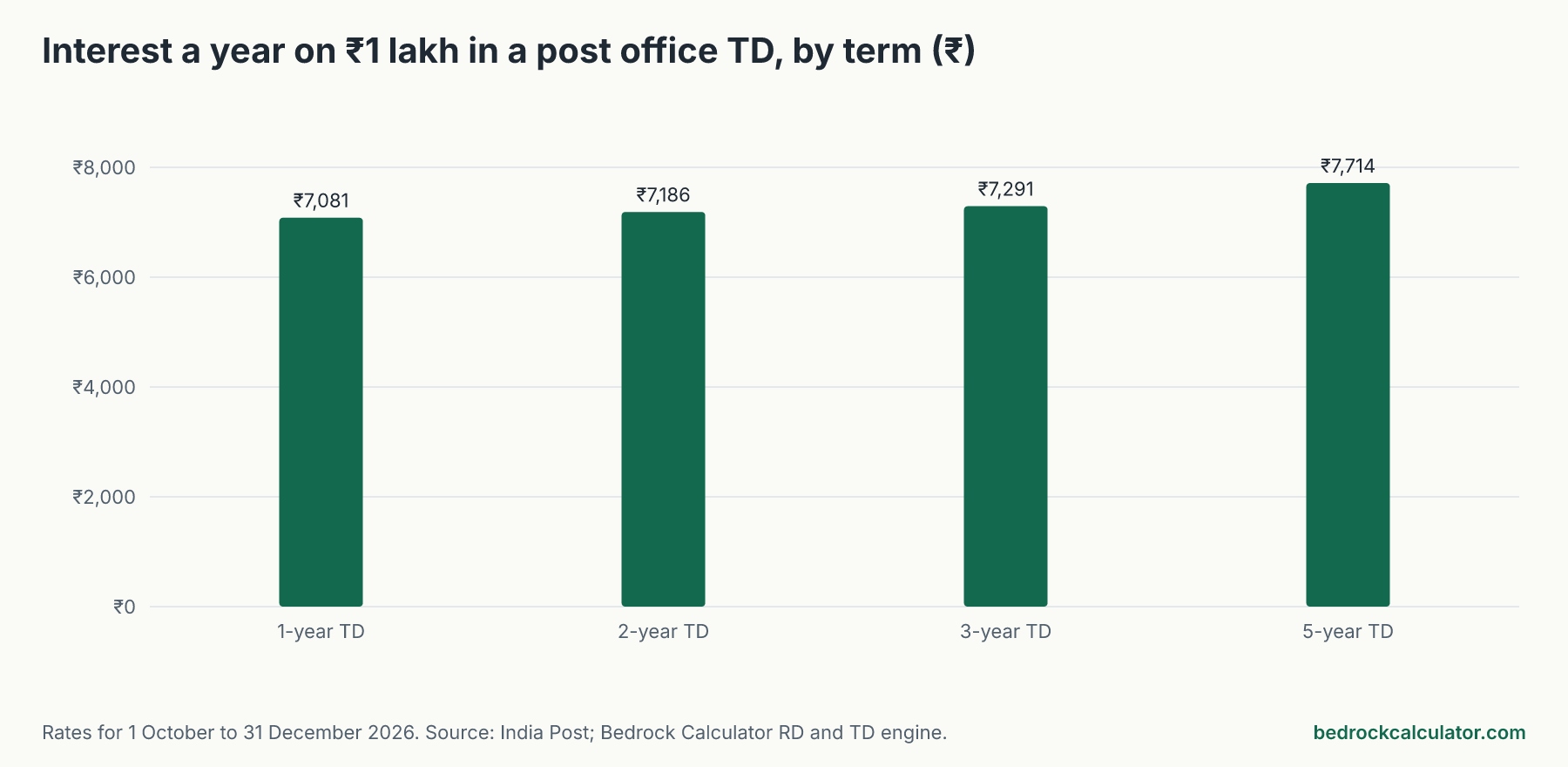
| ₹1,00,000 | 1 year | 6.9% | ₹7,081 | ₹7,081 |
| ₹1,00,000 | 2 years | 7.0% | ₹7,186 | ₹14,372 |
| ₹1,00,000 | 3 years | 7.1% | ₹7,291 | ₹21,873 |
| ₹1,00,000 | 5 years | 7.5% | ₹7,714 | ₹38,570 |
| ₹5,00,000 | 1 year | 6.9% | ₹35,403 | ₹35,403 |
| ₹5,00,000 | 2 years | 7.0% | ₹35,930 | ₹71,860 |
| ₹5,00,000 | 3 years | 7.1% | ₹36,456 | ₹1,09,368 |
| ₹5,00,000 | 5 years | 7.5% | ₹38,568 | ₹1,92,840 |
| ₹10,00,000 | 1 year | 6.9% | ₹70,806 | ₹70,806 |
| ₹10,00,000 | 2 years | 7.0% | ₹71,859 | ₹1,43,718 |
| ₹10,00,000 | 3 years | 7.1% | ₹72,913 | ₹2,18,739 |
| ₹10,00,000 | 5 years | 7.5% | ₹77,136 | ₹3,85,680 |
The longer term pays more. On ₹10 lakh, a 1-year TD pays ₹70,806, while a 5-year TD pays ₹77,136 every year, ₹3.86 lakh over five years. A 3-year TD on ₹10 lakh pays ₹2,18,739 in total. Only the 5-year TD qualifies for the old section 80C deduction, according to India Post, and that only helps under the old tax regime.
RD or TD: which earns more?
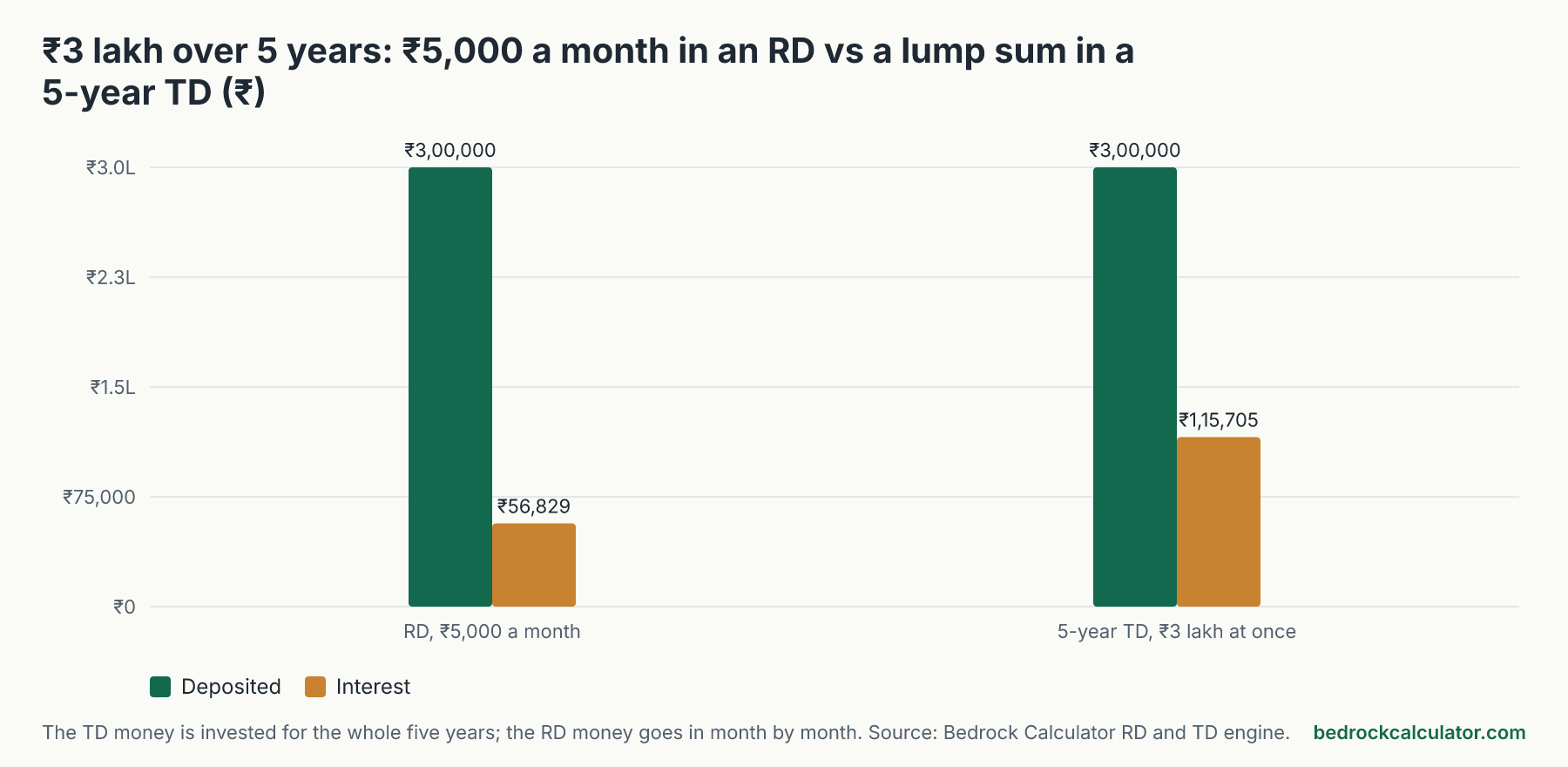
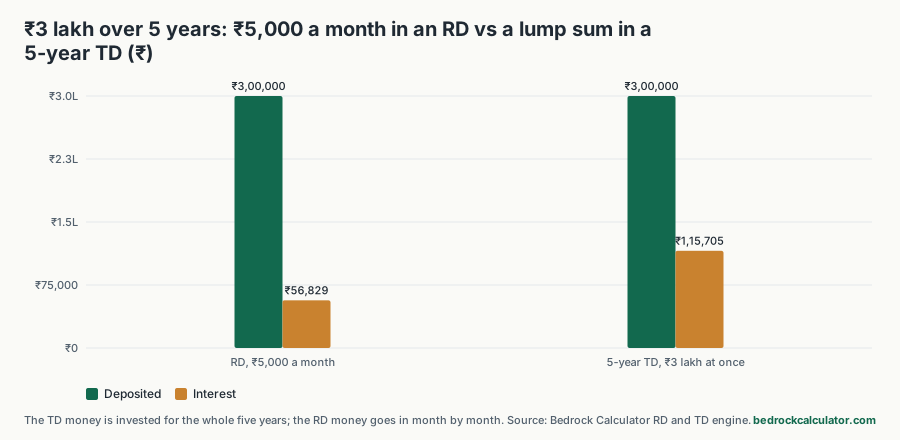
If you already have the money, a TD earns more, because all of it works from day one. Put the same ₹3 lakh side by side:
₹5,000 a month in an RD for five years puts in ₹3 lakh and returns ₹3,56,829. ₹3 lakh in a 5-year TD at once returns ₹4,15,705 counting its five yearly payouts, ₹58,876 more. That gap is not because the TD rate of 7.5% beats the RD rate of 6.7% by much. It's because the RD money arrives a little at a time, so on average it's invested for only about half the five years.
That's why the comparison usually isn't real. Most people use an RD precisely because they don't have a lump sum: it turns part of a monthly salary into savings. A TD makes sense for money you already have, such as a bonus, a maturing deposit or retirement funds, especially if you want a yearly income from it.
TDS and tax on the interest
Interest from both is taxable income. The post office deducts TDS once the interest it pays you in a tax year goes over ₹50,000, or ₹1 lakh for a senior citizen. TDS is 10% of the whole interest once that line is crossed.
The ₹77,136 a year from a ₹10 lakh 5-year TD has ₹7,714 deducted for someone under 60, but ₹0 for a senior citizen because it's under the higher threshold. A ₹5 lakh 5-year TD has ₹0 deducted for someone under 60. The threshold counts all interest from the post office in the year, including other deposits there. You can give Form 15G, or 15H if you're a senior, if your total income is below the taxable limit.
How we worked out these numbers
- RD and TD figures come from the post office RD and TD calculator at the rates India Post lists for 1 October to 31 December 2026
- RD: 60 monthly deposits made on time, interest compounded quarterly
- TD: interest compounded quarterly, paid out yearly and not reinvested
- TDS uses the post office thresholds in the Income-tax Act, 2025, with PAN given and no Form 15G or 15H
What these numbers leave out
- Reinvesting TD payouts. If you put each year's TD interest into an RD or another deposit, it earns that product's rate, which isn't added here.
- Closing early. An RD can be closed after three years at the savings account rate. A TD can't be withdrawn in the first six months, and closing it early pays a lower rate.
- Extensions. A TD can be extended at maturity at the rate then in force. The figures stop at the first maturity.
- Rate changes. Rates are reviewed every quarter. An account opened next quarter may get a different rate.
- Your tax. The tax you finally owe depends on your slab and regime, not just on TDS.
Run your own numbers
Use the post office RD and TD calculator for any monthly amount, lump sum and term. To compare with a bank, the FD and RD calculator runs bank deposits, and for retirees the SCSS calculator shows a higher-rate quarterly income option. The TDS calculator checks interest against the thresholds.