How much does the Senior Citizens Savings Scheme pay each quarter after tax?
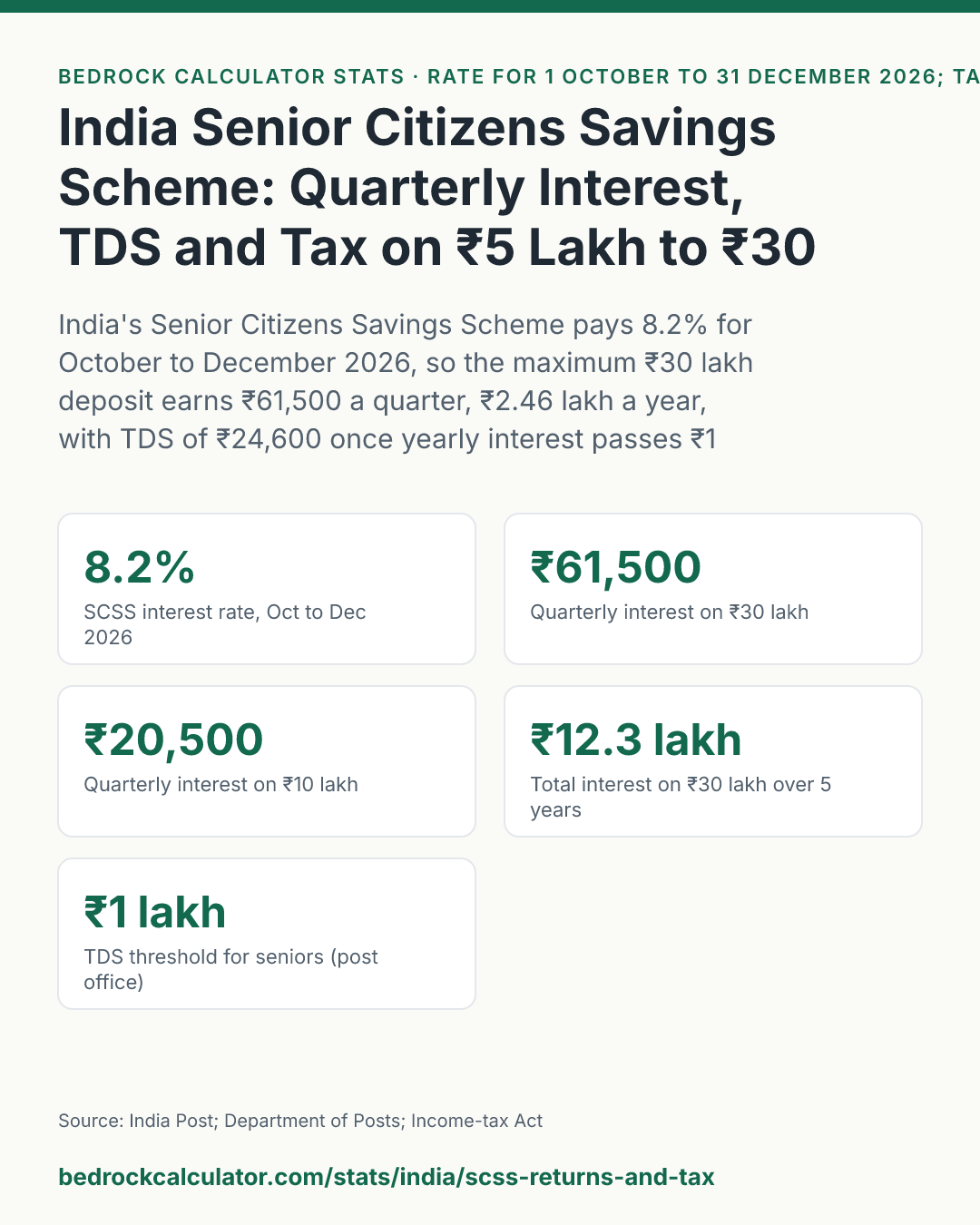
The Senior Citizens Savings Scheme (SCSS) pays 8.2% a year for deposits made from 1 October to 31 December 2026. Interest is paid out every quarter rather than added to your balance, which is why many retirees in India use it as a pension top-up.
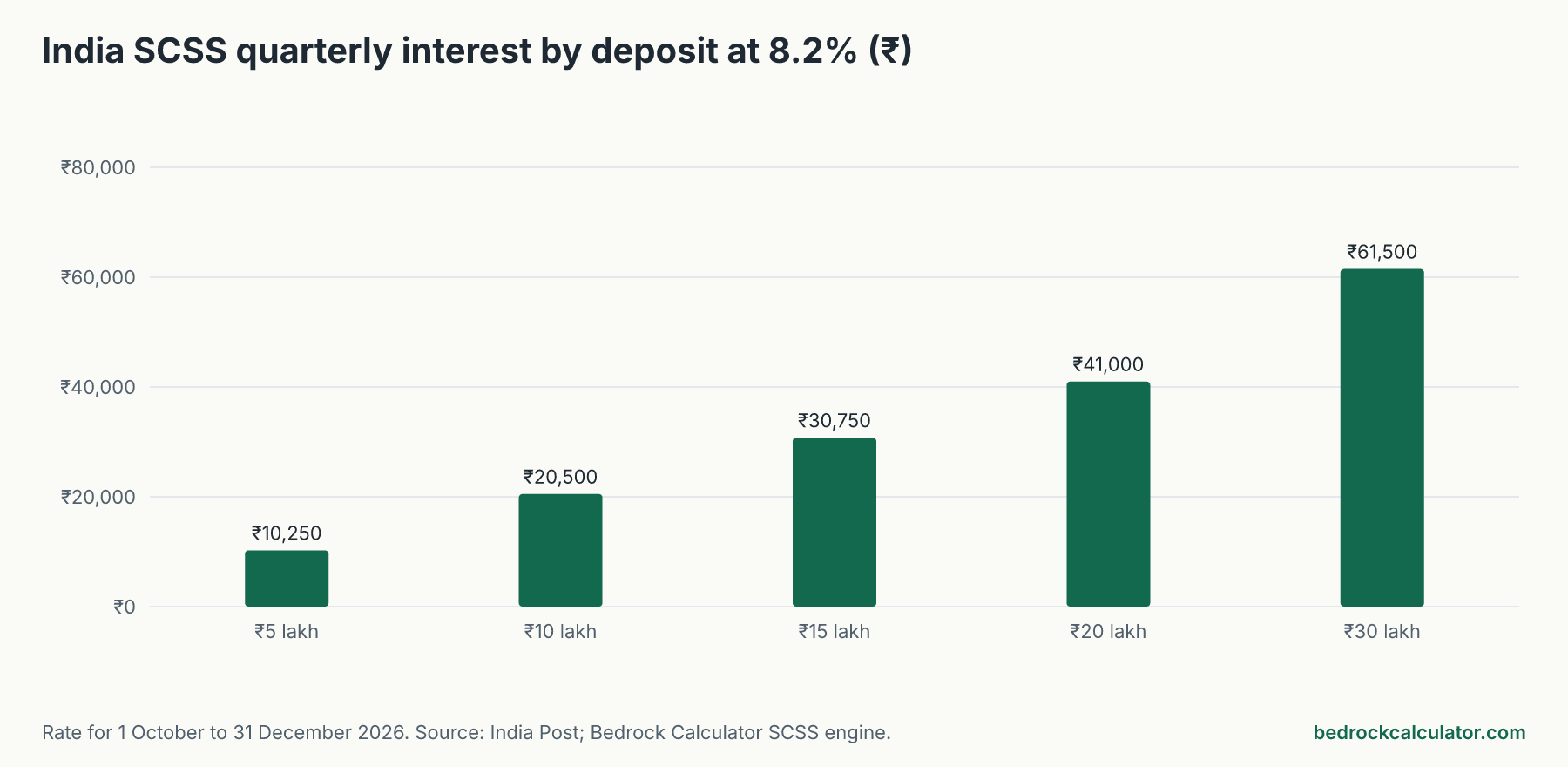
On the maximum deposit of ₹30 lakh, that's ₹61,500 a quarter, or ₹2,46,000 a year. On ₹10 lakh it's ₹20,500 a quarter. Interest above ₹1 lakh a year from the post office attracts TDS, and the interest is taxable, but under the new regime many retirees end up owing no tax on it at all.
How SCSS pays you
SCSS is a five-year deposit you open at a post office. It's for people aged 60 and over, and in some cases for retirees younger than that. You put in a lump sum once, up to ₹30 lakh in your own name. Interest is worked out on that fixed deposit every quarter and credited to your savings account on 1 April, 1 July, 1 October and 1 January. It doesn't compound inside the scheme: each payout is the same, and your deposit comes back in full at the end.
That makes the maths simple. The SCSS calculator on this site takes the deposit and the rate, divides the yearly interest into four, and adds up the payouts over the term.
What each deposit earns
Click a column heading to sort.
India SCSS interest and TDS by deposit at 8.2% (₹)
Download CSVInterest is paid every quarter and not compounded. TDS assumes PAN given, no Form 15H, and no other post office interest in the year.
| ₹5,00,000 | ₹10,250 | ₹41,000 | ₹2,05,000 | ₹3,28,000 | ₹0 |
| ₹10,00,000 | ₹20,500 | ₹82,000 | ₹4,10,000 | ₹6,56,000 | ₹0 |
| ₹15,00,000 | ₹30,750 | ₹1,23,000 | ₹6,15,000 | ₹9,84,000 | ₹12,300 |
| ₹20,00,000 | ₹41,000 | ₹1,64,000 | ₹8,20,000 | ₹13,12,000 | ₹16,400 |
| ₹30,00,000 | ₹61,500 | ₹2,46,000 | ₹12,30,000 | ₹19,68,000 | ₹24,600 |
Over the 5-year term, ₹10 lakh earns ₹4.1 lakh in total and ₹30 lakh earns ₹12.3 lakh. If you extend by one 3-year block at the same rate, the ₹30 lakh account earns ₹19.68 lakh over eight years. In practice an extended account earns whatever rate applies on the day it matures, so the extension figure is only as good as that assumption.
If you leave a quarter's interest unclaimed, it doesn't earn anything extra while it waits. So the figures here are exactly what you receive, not what you'd have if the interest were reinvested. If you put each payout into a post office RD or another deposit, your overall return goes up by whatever that earns.
When TDS is deducted
The post office deducts tax at source once the interest it pays you in a tax year goes over ₹1 lakh, the threshold for senior citizens in the Income-tax Act, 2025. TDS is then 10% of the whole interest, not just the part over the threshold, or 20% if you haven't given your PAN.
On these deposits, everything up to ₹10 lakh stays under the threshold. At ₹15 lakh the yearly interest is ₹1,23,000 and TDS is ₹12,300. At ₹20 lakh it's ₹16,400, and at ₹30 lakh it's ₹24,600.
The threshold counts all interest you get from that post office in the year, including other deposits there, so your TDS may start sooner than the table suggests. If your total income is low enough that you owe no tax, you can give the post office Form 15H and it won't deduct anything. TDS isn't an extra tax. It's credited against your final bill, and any excess comes back as a refund when you file.
How much tax you actually pay
SCSS interest is fully taxable as your income. What it costs depends on your other income, and under the new regime, which applies unless you opt out, a lot of retirees pay nothing on it. The 87A rebate means a resident pays no income tax if total taxable income is within ₹12 lakh.
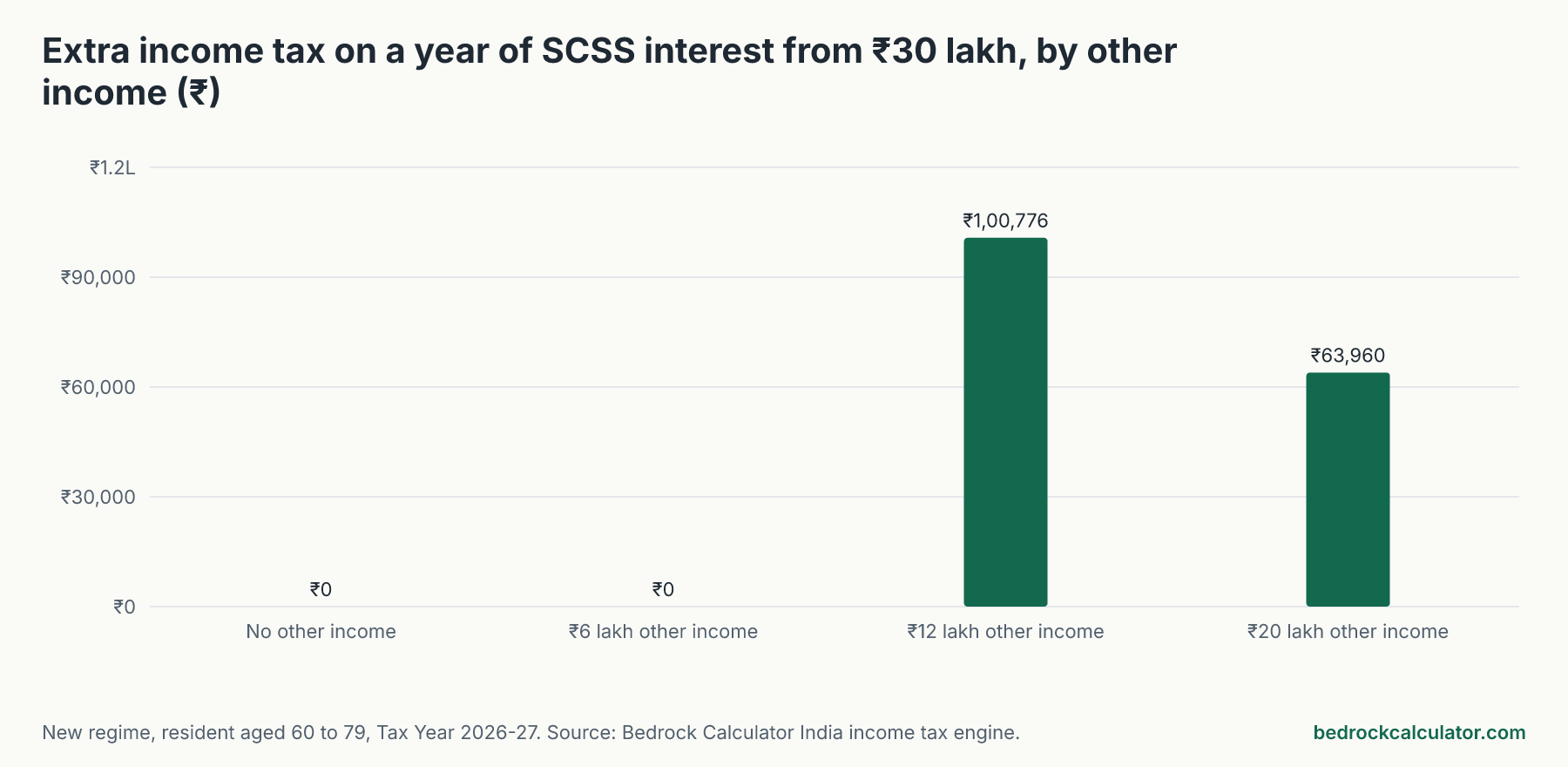
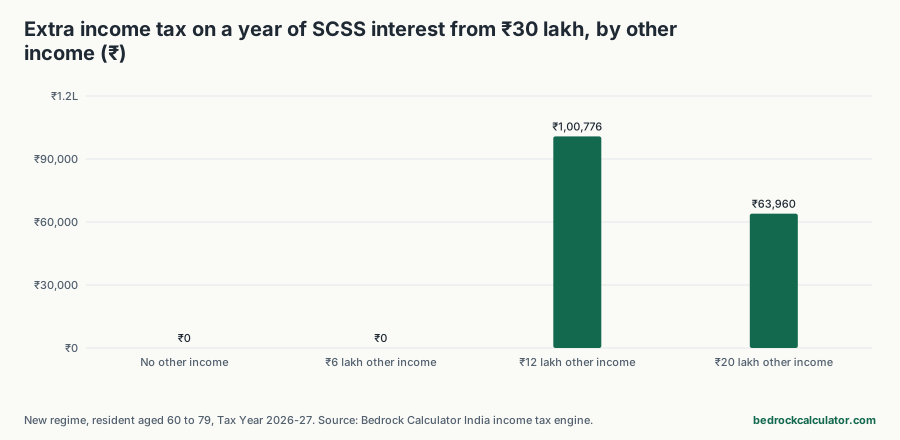
The table shows the extra tax a year of SCSS interest adds, for a resident aged 60 to 79.
Extra income tax on a year of SCSS interest, new regime, Tax Year 2026-27 (₹)
Download CSVResident aged 60 to 79. Other taxable income is after any deductions. Tax includes the 87A rebate, surcharge where it applies and 4% cess.
| ₹0 | ₹0 | ₹0 | ₹0 | ₹0 | ₹0 |
| ₹6,00,000 | ₹0 | ₹0 | ₹0 | ₹0 | ₹0 |
| ₹12,00,000 | ₹42,640 | ₹75,192 | ₹81,588 | ₹87,984 | ₹1,00,776 |
| ₹20,00,000 | ₹10,660 | ₹21,320 | ₹31,980 | ₹42,640 | ₹63,960 |
With no other income, even the maximum deposit adds ₹0 of tax. With ₹6 lakh of other taxable income, such as a pension, it's ₹0, because the total still sits inside the rebate. The jump comes once other income is already at ₹12 lakh. Any interest on top pushes total income past the rebate limit, and the rebate is lost on the whole income, so a year of interest on ₹10 lakh adds ₹75,192 and on ₹30 lakh adds ₹1,00,776. With ₹20 lakh of other income, the ₹30 lakh deposit's interest costs ₹63,960 in tax, leaving ₹1,82,040 of the ₹2,46,000 after tax.
India Post lists the SCSS deposit as qualifying for the old section 80C deduction. In the new regime that deduction isn't allowed, so it only helps if you choose the old regime.
How we worked out these numbers
- Interest is from the SCSS calculator at 8.2%, the rate India Post lists for 1 October to 31 December 2026
- TDS uses the senior citizen threshold for a post office and assumes PAN is given and no Form 15H
- Tax is from the site's income tax engine, new regime, Tax Year 2026-27, for a resident aged 60 to 79, including the 87A rebate and 4% cess
What these numbers leave out
- Rate changes for new deposits. The rate is reviewed every quarter. A deposit opened next quarter may get a different rate.
- Closing early. Closing within a year forfeits the interest, and closing later costs a deduction from the deposit.
- Joint accounts. A joint account with a spouse counts entirely toward the first holder's limit. The table models one single account.
- The old tax regime. Under the old regime the slabs, rebate and deduction rules are different.
- Surcharge and other income types. Capital gains and other special-rate income are not included.
Run your own numbers
The SCSS calculator shows the quarterly payout and total interest for any deposit and term. The income tax regime calculator compares the new and old regimes on your whole income, and the TDS calculator checks interest TDS against the thresholds.