What does a sovereign gold bond return at maturity?
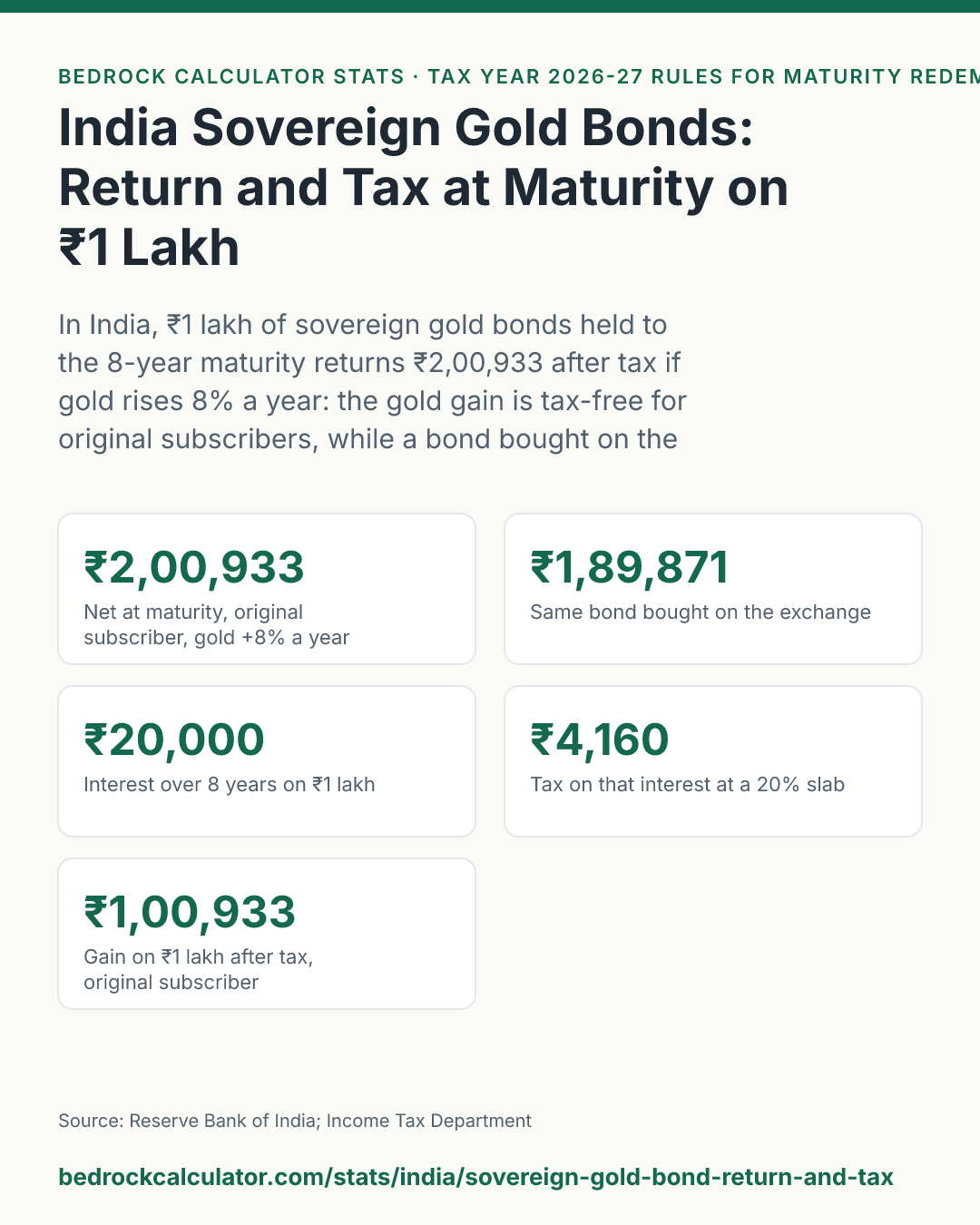
Sovereign gold bonds in India pay you two ways: the bond tracks the price of gold, and it pays 2.5% interest a year on what you invested. Hold ₹1 lakh of bonds for the full eight years, and if gold rises 8% a year you'd get ₹1,85,093 back at maturity plus ₹20,000 of interest along the way.
After tax at a 20% slab, you keep ₹2,00,933, a gain of ₹1,00,933.
The tax treatment now depends on how you got the bond. If you bought it at the original RBI issue and held it throughout, the gold gain is tax-free. If you bought it on the stock exchange, the same bond leaves you with ₹1,89,871, because the gain is taxed.
How we worked out these numbers
We ran the sovereign gold bond calculator on this site for ₹1 lakh of bonds held to the eight-year maturity. It works out:
- The redemption value, by growing the issue price at the gold price change you choose each year.
- The interest, 2.5% a year on the issue price for eight years. It's paid every six months, but the amount never changes with the gold price.
- Tax on the interest, as the extra income tax it adds on top of your other income under the regime you pick, including the 4% cess and the Section 87A rebate. We used the new regime.
- Tax on the gold gain, which is zero for an original subscriber redeeming at maturity and 12.5% plus cess for anyone else.
The gold price growth figures are scenarios, not forecasts. Nobody knows what gold will do over eight years, so we show a flat price, 4%, 8% and 12% a year.
Sovereign gold bond return at maturity, by gold price
All figures for an original subscriber with ₹18 lakh of other income, which puts the interest in the 20% slab. Rupees. Click a column heading to sort.
India sovereign gold bond on ₹1 lakh at the 8-year maturity, by gold price growth (₹)
Download CSVOriginal RBI subscriber, other income ₹18 lakh under the new regime (20% slab). Interest at 2.5% a year on the issue price, taxed at the slab rate plus 4% cess. Rupees.
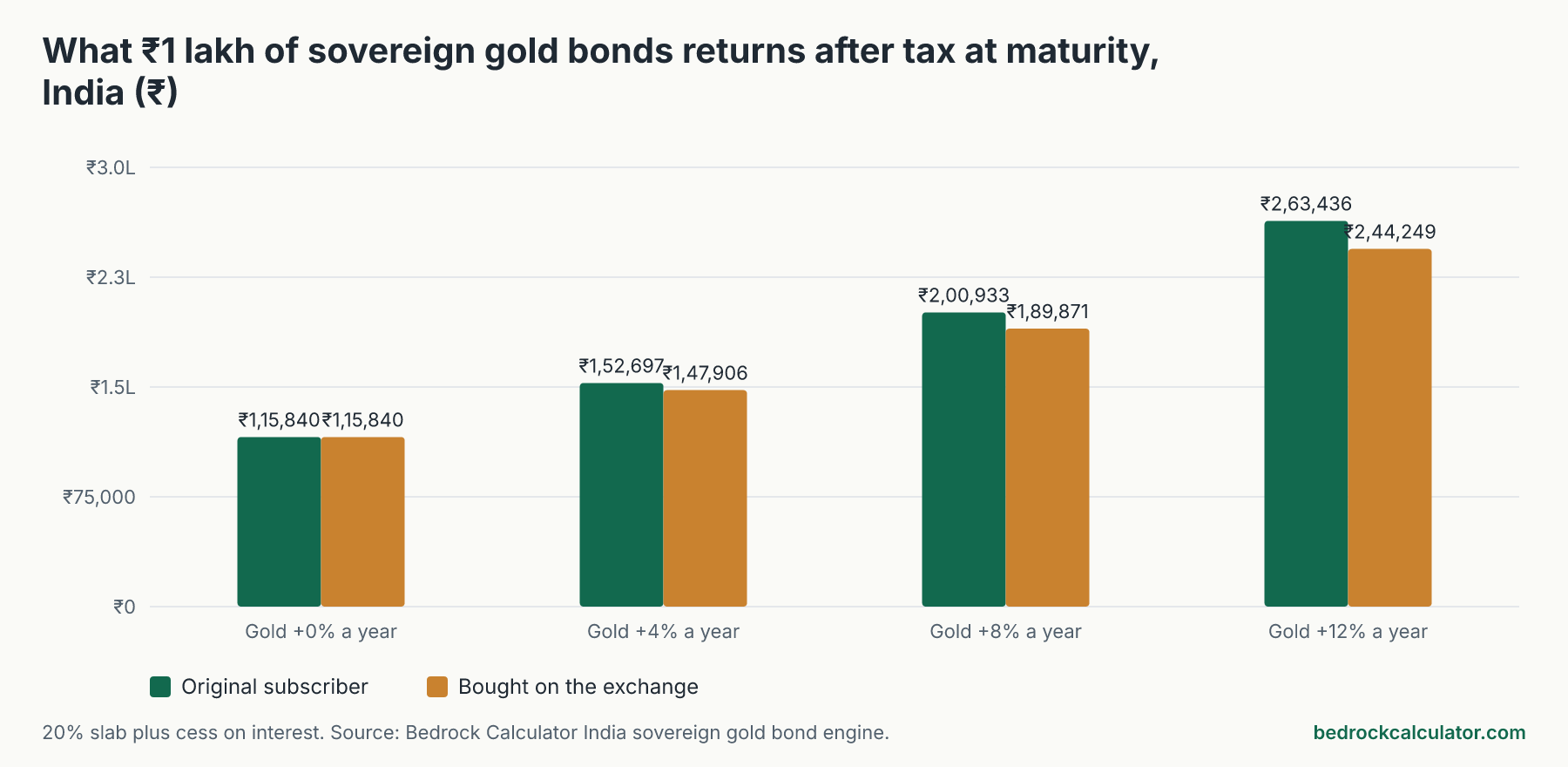
| 0 | ₹1,00,000 | ₹20,000 | ₹4,160 | ₹1,15,840 | ₹1,15,840 |
| 4 | ₹1,36,857 | ₹20,000 | ₹4,160 | ₹1,52,697 | ₹1,47,906 |
| 8 | ₹1,85,093 | ₹20,000 | ₹4,160 | ₹2,00,933 | ₹1,89,871 |
| 12 | ₹2,47,596 | ₹20,000 | ₹4,160 | ₹2,63,436 | ₹2,44,249 |
Two things stand out. First, the interest is a floor. Even if gold ends exactly where it started, you'd keep ₹1,15,840 on ₹1 lakh, a gain of ₹15,840 from interest alone, something a gold ETF or physical gold can't give you. Second, almost all the upside comes from the gold price. At 12% a year the bond redeems for ₹2,47,596 and you keep ₹2,63,436.
Is sovereign gold bond maturity tax-free?
For original subscribers, the gold gain at maturity is still tax-free. What changed for Tax Year 2026-27 is who counts. The exemption now needs you to have bought the bond when RBI issued it and to have held it continuously until maturity. Before, anyone holding the bond at maturity qualified.
So if you bought sovereign gold bonds on the stock exchange, often at a discount to the gold price, the gain at maturity is now taxed at 12.5%. On ₹1 lakh with gold up 8% a year, that's ₹11,062 of extra tax, and you keep ₹1,89,871 instead of ₹2,00,933. At 12% a year it's ₹19,188.
The interest has always been taxable for everyone. It's added to your income and taxed at your slab rate.
How much tax you pay on SGB interest
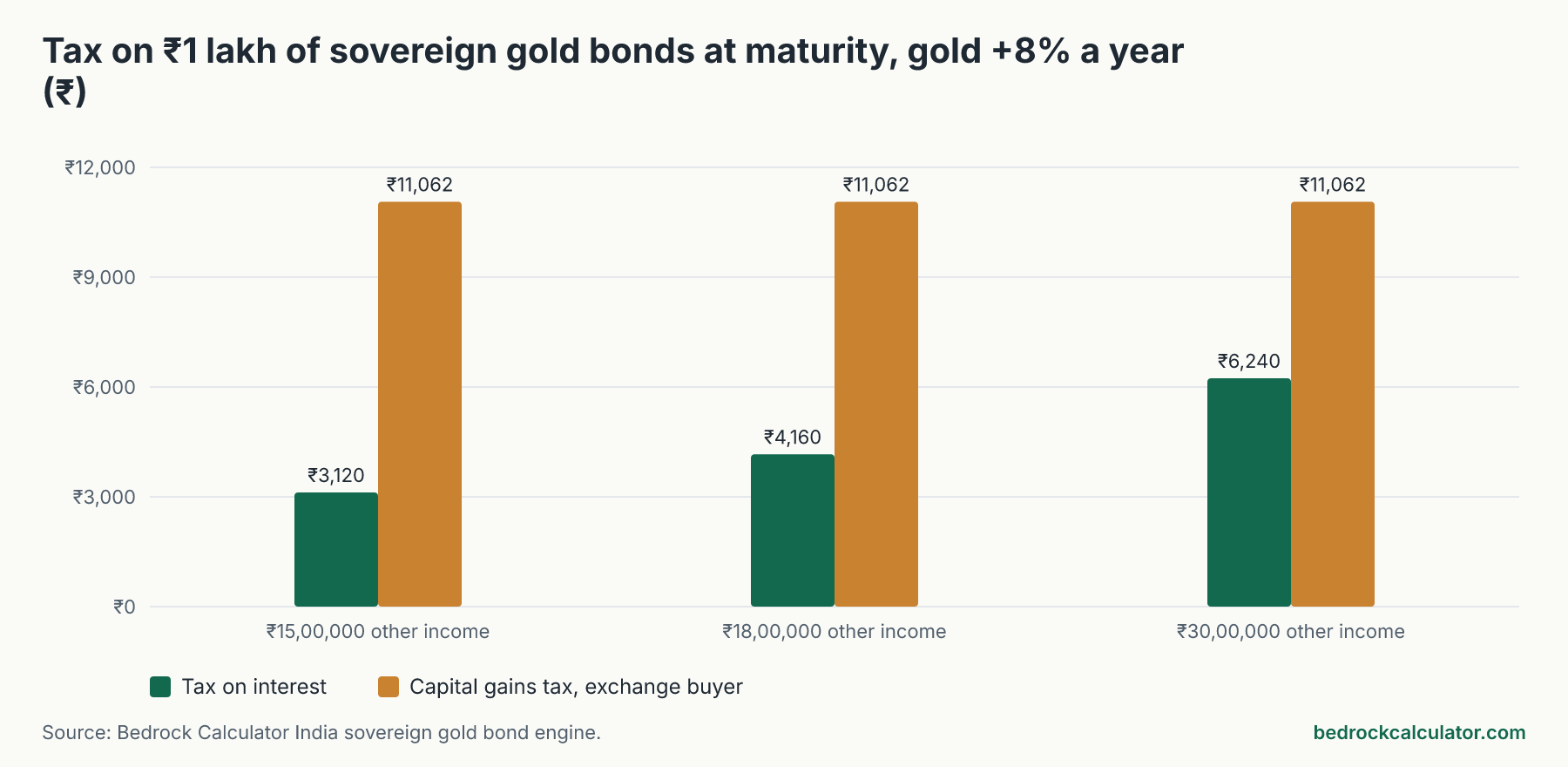
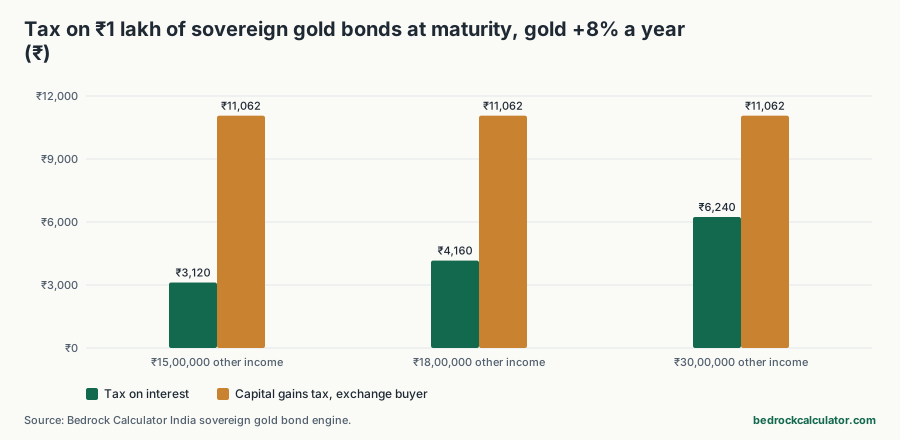
The interest is small, so the tax on it is too. On ₹1 lakh of bonds, eight years of interest is ₹20,000. At a 15% slab that costs ₹3,120 in tax. At 30% it's ₹6,240.
India sovereign gold bond tax at maturity by income, gold +8% a year (₹)
Download CSV₹1 lakh of bonds. Other taxable income under the new regime sets the slab rate on the interest. A bond bought on the exchange also pays 12.5% on the gold gain. Rupees.
| ₹15,00,000 | ₹3,120 | ₹2,01,973 | ₹11,062 | ₹1,90,911 |
| ₹18,00,000 | ₹4,160 | ₹2,00,933 | ₹11,062 | ₹1,89,871 |
| ₹30,00,000 | ₹6,240 | ₹1,98,853 | ₹11,062 | ₹1,87,791 |
Even at the top slab, an original subscriber keeps ₹1,98,853 if gold rises 8% a year, against ₹1,87,791 for an exchange buyer. The capital gains tax on the exchange buyer is a much bigger cost than the interest tax for anyone.
Can you still buy sovereign gold bonds?
Not new ones. RBI hasn't issued a new tranche since February 2024, and the government has said no more are planned. You can buy existing bonds on the stock exchange, but under the current rules they no longer get the tax-free gold gain at maturity.
That makes them closer to a gold ETF with a 2.5% interest bonus, and the comparison should be made on that basis.
If you already hold bonds from an RBI issue, the case for keeping them to maturity is strong. Selling early on the exchange or redeeming early means the gain is taxed.
What the calculator leaves out
- Surcharge on the gold gain. An exchange buyer's capital gains tax includes the 4% cess but not surcharge, which only applies above ₹50 lakh of income.
- Timing of the interest. Interest arrives every six months. The figures simply add it up and don't assume you reinvest it.
- Your purchase price. For an exchange buyer, the taxable gain is worked out from what you paid. The calculator uses the ₹1 lakh you enter, so if you bought at a discount, enter what you actually paid.
- Early redemption. Bonds can be redeemed through RBI from the fifth year. This page only covers maturity.
- Gold price risk. Gold can fall. A 12% a year scenario isn't more likely than a flat one.
Getting your own figure
Open the sovereign gold bond calculator, enter what you invested, your years held, how you bought the bond and your other income, and it shows the redemption value and the tax on each part. If you're weighing gold against equity, the equity capital gains calculator shows how shares and equity funds are taxed when you sell.