How much gratuity will you get in India?
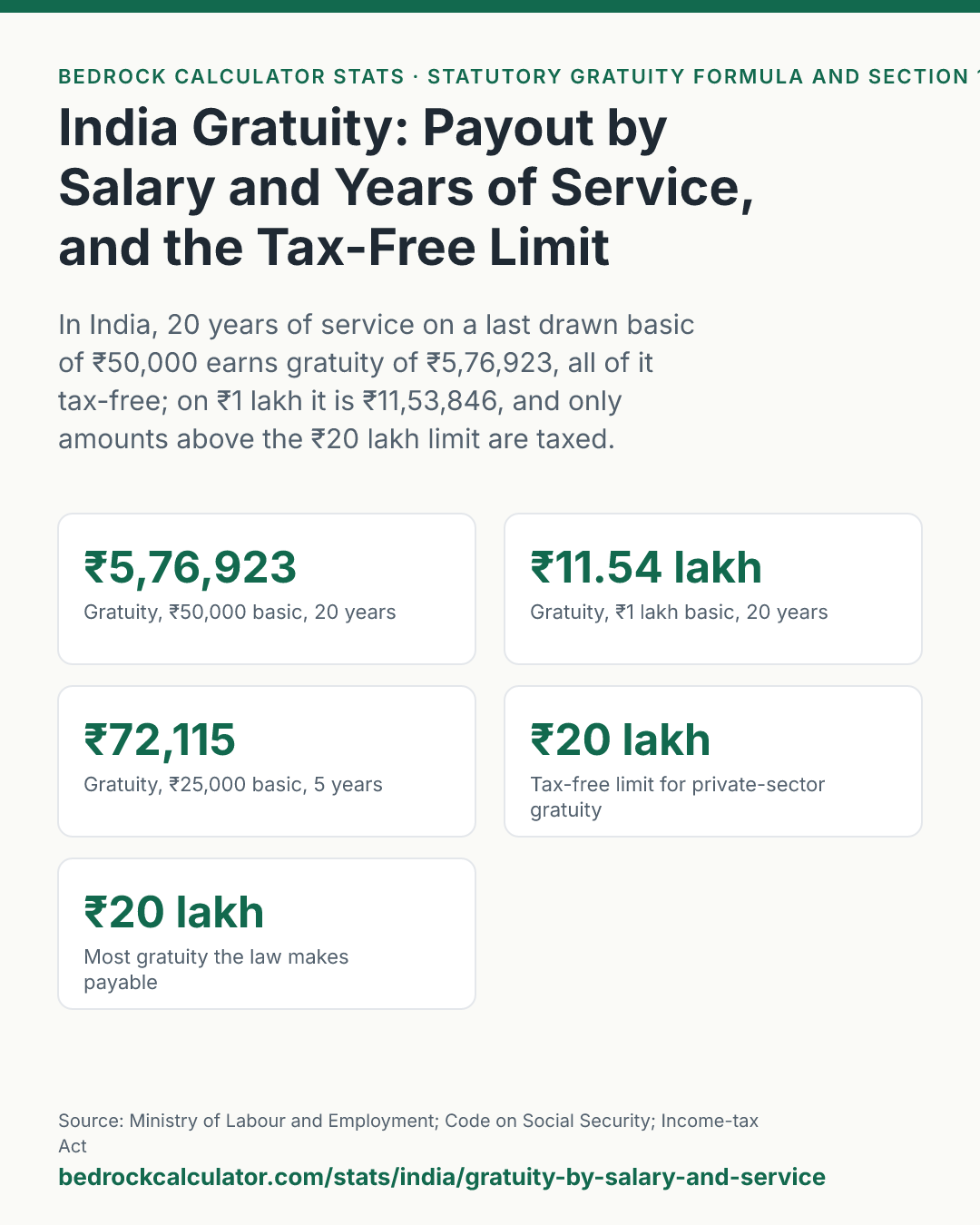
Gratuity in India is 15 days of your last drawn basic pay plus dearness allowance for every year you've worked, with a month counted as 26 working days. On a basic of ₹50,000 a month, 20 years of service earns ₹5,76,923. On ₹1 lakh it's ₹11,53,846.
For a private-sector employee, the law caps gratuity at ₹20 lakh, and gratuity is tax-free up to that same ₹20 lakh. Only very long careers on high basic pay reach the cap: in our table, just 3 of the 24 combinations do, all on a ₹2 lakh basic.
How gratuity is calculated
Every figure here comes from the gratuity calculator on this site. For an employer covered by gratuity law, it works out:
- Your last drawn monthly basic plus DA, divided by 26, times 15. That's 15 days' wages.
- Times your years of service, where a final part year of more than six months counts as a full year.
- Capped at ₹20 lakh, the most Section 53 of the Code on Social Security, 2020 makes payable.
That's all. Your gross salary, allowances and bonus don't count, only basic plus DA. Because of that, two people on the same CTC can get very different gratuity depending on how their pay is split.
You normally need five years of continuous service to qualify. That rule is waived on death or disablement.
Gratuity for every salary and length of service
Figures are in lakh rupees. Click a column heading to sort.
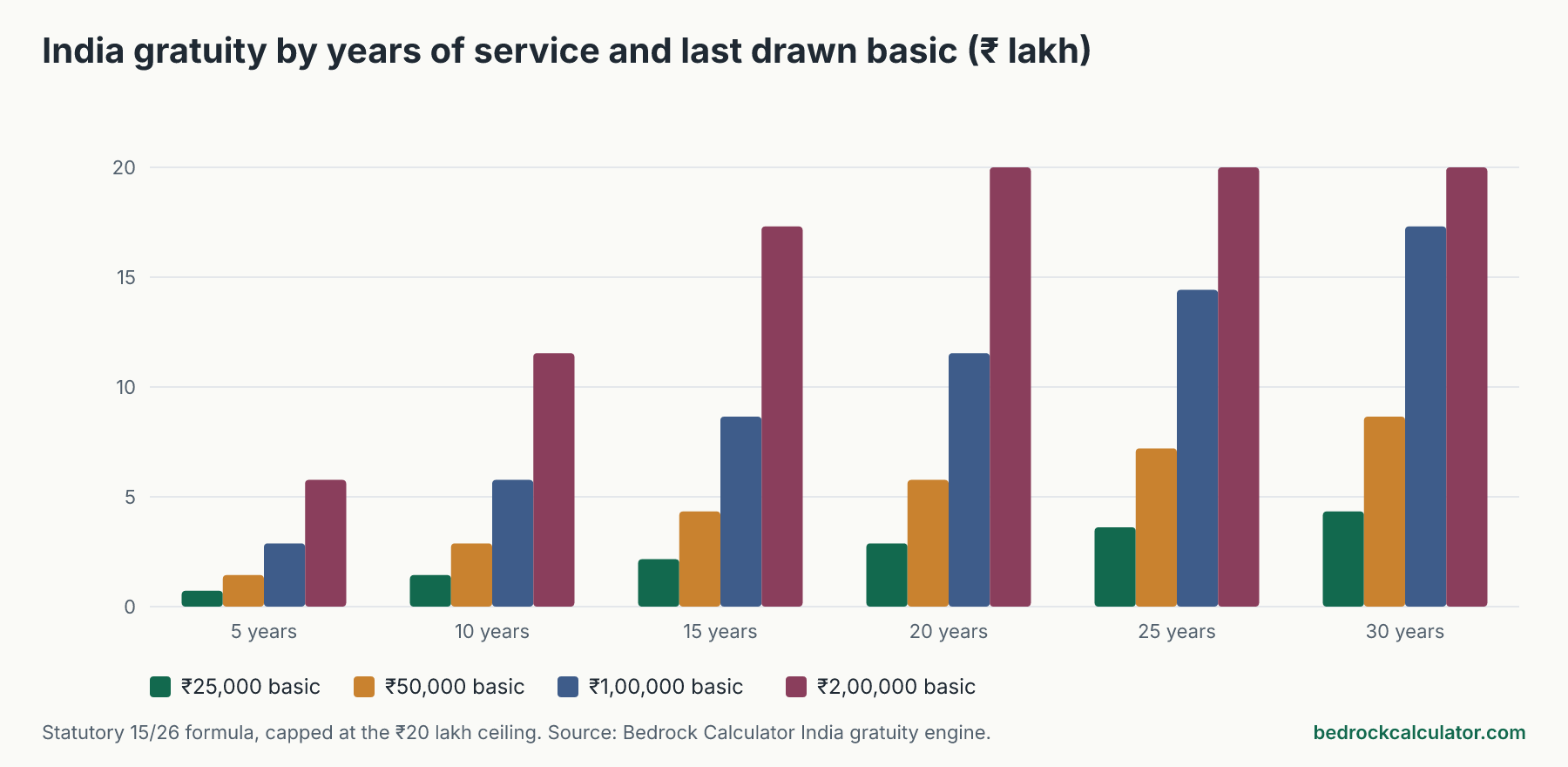
India gratuity by last drawn basic and years of service (₹ lakh)
Download CSVEmployer covered by gratuity law: 15 days of last drawn Basic + DA (monthly pay divided by 26, times 15) for each year of service, capped at the ₹20 lakh ceiling on the amount payable. Lakh rupees.
| 5 | 0.72 | 1.44 | 2.88 | 5.77 |
| 10 | 1.44 | 2.88 | 5.77 | 11.54 |
| 15 | 2.16 | 4.33 | 8.65 | 17.31 |
| 20 | 2.88 | 5.77 | 11.54 | 20 |
| 25 | 3.61 | 7.21 | 14.42 | 20 |
| 30 | 4.33 | 8.65 | 17.31 | 20 |
Below the cap the table is a straight line in both directions. Double the basic and you double the gratuity. Double the years and you double it again. Five years on ₹25,000 earns ₹72,115. On a ₹2 lakh basic the formula passes the cap by 20 years, so the column stops at ₹20 lakh: thirty years would give ₹34.62 lakh by formula, but the law makes only ₹20 lakh payable.
Why the seventh month matters
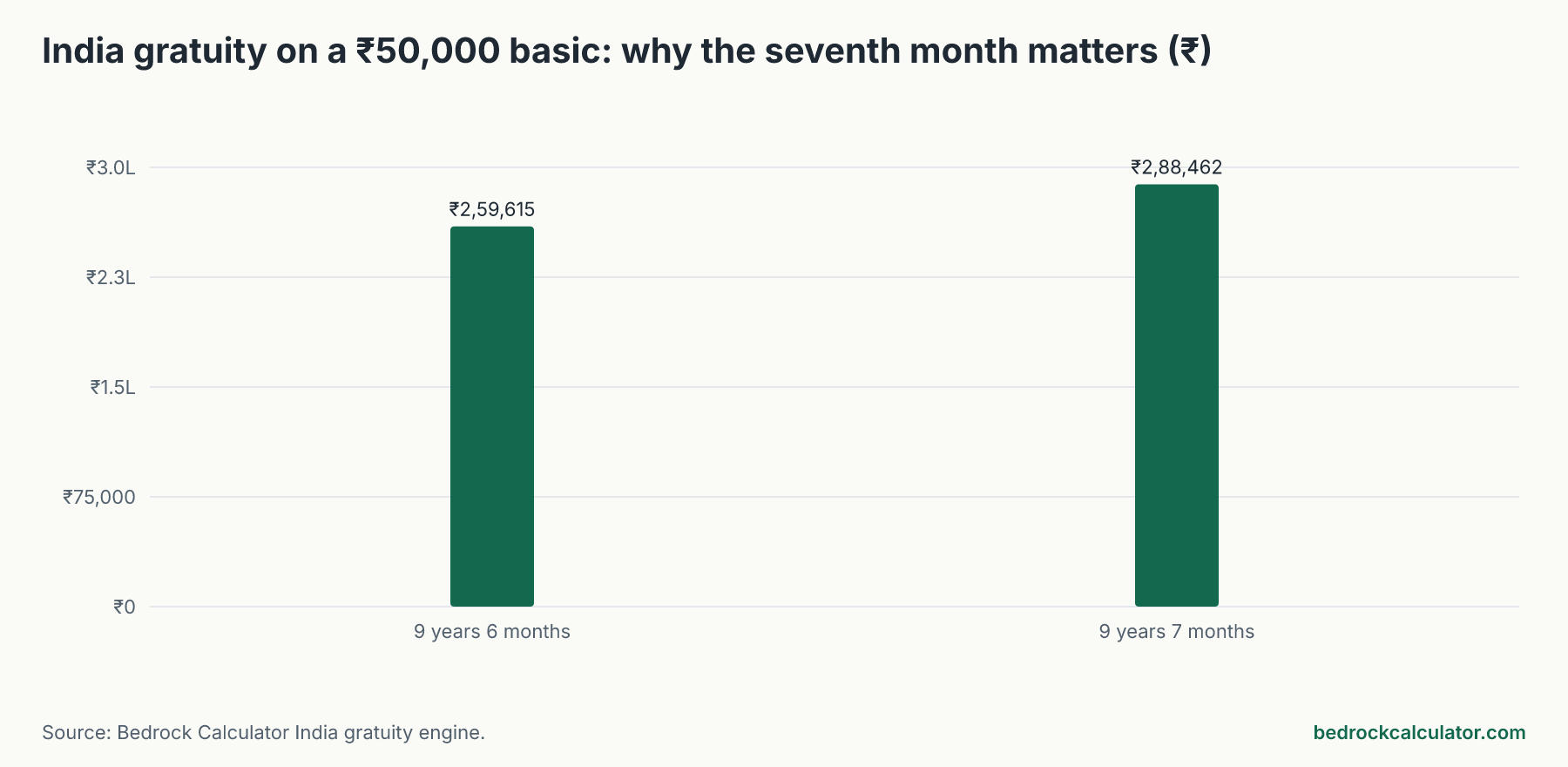
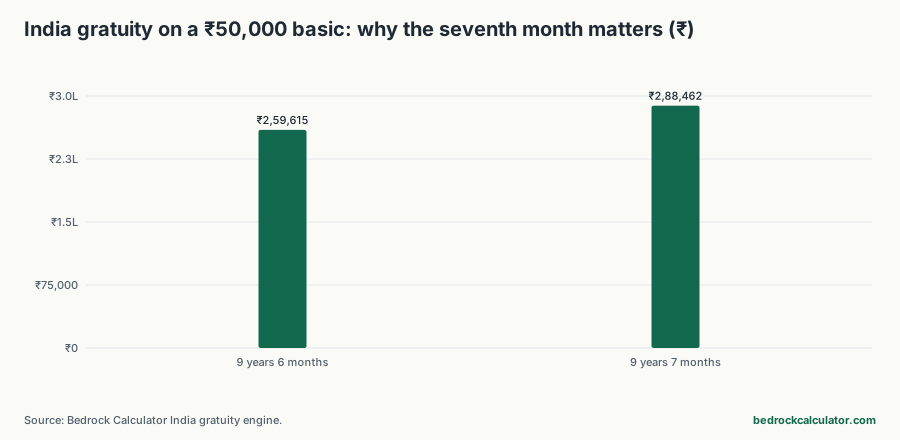
The rounding rule catches people out. If your last year is more than six months long, it counts as a whole year. If it's exactly six months or less, it's dropped.
On a ₹50,000 basic, leaving after 9 years and 6 months earns ₹2,59,615, for 9 years of service. Staying one more month, to 9 years and 7 months, earns ₹2,88,462, because the service now counts as 10 years. If you're planning a resignation date, check where you stand against that line.
Is gratuity tax-free in India?
It depends on who you work for.
Government employees: fully tax-free, with no upper limit. A government employee on a ₹2 lakh basic with 30 years of service would get ₹34.62 lakh with ₹0 taxable.
Everyone else: under Section 19 of the Income-tax Act, 2025, the tax-free amount is the lowest of three figures: the gratuity you actually receive, the statutory formula amount, and ₹20 lakh. For most people the formula amount is the lowest, so the whole payout is tax-free. The exemption applies in both the old and new tax regimes.
Because the payout cap and the tax-free limit are the same ₹20 lakh, the statutory amount is never taxed. Tax arises only when an employer pays more than the law requires, under its own policy:
India gratuity where the formula passes the limit: what the law pays, and the tax if the employer pays more (₹)
Download CSVPrivate-sector employee. The law caps the payout at ₹20 lakh, which is fully tax-free. The last two columns assume the employer pays the full formula amount by its own policy: Section 19 of the Income-tax Act, 2025 then exempts the least of the amount received, ₹20 lakh and the formula amount. Rupees.
| 200,000 | 30 | ₹34,61,538 | ₹20,00,000 | ₹20,00,000 | ₹14,61,538 |
| 200,000 | 25 | ₹28,84,615 | ₹20,00,000 | ₹20,00,000 | ₹8,84,615 |
| 200,000 | 20 | ₹23,07,692 | ₹20,00,000 | ₹20,00,000 | ₹3,07,692 |
On a ₹2 lakh basic, 20 years of service gives a formula amount of ₹23.08 lakh. The law makes ₹20 lakh payable, all tax-free. If the employer pays the full formula, ₹3.08 lakh is taxable. After 30 years the formula is ₹34.62 lakh, and paying all of it would leave ₹14.62 lakh taxed as salary. The gratuity calculator has an input for the amount your employer actually pays.
If your employer isn't covered
Smaller employers outside gratuity law often pay half a month's salary per year of service instead, dividing by 30 rather than 26. On ₹50,000 and 20 years that gives ₹5,00,000, which is ₹76,923 less than the statutory formula. The gratuity calculator has a switch for this.
What the calculator leaves out
- The Code's wider definition of wages and the fixed-term rule. India's labour codes took effect in November 2025 and replaced the Payment of Gratuity Act with the same formula and cap. Fixed-term employees no longer need five years, and if allowances make up more than half your pay, the excess counts as wages and raises the pay gratuity is worked out on. The calculator uses basic plus DA as you enter it and doesn't test eligibility.
- The five-year eligibility test. The calculator works out an amount for any length of service. Whether you meet the eligibility rule is up to you to check.
- Gratuity insurance schemes that change how and when gratuity is paid.
- Tax on the taxable part. The calculator tells you how much is taxable but not the tax itself. That depends on your other income and your regime.
Getting your own gratuity figure
Open the gratuity calculator, enter your last drawn basic plus DA and your years and months of service, and it shows the payout and how much of it is tax-free. If you're retiring, the leave encashment calculator covers the other big lump sum many employees get on exit, and the EPF calculator shows the balance waiting in your provident fund.