How much can you borrow for a UK mortgage on your salary?
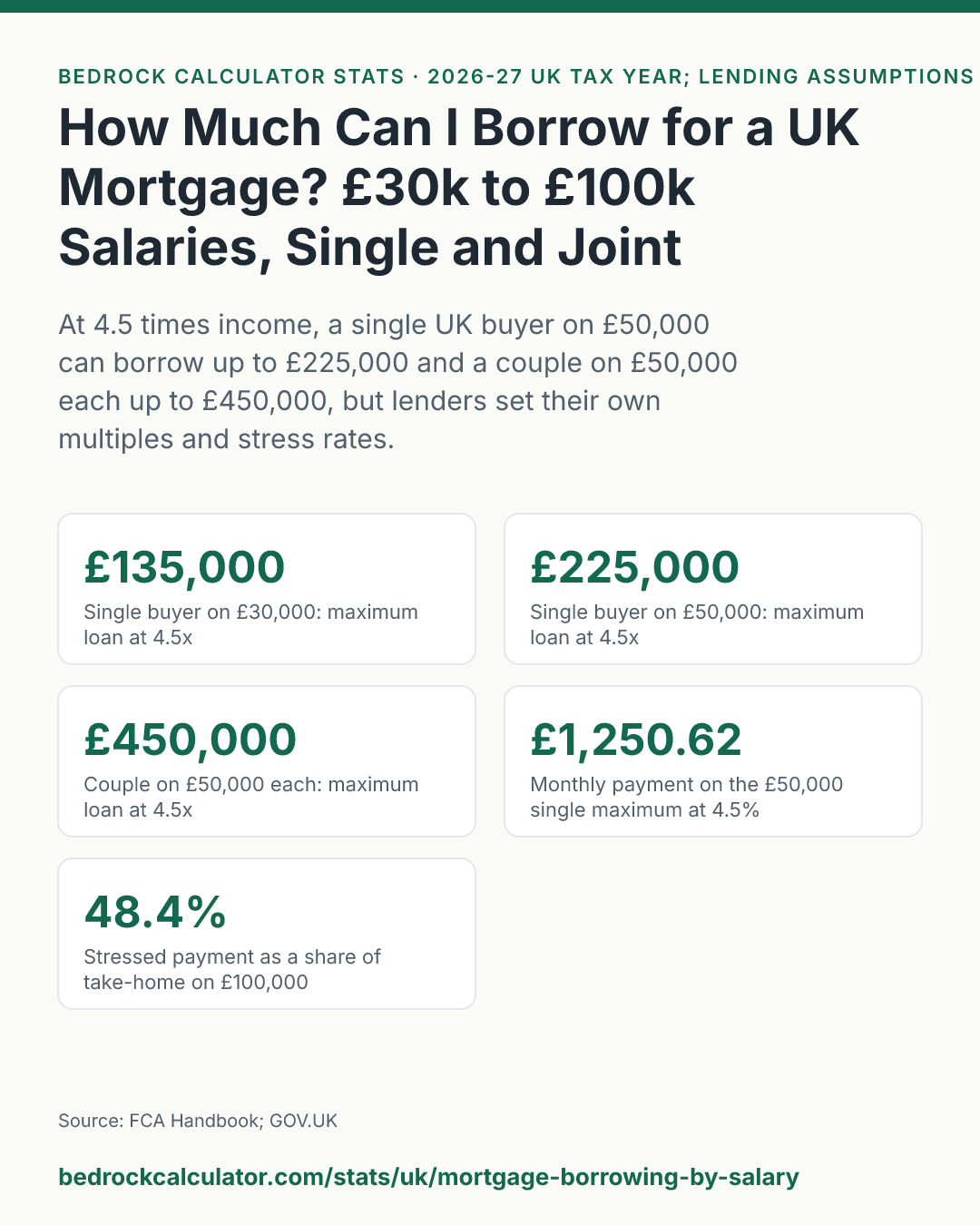
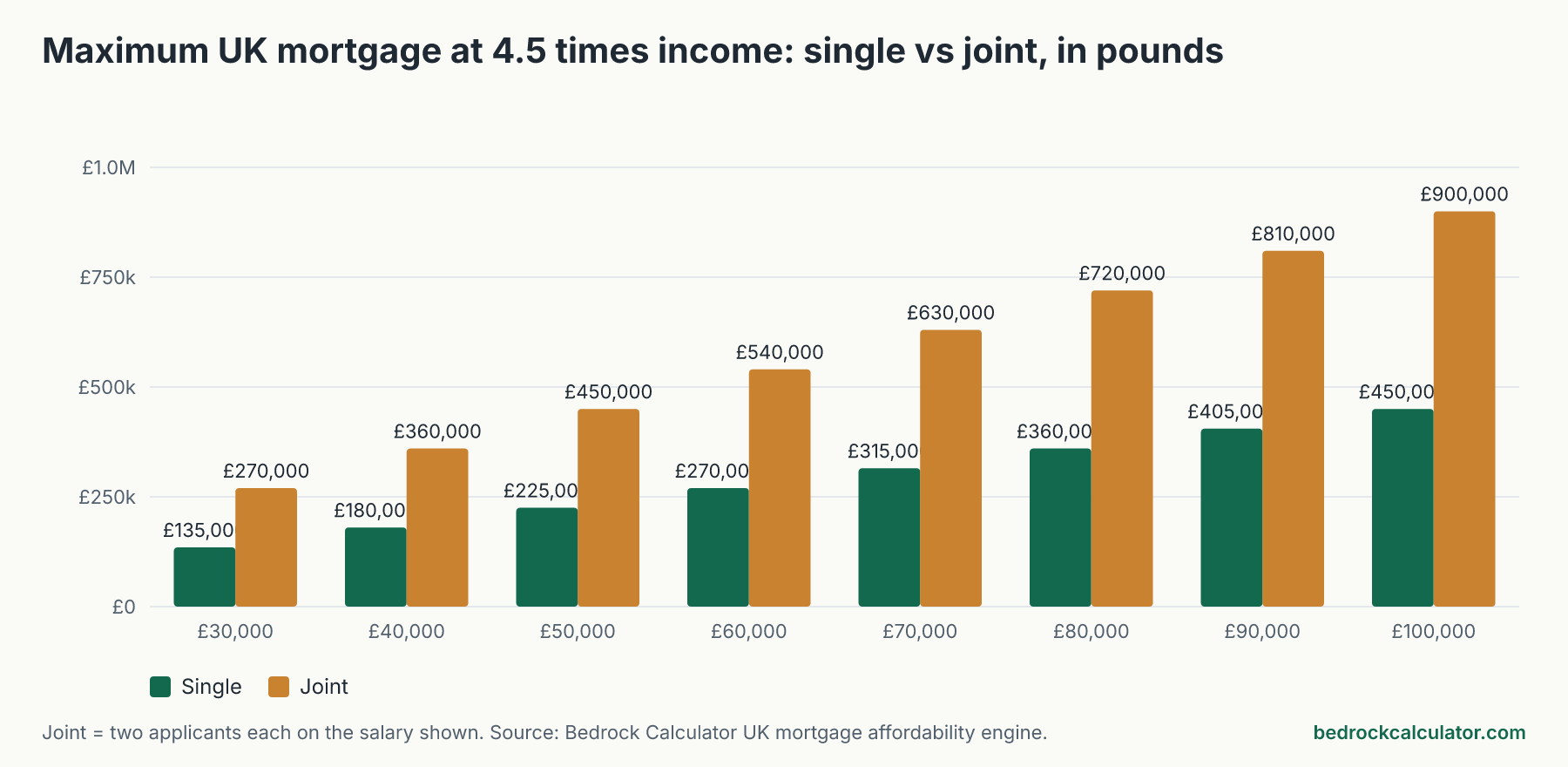
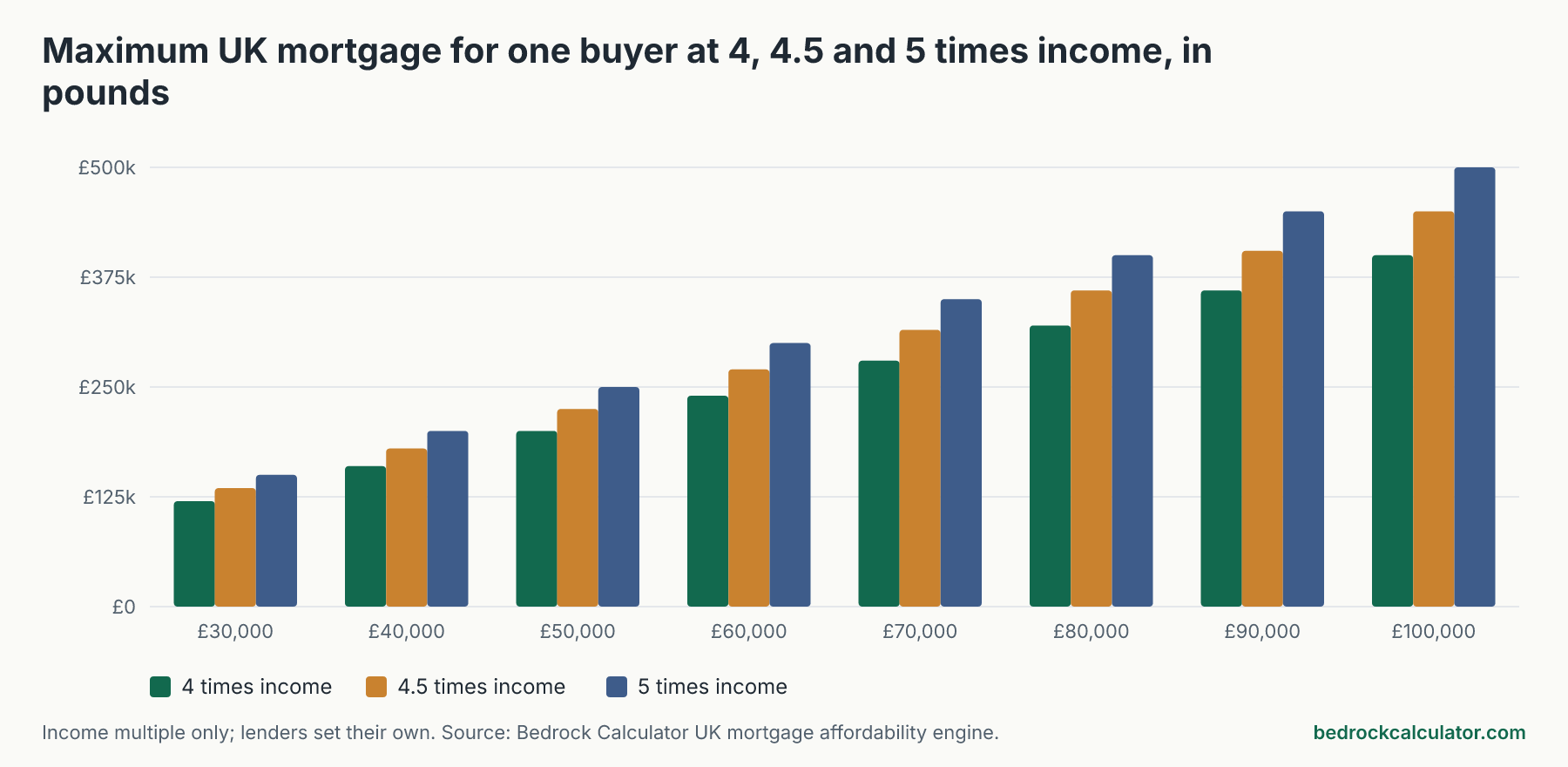
Most UK lenders start from a multiple of your income. At 4.5 times income, which is where many mainstream lenders cap a standard application, a single buyer on £30,000 can borrow up to £135,000, on £50,000 up to £225,000 and on £100,000 up to £450,000.
A couple applying together is assessed on combined income. Two people on £50,000 each can borrow up to £450,000. The multiple is only the ceiling, though. Whether a lender actually offers that much depends on its own affordability checks, and lenders don't all use the same multiple.
How we worked out these numbers
We ran the UK mortgage affordability calculator on this site at eight salaries from £30,000 to £100,000, once for a single applicant and once for two applicants who each earn that salary.
Be clear on what the calculator does. Its maximum loan is your gross income times an income multiple, and that's all. We used its default settings, which are assumptions rather than rules:
- An income multiple of 4.5 times income
- A repayment mortgage at 4.5% over 25 years
- A stress test one percentage point above that rate, so 5.50%
- No loans, credit cards or childcare costs going out each month
It then works out the monthly payment on that maximum loan, the payment at the stressed rate, and your monthly take-home pay after 2026-27 Income Tax and employee National Insurance for England, Wales and Northern Ireland.
One adjustment for couples. The calculator takes combined income for a joint application, which is the right base for the loan. But it works out take-home pay as if one person earned the whole amount, which overstates the tax a two-earner couple pays. So for the joint columns we added together two single take-home figures from the calculator rather than using its joint take-home figure.
Mortgage borrowing at every salary, single and joint
Click any column heading to sort. Salaries are per applicant, so the joint row for £40,000 is two people each earning £40,000.
UK mortgage borrowing at 4.5 times income, single and joint (2026-27)
Download CSVJoint means two applicants each earning the salary shown. Repayment mortgage at 4.5% over 25 years; stressed payment at 5.50%. Take-home pay uses 2026-27 Income Tax and employee NI for England, Wales and Northern Ireland. Pounds.
| £30,000 | £135,000 | £750.37 | £829.02 | 39.6% | £270,000 | £1,500.75 | 39.6% |
| £40,000 | £180,000 | £1,000.50 | £1,105.36 | 41.0% | £360,000 | £2,001 | 41.0% |
| £50,000 | £225,000 | £1,250.62 | £1,381.70 | 41.9% | £450,000 | £2,501.25 | 41.9% |
| £60,000 | £270,000 | £1,500.75 | £1,658.04 | 43.9% | £540,000 | £3,001.50 | 43.9% |
| £70,000 | £315,000 | £1,750.87 | £1,934.38 | 45.4% | £630,000 | £3,501.74 | 45.4% |
| £80,000 | £360,000 | £2,001 | £2,210.71 | 46.6% | £720,000 | £4,001.99 | 46.6% |
| £90,000 | £405,000 | £2,251.12 | £2,487.05 | 47.6% | £810,000 | £4,502.24 | 47.6% |
| £100,000 | £450,000 | £2,501.25 | £2,763.39 | 48.4% | £900,000 | £5,002.49 | 48.4% |
On £50,000 the maximum single loan of £225,000 costs £1,250.62 a month at 4.5%. At the stressed rate it would be £1,381.70, which is £131.08 more. Take-home pay at that salary is about £3,293.30 a month.
Why the same multiple feels tighter as you earn more
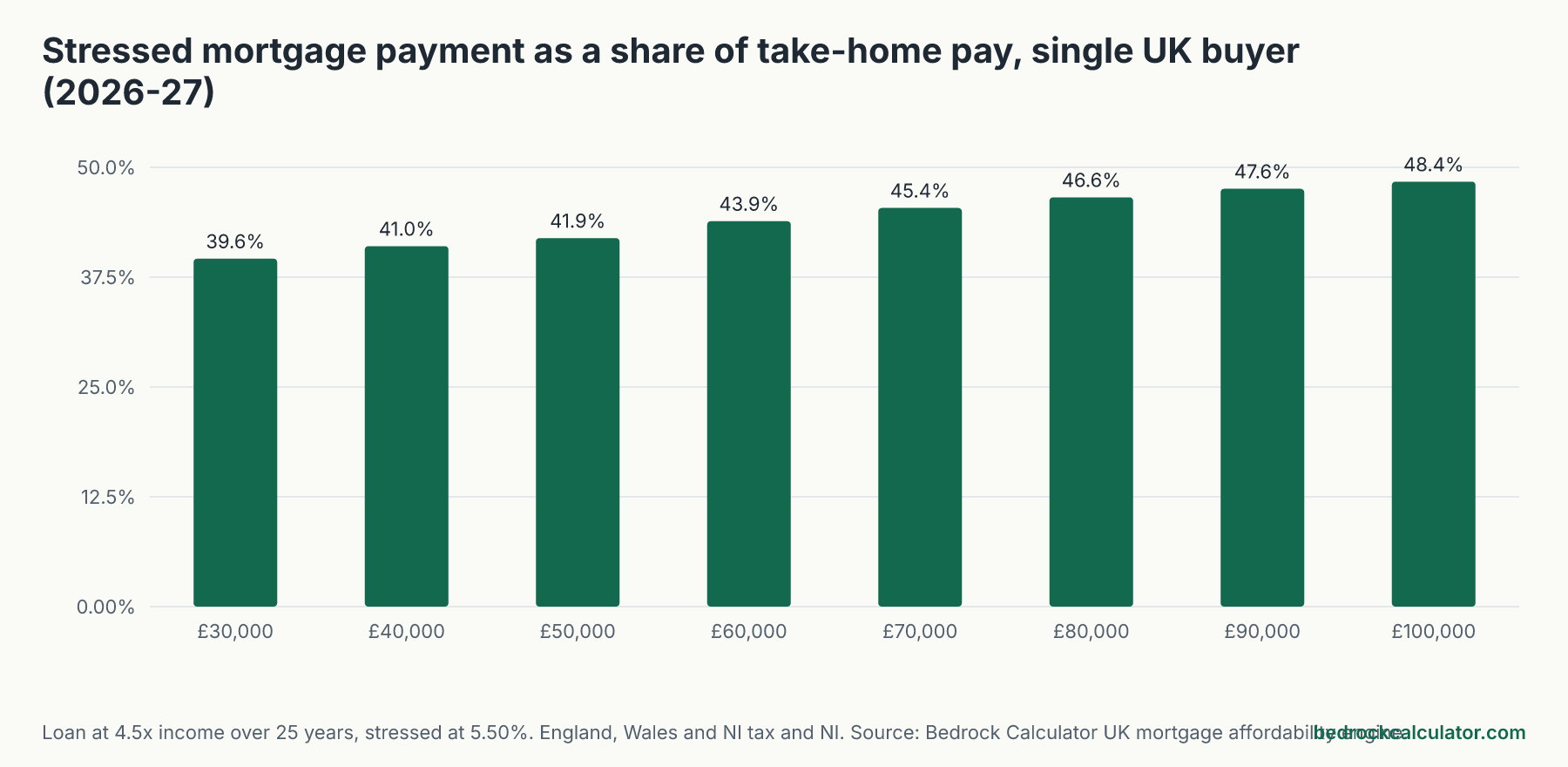
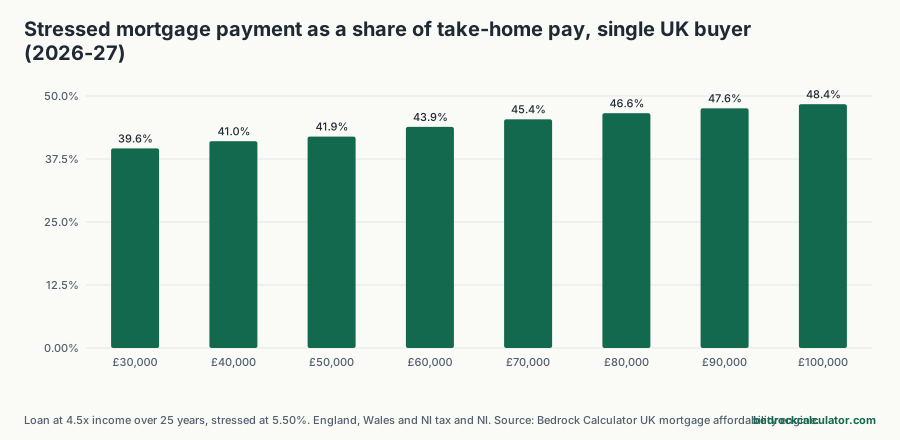
This is the part that the headline figure hides. The loan grows in step with gross pay, but take-home pay doesn't, because more of each extra pound goes in tax and NI once you're in the higher rate band. So the stressed payment eats a bigger share of what you actually bring home as salary rises.
On £30,000 the stressed payment on the maximum loan is 39.6% of take-home pay. On £50,000 it's 42.0%. On £100,000 it's 48.4%. Lenders look at what's left after your payment and your spending, so a high earner at the top multiple can still fail affordability even though the multiple says yes.
Couples tend to look better on this measure. Two people on £40,000 each pay less tax between them than one person on £80,000, so their stressed payment is 41.0% of combined take-home. A single buyer on £80,000 borrowing the same £360,000 would be at 46.6%. With two equal salaries the share is the same as for one person on either salary, because both the loan and the take-home pay double.
What a different income multiple does
Lenders don't all use 4.5 times. Some cap lower for some borrowers, and some go to 5 times or more for higher earners or certain professions. On £50,000 the gap between a 4 times and a 5 times lender is £50,000: £200,000 against £250,000. On £100,000 the range runs from £400,000 to £500,000.
If you're close to the edge, it pays to find out which multiple a lender will use before you start viewing homes. A mortgage broker can usually tell you.
The stress test is the lender's call
FCA rules require lenders to check that you could still afford the mortgage if interest rates went up. The rules don't fix one stress rate for everyone, so each lender sets its own. The calculator adds whatever uplift you choose to your rate, and we used one point. If your lender tests at a higher rate, the stressed payments in the table will understate what they're checking you against.
What these figures leave out
The calculator is a guide, not a decision in principle. It doesn't model:
- The lender's own affordability model. Each lender uses its own income multiples, stress rates and estimates of your spending.
- Loan-to-value limits. Most lenders cap lending at a share of the property's value and charge more above certain thresholds. We set the deposit to zero, so nothing here checks whether your deposit is big enough.
- Credit history, which can stop an offer whatever your income.
- Stamp duty, legal fees, survey and moving costs. Use the stamp duty calculator for the tax side.
- Self-employed income, which lenders usually average over two or three years of accounts.
- How lenders treat unequal joint incomes. Our joint figures assume two equal salaries.
- Interest-only mortgages, Help to Buy, shared ownership and other schemes.
- Scottish tax bands. Take-home pay here uses the rates for England, Wales and Northern Ireland.
Run your own numbers
Open the UK mortgage affordability calculator and put in your own income, deposit, monthly commitments and the rate you've been quoted. Adding even a few hundred pounds a month of existing loans or childcare cuts the headroom it reports. To see exactly what reaches your bank account each month, the UK take-home pay calculator breaks down tax and NI on your salary.