How much do you keep from a UK pension lump sum after tax?
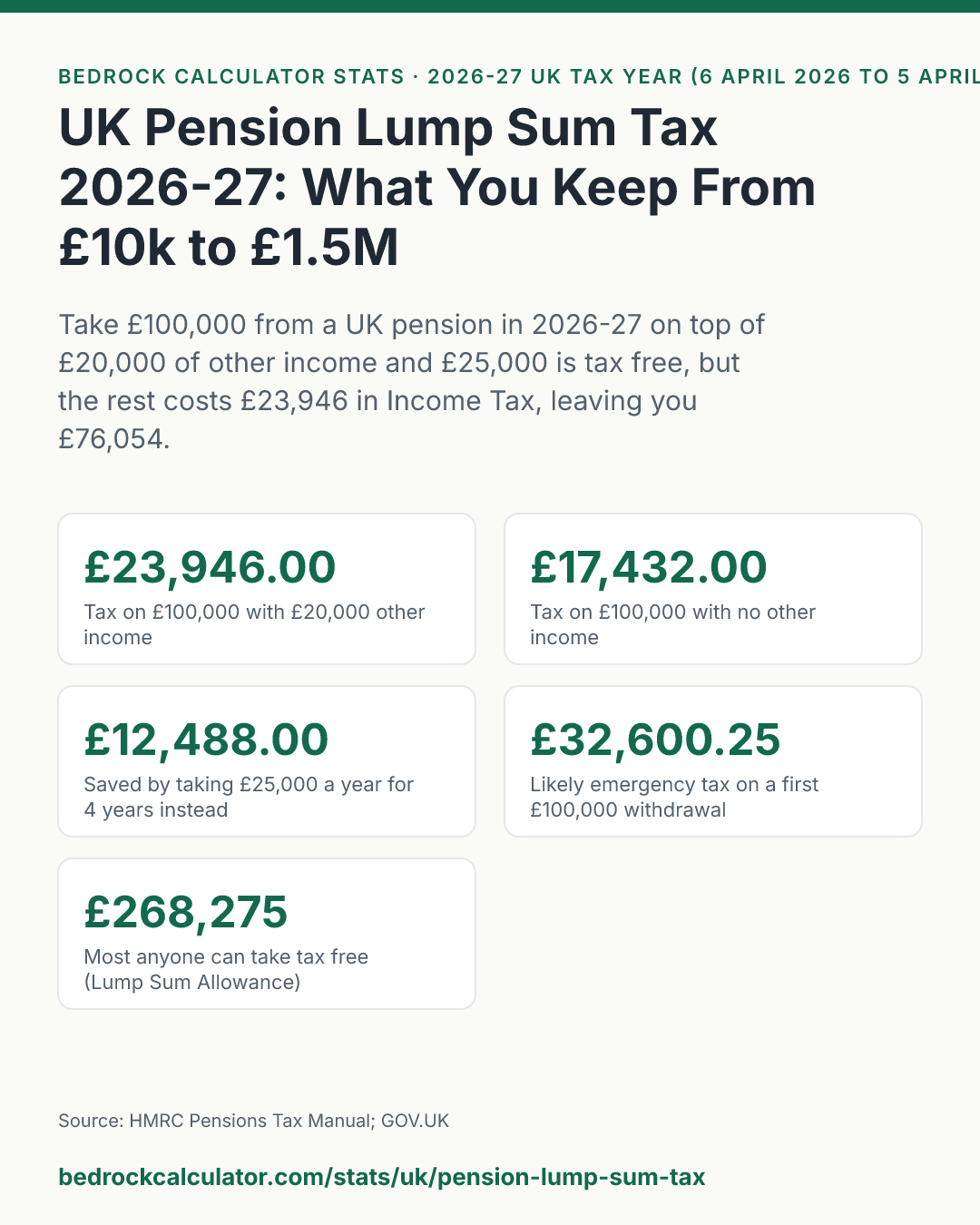
When you take a lump sum from a UK defined contribution pension, a quarter of it is normally tax free and the rest is taxed as income in that year. On a £100,000 withdrawal that means £25,000.00 tax free and £75,000.00 added to your income.
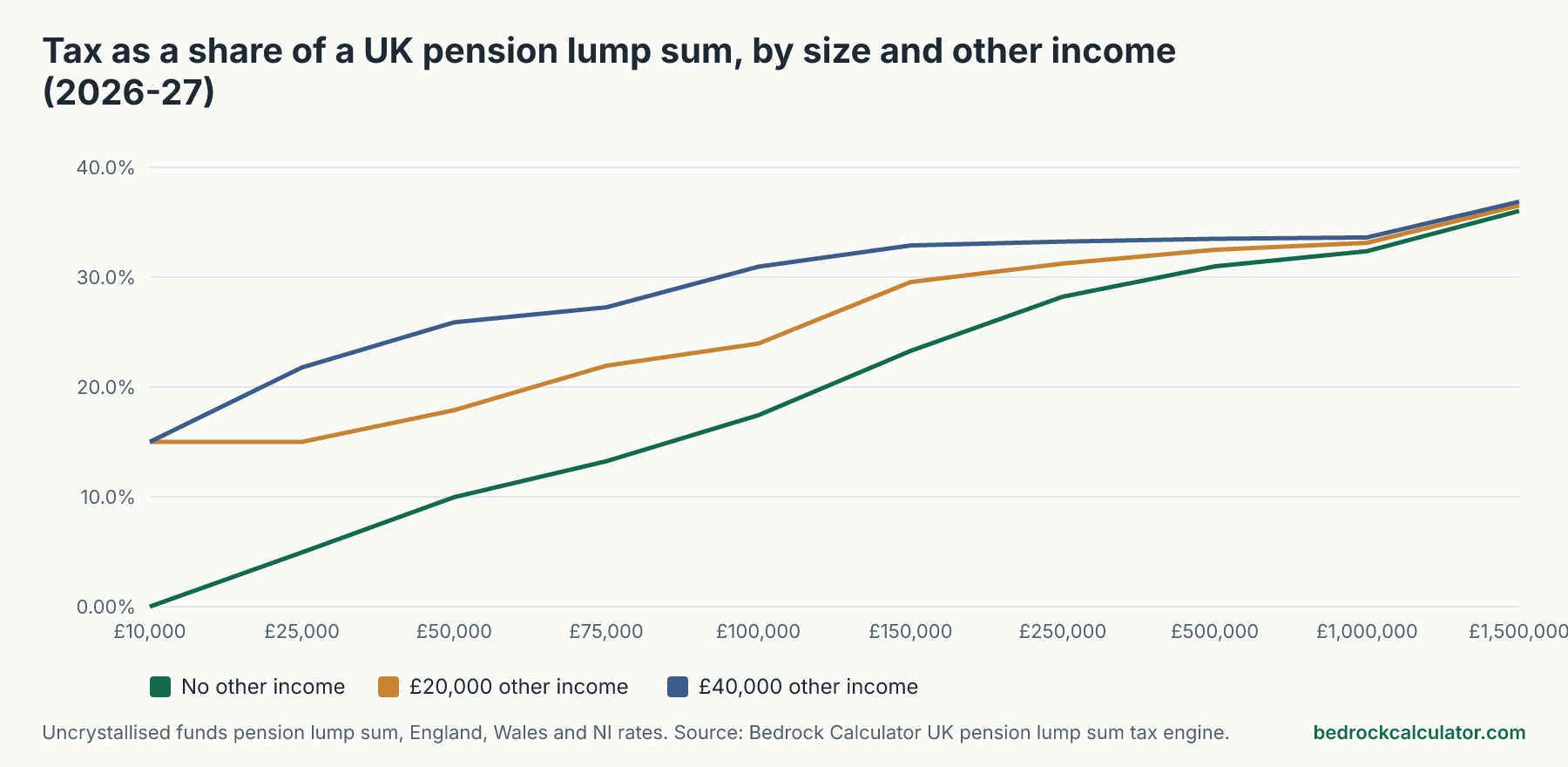
How much tax you pay depends on what else you earn that year. With no other income, the tax on £100,000 is £17,432.00. With £20,000 of other income it's £23,946.00. With £40,000 it's £30,946.00. Spreading the money over several tax years can cut the bill a lot.
How we worked out these numbers
We ran the UK pension lump sum tax calculator on this site for ten withdrawal sizes from £10,000 to £1.5 million, at three levels of other income: none, £20,000 and £40,000.
The calculator treats each withdrawal as an uncrystallised funds pension lump sum, the usual way people take cash straight from a pot. It works like this:
- 25% of the withdrawal is tax free, up to whatever is left of the £268,275 Lump Sum Allowance.
- The other 75% is added to your other income for the year.
- The tax on the lump sum is the extra Income Tax that addition creates, at 2026-27 rates for England, Wales and Northern Ireland unless you choose Scotland.
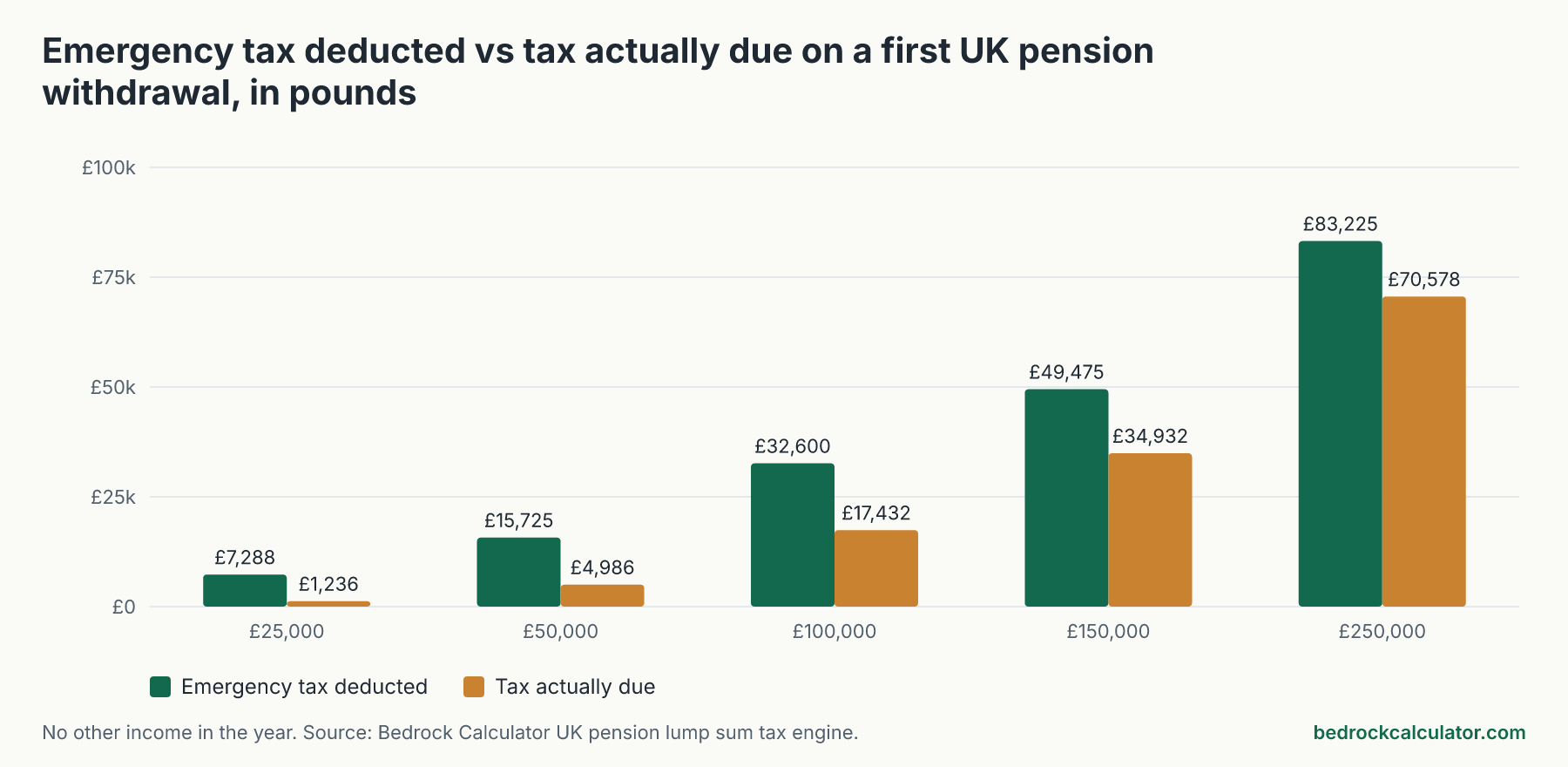
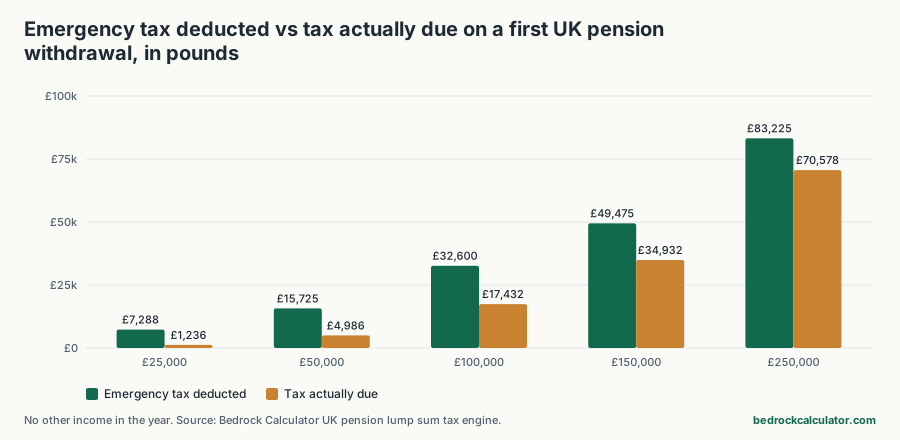
It also estimates the emergency tax a pension provider usually takes from a first withdrawal, which is often much more than you actually owe.
Tax on a pension lump sum at every size
Click any column heading to sort. The figures assume you take the whole amount in one tax year and haven't used any of your Lump Sum Allowance before.
Tax on a UK pension lump sum in 2026-27, by size and other income
Download CSVWhole withdrawal taken in one tax year as an uncrystallised funds pension lump sum. England, Wales and NI Income Tax rates. Emergency tax is what a provider would typically deduct on a month-1 code from a first withdrawal, before any refund. Pounds.
| £10,000 | £2,500 | £0 | £1,500 | £1,500 | £8,500 | £1,952.67 |
| £25,000 | £6,250 | £1,236 | £3,750 | £5,446 | £21,250 | £7,287.75 |
| £50,000 | £12,500 | £4,986 | £8,946 | £12,946 | £41,054 | £15,725.25 |
| £75,000 | £18,750 | £9,932 | £16,446 | £20,446 | £58,554 | £24,162.75 |
| £100,000 | £25,000 | £17,432 | £23,946 | £30,946 | £76,054 | £32,600.25 |
| £150,000 | £37,500 | £34,932 | £44,342 | £49,342 | £105,658 | £49,475.25 |
| £250,000 | £62,500 | £70,578 | £78,092 | £83,092 | £171,908 | £83,225.25 |
| £500,000 | £125,000 | £154,953 | £162,467 | £167,467 | £337,533 | £167,600.25 |
| £1,000,000 | £250,000 | £323,703 | £331,217 | £336,217 | £668,783 | £336,350.25 |
| £1,500,000 | £268,275 | £540,479.25 | £547,993.25 | £552,993.25 | £952,006.75 | £553,126.50 |
The pattern is the one you'd expect from Income Tax bands. A small withdrawal on top of no other income can fall almost entirely inside your Personal Allowance and the basic rate band, so the tax on a £10,000 lump sum is £0.00. As the sum grows, more of it is pushed into the 40% and 45% bands. With £20,000 of other income, tax takes 23.9% of £100,000 and 31.2% of £250,000.
There's also the Personal Allowance taper to watch. Once your total income for the year passes £100,000, you start losing your tax-free Personal Allowance, so a large lump sum can be taxed at an effective 60% on part of it. The calculator applies this automatically.
Taking it over several years instead
This is the decision that makes the biggest difference for most people. If you have no other income and take £100,000 in one go, the tax is £17,432.00. If you take £25,000 in each of four tax years instead, the tax adds up to £4,944.00 at 2026-27 rates. That's £12,488.00 saved, simply because each year's taxable slice stays mostly in your Personal Allowance and the basic rate band.
Phasing isn't right for everyone. You may need the money now, and money left in the pension stays invested, which can go up or down. But if the plan is to clear a mortgage or fund a big purchase, it's worth checking whether you could split the withdrawal across two or more tax years. The tax year starts on 6 April, so a withdrawal in March and another in April already lands in two different years.
Why your first withdrawal may be over-taxed
When you take a first payment, the provider usually has no tax code for you and uses an emergency code on a month-1 basis. That taxes your withdrawal as though you'll take the same amount every month for the rest of the year.
On £100,000 with no other income, that means about £32,600.25 is deducted when only £17,432.00 is due, so you'd be owed £15,168.25. You can claim it back from HMRC during the year rather than waiting until the year ends. On a £25,000 withdrawal the emergency deduction is about £7,287.75, which is £6,051.75 more than the tax due.
The cap on tax-free cash
The Lump Sum Allowance limits how much you can take tax free across all your pensions in your lifetime. It's £268,275 for most people. At 25% tax free, you reach the cap once you've taken £1,073,100 in lump sums. Above that, every extra pound is taxable. That's why a £1,500,000 withdrawal has only £268,275.00 tax free and a tax bill of £540,479.25, or 36.0% of the whole amount, even with no other income.
Some people have a protected higher allowance from earlier pension rules. If that's you, the calculator's figures will understate your tax-free cash.
Scottish taxpayers
Pension income counts as non-savings income, so Scottish rates apply if you're a Scottish taxpayer. On £100,000 with £20,000 of other income, a Scottish taxpayer pays £27,035.72, which is £3,089.72 more than someone elsewhere in the UK.
What these figures leave out
The calculator covers cash taken from a defined contribution pot. It doesn't model:
- Defined benefit pensions, where the tax-free lump sum comes from scheme rules and commutation factors, not a quarter of a pot.
- The Money Purchase Annual Allowance. Taking taxable cash usually cuts how much you can pay into pensions in future, which matters if you're still working.
- Protected tax-free cash above the standard 25%.
- Death and serious ill-health lump sums, which have their own allowance.
- Scheme charges and exit fees.
- The State Pension, which is taxable and should be included in other income if you receive it.
- Whether taking the money is wise. Cash taken out leaves a tax-sheltered wrapper and becomes part of your estate.
- The minimum age. You can usually start taking money at 55, rising to 57 from April 2028.
Run your own numbers
Use the UK pension lump sum tax calculator with your own lump sum, other income and any tax-free cash you've already taken. To see the full Income Tax picture for the year, the UK income tax calculator breaks it down by band. If you're still paying into a pension, check the pension annual allowance calculator before you take any taxable cash.