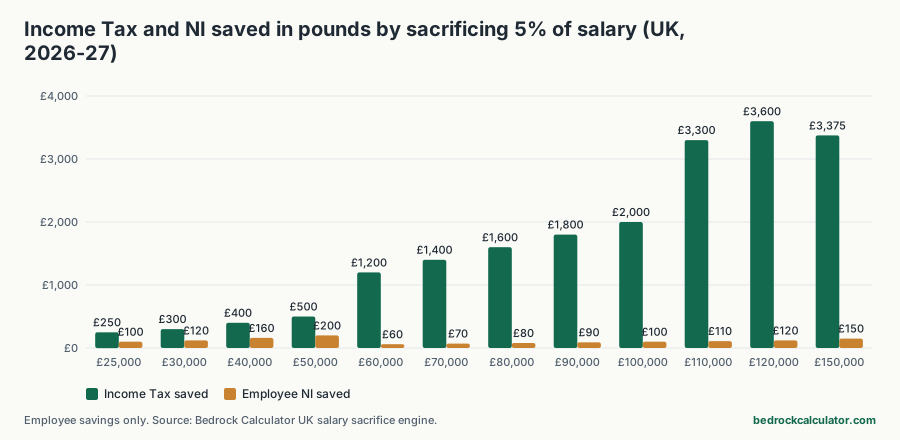
How much does UK pension salary sacrifice save at each salary?
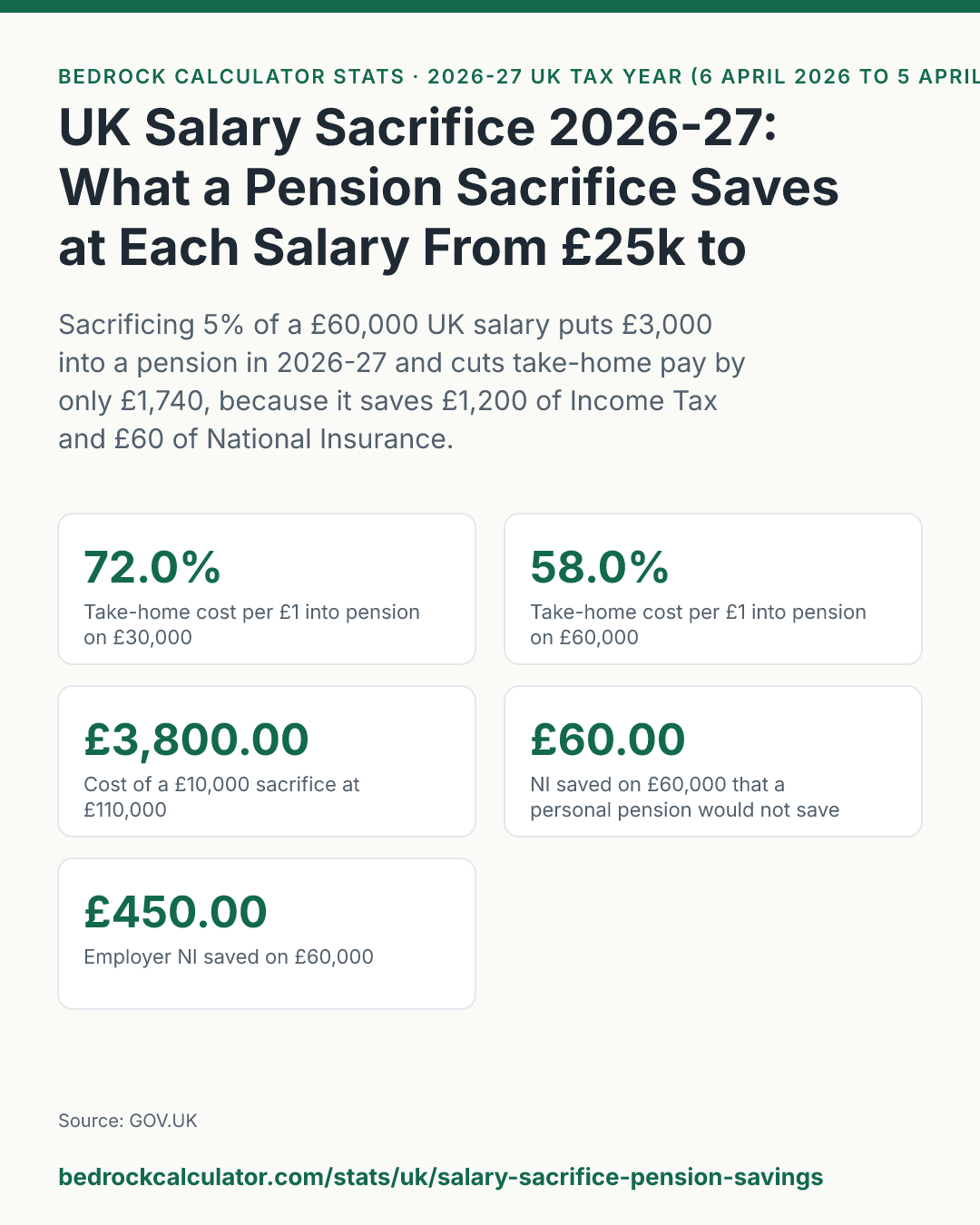
Salary sacrifice means a pound into your pension costs you well under a pound of take-home pay. In the 2026-27 tax year, an employee in England, Wales or Northern Ireland on £60,000 who sacrifices 5% of salary puts £3,000 into their pension and takes home just £1,740.00 less. The rest is Income Tax and National Insurance they no longer pay.
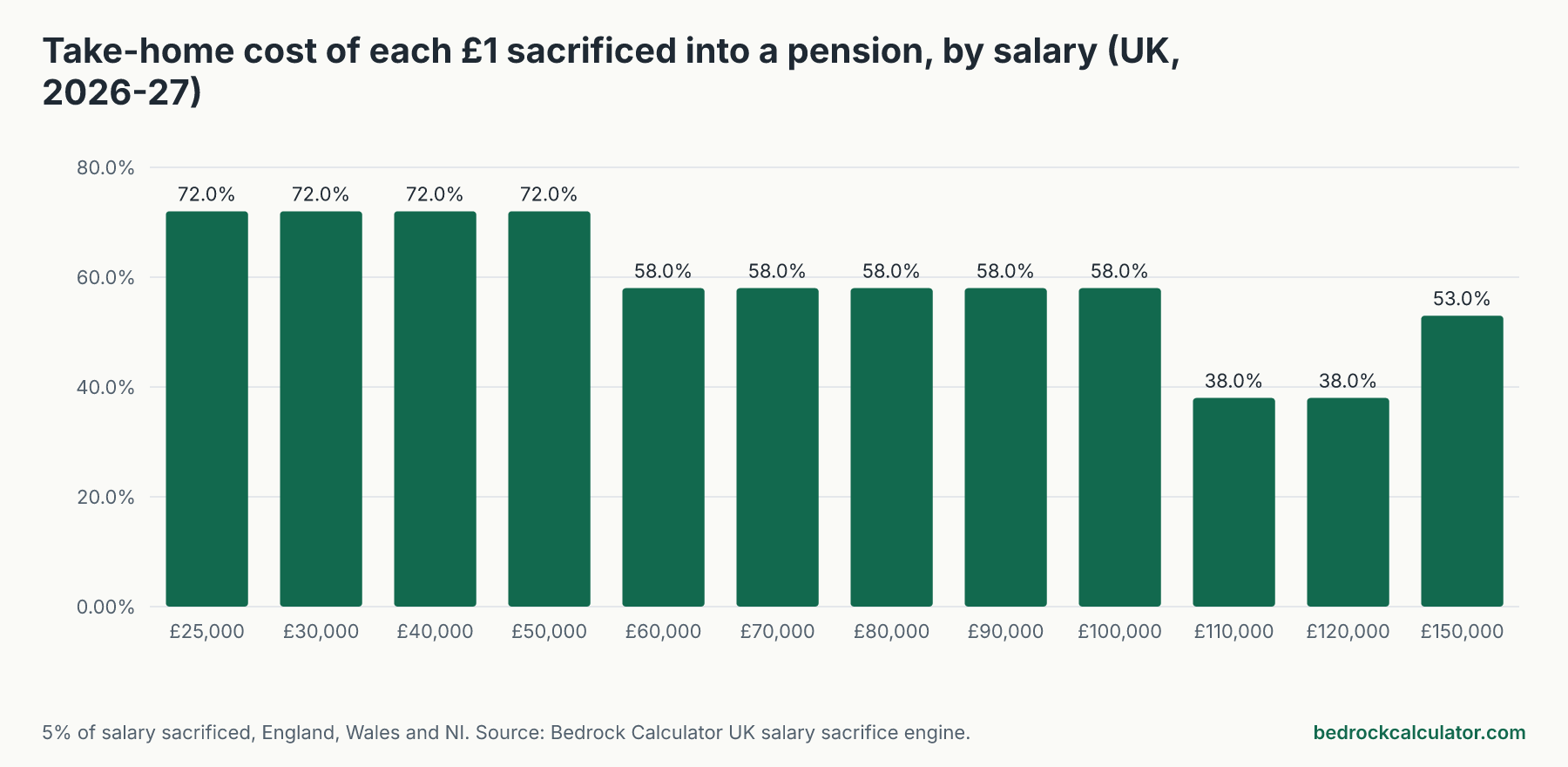
How good the deal is depends on your band. Each pound into the pension costs 72.0% of take-home on £30,000, 58.0% on £60,000, and as little as 38.0% for someone using it to climb back below £100,000.
How we worked out these numbers
We ran the UK salary sacrifice calculator on this site at twelve salaries from £25,000 to £150,000. In each run the employee gives up 5% of salary in exchange for the same amount paid into their pension by the employer. The calculator works out take-home pay before and after, using 2026-27 Income Tax bands and employee Class 1 National Insurance, and also reports how much employer NI the sacrifice saves.
We assumed the employer keeps its own NI saving rather than adding it to the pension. If yours passes it on, your pension gets more than the figures here.
One thing we deliberately didn't do. The UK take-home pay calculator has a pension box, but it treats a personal pension contribution only as a reduction in adjusted net income. It doesn't add the basic rate relief a provider claims or the higher rate band extension, so it understates what a personal contribution is worth. None of the figures on this page come from that box.
The salary sacrifice calculator has its own limits. It doesn't check the £60,000 pension annual allowance, or the minimum wage floor that stops sacrifice taking pay too low. It doesn't show knock-on effects on things worked out from salary, such as mortgage applications, life cover or statutory maternity pay. And it treats Scotland using the Scottish bands, which give slightly different results.
Salary sacrifice savings at each salary
Click any column heading to sort. All amounts are in pounds.
UK salary sacrifice of 5% of salary into a pension, 2026-27
Download CSVEngland, Wales and NI rates. Pounds, rounded to the nearest pound. Cost to take-home is how much less you take home for the amount that goes into the pension. Employer keeps its NI saving.
| £25,000 | £1,250 | £250 | £100 | £900 | 72.0% | £188 |
| £30,000 | £1,500 | £300 | £120 | £1,080 | 72.0% | £225 |
| £40,000 | £2,000 | £400 | £160 | £1,440 | 72.0% | £300 |
| £50,000 | £2,500 | £500 | £200 | £1,800 | 72.0% | £375 |
| £60,000 | £3,000 | £1,200 | £60 | £1,740 | 58.0% | £450 |
| £70,000 | £3,500 | £1,400 | £70 | £2,030 | 58.0% | £525 |
| £80,000 | £4,000 | £1,600 | £80 | £2,320 | 58.0% | £600 |
| £90,000 | £4,500 | £1,800 | £90 | £2,610 | 58.0% | £675 |
| £100,000 | £5,000 | £2,000 | £100 | £2,900 | 58.0% | £750 |
| £110,000 | £5,500 | £3,300 | £110 | £2,090 | 38.0% | £825 |
| £120,000 | £6,000 | £3,600 | £120 | £2,280 | 38.0% | £900 |
| £150,000 | £7,500 | £3,375 | £150 | £3,975 | 53.0% | £1,125 |
Basic rate taxpayers: is salary sacrifice worth it?
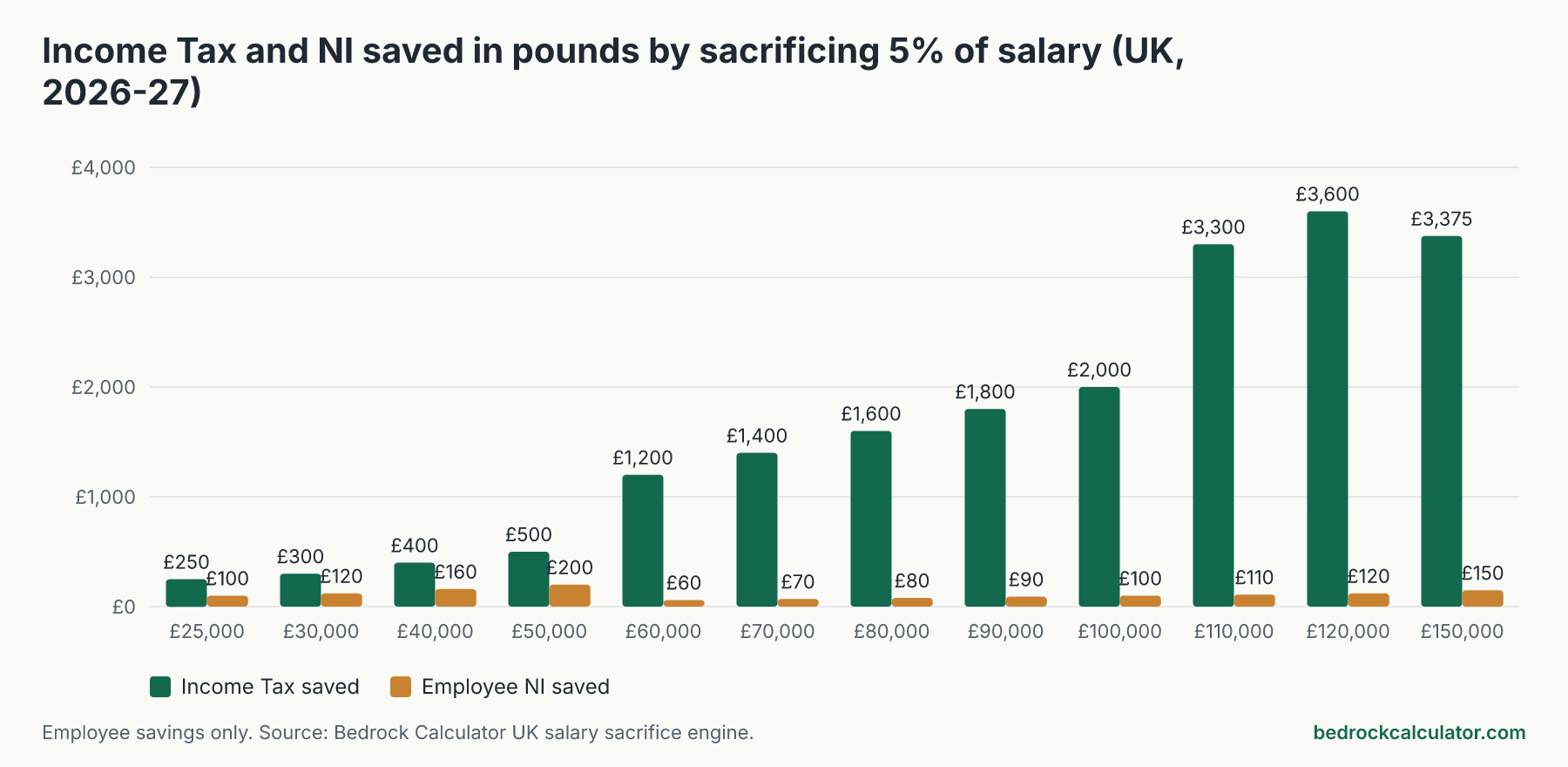
For a basic rate taxpayer, every pound sacrificed saves the basic rate of Income Tax plus the main rate of National Insurance. On £30,000, sacrificing £1,500 saves £300.00 of tax and £120.00 of NI, so take-home falls by £1,080.00. That's the 72.0% figure, and it's the same anywhere in the basic rate band. On £50,000 it's still 72.0%.
The NI part is the reason sacrifice beats paying into a pension from your net pay. Relief on a personal contribution gives you back the Income Tax but not the NI.
Higher rate taxpayers: the sweet spot
Cross into the higher rate band and the Income Tax saving doubles, while the NI saving shrinks to the lower rate. The net effect is a much cheaper pension. On £60,000, a £3,000 sacrifice saves £1,200.00 of Income Tax and £60.00 of NI, and costs £1,740.00 of take-home. Each pound in the pension costs 58.0%.
The NI saving here is small, so the gap between sacrifice and a personal contribution narrows. The calculator puts the cost of an equal personal contribution at £1,800.00, which assumes you claim the higher rate relief through Self Assessment. Sacrifice is cheaper by £60.00, the NI you avoid.
Getting back under £100,000
Between £100,000 and £125,140 the Personal Allowance is withdrawn, which makes this the band where sacrifice does the most. Our article on the UK tax trap above £100,000 explains the mechanics.
Take someone on £110,000 who sacrifices £10,000, bringing pay back to £100,000. The sacrifice saves £6,000.00 of Income Tax, because it also wins back the allowance, plus £200.00 of NI. Their take-home falls by only £3,800.00, so each pound in the pension costs 38.0%. In Scotland the same move costs £3,050.00.
The 5% rows at £110,000 and £120,000 in the table show the same effect on a smaller sacrifice. Once pay is above £125,140 and the allowance is fully gone, the cost per pound rises again, to 53.0% at £150,000.
What your employer saves
Employers pay their own National Insurance on salary, and sacrifice reduces it too. On £30,000 a 5% sacrifice saves the employer £225.00 a year; on £60,000 it's £450.00; on £150,000 it's £1,125.00. Some employers pass all or part of that into your pension. It's worth asking HR whether yours does, because it's free money that these figures leave out.
Before you sign up
Salary sacrifice changes your contract, so it isn't instant, and it can lower the salary figure lenders and insurers see. Very large sacrifices can also bump into the annual allowance, which the pension annual allowance calculator checks. If you claim Child Benefit and earn between £60,000 and £80,000, sacrifice can cut the High Income Child Benefit Charge as well; our figures on the Child Benefit charge show what's at stake.
Getting your own figure
Enter your salary and the amount you'd sacrifice in the salary sacrifice calculator, and choose whether your employer passes on its NI saving. It shows your new take-home, the tax and NI saved, and how much goes into the pension.