How much sales tax do you pay on a $35,000 car in each US state?
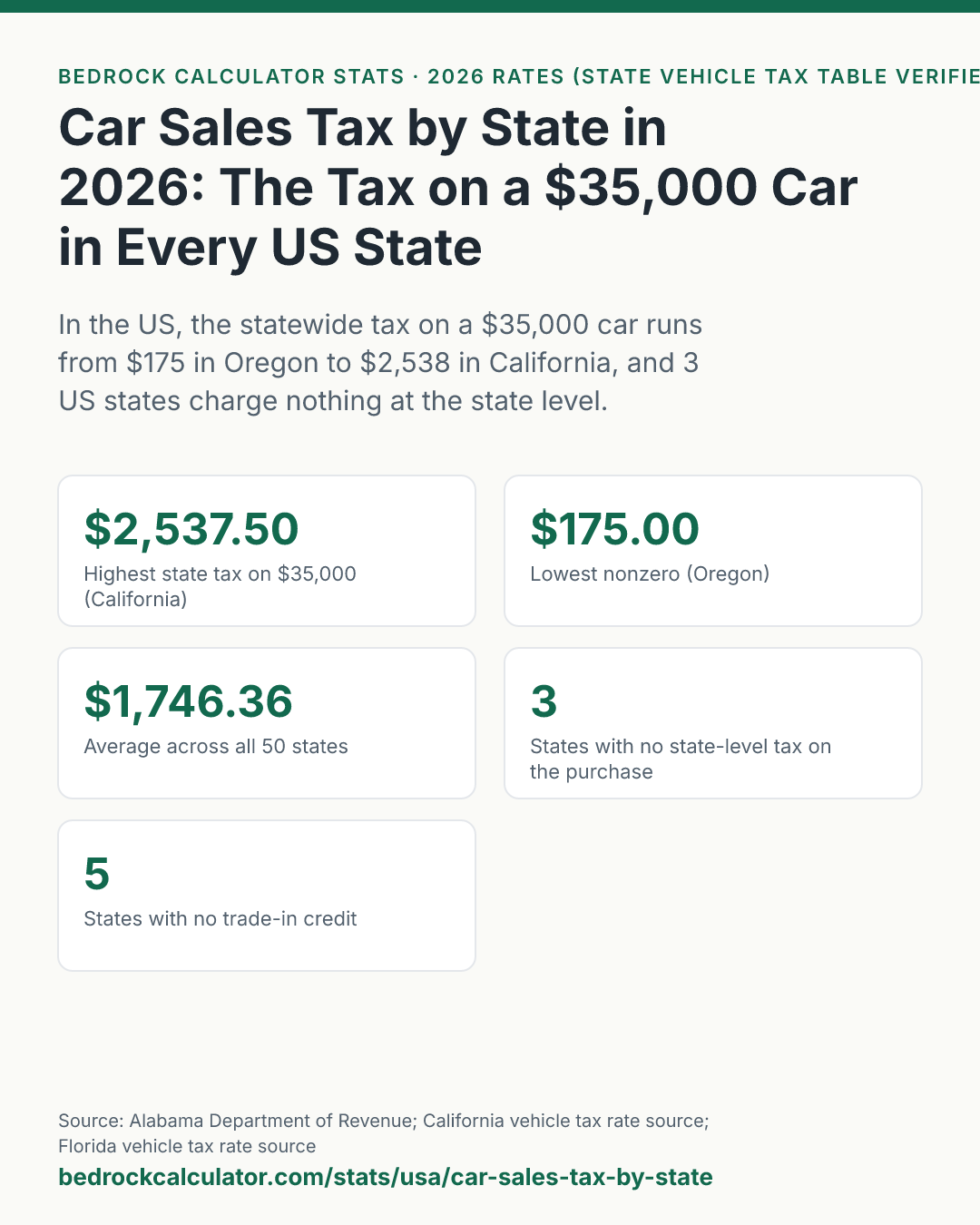
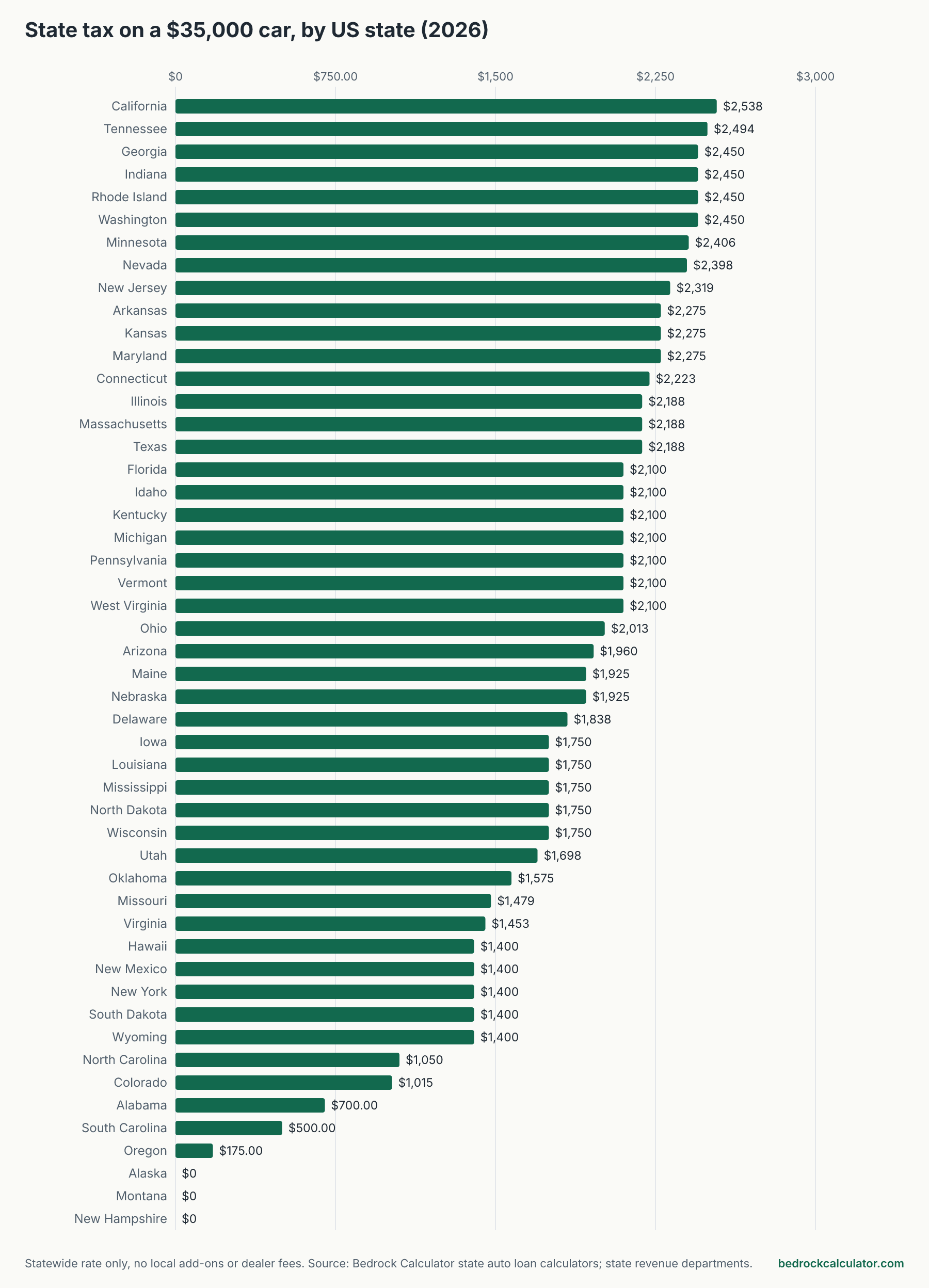
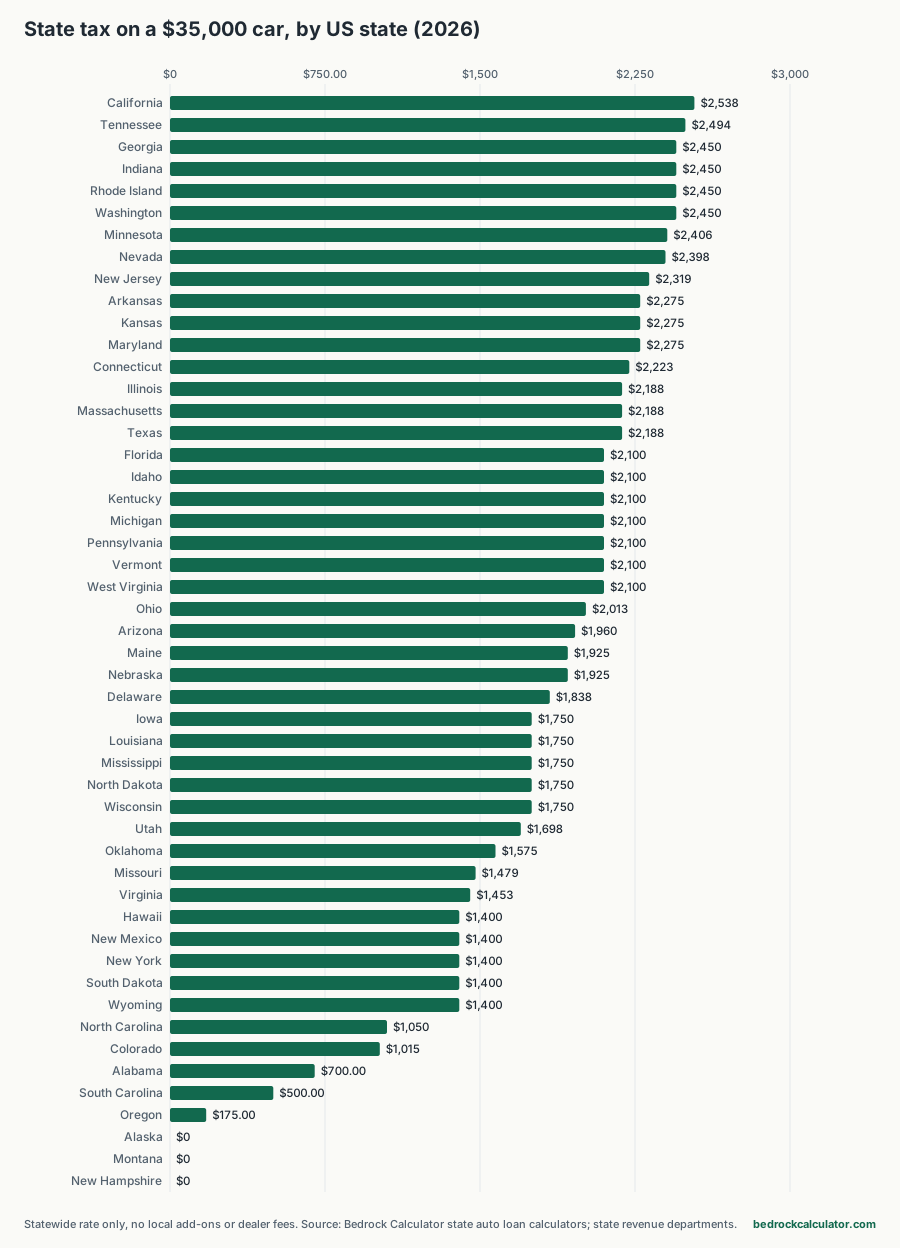
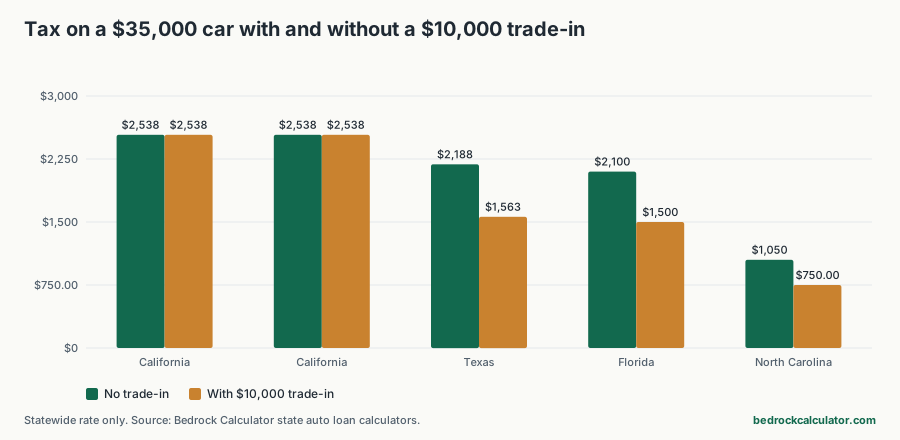
Buy the same $35,000 car in two different US states and the tax bill can differ by $2,362.50. At the statewide rate, California takes the most, $2,537.50. Oregon takes the least of the states that tax the purchase at all, $175.00. And Alaska, Montana and New Hampshire charge nothing at the state level.
Across all 50 US states the average statewide tax on a $35,000 car is $1,746.36, and the median is $1,942.50. Those numbers are before any city or county add-on, which matters a lot in some states and not at all in others.
How we worked out these numbers
Every figure here comes from running this site's own state auto loan calculators, one per state, such as the California auto loan calculator and the Texas auto loan calculator. Each one applies that state's vehicle tax rules from a table we checked against the state's revenue or motor vehicle agency.
Every run used the same setup so that only the state changes:
- A vehicle price of $35,000
- No trade-in, then a second run with a $10,000 trade-in
- No dealer documentation fee, because dealer fees are set by the dealer, not the state, and they are taxable in some states and not in others
- The statewide rate only, with every local add-on set to zero
That last choice is the big one. Many states let cities, counties or transit districts add their own tax on a vehicle, and a buyer in those places pays more than the figure in this table. Our vehicle table flags 24 states where a local add-on can apply. The state calculators let you enter your local rate, so you can see your own number.
The loan rate and term don't change the tax at all. The calculators need them to run, so we used a 60-month loan, but the tax line would be the same with cash.
Car sales tax in every state
Click any column heading to sort. "Tax as share of price" is the tax divided by $35,000, which shows where the calculator's answer differs from the headline rate.
State tax on a $35,000 car, 2026
Download CSVStatewide rate only; city, county and district add-ons are excluded. No dealer documentation fee. Trade-in column shows the tax the calculator removes for a $10,000 trade-in.
| California | 7.25% | $2,537.50 | 7.25% | No | $0.00 | Yes |
| Tennessee | 7.00% | $2,494.00 | 7.13% | Yes | $700.00 | Yes |
| Georgia | 7.00% | $2,450.00 | 7.00% | Yes | $700.00 | No |
| Indiana | 7.00% | $2,450.00 | 7.00% | Yes | $700.00 | No |
| Rhode Island | 7.00% | $2,450.00 | 7.00% | Yes | $700.00 | No |
| Washington | 7.00% | $2,450.00 | 7.00% | Yes | $700.00 | Yes |
| Minnesota | 6.88% | $2,406.25 | 6.88% | Yes | $687.50 | Yes |
| Nevada | 6.85% | $2,397.50 | 6.85% | Yes | $685.00 | Yes |
| New Jersey | 6.63% | $2,318.75 | 6.63% | Yes | $662.50 | No |
| Arkansas | 6.50% | $2,275.00 | 6.50% | Yes | $650.00 | Yes |
| Kansas | 6.50% | $2,275.00 | 6.50% | Yes | $650.00 | Yes |
| Maryland | 6.50% | $2,275.00 | 6.50% | Yes | $650.00 | No |
| Connecticut | 6.35% | $2,222.50 | 6.35% | Yes | $635.00 | No |
| Illinois | 6.25% | $2,187.50 | 6.25% | Yes | $625.00 | Yes |
| Massachusetts | 6.25% | $2,187.50 | 6.25% | Yes | $625.00 | No |
| Texas | 6.25% | $2,187.50 | 6.25% | Yes | $625.00 | No |
| Florida | 6.00% | $2,100.00 | 6.00% | Yes | $600.00 | Yes |
| Idaho | 6.00% | $2,100.00 | 6.00% | Yes | $600.00 | No |
| Kentucky | 6.00% | $2,100.00 | 6.00% | Yes | $600.00 | No |
| Michigan | 6.00% | $2,100.00 | 6.00% | Yes | $600.00 | No |
| Pennsylvania | 6.00% | $2,100.00 | 6.00% | Yes | $600.00 | Yes |
| Vermont | 6.00% | $2,100.00 | 6.00% | Yes | $600.00 | No |
| West Virginia | 6.00% | $2,100.00 | 6.00% | Yes | $600.00 | No |
| Ohio | 5.75% | $2,012.50 | 5.75% | Yes | $575.00 | Yes |
| Arizona | 5.60% | $1,960.00 | 5.60% | Yes | $560.00 | Yes |
| Maine | 5.50% | $1,925.00 | 5.50% | Yes | $550.00 | No |
| Nebraska | 5.50% | $1,925.00 | 5.50% | Yes | $550.00 | Yes |
| Delaware | 5.25% | $1,837.50 | 5.25% | Yes | $525.00 | No |
| Iowa | 5.00% | $1,750.00 | 5.00% | Yes | $500.00 | No |
| Louisiana | 5.00% | $1,750.00 | 5.00% | Yes | $500.00 | Yes |
| Mississippi | 5.00% | $1,750.00 | 5.00% | Yes | $500.00 | No |
| North Dakota | 5.00% | $1,750.00 | 5.00% | Yes | $500.00 | No |
| Wisconsin | 5.00% | $1,750.00 | 5.00% | Yes | $500.00 | Yes |
| Utah | 4.85% | $1,697.50 | 4.85% | Yes | $485.00 | Yes |
| Oklahoma | 4.50% | $1,575.00 | 4.50% | No | $0.00 | No |
| Missouri | 4.23% | $1,478.75 | 4.23% | Yes | $422.50 | Yes |
| Virginia | 4.15% | $1,452.50 | 4.15% | No | $0.00 | No |
| Hawaii | 4.00% | $1,400.00 | 4.00% | No | $0.00 | Yes |
| New Mexico | 4.00% | $1,400.00 | 4.00% | Yes | $400.00 | No |
| New York | 4.00% | $1,400.00 | 4.00% | Yes | $400.00 | Yes |
| South Dakota | 4.00% | $1,400.00 | 4.00% | Yes | $400.00 | No |
| Wyoming | 4.00% | $1,400.00 | 4.00% | Yes | $400.00 | Yes |
| North Carolina | 3.00% | $1,050.00 | 3.00% | Yes | $300.00 | No |
| Colorado | 2.90% | $1,015.00 | 2.90% | Yes | $290.00 | Yes |
| Alabama | 2.00% | $700.00 | 2.00% | Yes | $200.00 | Yes |
| South Carolina | 5.00% | $500.00 | 1.43% | Yes | $0.00 | No |
| Oregon | 0.50% | $175.00 | 0.50% | No | $0.00 | No |
| Alaska | 0.00% | $0.00 | 0.00% | n/a | $0.00 | Yes |
| Montana | 0.00% | $0.00 | 0.00% | No | $0.00 | Yes |
| New Hampshire | 0.00% | $0.00 | 0.00% | n/a | $0.00 | No |
n/a means the column does not apply to that row.
Why a few states don't match their headline rate
For most states, the tax on a $35,000 car is just the statewide rate times the price. Two states don't work that way, and the table shows why it pays to run the numbers rather than multiply.
South Carolina doesn't charge its sales tax on vehicles. It charges an infrastructure maintenance fee instead, with a dollar cap. The headline rate is 5.00%, but on a $35,000 car the calculator returns $500.00 because the cap kicks in. Anyone buying a more expensive car in South Carolina pays the same capped amount.
Tennessee goes the other way. On top of its 7.00% state rate it adds a separate state single article tax on a slice of the price, which adds $44.00, for a total of $2,494.00 before local tax. Tennessee's local tax is also unusual: it only applies to a small first slice of the price, so it's far smaller than the local sales tax you'd pay on other goods.
North Carolina doesn't use sales tax on cars at all. It charges a highway use tax of 3.00%, which comes to $1,050.00 on a $35,000 car. That's one of the lowest bills among states that tax the purchase.
The states with no car sales tax
Alaska, Montana and New Hampshire have no state-level tax on buying a car. That doesn't mean buying there is free. You still pay title and registration fees, and some of those states lean on annual fees or local taxes instead. In Alaska, a handful of cities, including Juneau, tax vehicle sales even though the state doesn't.
Oregon is a near miss. It has no general sales tax, but it charges a small vehicle privilege tax on new cars bought from a dealer, which comes to $175.00 here.
How much a trade-in saves you on tax
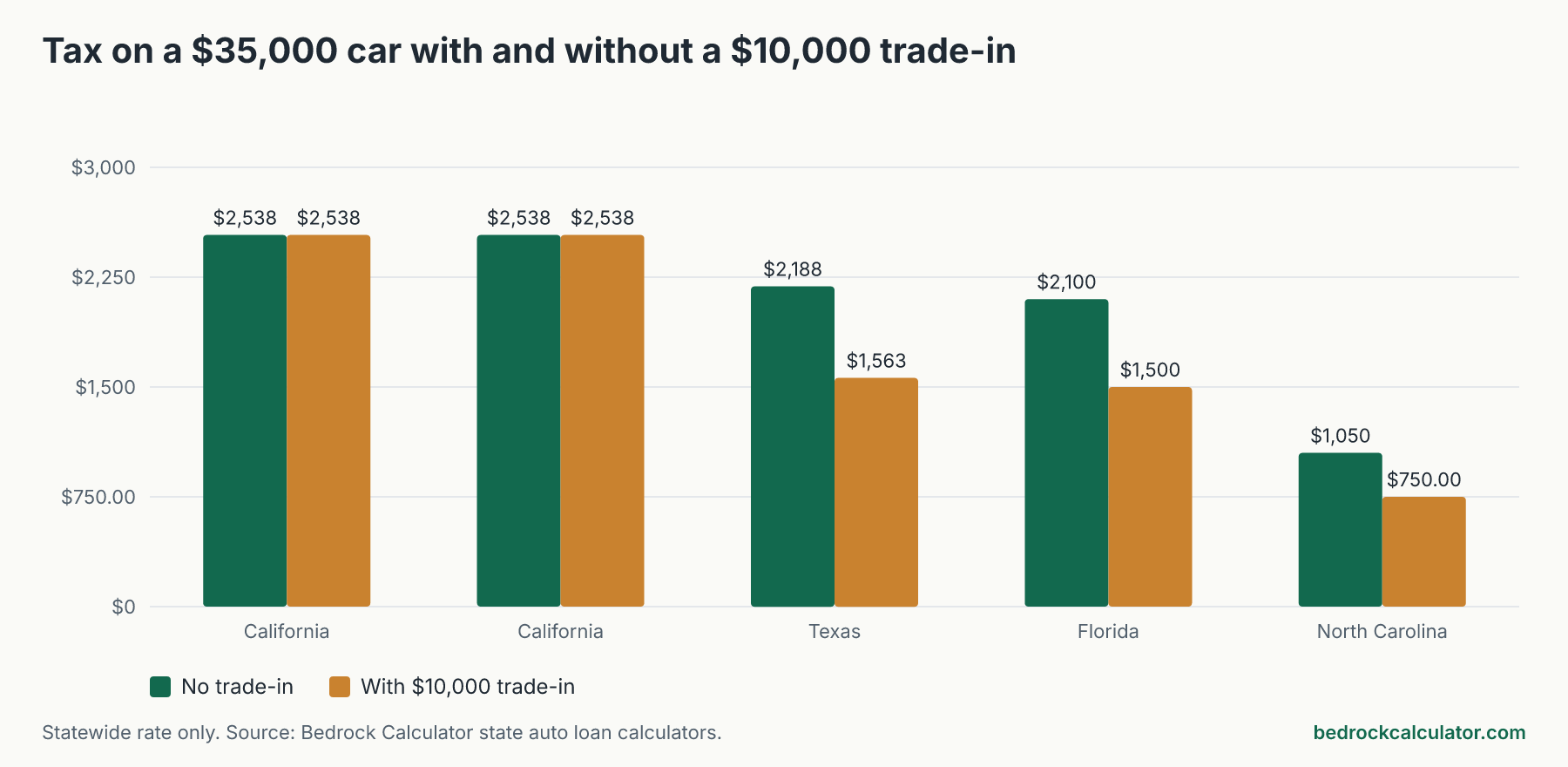
In most states, the value of your trade-in comes off the taxable price. On a $35,000 car with a $10,000 trade-in, you're taxed on the difference, so the trade-in saves you the tax rate times the trade-in value. The biggest saving in our runs is $700.00, which 5 states share: Georgia, Indiana, Rhode Island, Tennessee and Washington.
5 states give no trade-in credit against the tax: California, Oklahoma, Virginia, Hawaii and Oregon. In those states you pay tax on the full price no matter what you trade in. A trade-in still lowers how much you borrow there. It just doesn't cut the tax.
What the numbers leave out
These figures are a fair way to compare states, but they aren't your exact bill. Here is what the calculators don't include in this comparison:
- Local add-ons. We set them to zero. In states that allow them, your total rate can be noticeably higher.
- Dealer documentation fees. They're set by the dealer. Where they're taxable, they add a little tax on top.
- Title, registration and annual vehicle taxes. Those are separate from the purchase tax. Some states charge an annual tax based on the car's value, which can add up to more than the one-time sales tax over a few years.
- Rebates and incentives. We used a single negotiated price. How a manufacturer rebate changes the taxable price depends on the state.
- Used cars and private sales. The rules can differ for private-party purchases, and a few states treat used cars differently.
Get your own figure
To see the tax on your own car, including your local rate, your trade-in and your dealer's fees, open your state's calculator, such as the Florida auto loan calculator, or start from the general auto loan calculator. If you're comparing the tax on other purchases, the sales tax calculator covers general retail rates.