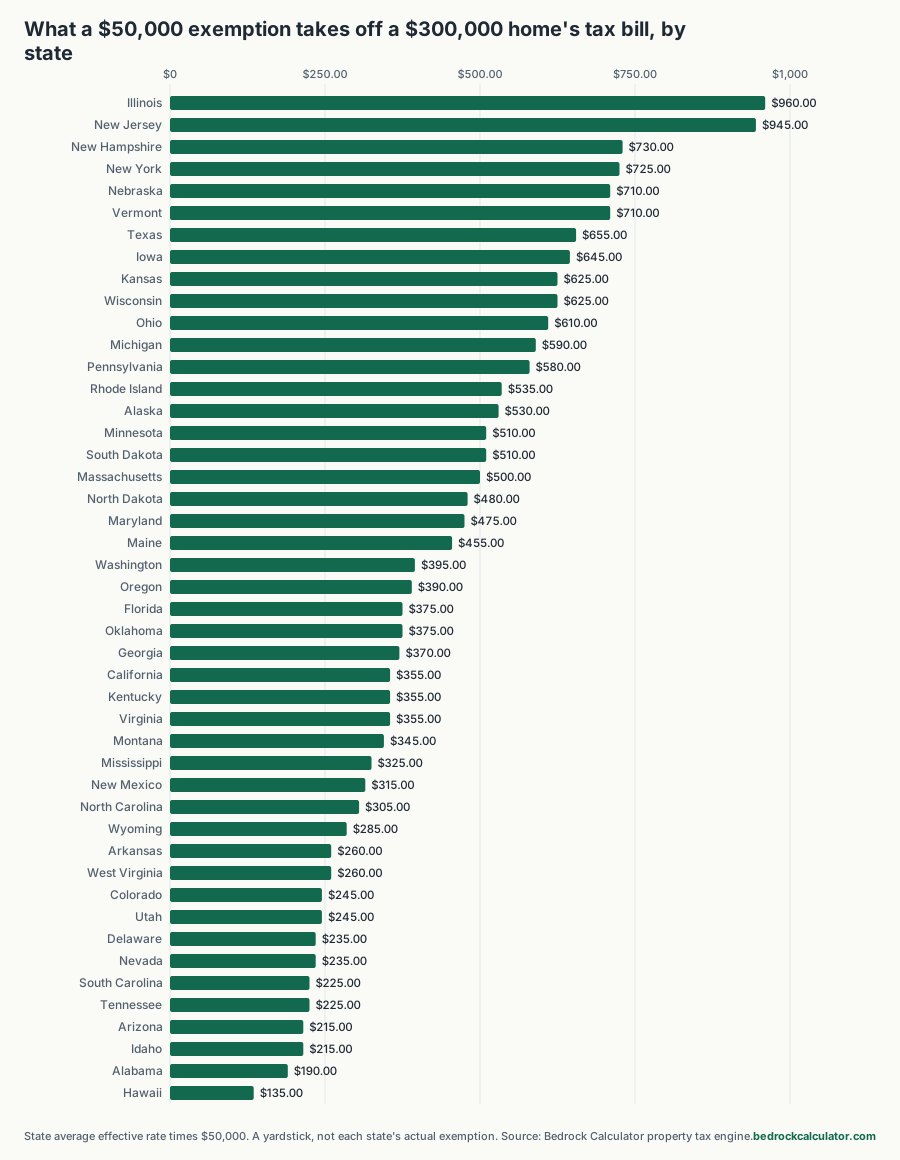
How much does a homestead exemption save in each US state?
Two rules do most of the work of keeping a homeowner's property tax bill in check: a homestead exemption, which takes part of your home's value (or part of the bill) off the table, and an assessment cap, which limits how fast your home's taxable value can climb.
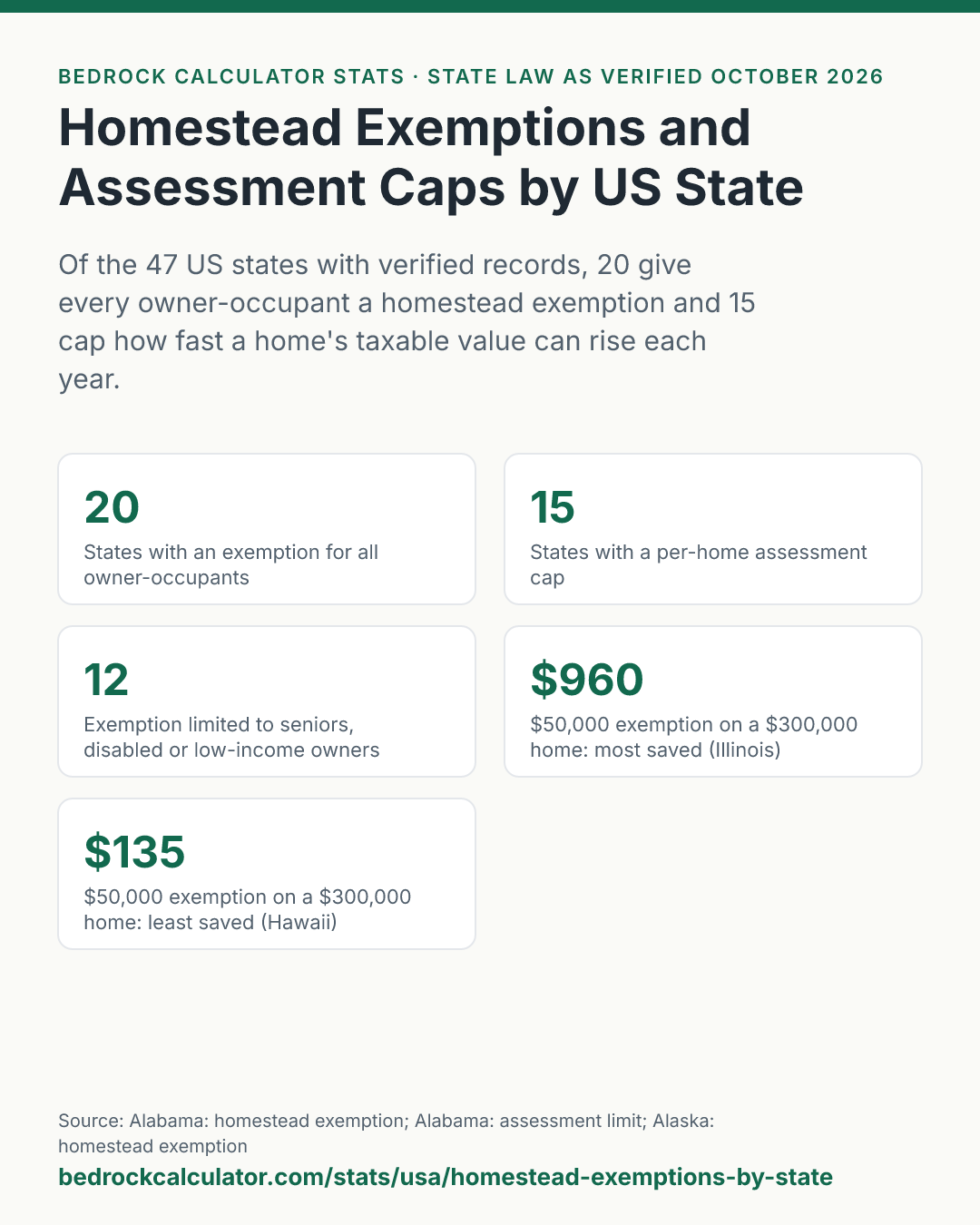
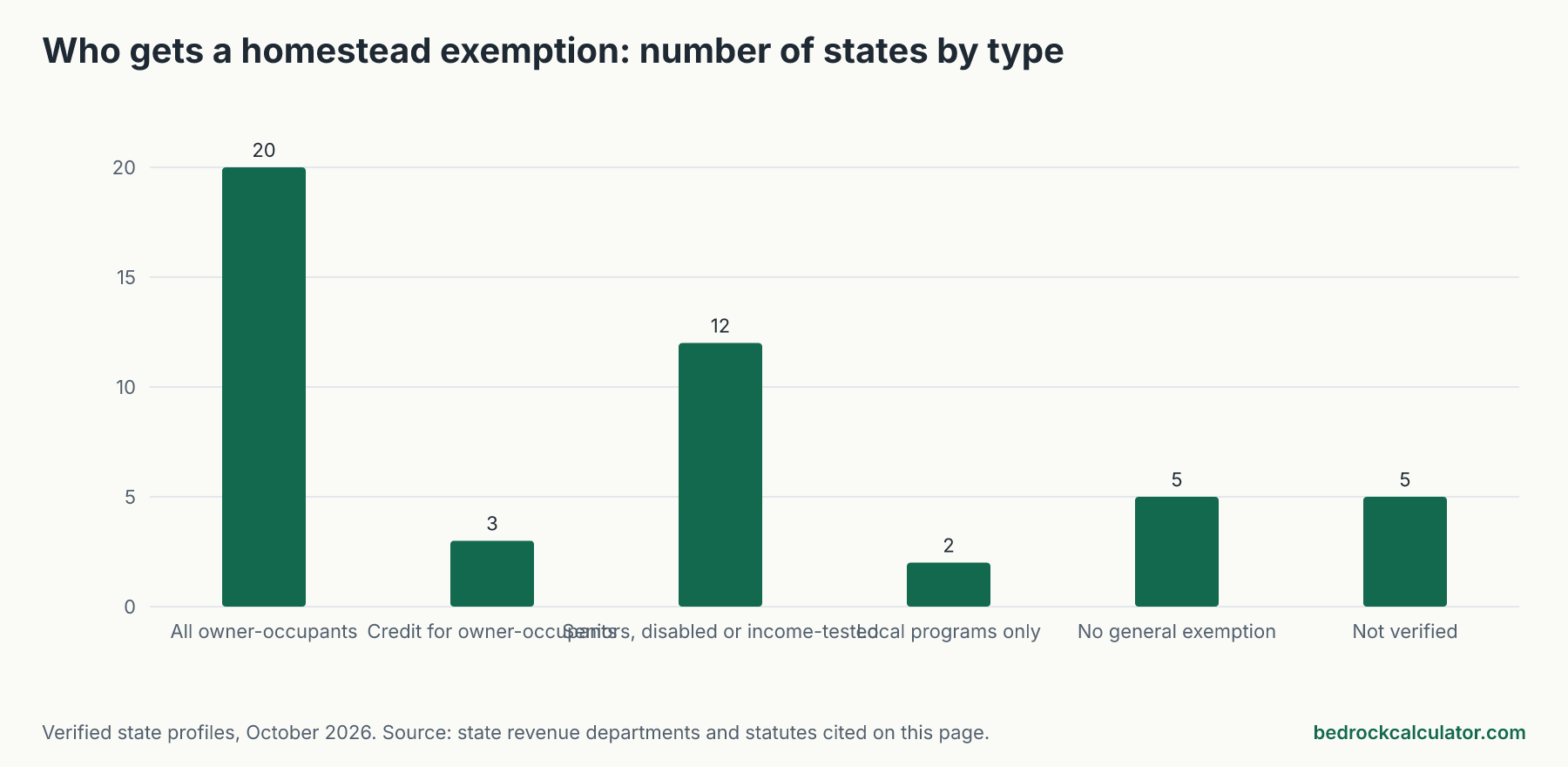
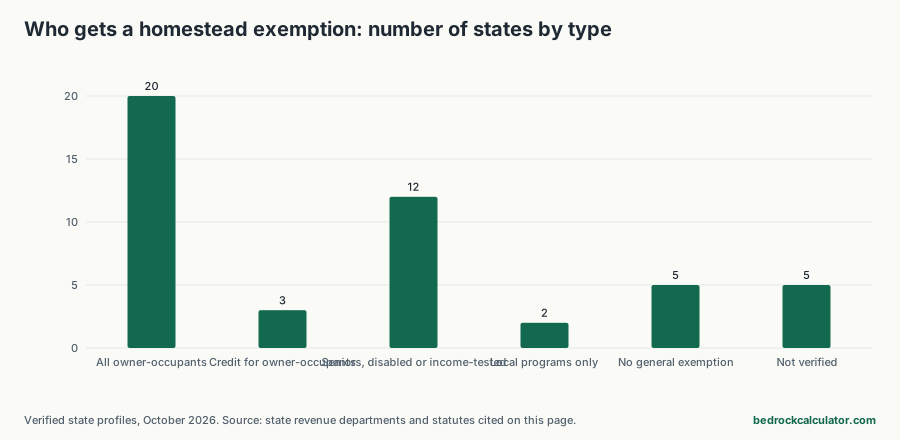
Of the 47 US states with verified records here (we count the District of Columbia as a state for this page), 20 give a homestead exemption to every owner-occupant, and 12 reserve theirs for seniors, people with disabilities or lower-income owners. 15 put a cap on how much an individual home's taxable value can rise each year.
How we built this list
Every rule on this page comes from our verified state profiles, which record each state's homestead and assessment rules with a link to the revenue department, statute or county office they came from. We only publish a rule that has both a description and a source. Connecticut, Indiana, Louisiana, Missouri have neither rule verified yet, so they're left out rather than guessed at.
We then sorted each state into a few plain types so you can compare at a glance. The types are our reading of the cited rule. The rule itself, word for word as we verified it, sits in the state-by-state list further down.
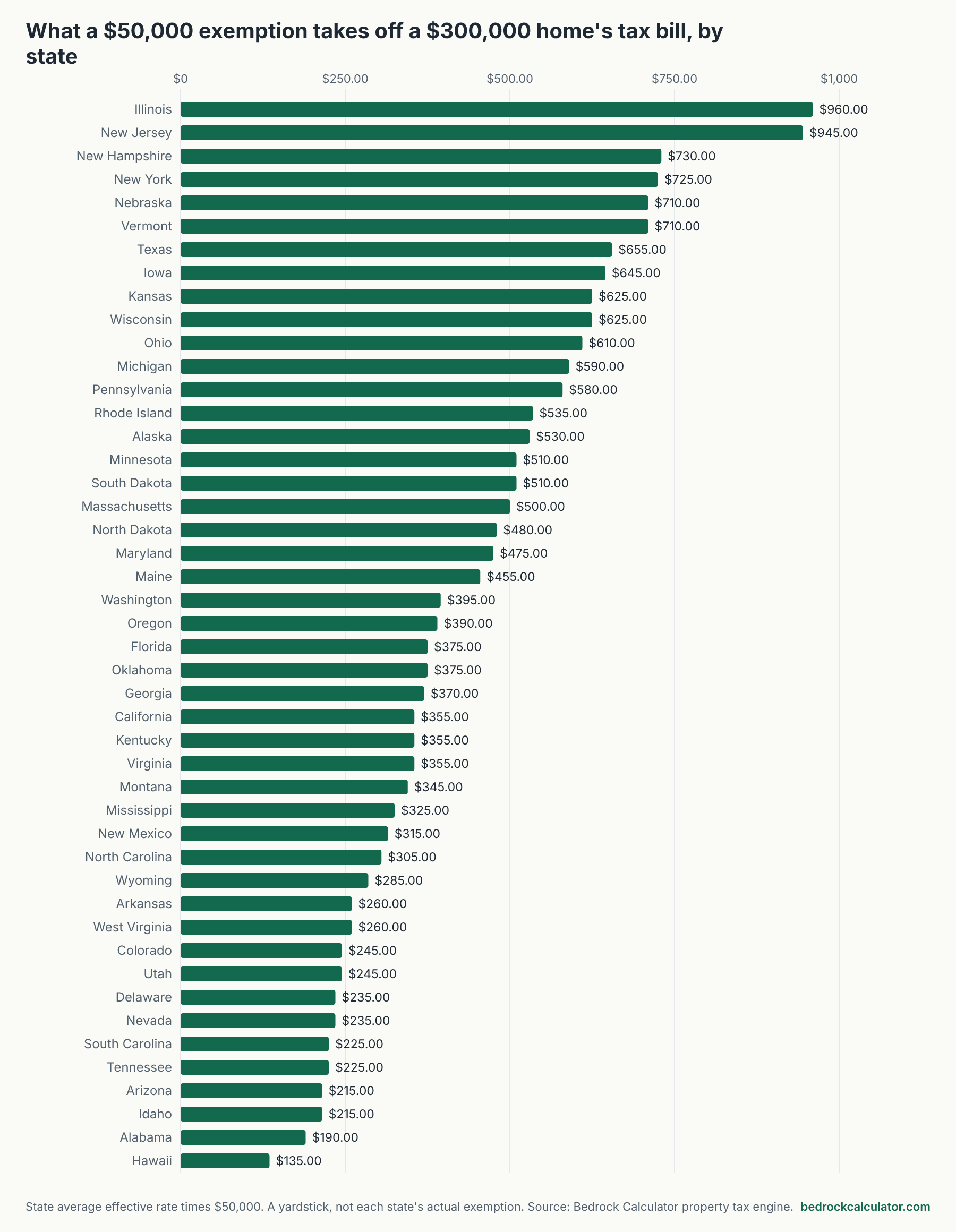
The dollar columns come from the property tax calculator. "Tax on $300,000" is the bill on a $300,000 home at the state's average effective rate. "Saved by a $50,000 exemption" is how much that bill drops when $50,000 of value is exempted, which is the calculator's own exemption example. It's a yardstick for how much an exemption is worth in each state, not the size of any state's real exemption. The District of Columbia has no rate in our property tax engine, so its dollar cells are blank.
Homestead exemption and assessment cap by US state
Click a column heading to sort. "None listed" in the cap column means our verified record doesn't show a cap on individual homes. It isn't a promise that no local limit exists.
Homestead exemption and assessment cap by state
Download CSVTypes are our reading of each state's cited rule; the full rule and its source are listed below the table. Dollar columns use the state average effective rate.
| Alabama | All owner-occupants | Per-home assessment cap | $1,140 | $190 |
| Alaska | Local programs only | None listed | $3,180 | $530 |
| Arizona | Not verified | Per-home assessment cap | $1,290 | $215 |
| Arkansas | Credit for owner-occupants | Per-home assessment cap | $1,560 | $260 |
| California | All owner-occupants | Per-home assessment cap | $2,130 | $355 |
| Colorado | Seniors, disabled or income-tested | None listed | $1,470 | $245 |
| Delaware | Seniors, disabled or income-tested | None listed | $1,410 | $235 |
| District of Columbia | All owner-occupants | Per-home assessment cap | n/a | n/a |
| Florida | All owner-occupants | Per-home assessment cap | $2,250 | $375 |
| Georgia | All owner-occupants | Per-home assessment cap | $2,220 | $370 |
| Hawaii | Local programs only | None listed | $810 | $135 |
| Idaho | All owner-occupants | None listed | $1,290 | $215 |
| Illinois | All owner-occupants | Levy or aggregate limit, not per home | $5,760 | $960 |
| Iowa | All owner-occupants | Levy or aggregate limit, not per home | $3,870 | $645 |
| Kansas | All owner-occupants | None listed | $3,750 | $625 |
| Kentucky | Seniors, disabled or income-tested | None listed | $2,130 | $355 |
| Maine | All owner-occupants | None listed | $2,730 | $455 |
| Maryland | Not verified | Per-home assessment cap | $2,850 | $475 |
| Massachusetts | Not verified | Levy or aggregate limit, not per home | $3,000 | $500 |
| Michigan | All owner-occupants | Per-home assessment cap | $3,540 | $590 |
| Minnesota | All owner-occupants | None listed | $3,060 | $510 |
| Mississippi | All owner-occupants | None listed | $1,950 | $325 |
| Montana | All owner-occupants | None listed | $2,070 | $345 |
| Nebraska | Seniors, disabled or income-tested | None listed | $4,260 | $710 |
| Nevada | Not verified | Cap on the tax bill | $1,410 | $235 |
| New Hampshire | Seniors, disabled or income-tested | None listed | $4,380 | $730 |
| New Jersey | Seniors, disabled or income-tested | None listed | $5,670 | $945 |
| New Mexico | All owner-occupants | Per-home assessment cap | $1,890 | $315 |
| New York | Seniors, disabled or income-tested | Local only | $4,350 | $725 |
| North Carolina | Seniors, disabled or income-tested | None listed | $1,830 | $305 |
| North Dakota | Credit for owner-occupants | Levy or aggregate limit, not per home | $2,880 | $480 |
| Ohio | Seniors, disabled or income-tested | Levy or aggregate limit, not per home | $3,660 | $610 |
| Oklahoma | All owner-occupants | Per-home assessment cap | $2,250 | $375 |
| Oregon | No general exemption | Per-home assessment cap | $2,340 | $390 |
| Pennsylvania | All owner-occupants | Levy or aggregate limit, not per home | $3,480 | $580 |
| Rhode Island | Not verified | Levy or aggregate limit, not per home | $3,210 | $535 |
| South Carolina | Seniors, disabled or income-tested | Per-home assessment cap | $1,350 | $225 |
| South Dakota | Seniors, disabled or income-tested | Levy or aggregate limit, not per home | $3,060 | $510 |
| Tennessee | No general exemption | Local only | $1,350 | $225 |
| Texas | All owner-occupants | Per-home assessment cap | $3,930 | $655 |
| Utah | All owner-occupants | None listed | $1,470 | $245 |
| Vermont | No general exemption | None listed | $4,260 | $710 |
| Virginia | No general exemption | None listed | $2,130 | $355 |
| Washington | No general exemption | None listed | $2,370 | $395 |
| West Virginia | Seniors, disabled or income-tested | None listed | $1,560 | $260 |
| Wisconsin | Credit for owner-occupants | None listed | $3,750 | $625 |
| Wyoming | All owner-occupants | Per-home assessment cap | $1,710 | $285 |
n/a means the property tax calculator holds no rate for that area, so no dollar figures are computed.
Which states give every homeowner an exemption
The 20 states with a general exemption for owner-occupants are Alabama, California, District of Columbia, Florida, Georgia, Idaho, Illinois, Iowa, Kansas, Maine, Michigan, Minnesota, Mississippi, Montana, New Mexico, Oklahoma, Pennsylvania, Texas, Utah, Wyoming. They work in very different ways:
- A fixed dollar amount off the value. California takes a flat amount off the taxable value of an owner-occupied home. Florida exempts a first slice from all levies and a second slice from non-school levies only. Texas exempts a large amount, but only from school district taxes.
- A share of the value. Utah taxes a primary residence on only part of its market value, and Idaho and Wyoming exempt a percentage up to a cap.
- A lower rate. Montana taxes a qualifying homestead under its own tiered rate schedule.
Arkansas, North Dakota, Wisconsin use a credit against the bill instead, which works out the same for the owner: a smaller bill if you apply.
In Colorado, Delaware, Kentucky, Nebraska, New Hampshire, New Jersey, New York, North Carolina, Ohio, South Carolina, South Dakota, West Virginia, the main relief is limited to seniors, people with disabilities, veterans or households under an income limit. Alaska, Hawaii leave it to local governments, and our records cite the program in their largest city or borough. Oregon, Tennessee, Vermont, Virginia, Washington have no general homestead exemption at all, though each offers some targeted relief or deferral.
Assessment caps: which states limit how fast your value rises
A per-home cap is the rule most homeowners notice, because it decides what happens to your bill when local prices jump. Alabama, Arizona, Arkansas, California, District of Columbia, Florida, Georgia, Maryland, Michigan, New Mexico, Oklahoma, Oregon, South Carolina, Texas, Wyoming limit how much an individual home's taxable value can rise in a year. The limits run from tight to loose, and many reset when the home sells, so a new buyer is taxed on the full price while the neighbor who bought years ago is not.
Nevada caps the increase in the tax bill itself rather than the value. New York, Tennessee have limits that apply only in some places: in New York only in its largest assessing units, and in Tennessee through local senior freezes.
Illinois, Iowa, Massachusetts, North Dakota, Ohio, Pennsylvania, Rhode Island, South Dakota limit something different. These states cap the total a town or school district can raise, or the growth in the tax base as a whole. That restrains overall growth, but it doesn't stop your own assessment from rising faster than your neighbors'.
What an exemption is worth in dollars
An exemption is worth more where rates are high. At Illinois's average rate, taking $50,000 off a home's value cuts the bill by about $960 a year. At Hawaii's rate the same exemption is worth $135. Use this as a sense of scale: your real saving depends on the exemption your state actually grants and the rate in your county.
The rule in each state, with sources
- Alabama. Homestead: Owner-occupants under 65 are exempt from state property tax on up to $4,000 of assessed value and from county tax on up to $2,000 of assessed value; homeowners 65 and older, permanently disabled or blind owners get larger exemptions, some tied to income of $12,000. (source) Cap: Act 2024-344 (HB73) limits annual increases in the taxable assessed value of Class II and Class III property to 7% for tax collections beginning October 1, 2025, continuing through the fiscal year beginning October 1, 2027. (source)
- Alaska. Homestead: In Anchorage, a resident 65 or older (or a qualifying widow or widower 60 or older) can exempt up to $150,000 of a primary residence's assessed value, and any owner-occupant can claim a residential exemption of 40% of assessed value up to $75,000; both are due by March 15. (source)
- Arizona. Cap: A property's limited property value, which drives the tax bill, can rise by no more than 5% a year over the prior year's limited value. (source)
- Arkansas. Homestead: Homeowners who apply through the county assessor get a homestead property tax credit of up to $500 a year, rising to up to $600 starting with 2026 tax bills; owners 65 or older or disabled can also have their homestead's assessed value frozen. (source) Cap: Under Amendment 79, a homestead's taxable value can rise no more than 5% a year and other real property no more than 10% a year until it reaches full assessed value; new construction and substantial improvements are not capped. (source)
- California. Homestead: The homeowners' exemption reduces the taxable value of an owner-occupied principal residence by $7,000; first-time filers must claim it with the county assessor by February 15 for the full exemption. (source) Cap: Proposition 13 generally limits annual increases in a property's base year value to no more than 2%, except when it changes ownership or undergoes new construction. (source)
- Colorado. Homestead: Qualifying seniors (and surviving spouses) can exempt 50% of the first $200,000 of their primary residence's actual value when the state budget allows, with the state reimbursing local governments. (source)
- Delaware. Homestead: Homeowners 65 or older get a state credit of 50% of regular school property taxes, up to $500, on their primary residence; applications are due April 30 and recent arrivals must meet a domicile requirement (10 consecutive years for those domiciled on or after January 1, 2018). (source)
- District of Columbia. Homestead: The homestead deduction cuts an owner-occupant's assessed value by $91,950 for tax year 2026, saving about $781.58 a year; applications approved between October 1 and March 31 cover the whole tax year. (source) Cap: Homestead properties may not be taxed on more than a 10% increase in assessed value each year, applied automatically as a credit on the bill (the cap is 2% for qualifying seniors). (source)
- Florida. Homestead: The homestead exemption removes the first $25,000 of assessed value from all property taxes and an additional $25,000 (inflation-adjusted each January 1) of value above $50,000 from non-school levies. (source) Cap: Under Save Our Homes, a homestead's assessed value can rise each year by no more than the lower of 3% or the prior calendar year's change in CPI-U. (source)
- Georgia. Homestead: An owner-occupied home may receive a $2,000 exemption from county and school taxes, deducted from its 40% assessed value; applications are due April 1 (or by the end of the 45-day assessment appeal window). (source) Cap: Under HB 581 (2024), unless a county, city or school district opted out, a homestead's assessed value is frozen at its 2024 base for 2025 and from the 2026 digest year can rise only by an inflation index equal to the prior year's CPI-U change. (source)
- Hawaii. Homestead: In Honolulu the home exemption cuts the taxable value of an owner-occupied principal residence by $120,000, or $160,000 for owners 65 or older, rising to $140,000 and $180,000 effective July 1, 2027; claims are due September 30. (source)
- Idaho. Homestead: The homeowner's exemption removes 50% of the value of a primary residence and up to one acre of land from tax, capped at $125,000 (the maximum the State Tax Commission lists for 2021-2025); it is filed once with the county assessor. (source)
- Illinois. Homestead: The General Homestead Exemption (35 ILCS 200/15-175) cuts equalized assessed value by the increase over the 1977 EAV, up to $10,000 in Cook County, $8,000 in counties contiguous to Cook, and $6,000 elsewhere, with a separate Senior Citizens Homestead Exemption for owner-occupants 65 and older. (source) Cap: There is no statewide cap on individual assessments; the Property Tax Extension Limitation Law (PTELL) generally limits growth in property tax extensions for covered taxing districts to the lesser of 5% or the annual change in CPI. (source)
- Iowa. Homestead: SF 2472 (signed May 18, 2026) replaces the homestead tax credit (tax on $4,850 of value) with an exemption of 10% of the homestead's taxable value, minimum $5,500 and maximum $20,000, starting with assessment year 2026 (taxes paid September 2027 and March 2028); owners 65 or older also get an additional $6,500 exemption. (source) Cap: Residential taxable value is assessed value times an annual assessment limitation percentage certified by the Department of Revenue, which was 44.5345% for assessment year 2025. (source)
- Kansas. Homestead: Residential property is exempt from the statewide school levy (K.S.A. 72-5142) on the first $75,000 of appraised value; Kansas has no general homestead exemption from other local levies. (source)
- Kentucky. Homestead: Homeowners 65 or older, or classified as totally disabled, can deduct $49,100 from their home's assessed value for the 2025-2026 assessment years. (source)
- Maine. Homestead: Owners who have held Maine homestead property for at least 12 months and make it their permanent residence on April 1 can exempt up to $25,000 of its just value. (source)
- Maryland. Cap: The Homestead Property Tax Credit limits the taxable assessment increase on an owner-occupied home to 10% a year (110% of the prior year's taxable assessment) for the State property tax; each county sets its own homestead percentage for county tax. (source)
- Massachusetts. Cap: Proposition 2 1/2 bars a community from levying more than 2.5% of the total full and fair cash value of all taxable property and limits how much the total levy can grow each year. (source)
- Michigan. Homestead: The Principal Residence Exemption (Form 2368) exempts an owner-occupied home from up to 18 mills of local school operating tax; an affidavit filed by June 1 covers that year's summer and winter levies. (source) Cap: Taxable value can rise by the lesser of 5% or inflation each year until a transfer of ownership uncaps it; the 2026 inflation rate multiplier is 1.027 (a 2.7% cap). (source)
- Minnesota. Homestead: The homestead market value exclusion removes 40% of value for homes worth $95,000 or less, then $38,000 minus 9% of value above $95,000, and phases out completely at $517,200. (source)
- Mississippi. Homestead: Homeowners who own and occupy on January 1 apply at the county tax assessor between January 1 and April 1; owners under 65 get a credit of up to $300, while owners 65 or older or totally disabled are exempt on the first $7,500 of assessed value. (source)
- Montana. Homestead: For 2026 a qualifying homestead is taxed at tiered rates: 0.76% on the first $378,000 of market value, 0.90% to $756,000, 1.10% to $1,511,999 and 1.90% above; 2027 applications run May 4, 2026 to March 1, 2027. (source)
- Nebraska. Homestead: The homestead exemption is limited to people 65 or older before January 1, 2026, qualified disabled individuals, and qualified disabled veterans and their surviving spouses; Form 458 was due to the county assessor by June 30, 2026, and some categories face income and value limits. (source)
- Nevada. Cap: An owner's primary residence gets a partial abatement that limits the tax bill increase to 3% a year (NRS 361.4723); for fiscal 2026-27 the residential cap factor is 1.030 in every county, while other property is capped at up to 8% (8.0% in Clark and Washoe). (source)
- New Hampshire. Homestead: Personal exemptions and credits such as the Elderly Exemption (RSA 72:39-a), Exemption for the Blind (RSA 72:37) and Standard and Optional Veterans' Tax Credit (RSA 72:28) are adopted by each municipality; you apply to the municipality by April 15 and may appeal a denial to the BTLA or Superior Court by September 1. (source)
- New Jersey. Homestead: State relief for homeowners comes through the ANCHOR benefit; the 2025 ANCHOR benefit requires NJ gross income of $250,000 or less, with applications due by November 2, 2026. (source)
- New Mexico. Homestead: The Head of Family exemption reduces the taxable value of one New Mexico resident's property by $2,000 (one claim per household, statewide); veterans may also deduct up to $10,000 of taxable value. (source) Cap: Residential valuation increases are generally limited to 3% per year under the limitation in effect since 2001, but the cap is removed when a property is transferred and the home is reappraised at current market value; owners 65+ or disabled with modified gross income of $44,200 or less (Bernalillo County figure) can apply for a value freeze. (source)
- New York. Homestead: The School Tax Relief (STAR) program offers Basic STAR (income limit $500,000 for the STAR credit, $250,000 for the STAR exemption) and Enhanced STAR for owners 65 or older, with an Enhanced STAR income limit of $110,750 for 2026 benefits ($113,550 for 2027). (source) Cap: Real Property Tax Law 1805 limits class-one (mainly 1-3 family residential) assessment increases to 6% per year and 20% over any five years, but only in 'special assessing units' (assessing units with a population of one million or more, per RPTL 1801); no general statewide cap was found. (source)
- North Carolina. Homestead: For 2026, owners who are 65 or older or totally and permanently disabled and whose income is $38,800 or less can exclude the greater of $25,000 or 50% of their home's appraised value. Disabled veterans can exclude up to $45,000, with no age or income limit. Under the circuit breaker deferment, taxes are capped at 4% of income for qualifying owners with income up to $38,800, or 5% for income up to $58,200. All three programs use Form AV-9. (source)
- North Dakota. Homestead: Any owner-occupant can apply online from January 1 to April 1 for the state Primary Residence Credit of up to $1,600 a year, with no age or income limit and one credit per household (N.D.C.C. 57-02-08.9); owners 65 or older or permanently disabled with income up to $70,000 may also qualify for the separate Homestead Property Tax Credit. (source) Cap: North Dakota has no cap on assessed values; instead N.D.C.C. 57-15-01.2 limits each taxing district's property tax levy in dollars to 3% growth over its base-year levy unless voters approve more, with listed exceptions. (source)
- Ohio. Homestead: Homeowners who are 65 or older, permanently and totally disabled, or certain surviving spouses, with income under the inflation-indexed limit ($40,000 for tax year 2025), are shielded from tax on up to $29,000 of true value (indexed annually); 100% disabled veterans get $58,000 with no income test, and owner-occupied homes also get a 2.5% owner-occupancy credit on qualifying levies. (source) Cap: Ohio does not cap assessed values; instead, tax reduction factors under R.C. 319.301 (H.B. 920) cancel the effect of reappraisal value changes on voted levies for existing property, subject to a 20-mill floor for school district current-expense levies. (source)
- Oklahoma. Homestead: The homestead exemption takes $1,000 off the assessed value of a primary residence. To count for the current year, the application (OTC Form 921) must be filed with the county assessor by March 15, or within 30 days of a Notice of Increase in Valuation. The owner must own and live in the home on January 1. (source) Cap: Under Okla. Const. Art. 10 § 8B, the fair cash value of locally assessed real property may rise at most 3% a year for homestead and agricultural land and 5% for all other property. A 2026 referred measure, SQ 847 (SJR 39), would lower these caps to 1.75% and 4% starting in tax year 2027. (source)
- Oregon. Homestead: Oregon has no statewide general homestead exemption and no exemptions based solely on age or income. Disabled veterans and their surviving spouses can exempt part of their homestead's assessed value, and senior and disabled homeowners may qualify to defer their taxes. (source) Cap: Ballot Measure 50 limits MAV to the greater of 103% of the prior year's assessed value or the prior year's MAV, so MAV rises at most 3% a year. Exceptions include new construction or remodeling worth more than $18,700 in one year or $46,200 over 5 years (thresholds CPI-indexed after 2024). (source)
- Pennsylvania. Homestead: Under the Taxpayer Relief Act (Act 1 of 2006), state gaming money funds school-tax homestead and farmstead exclusions that cut a primary residence's taxable assessed value; owners apply to the county assessment office by March 1. In Philadelphia the money lowers the wage tax instead. (source) Cap: Act 1 of 2006 limits school property-tax increases (it is a tax-increase control, not an assessment cap): school boards can raise taxes each year to keep up with inflation, but larger increases need voter approval by referendum unless an exception applies. (source)
- Rhode Island. Cap: R.I. Gen. Laws § 44-5-2 limits each city or town's total property tax levy to no more than 4% above the previous fiscal year's levy (fiscal 2013 and later); this caps the levy, not individual assessments. (source)
- South Carolina. Homestead: The first $50,000 of fair market value of the dwelling is exempt from county, municipal, school and special-assessment property taxes for owners who are 65 or older, totally and permanently disabled, or legally blind and have lived in South Carolina for at least one year (S.C. Code 12-37-250). (source) Cap: Increases in a property's fair market value from a countywide reappraisal are capped at 15% over five years, measured on land and improvements together; the cap does not apply to new improvements or to the year after an assessable transfer of interest such as a sale (S.C. Code 12-37-3140(B)). (source)
- South Dakota. Homestead: South Dakota's 'homestead exemption' is a deferral for owners 70 or older that delays payment until the property is sold, alongside an assessment freeze for owners 65 or older or disabled (income limits apply) and a $200,000 valuation exemption for permanently and totally disabled veterans. (source) Cap: SB 216 (2025) caps growth in each county's total owner-occupied assessed value at 3% a year, and taxing district budgets at 3% growth, for taxes payable in 2027 through 2031. (source)
- Tennessee. Homestead: Tennessee has no general homestead exemption; instead, the 2026 state tax relief program reimburses low-income homeowners 65 or older or disabled (2025 household income up to $38,470, relief calculated on up to $33,600 of market value) and disabled veterans (relief on up to $175,000 of market value). (source) Cap: There is no statewide assessment cap, but participating counties and cities offer a tax freeze for homeowners 65 or older under a local income limit (for example $63,470 for 2026 in Davidson, Knox and Shelby counties). (source)
- Texas. Homestead: School districts must exempt $140,000 of a residence homestead's value (Tax Code 11.13(b)), plus an additional $60,000 for owners age 65 or older or disabled (Tax Code 11.13(c)). (source) Cap: A qualified residence homestead's appraised value may rise no more than 10% a year plus new improvements (Tax Code 23.23); other real property under an annually set value threshold has a 20% annual circuit breaker cap (Tax Code 23.231). (source)
- Utah. Homestead: A primary residence (occupied at least 183 consecutive days a year) gets a 45% exemption, so the owner pays tax on 55% of fair market value, and only one residential exemption is allowed per household (Utah Code 59-2-103; Utah Constitution Article XIII, Section 3). (source)
- Vermont. Homestead: Vermont has no flat homestead exemption; instead, residents who own and occupy their home as of April 1 file Form HS-122 (Homestead Declaration and Property Tax Credit Claim) by April 15, 2026 to be taxed at the homestead education rate rather than the nonhomestead rate, and filing after October 15 classifies the home as nonhomestead. (source)
- Virginia. Homestead: Virginia has no general homestead exemption; a locality may by ordinance grant real estate tax exemption or deferral for owner-occupants 65 or older and, if the ordinance provides, the permanently and totally disabled (Va. Code 58.1-3210). (source)
- Washington. Homestead: Washington has no general homestead exemption; relief is limited to the senior citizen and people with disabilities exemption and deferral programs for qualifying limited-income owners. (source)
- West Virginia. Homestead: Owner-occupants who are 65 or older or permanently and totally disabled may exempt the first $20,000 of their home's assessed value, applying to the county assessor by December 1. (source)
- Wisconsin. Homestead: The lottery and gaming credit, shown as a reduction on the tax bill, lowers the property tax bill for Wisconsin residents who own and use the dwelling as their primary residence on January 1 of the levy year. (source)
- Wyoming. Homestead: Under W.S. 39-11-105(a)(xlvi), owner-occupied single-family homes get a 25% exemption on the first $1,000,000 of fair market value, and from tax year 2026 the owner must live there at least eight months a year; owners 65 or older who have paid Wyoming residential property tax for 25 years may instead take a 50% exemption on up to $3,000,000 under paragraph (xlv), which is repealed effective July 1, 2027. (source) Cap: W.S. 39-11-105(a)(xliii)-(xliv) exempts any increase in a single-family home's and its improved land's assessed value above the prior year's assessed value plus 4%, effectively capping annual growth at 4% unless the increase comes from improvements or other listed exceptions. (source)
What this page doesn't cover
This page covers the property tax bill on the home you live in. If you're planning a retirement move and want the taxes on wages, estates and inheritances side by side, see retiree taxes by state, which flags the senior relief listed here but answers a different question. These are the main statewide rules, not every program. Many states add exemptions for veterans, surviving spouses, farmland or disability, and many counties and cities run their own. Deadlines matter too: most exemptions need an application, often by a date early in the year, and some must be renewed.
To estimate your own bill, open the property tax calculator and enter your exemption in dollars. State pages such as the Texas property tax calculator, the Florida property tax calculator and the California property tax calculator explain how each state's rules apply. If you think your assessment is too high, the property tax appeal savings calculator shows what a successful appeal is worth.