How much is overtime worth after taxes?
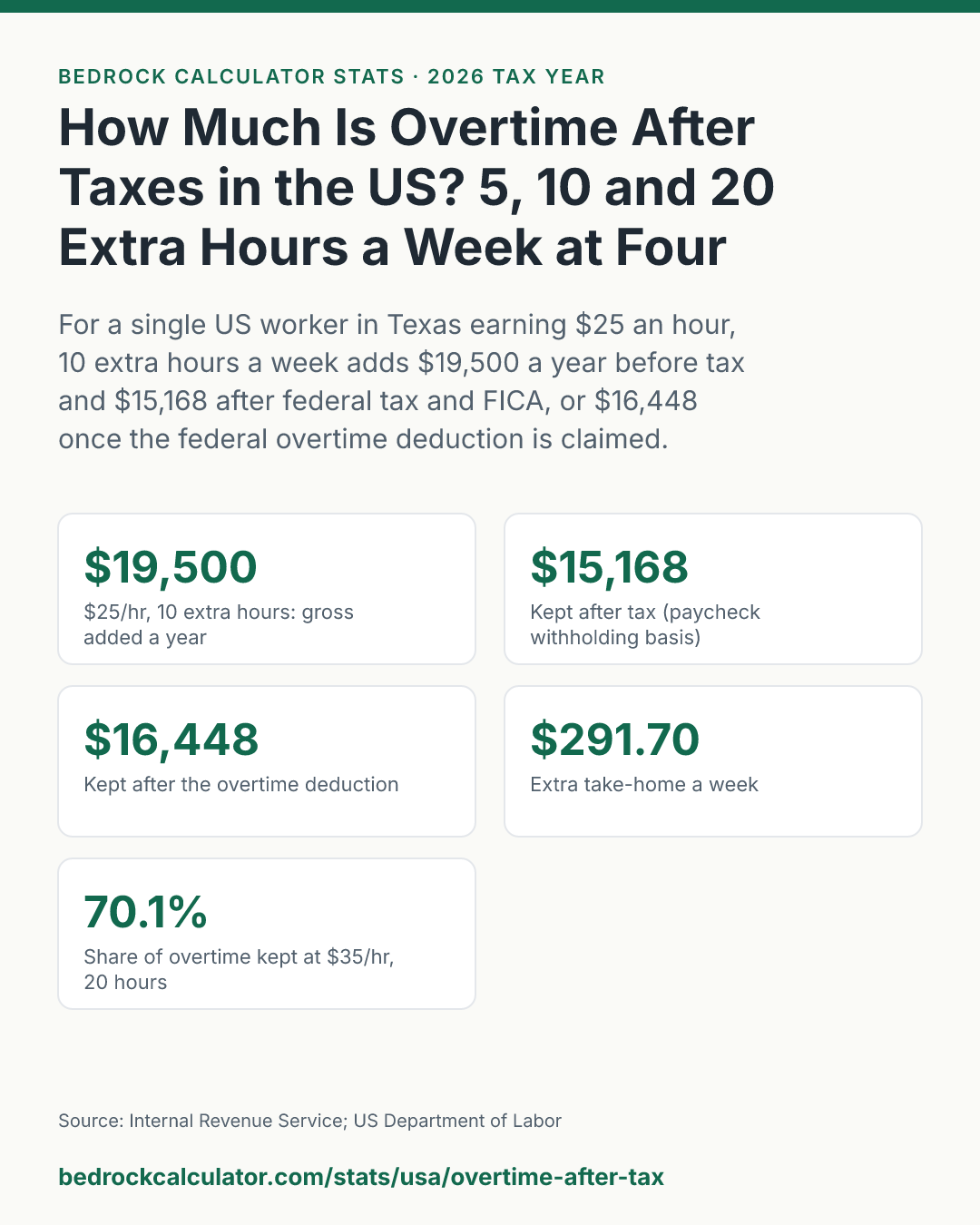
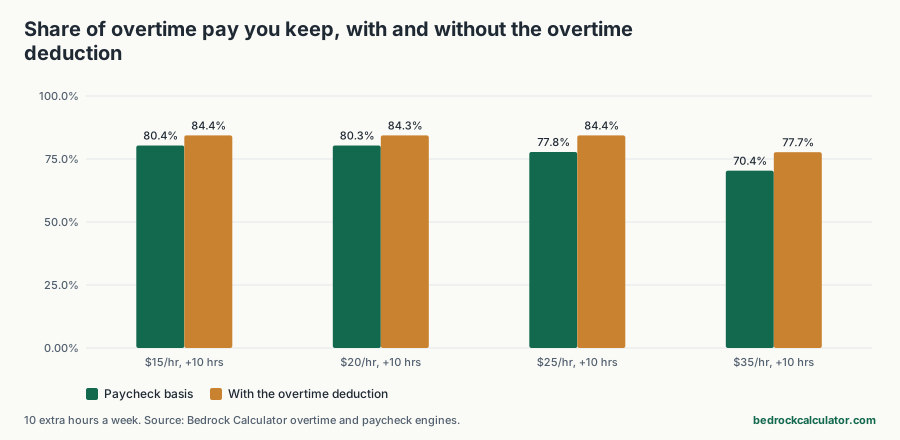
For a single US worker in Texas earning $25 an hour, working 10 extra hours every week adds $19,500 to a year's pay before tax. After federal income tax, Social Security and Medicare, $15,168 of it reaches your bank account, about $291.70 a week. That's 77.8% of every overtime dollar.
The new federal deduction for overtime pay, available for 2025 through 2028, lowers the tax on the premium half of time and a half. Claim it on your return and the same overtime is worth $16,448 for the year.
How we worked out these numbers
All figures are for the United States in the 2026 tax year. We used two of the site's calculators together:
- The overtime pay calculator works out gross pay under the federal Fair Labor Standards Act: straight time for the first 40 hours of the week and 1.5 times the regular rate for every hour above that. At $25 an hour that's $37.50 an hour of overtime. We used no bonus, so the regular rate is the hourly wage.
- The paycheck calculator turns a year's gross pay into take-home pay. We ran it once for 40 hours a week and once with overtime, and took the difference.
The paycheck setup is the same every time: a single filer in Texas, paid weekly, with no 401(k), health insurance or other deductions. We chose Texas because it has no state income tax, so the figures show the federal picture on its own. In a state with an income tax you'd keep less. The overtime is assumed to happen every week for all 52 weeks.
What the paycheck calculator doesn't do is apply the overtime deduction. It's a deduction you claim when you file, so we priced it separately using the same 2026 federal brackets and standard deduction the paycheck calculator uses: the tax on your wages, minus the tax on your wages less the year's overtime premium. More on that below.
What 5, 10 and 20 extra hours a week add after tax
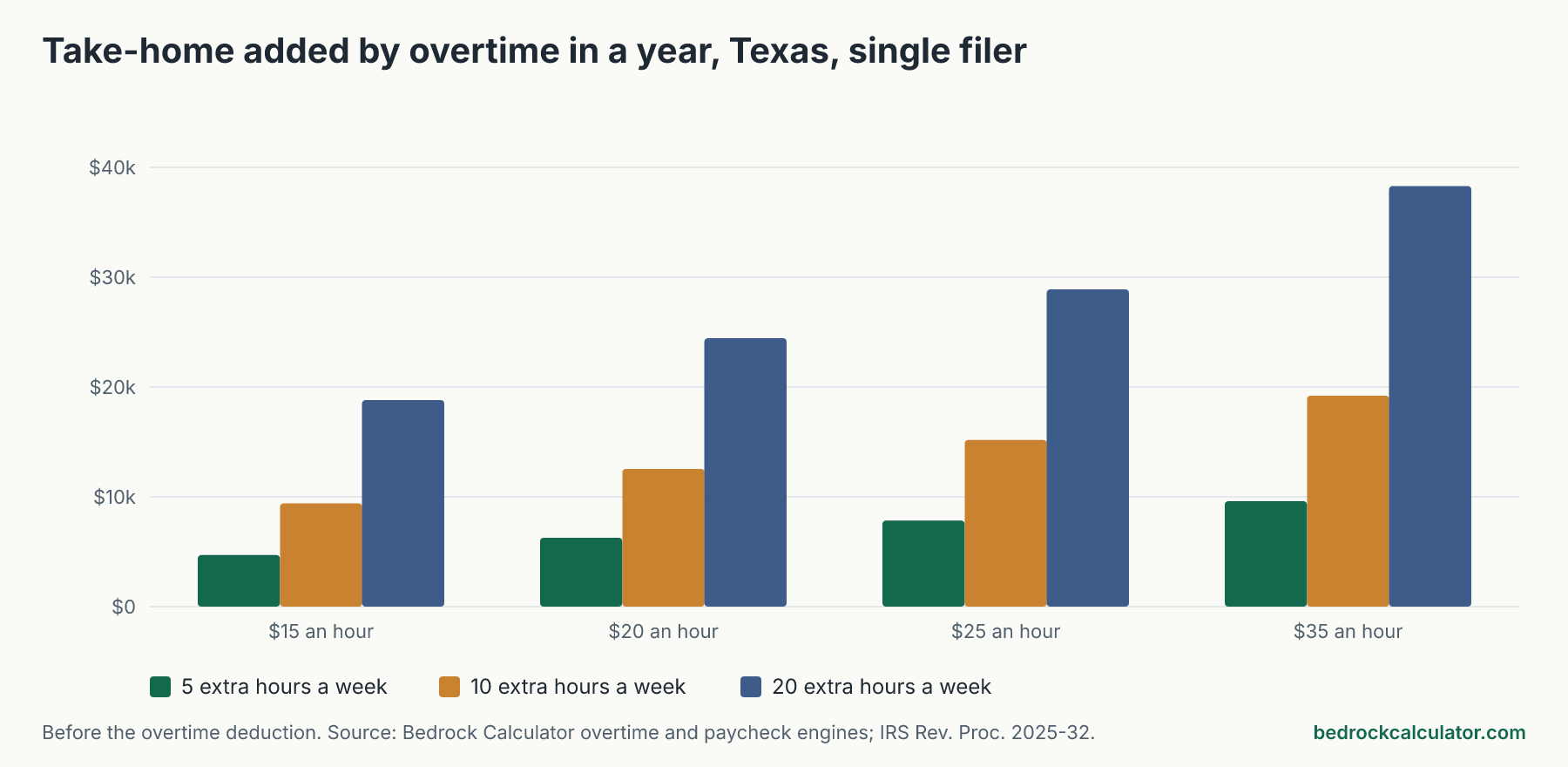
What overtime adds in a year after tax, single filer in Texas
Download CSVOvertime every week for 52 weeks at 1.5x the regular rate. After-tax figures subtract federal income tax and FICA from the paycheck calculator; the last columns add back the federal deduction for qualified overtime (2025 to 2028).
| $15.00 | 5 | $5,850 | $4,700 | 80.3% | $234 | $4,934 |
| $15.00 | 10 | $11,700 | $9,401 | 80.4% | $468 | $9,869 |
| $15.00 | 20 | $23,400 | $18,802 | 80.3% | $936 | $19,738 |
| $20.00 | 5 | $7,800 | $6,267 | 80.4% | $312 | $6,579 |
| $20.00 | 10 | $15,600 | $12,535 | 80.3% | $624 | $13,159 |
| $20.00 | 20 | $31,200 | $24,439 | 78.3% | $1,878 | $26,317 |
| $25.00 | 5 | $9,750 | $7,834 | 80.3% | $390 | $8,224 |
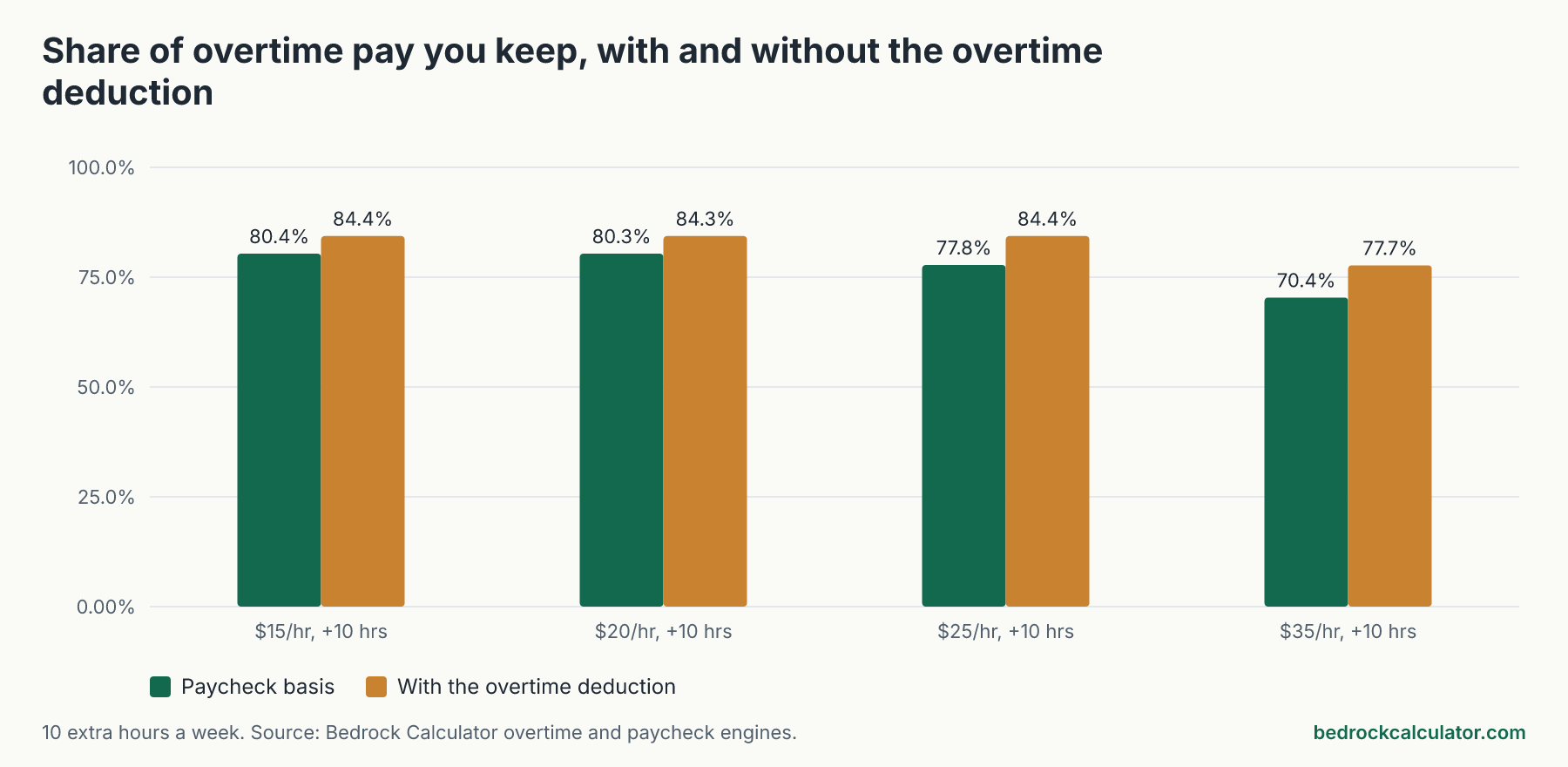
| $25.00 | 10 | $19,500 | $15,168 | 77.8% | $1,280 | $16,448 |
| $25.00 | 20 | $39,000 | $28,887 | 74.1% | $2,750 | $31,637 |
| $35.00 | 5 | $13,650 | $9,603 | 70.3% | $1,001 | $10,604 |
| $35.00 | 10 | $27,300 | $19,206 | 70.4% | $2,002 | $21,208 |
| $35.00 | 20 | $54,600 | $38,299 | 70.1% | $2,862 | $41,161 |
At lower wages, about four-fifths of overtime pay makes it to you. A $15-an-hour worker adding five hours a week keeps 80.3% of the extra $5,850, or $4,700. Ten hours at $20 an hour adds $12,535 after tax.
The share kept falls as overtime pushes income into a higher bracket. At $35 an hour with 20 extra hours, you'd earn $54,600 more and keep $38,299, or 70.1%.
Is overtime taxed more than regular pay?
No. There's no separate overtime tax. Overtime is ordinary wages, taxed under the same brackets and the same Social Security and Medicare rates as the rest of your pay.
It can feel like it's taxed more for two reasons. First, overtime is the top slice of your income, so it's taxed at your highest bracket, while your first dollars of pay were taxed at the lowest rates or, under the standard deduction, not at all. Second, when a big overtime week lands in one paycheck, payroll software may withhold as if you earned that much every week. Any excess comes back as a refund when you file.
How the federal overtime deduction changes the answer
For tax years 2025 through 2028, you can deduct qualified overtime from your federal taxable income. "Qualified" means the premium portion only: the extra half in time and a half, not the regular rate you'd get for any hour. Single filers can deduct up to $12,500 a year, and the deduction phases out once income passes $150,000. Every scenario on this page stays under that income level.
For the $25-an-hour worker with 10 extra hours a week, the deduction cuts federal income tax by $1,280, raising what they keep from $15,168 to $16,448. At $35 an hour with 20 extra hours, it lifts the total to $41,161. The cap matters at the top of our range: $25 an hour with 20 extra hours; $35 an hour with 20 extra hours would earn more premium than $12,500, so only the capped amount is deducted.
A few things the deduction doesn't do:
- It doesn't cut Social Security or Medicare tax. FICA still applies to every overtime dollar.
- It doesn't change state income tax unless your state chooses to follow it.
- It usually doesn't show up in your paycheck. Withholding is generally figured on your full wages, so the saving tends to arrive as a bigger refund or a smaller bill when you file.
When overtime is worth it
The math is simple: after federal tax and FICA, a single worker in a no-income-tax state keeps between 70.1% and 80.4% of every overtime dollar in our examples, and somewhat more with the deduction. Whether that's worth your evenings and weekends is a personal call, but the money is real.
Two things can change your number. Overtime rules differ in some states: California and a few others require overtime after eight hours in a day, not just 40 in a week, which the overtime calculator doesn't apply. And if a non-discretionary bonus or commission is part of your pay, it raises your regular rate and therefore your overtime rate. Enter it in the overtime calculator to see the effect.
Getting your own number
Start with the overtime pay calculator to get your weekly gross, including any bonus. Then put a year of that pay into the paycheck calculator for your state, or the Texas paycheck calculator if you're in Texas. To see roughly how the overtime deduction would change your tax bill, run the federal income tax calculator on your income with and without the premium portion of your overtime.