When are 2026 estimated tax payments due, and how much should you pay?
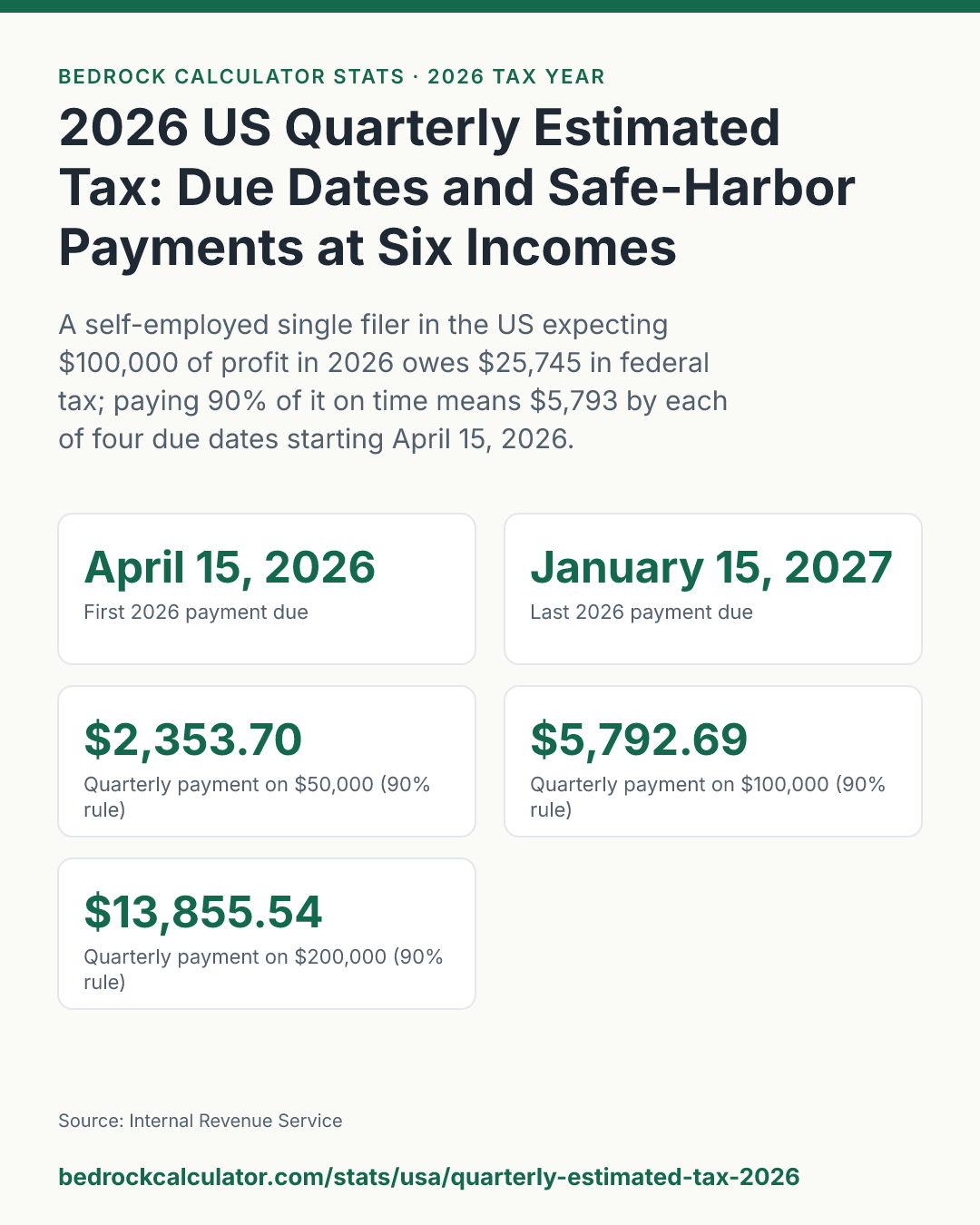
If you're self-employed in the US, or have other income with no tax withheld, the IRS expects you to pay your 2026 tax in four installments: April 15, 2026, June 15, 2026, September 15, 2026 and January 15, 2027.
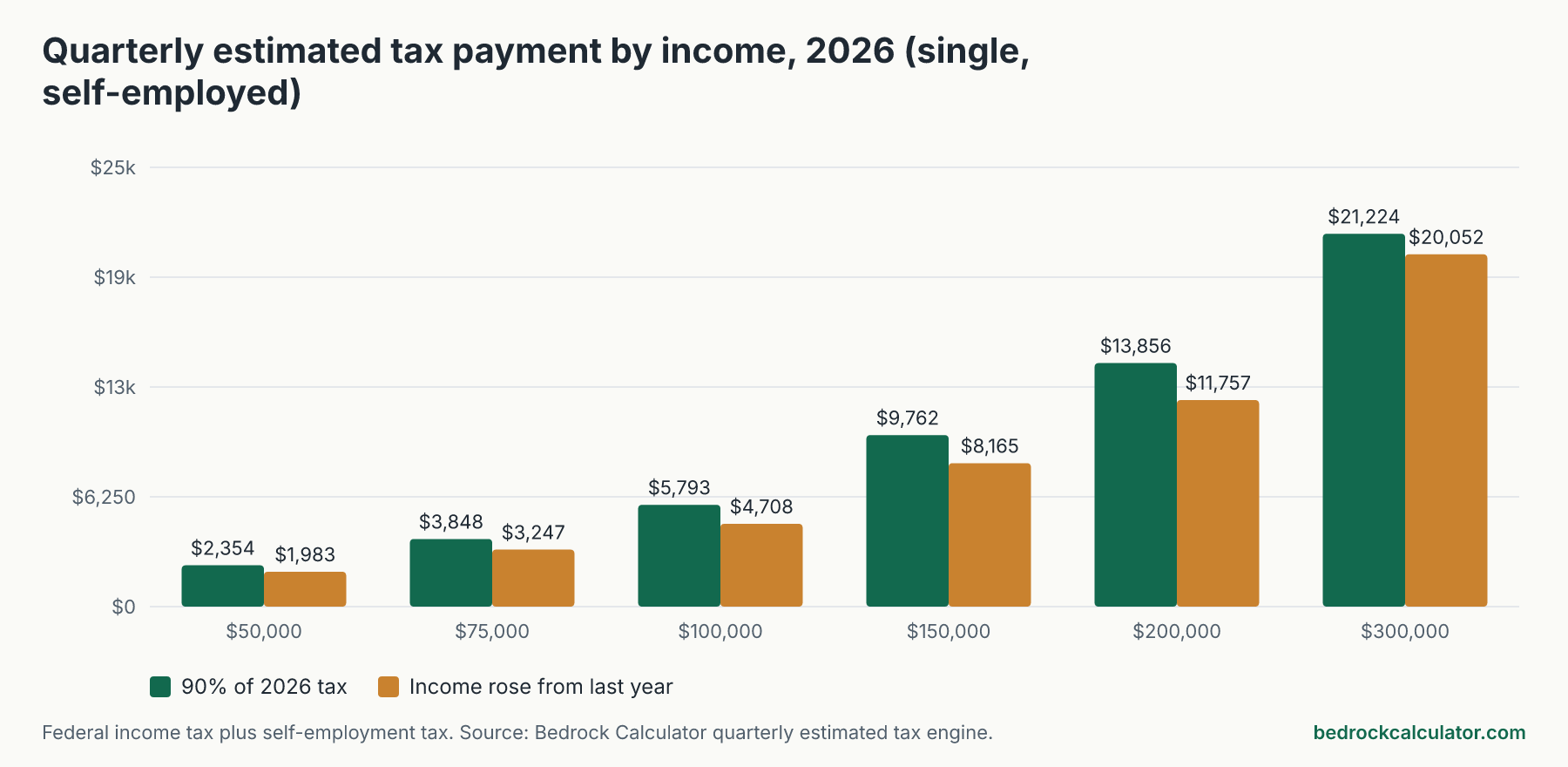
How much? Enough to reach a safe harbor, which keeps you clear of the underpayment penalty. For a single filer with $100,000 of self-employment profit, the total federal bill for 2026 is $25,745.30. Paying 90% of that in four equal parts means $5,792.69 a quarter. If your income was lower last year, basing payments on last year's tax can bring that down, to $4,707.56 a quarter in our example.
2026 estimated tax due dates
2026 federal estimated tax due dates
Download CSV| 1 | January 1 to March 31 | April 15, 2026 |
| 2 | April 1 to May 31 | June 15, 2026 |
| 3 | June 1 to August 31 | September 15, 2026 |
| 4 | September 1 to December 31 | January 15, 2027 |
The periods aren't equal quarters. The second payment covers only two months and the fourth covers four, so if your income is lumpy it's worth looking at which months your money actually came in. You can skip the January payment if you file your 2026 return and pay everything owed by the end of that January.
How we worked out these numbers
We ran the quarterly estimated tax calculator on this site at six levels of self-employment profit for a single filer with no other income and the standard deduction. For each income it works out:
- Self-employment tax from Schedule SE.
- Federal income tax on the profit, after deducting half of the self-employment tax and the 2026 standard deduction.
- The two safe-harbor targets: 90% of this year's total tax, and last year's tax, at 100% or at 110% if last year's adjusted gross income was over the high-income threshold.
- Whichever target is smaller, divided into four equal installments.
For the "income rose" example, we needed a prior-year tax bill. We got it by running the same calculator on last year's income, set so that this year's income is 25% higher, using 2026 rules. That makes it an illustration of how the rule works rather than a real 2025 return, which would use 2025 brackets.
What the calculator leaves out:
- Withholding from a job. Tax withheld from W-2 wages counts toward the safe harbor, and can replace estimated payments altogether. These figures assume none.
- Uneven income. If most of your income arrives late in the year, the annualized installment method on Form 2210 lets you pay less early on. The calculator splits evenly.
- State estimated tax, which most states with an income tax require on their own schedule.
- The Net Investment Income Tax and other taxes beyond income and self-employment tax.
If you owed no tax last year
If your total tax for last year was zero, the year was a full 12 months, and you were a US citizen or resident for all of it, there's no underpayment penalty this year whatever you pay. The calculator applies this exception when you enter zero prior-year tax and confirm the full year. You still owe the tax itself by the April filing deadline, so the 90% figures below are a sensible amount to set aside.
How much to pay each quarter if you base it on this year's tax
The 90% rule works for anyone, whatever happened last year, because it only needs a good estimate of this year.
2026 estimated tax paid on this year's tax: 90% of the 2026 bill (single, self-employed)
Download CSVThe current-year safe harbor: 90% of the 2026 tax, paid in four equal installments. Standard deduction; no other income.
| $50,000 | $7,064.78 | $3,396.11 | $10,460.89 | $9,414.80 | $2,353.70 |
| $75,000 | $10,597.16 | $6,504.31 | $17,101.47 | $15,391.32 | $3,847.83 |
| $100,000 | $14,129.55 | $11,615.75 | $25,745.30 | $23,170.77 | $5,792.69 |
| $150,000 | $21,194.33 | $22,190.68 | $43,385.01 | $39,046.51 | $9,761.63 |
| $200,000 | $28,234.30 | $33,345.88 | $61,580.18 | $55,422.16 | $13,855.54 |
| $300,000 | $31,605.90 | $62,724.57 | $94,330.47 | $84,897.42 | $21,224.36 |
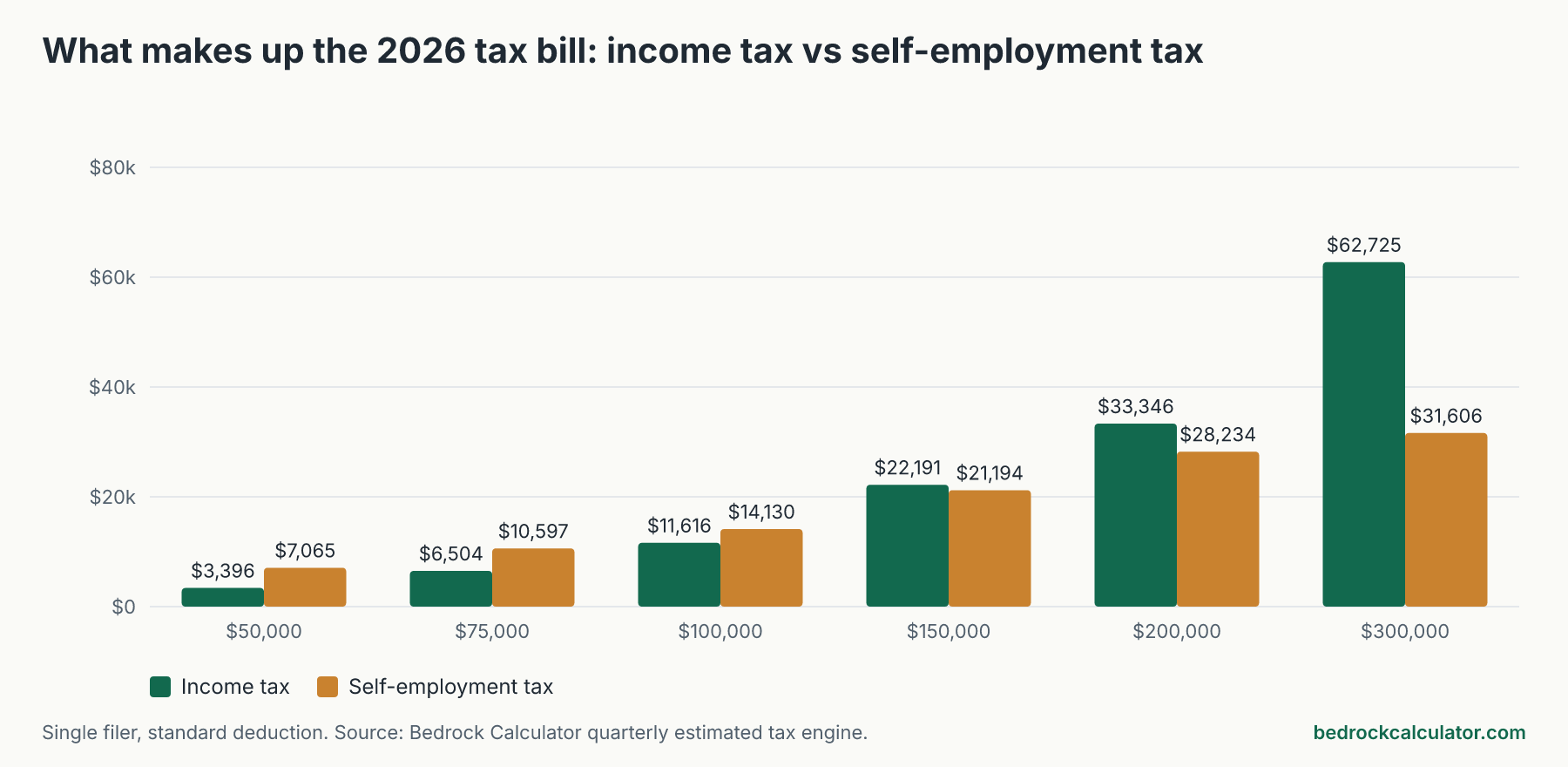
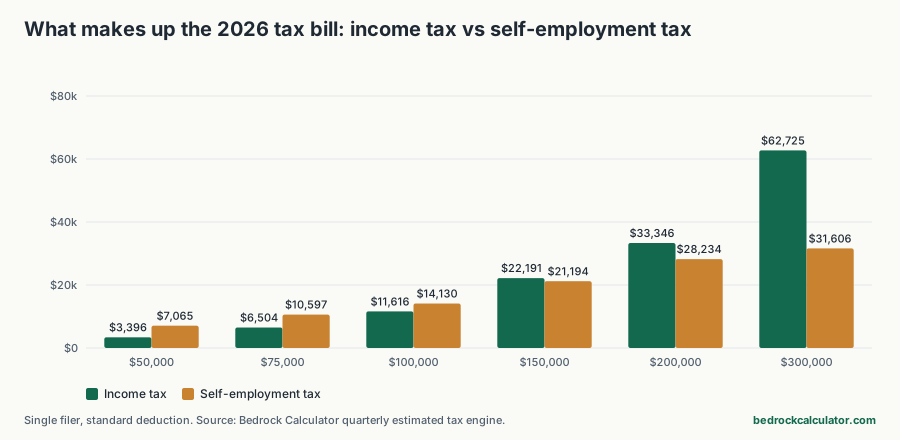
On $50,000 of profit the payment is $2,353.70 a quarter. On $150,000 it's $9,761.63, and on $300,000 it's $21,224.36. Self-employment tax is a big part of these bills, especially at lower incomes.
At $50,000, self-employment tax is $7,064.78 and income tax only $3,396.11. By $300,000 the order has flipped: income tax is $62,724.57 and self-employment tax $31,605.90, because Social Security stops at the wage base while income tax keeps rising through the brackets.
When last year's tax is the cheaper safe harbor
If your income is growing, the prior-year rule usually asks for less. You pay 100% of last year's total tax, or 110% if last year's AGI was above the high-income threshold, and you're protected even if this year's bill turns out much larger.
Safe harbor when income rose 25% from the year before (single)
Download CSVPrior-year tax is the calculator's own figure for the lower income, using 2026 rules, as an illustration. Required payment is the smaller of 90% of 2026 tax and 100% (or 110% above the AGI threshold) of prior-year tax.
| $50,000 | $40,000 | $9,414.80 | $7,932.71 | 100% of prior-year tax | $1,983.18 | $2,528.18 |
| $75,000 | $60,000 | $15,391.32 | $12,989.07 | 100% of prior-year tax | $3,247.27 | $4,112.40 |
| $100,000 | $80,000 | $23,170.77 | $18,830.24 | 100% of prior-year tax | $4,707.56 | $6,915.06 |
| $150,000 | $120,000 | $39,046.51 | $32,660.36 | 100% of prior-year tax | $8,165.09 | $10,724.65 |
| $200,000 | $160,000 | $55,422.16 | $47,028.41 | 100% of prior-year tax | $11,757.10 | $14,551.77 |
| $300,000 | $240,000 | $84,897.42 | $80,206.97 | 110% of prior-year tax | $20,051.74 | $14,123.50 |
Take someone at $100,000 this year who earned $80,000 last year. Their prior-year tax in our illustration was $18,830.24, so quarterly payments of $4,707.56 meet the safe harbor. That's $4,340.53 less over the year than the 90% route. At the top of the table, $300,000 of income, last year's AGI is high enough that the 110% version applies, and the target becomes $80,206.97.
The catch is the April bill. The safe harbor stops the penalty, not the tax. In the $150,000 example, $10,724.65 is still owed with the return. Setting that money aside as you go saves an unpleasant surprise.
How to make the payments
You can pay through IRS Direct Pay, your IRS online account, or EFTPS, and choose "estimated tax" and the 2026 tax year. A payment made late is penalized only for the days it's late, so a missed date is worth fixing as soon as you notice.
To get your own figures, enter your expected profit, other income and last year's tax in the quarterly estimated tax calculator. The self-employment tax calculator breaks out the Schedule SE part, and the federal income tax calculator shows the income tax on its own. For where each bracket starts, see the 2026 federal tax brackets guide.