How long until a refinance pays for itself?
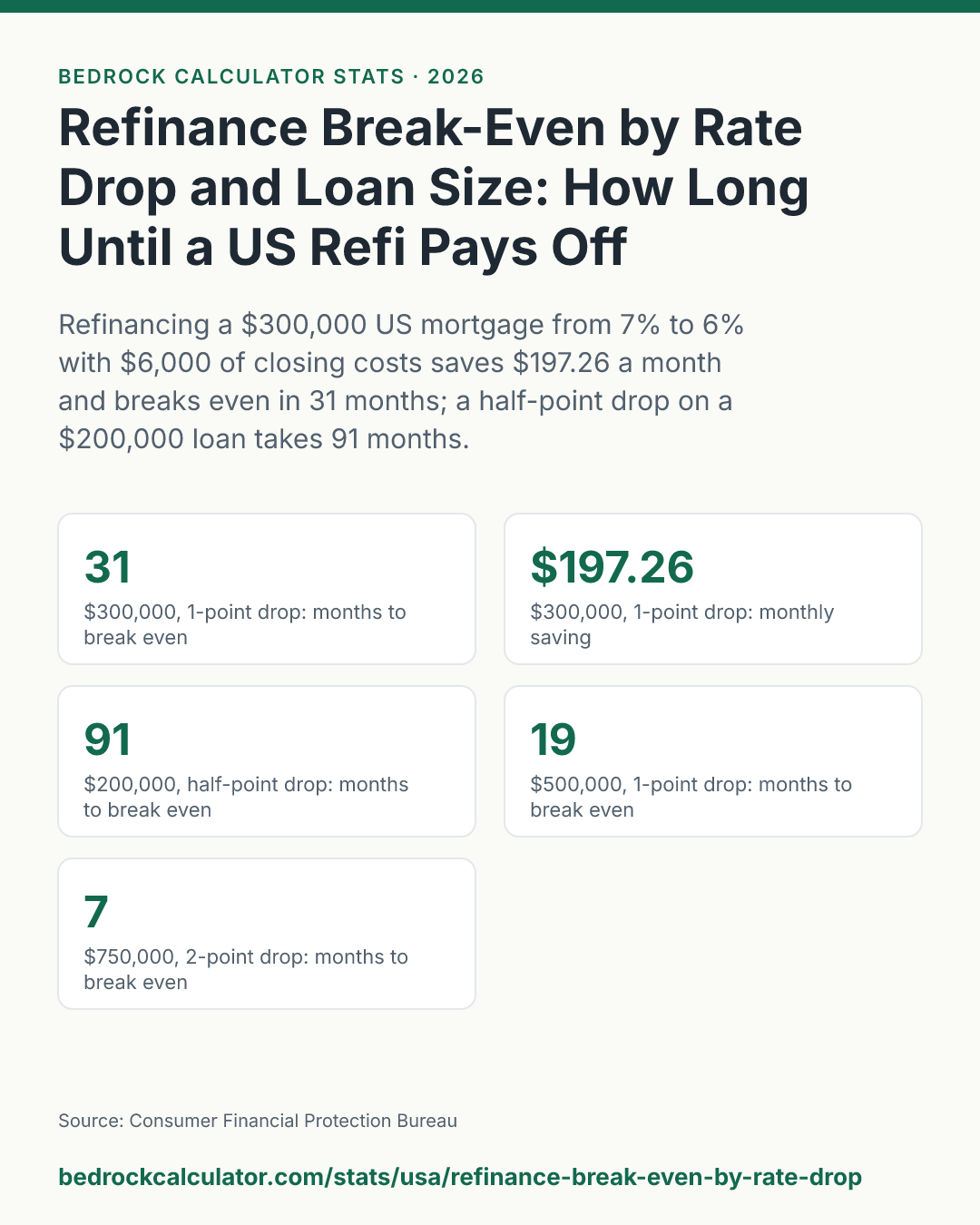
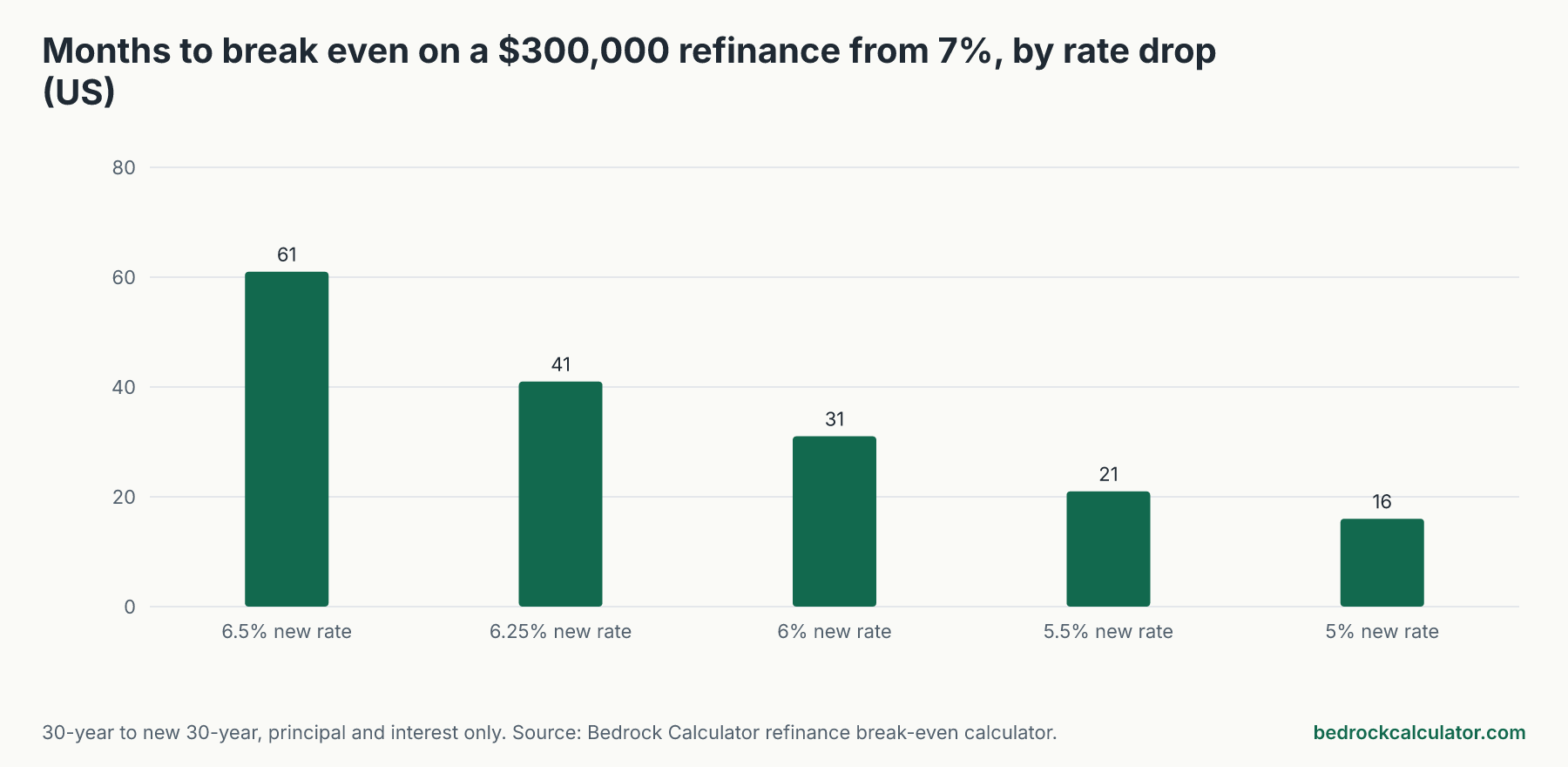
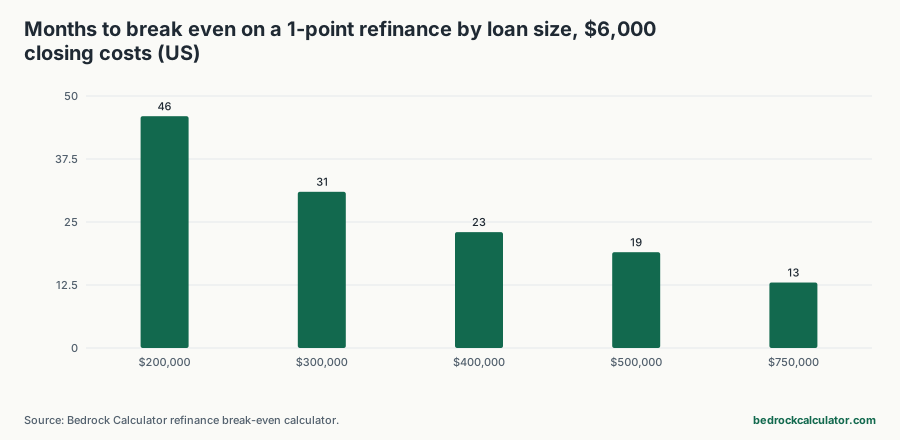
A US homeowner with a $300,000 mortgage at 7% who refinances to 6% cuts the monthly payment from $1,995.91 to $1,798.65, a saving of $197.26. With $6,000 of closing costs, that takes 31 months to pay back, about 2.6 years. Stay longer than that and the refinance comes out ahead.
Smaller loans and smaller rate drops take much longer. A half-point drop on a $200,000 loan needs 91 months, more than 7.6 years, before the same closing costs are recovered.
How we worked out these numbers
We ran the site's refinance break-even calculator for five loan balances and five rate drops, all starting from a 7% rate. Its method is simple: closing costs divided by the drop in your monthly payment, rounded up to a whole month.
To make the comparison fair, every run swaps a 30-year loan with 30 years left for a new 30-year loan. That way the payment falls only because of the lower rate, not because the loan is stretched out. We look at what happens when you do restart the clock further down.
Some things to keep in mind:
- Principal and interest only. Property tax, homeowners insurance and any mortgage insurance stay the same either way, so they don't affect the break-even.
- Closing costs of $6,000, paid in cash. That's an assumption, not a typical figure. Real costs depend on your lender, your state and the loan size, so use your own Loan Estimate. If you roll costs into the new loan instead, the break-even runs a little longer than shown, because you'd pay interest on them.
- No points. Paying discount points changes both the rate and the cost, which the calculator expects you to enter yourself.
- No tax effect. If you itemize and deduct mortgage interest, a lower rate also shrinks that deduction, which isn't counted here.
Break-even months for every loan size and rate drop
Months to break even on a US mortgage refinance, by loan size and rate drop (from 7%)
Download CSV30-year loan with 30 years left refinanced into a new 30-year loan. $6,000 closing costs paid in cash. Principal and interest only; taxes, insurance and PMI are unchanged.
| $200,000 | 91 | 61 | 46 | 31 | 24 |
| $300,000 | 61 | 41 | 31 | 21 | 16 |
| $400,000 | 46 | 31 | 23 | 16 | 12 |
| $500,000 | 37 | 25 | 19 | 13 | 10 |
| $750,000 | 25 | 17 | 13 | 9 | 7 |
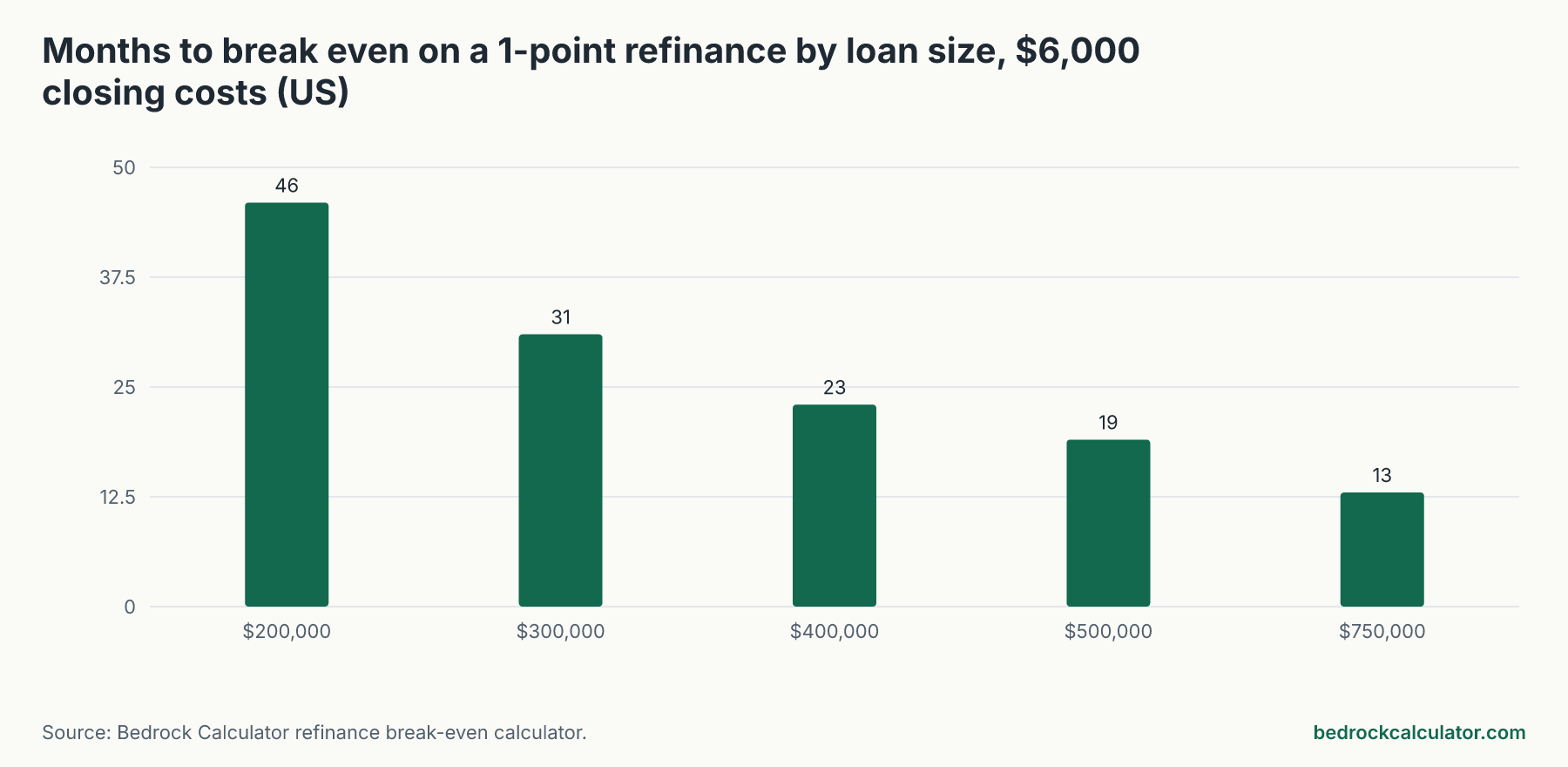
Read across a row to see how much the size of the rate drop matters. On $400,000, a half-point drop pays back in 46 months, one point in 23 months and two points in 12 months. Read down a column to see the effect of loan size: the same one-point drop takes 46 months on $200,000 and 13 months on $750,000.
The rule of thumb that falls out of the table: with fixed closing costs, the bigger the loan and the bigger the rate cut, the faster it pays off. Small loans need a larger rate drop to be worth the trouble.
Why loan size matters so much
Your monthly saving grows in step with the loan. One point off a $200,000 loan saves $131.50 a month. On $500,000 it saves $328.76. If closing costs are a fixed dollar amount, the larger saving pays them back sooner.
In practice, some closing costs scale with the loan, such as title insurance and lender fees charged as a share of the amount, and others don't. If all your costs were 2% of the loan, the break-even on a one-point drop would be 31 months on $200,000 and 31 months on $750,000, the same at every size. Your real costs will sit somewhere between the two pictures.
Closing costs move the answer in direct proportion. On $300,000 with a one-point drop, the break-even is 16 months with $3,000 of costs, 31 months with $6,000 and 46 months with $9,000. Getting a lender to cut fees is often worth more than chasing an extra eighth of a point.
The hidden cost of restarting a 30-year loan
Most people who refinance aren't at the start of their loan. Say you've paid for five years and have 25 left on a $300,000 balance at 7%, with a payment of $2,120.34. We ran this through the mortgage refinance calculator, which also tracks total payments over the life of each loan.
- New 30-year loan at 6%: the payment drops to $1,798.65, a saving of $321.69 a month, and you're back to even in 19 months. But over the full term you pay $17,415 more in total, closing costs included. Five more years of payments outweigh the lower rate.
- New 25-year loan at 6%: the payment is $1,932.90, so you save $187.44 a month and break even in 33 months. Over the life of the loan you come out $50,227 ahead.
The monthly break-even on its own makes the 30-year reset look better. The lifetime number tells the opposite story. If you want the lower payment for cash flow, the 30-year loan may still be the right call, but you can close the gap by paying extra toward principal each month.
When refinancing makes sense
Refinancing is worth it when you expect to keep the loan longer than the break-even period, and when the lifetime cost still works out. That usually means:
- A meaningful rate drop for your loan size. Use the table to see where your loan falls.
- Plans to stay in the home, and keep the mortgage, past the break-even month. If you might sell in two years, a refinance with a 46-month break-even loses money.
- A new term no longer than what you have left, or a plan to pay it down faster.
It's also worth looking at what happened to your loan since you took it. Removing private mortgage insurance, switching from an adjustable rate to a fixed one, or dropping a co-borrower can all be reasons to refinance that this calculation doesn't capture.
Run your own numbers
Plug your balance, current rate, remaining months, quoted rate and closing costs into the refinance break-even calculator for the payback period. Then check the lifetime picture, including a term reset or cash out, in the mortgage refinance calculator. The mortgage calculator shows the full payment with taxes and insurance.