How are RSUs and ESPP shares taxed, and what do you keep?
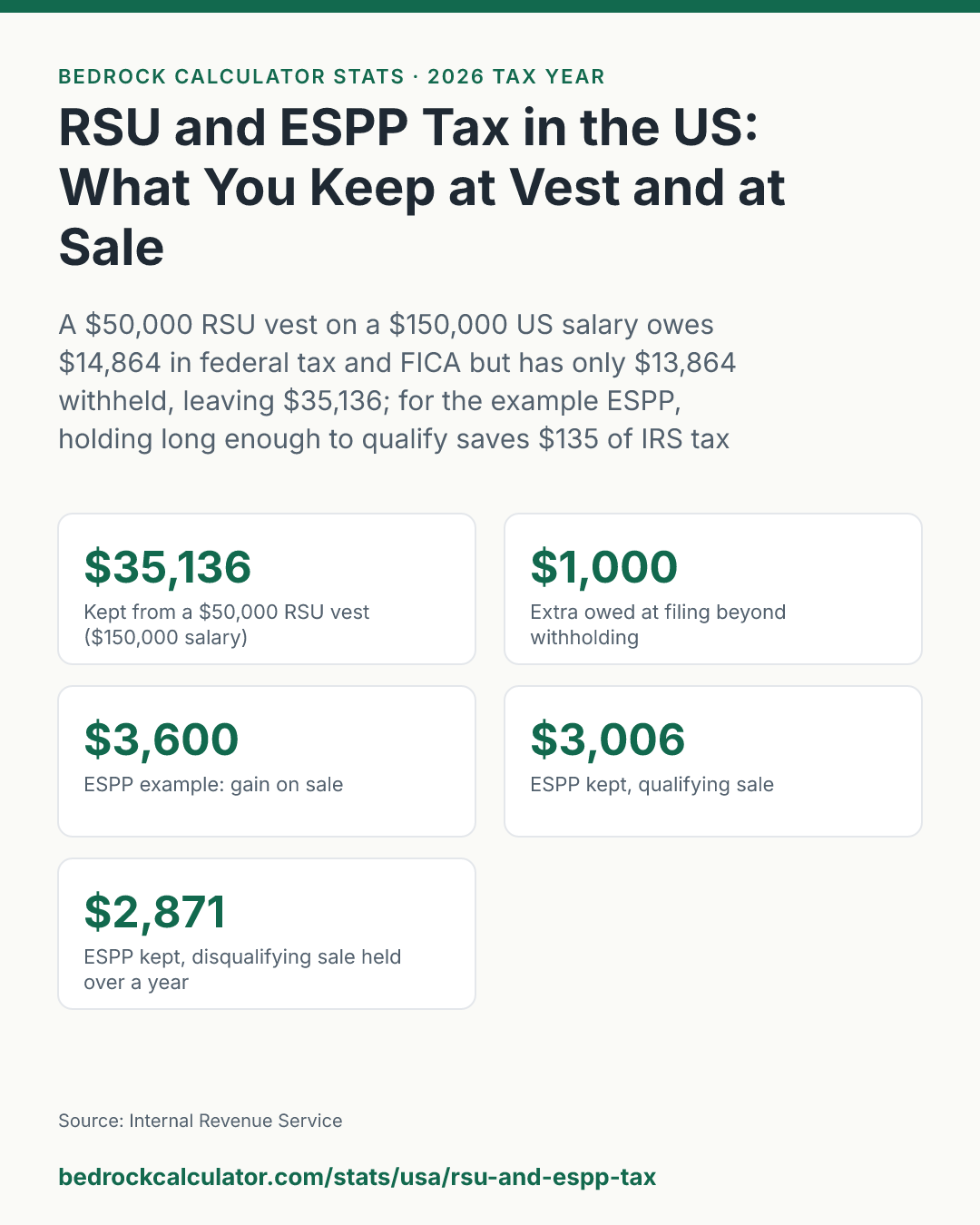
Restricted stock units are taxed in the US like a cash bonus paid in shares. On a $150,000 salary, a $50,000 RSU vest owes $14,864 in federal income tax, Social Security and Medicare. Your employer typically withholds $13,864, so you owe another $1,000 when you file, and you keep $35,136, about 70.3% of the vest.
Employee stock purchase plans are different. How they're taxed depends on how long you hold the shares. In our example plan, holding long enough for a qualifying sale cuts the IRS bill by $135 on a $3,600 gain.
How we worked out these numbers
All figures are for the US 2026 tax year, from the site's RSU tax calculator and ESPP tax calculator. Both cover federal tax only, for a single filer. State income tax is left out, and in most states it applies to both RSU income and ESPP gains.
RSUs. The calculator takes the value of the shares on the vest date and treats it as wages on top of your salary. It works out the real tax by running salary plus vest through the 2026 brackets and standard deduction, and adds Social Security and Medicare. It works out withholding at the flat 22% federal supplemental rate plus the same FICA. We modeled one vest at a time, with no other bonuses that year.
ESPPs. We used the calculator's example plan: shares worth $40 at the start of the offering period and $55 on the purchase date, a 15% discount applied to the lower of the two, 100 shares, and $120,000 of other taxable income. That sets the purchase price at $34.00 a share, or $3,400 in total. Then we changed the sale price.
The calculators don't model state tax, the net investment income tax on gains for higher earners, sell-to-cover share rounding, or what happens to the stock after you sell.
How RSUs are taxed when they vest
When RSUs vest, the full market value of the shares is income, whether you sell them or not. It goes on your W-2 like salary, and it's taxed at your ordinary rates plus FICA. Most employers sell enough shares at vesting to cover the withholding. In our $50,000 example at $100 a share, that's about 138.6 shares.
RSU vest: what you keep after US federal tax and FICA
Download CSVSingle filer, one vest, 2026 brackets and standard deduction. Withholding at the flat 22% supplemental rate plus FICA. State tax not included.
| $100,000 | $10,000 | $2,965 | $2,965 | $0 | $7,035 |
| $100,000 | $25,000 | $7,413 | $7,477 | $64 | $17,524 |
| $100,000 | $50,000 | $14,825 | $15,389 | $564 | $34,611 |
| $100,000 | $100,000 | $28,689 | $30,253 | $1,564 | $69,747 |
| $150,000 | $10,000 | $2,965 | $3,165 | $200 | $6,835 |
| $150,000 | $25,000 | $7,413 | $7,913 | $500 | $17,088 |
| $150,000 | $50,000 | $13,864 | $14,864 | $1,000 | $35,136 |
| $150,000 | $100,000 | $26,039 | $30,609 | $4,570 | $69,391 |
| $250,000 | $10,000 | $2,435 | $3,435 | $1,000 | $6,565 |
| $250,000 | $25,000 | $6,088 | $8,668 | $2,580 | $16,332 |
| $250,000 | $50,000 | $12,175 | $18,005 | $5,830 | $31,995 |
| $250,000 | $100,000 | $24,350 | $36,680 | $12,330 | $63,320 |
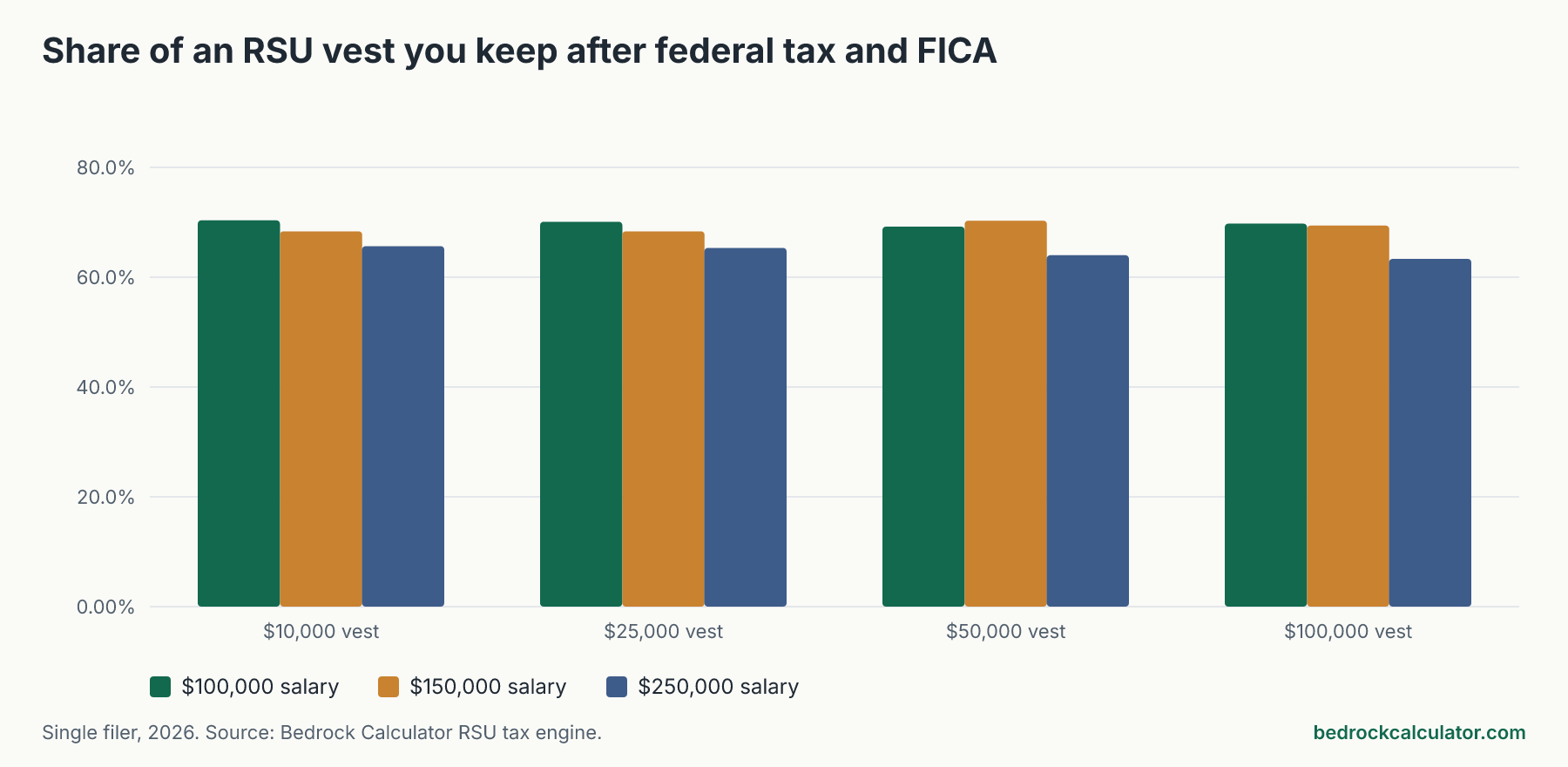
The amount you keep sits around two-thirds to seven-tenths of the vest in every case, but the gap at filing varies a lot. On a $100,000 salary a $25,000 vest is under-withheld by only $64. On a $250,000 salary a $100,000 vest is under-withheld by $12,330, and you keep $63,320, or 63.3%.
One quirk is worth knowing. Social Security tax stops once your wages for the year pass the wage base, so a large vest on a high salary can carry less FICA than you'd expect. That's why a $50,000 vest on a $150,000 salary keeps a slightly higher share than the same vest on a $100,000 salary in our table.
Why you owe tax on RSUs even though tax was withheld
Withholding on RSUs is usually a flat 22% of federal income tax. That's a payroll shortcut for bonus-type pay, not your bracket. If your salary plus the vest puts the shares in a higher bracket, the withholding falls short and the difference comes due in April.
You can close the gap by raising your W-4 withholding for the rest of the year, making an estimated tax payment, or simply setting aside cash from the vest. Cash bonuses follow the same supplemental wage rules, so the bonus tax calculator shows the same gap for them.
How ESPP shares are taxed when you sell
An ESPP lets you buy company stock at a discount, often through payroll deductions. Nothing is taxed when you buy. The tax comes when you sell, and the split between ordinary income and capital gain depends on how long you held the shares.
A qualifying sale means you sold at least two years after the offering date and at least one year after the purchase date. Then only the smaller of two amounts is taxed as ordinary income: the discount measured on the offering-date price, or your actual gain. Everything else is long-term capital gain, taxed at lower rates.
A disqualifying sale is anything earlier. The full bargain at purchase, the purchase-date price minus what you paid, is ordinary income. Any gain above that is capital gain, long-term if you held over a year and short-term if not.
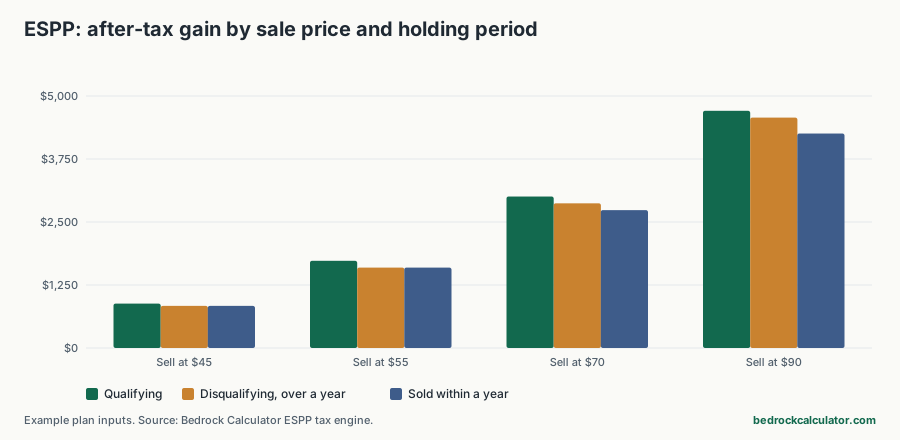
ESPP sale: qualifying vs disqualifying, by sale price
Download CSVExample plan: $40 at offering start, $55 at purchase, 15% discount with lookback, 100 shares, $120,000 of other taxable income, single filer. Federal tax only.
| $45.00 | $1,100 | $881 | $836 | $836 | $45 |
| $55.00 | $2,100 | $1,731 | $1,596 | $1,596 | $135 |
| $70.00 | $3,600 | $3,006 | $2,871 | $2,736 | $135 |
| $90.00 | $5,600 | $4,706 | $4,571 | $4,256 | $135 |
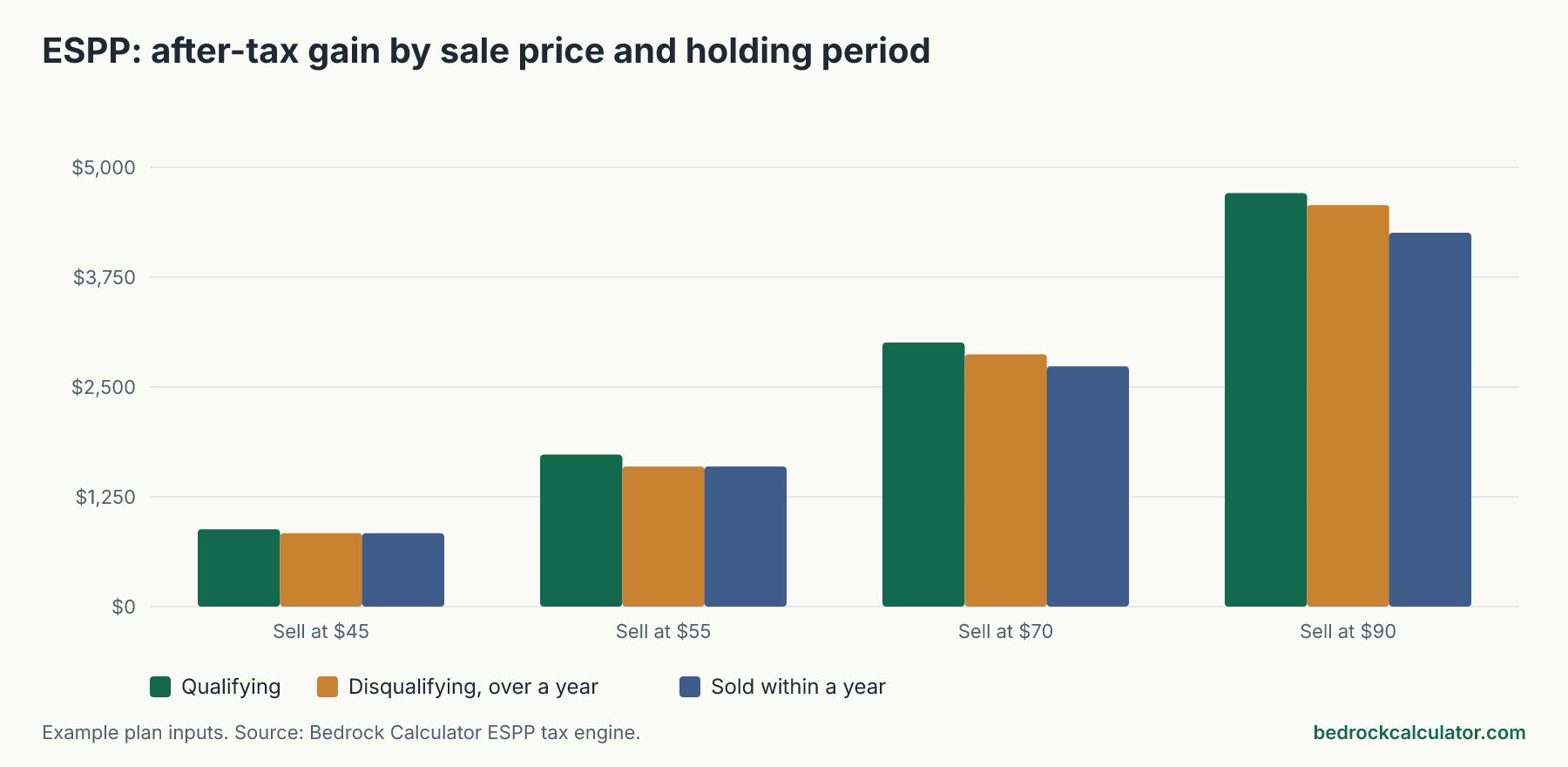
Selling at $70 a share, your total gain is $3,600. A qualifying sale treats $600 of that as ordinary income and leaves you $3,006 after federal tax. A disqualifying sale treats $2,100 as ordinary income and leaves $2,871 if you held over a year, or $2,736 if you sold within a year.
Is it worth holding ESPP shares for a qualifying sale?
On taxes alone, usually a little. In this example the qualifying sale saves $135 at $70 and $135 at $90. If the price falls toward the purchase-date value, the saving shrinks: at $45 it's $45.
The bigger question is risk. Holding company stock for two years ties more of your money to the same employer that pays your salary. A modest tax saving can be wiped out by a modest fall in the share price. Many people sell ESPP shares soon after purchase, accept the higher tax, and lock in the discount.
Getting your own numbers
For a vest, enter the shares, the price and your salary so far in the RSU tax calculator. For ESPP shares, put your plan's offering and purchase prices into the ESPP tax calculator and try a few sale dates and prices. If you've already held RSU shares after vesting and sold them, any change in price since the vest is a capital gain or loss, which the capital gains tax calculator handles.