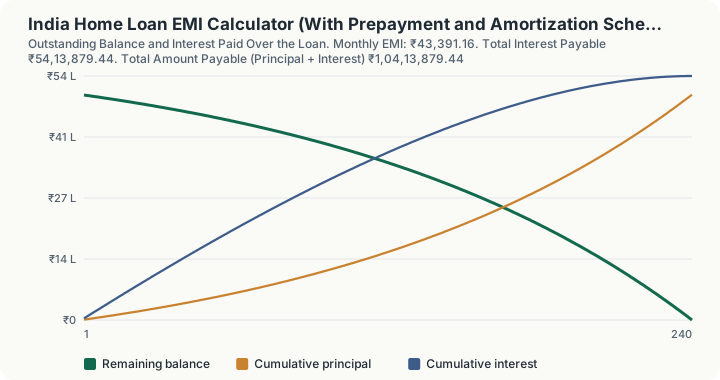
Quick Answer: A ₹50 lakh home loan at 8.5% a year over 20 years has an EMI of ₹43,391.16. Over the full tenure you pay ₹54,13,879.44 in interest, so the loan costs ₹1,04,13,879.44 in total. A single ₹5 lakh prepayment after five years cuts three years off the loan and saves ₹10,69,152.74 of interest.
What does this calculator do?
The EMI, or equated monthly instalment, is the fixed amount you pay your bank or housing finance company every month until the loan is cleared. This calculator works out that EMI for an Indian home loan in rupees, shows how much of the total goes to interest, and lays out the month-by-month amortization schedule so you can see the balance fall.
It also handles the two kinds of prepayment people actually make: a one-time part-payment, from a bonus or a matured deposit, and a fixed extra amount paid every month on top of the EMI. Both go straight to principal. The EMI stays the same and the loan simply ends sooner, which is the default way most lenders apply a part-payment unless you ask them to reduce the EMI instead.
For floating rate home loans taken by individuals, prepayment is free of charges for loans sanctioned or renewed on or after 1 January 2026, under the Reserve Bank of India's Pre-payment Charges on Loans Directions, 2025. The calculator therefore applies no prepayment fee. If you have a fixed rate loan, check your loan agreement, because a charge may apply.
How is this calculated?
The calculator uses the standard reducing-balance method that Indian lenders use for home loans.
- Monthly rate. The annual interest rate is divided by 12. At 8.5% that is about 0.7083% a month.
- EMI. The EMI is the fixed payment that clears the loan in exactly the number of months you chose, rounded to the paisa:
EMI = P × (i(1 + i)ⁿ)/((1 + i)ⁿ − 1)
where P is the loan amount, i is the monthly rate and n is the tenure in months.
- Interest each month. Interest is charged on the outstanding balance at the monthly rate and rounded to the paisa. The rest of the EMI repays principal.
- Prepayments. Any extra monthly amount, plus the one-time prepayment in the month you choose, is subtracted from the balance in full. The EMI does not change, so the loan finishes earlier.
- Last EMI. Because the EMI is rounded, the balance does not land on exactly zero by itself. The final instalment pays whatever principal is left plus that month's interest, so it can differ from the regular EMI by a few rupees.
- Totals. Total interest is the sum of every month's interest. Total payable adds the loan amount. Interest saved compares the total interest with and without your prepayments, using the same rate and tenure.
Worked Example
Take a ₹50,00,000 loan at 8.5% a year for 20 years, with no prepayment.
Step 1: the monthly rate. 8.5% ÷ 12 = 0.708333% a month
Step 2: the EMI. With n = 240 months, the formula gives ₹43,391.16 a month.
Step 3: the first month. Interest on ₹50,00,000 for one month is ₹50,00,000 × 0.708333% = ₹35,416.67. Only ₹43,391.16 − ₹35,416.67 = ₹7,974.49 reduces the loan. The balance after the first EMI is ₹49,92,025.51.
Step 4: the first year. After 12 EMIs you have paid ₹4,21,182.49 of interest and only ₹99,511.43 of principal. The outstanding balance is ₹49,00,488.57. This front-loading of interest is how every reducing-balance loan works, and it is why prepaying early saves so much.
Step 5: the halfway point. After 10 years (120 EMIs) you still owe ₹34,99,691.48. You have repaid ₹15,00,308.52 of principal while paying ₹37,06,630.68 in interest. The monthly principal portion first overtakes the interest portion in month 143, almost 12 years in.
Step 6: the full tenure. Over 240 months the interest adds up to ₹54,13,879.44, more than the loan itself. Total payable is ₹1,04,13,879.44. The last EMI is ₹43,392.20, a rupee and change above the regular EMI because of paisa rounding along the way.
Step 7: a ₹5 lakh prepayment in month 60. Paying ₹5,00,000 extra at the end of year 5 drops the loan to 17 years. Total interest falls to ₹43,44,726.70, saving ₹10,69,152.74. One prepayment of ₹5 lakh saves more than twice its own size in interest.
Step 8: ₹5,000 extra every month instead. A standing ₹5,000 top-up from month 1 clears the loan in 15 years 7 months and saves ₹13,89,250.13 of interest. This route saves more interest than the single prepayment, but it needs steady spare cash every month.
Step 9: stretching to 30 years. The EMI drops to ₹38,445.67, only ₹4,945.49 less a month, but total interest jumps to ₹88,40,448.38. Ten extra years cost ₹34,26,568.94 more in interest.
What does this calculator not account for?
- Rate changes. Most Indian home loans are floating rate and reset when the lender's external benchmark moves. The calculator holds the rate you enter for the whole loan. When rates change, your lender may adjust the tenure, the EMI or both.
- Reduce-EMI prepayment. Some borrowers ask the lender to keep the tenure and lower the EMI after a part-payment. This calculator always keeps the EMI and shortens the tenure.
- Pre-EMI interest. On an under-construction property, interest on the amount disbursed so far is often paid before full EMIs start. Not modelled.
- Fees and insurance. Processing fees, legal and valuation charges, and any loan protection insurance bundled into the loan are not included.
- Rounding to the rupee. Many lenders round the EMI to the nearest rupee. The calculator rounds to the paisa, so a lender's figure may differ by under a rupee a month.
- Tax benefits. Under the old tax regime, part of the interest on a self-occupied home and part of the principal can reduce your taxable income. None of that is netted off here. Use the home loan tax benefit calculator for that side.
- Day counts. Interest is worked out as one-twelfth of the annual rate each month, not by the actual number of days.
What mistakes do people make with this?
- Judging a loan by its EMI alone. A longer tenure always lowers the EMI and always raises the total interest. Look at both numbers before you pick a tenure.
- Waiting to prepay. A rupee prepaid in year 2 saves far more interest than a rupee prepaid in year 15, because early balances are large and the interest on them is too.
- Forgetting the rate is floating. If rates rise by 1%, your tenure can stretch by years without any change to the EMI you see. Check your outstanding balance and remaining tenure every year.
- Prepaying with your emergency fund. A home loan is cheap compared with personal loans and credit cards. Keep a cash buffer before putting spare money into prepayment.
- Assuming a prepayment fee applies. For floating rate loans to individuals for non-business use, the RBI's 2025 directions bar prepayment charges on loans sanctioned or renewed from 1 January 2026.
Frequently Asked Questions
What is the EMI on a ₹50 lakh home loan for 20 years?
What is the EMI on a ₹30 lakh home loan?
Is it better to prepay or reduce the EMI?
Do banks charge for home loan prepayment?
Why is most of my early EMI going to interest?
Sources
- Reserve Bank of India, Reserve Bank of India (Pre-payment Charges on Loans) Directions, 2025, RBI/2025-26/64 DoR.MCS.REC.38/01.01.001/2025-26, 2 July 2025, paragraphs 3 and 5(i): rbi.org.in/Scripts/NotificationUser.aspx
- Reserve Bank of India, Master Direction, Reserve Bank of India (Interest Rate on Deposits) Directions, 2016, for comparison with deposit rates when deciding whether to prepay: rbi.org.in/Scripts/BS_ViewMasDirections.aspx