What does a monthly SIP grow to over 10, 20 and 30 years?
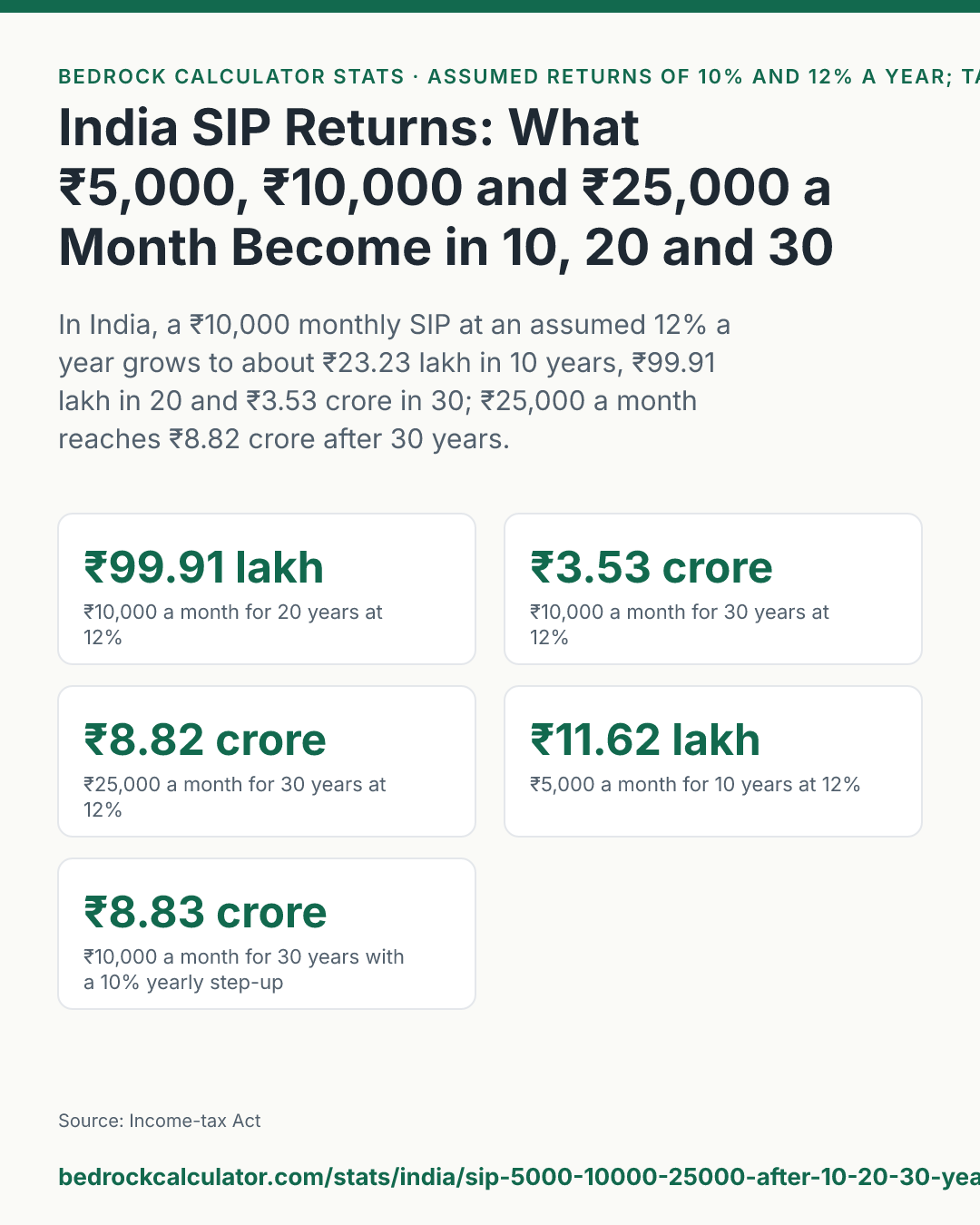
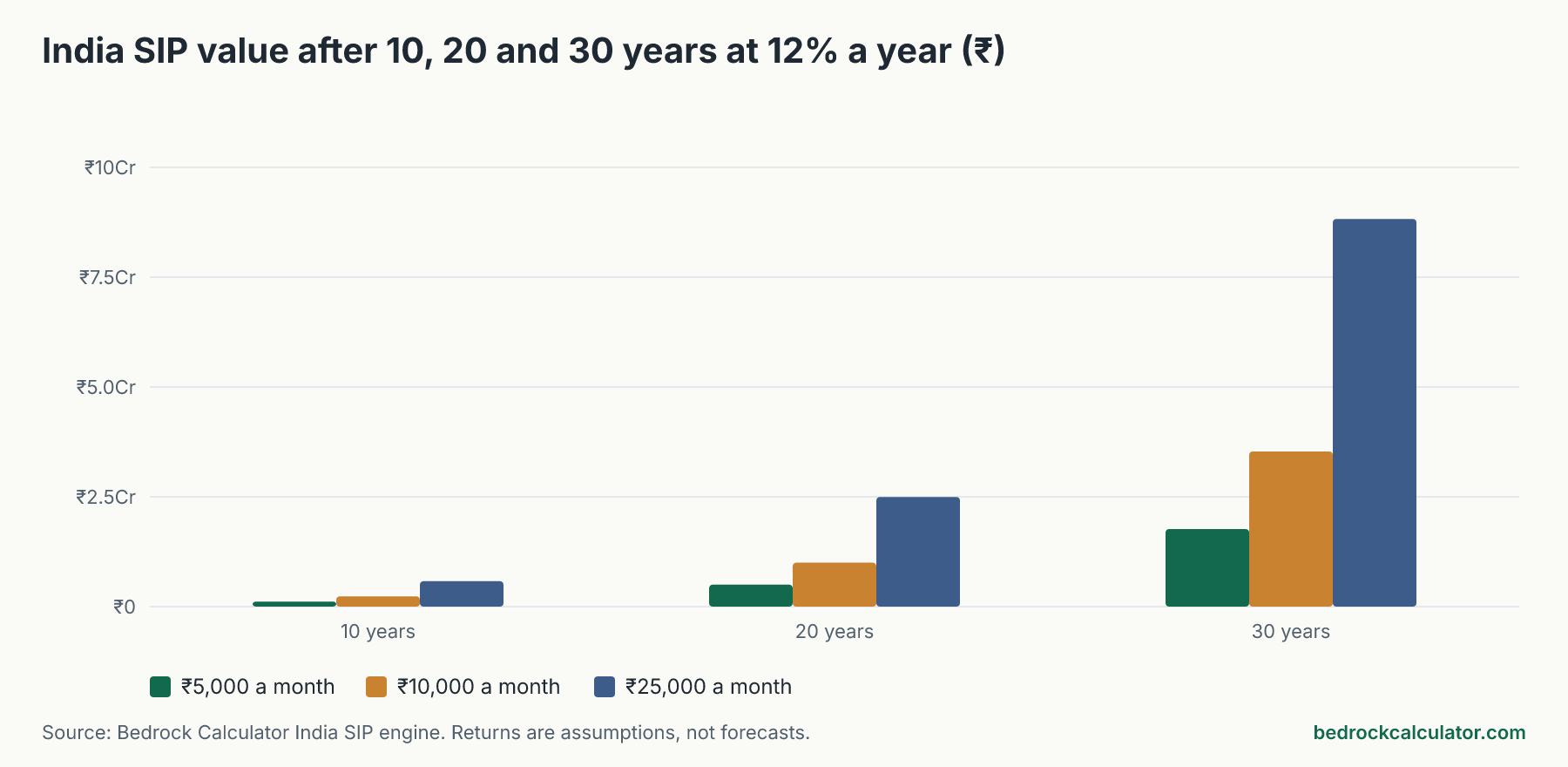
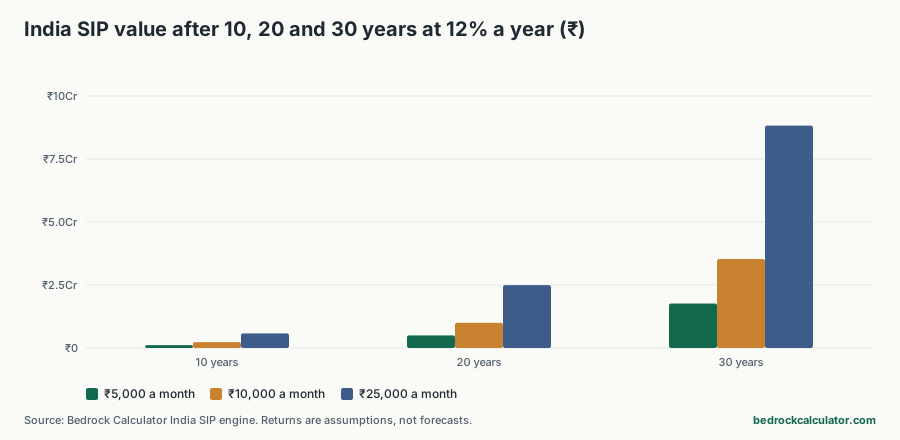
At an assumed 12% a year, a ₹10,000 monthly SIP in India grows to about ₹23.23 lakh in 10 years, ₹99.91 lakh in 20 years and ₹3.53 crore in 30. A ₹5,000 SIP reaches ₹11.62 lakh, ₹49.96 lakh and ₹1.76 crore over the same spans, and ₹25,000 a month reaches ₹58.08 lakh, ₹2.5 crore and ₹8.82 crore.
Those are projections at a return we picked, not promises. Drop the assumption to 10% and the 30-year figure on ₹10,000 a month falls to ₹2.28 crore.
How we worked out these numbers
Every figure comes from the SIP calculator on this site. It assumes:
- The same instalment every month, invested on the first day of the month so it earns that month's return
- A monthly return equal to the annual rate divided by 12, applied every month without a single bad year
- No withdrawals, no missed instalments, and no tax taken out
We ran two return assumptions, 10% and 12% a year, because nobody knows what equity funds will return over the next three decades. Treat the higher one as the optimistic case and the lower one as the planning case.
What ₹5,000, ₹10,000 and ₹25,000 a month become
Amounts in rupees. Click a column heading to sort.
India SIP value at an assumed 12% a year (₹)
Download CSVInstalment invested at the start of each month, monthly rate = annual rate ÷ 12, before tax. Rupees.
| ₹5,000 | 10 | ₹6,00,000 | ₹5,61,695 | ₹11,61,695 |
| ₹10,000 | 10 | ₹12,00,000 | ₹11,23,391 | ₹23,23,391 |
| ₹5,000 | 20 | ₹12,00,000 | ₹37,95,740 | ₹49,95,740 |
| ₹25,000 | 10 | ₹30,00,000 | ₹28,08,477 | ₹58,08,477 |
| ₹10,000 | 20 | ₹24,00,000 | ₹75,91,479 | ₹99,91,479 |
| ₹5,000 | 30 | ₹18,00,000 | ₹1,58,49,569 | ₹1,76,49,569 |
| ₹25,000 | 20 | ₹60,00,000 | ₹1,89,78,698 | ₹2,49,78,698 |
| ₹10,000 | 30 | ₹36,00,000 | ₹3,16,99,138 | ₹3,52,99,138 |
| ₹25,000 | 30 | ₹90,00,000 | ₹7,92,47,844 | ₹8,82,47,844 |
The pattern is simple: the value scales exactly with the instalment. ₹25,000 a month ends at two and a half times what ₹10,000 does, and ₹5,000 at half. So if your number sits between these, you can read it off by proportion.
What doesn't scale in a straight line is time. On ₹10,000 a month, the first 20 years build ₹99.91 lakh. The next ten years add ₹2.53 crore on their own. By year 30 you have put in ₹36 lakh and the projection is 9.8 times that, with gains making up 89.8% of the final value.
How much the return assumption matters
The difference between 10% and 12% looks small on paper. Over 30 years it isn't.
India SIP value at 10% vs 12% a year (₹)
Download CSVSame instalments, two return assumptions. Rupees.
| ₹5,000 | 10 | ₹10,32,760 | ₹11,61,695 | ₹1,28,935 |
| ₹10,000 | 10 | ₹20,65,520 | ₹23,23,391 | ₹2,57,871 |
| ₹5,000 | 20 | ₹38,28,485 | ₹49,95,740 | ₹11,67,255 |
| ₹25,000 | 10 | ₹51,63,801 | ₹58,08,477 | ₹6,44,676 |
| ₹10,000 | 20 | ₹76,56,969 | ₹99,91,479 | ₹23,34,510 |
| ₹5,000 | 30 | ₹1,13,96,627 | ₹1,76,49,569 | ₹62,52,942 |
| ₹25,000 | 20 | ₹1,91,42,423 | ₹2,49,78,698 | ₹58,36,275 |
| ₹10,000 | 30 | ₹2,27,93,253 | ₹3,52,99,138 | ₹1,25,05,885 |
| ₹25,000 | 30 | ₹5,69,83,133 | ₹8,82,47,844 | ₹3,12,64,711 |
On ₹10,000 a month for 30 years, the higher assumption adds ₹1.25 crore, so the lower figure is about 35.4% smaller. Over 10 years the gap is far smaller: ₹20.66 lakh against ₹23.23 lakh. Compounding magnifies small differences in return the longer you stay invested, which cuts both ways. Fees, a poor fund choice, or selling in a crash all quietly lower the return you actually get.
What a step-up SIP does
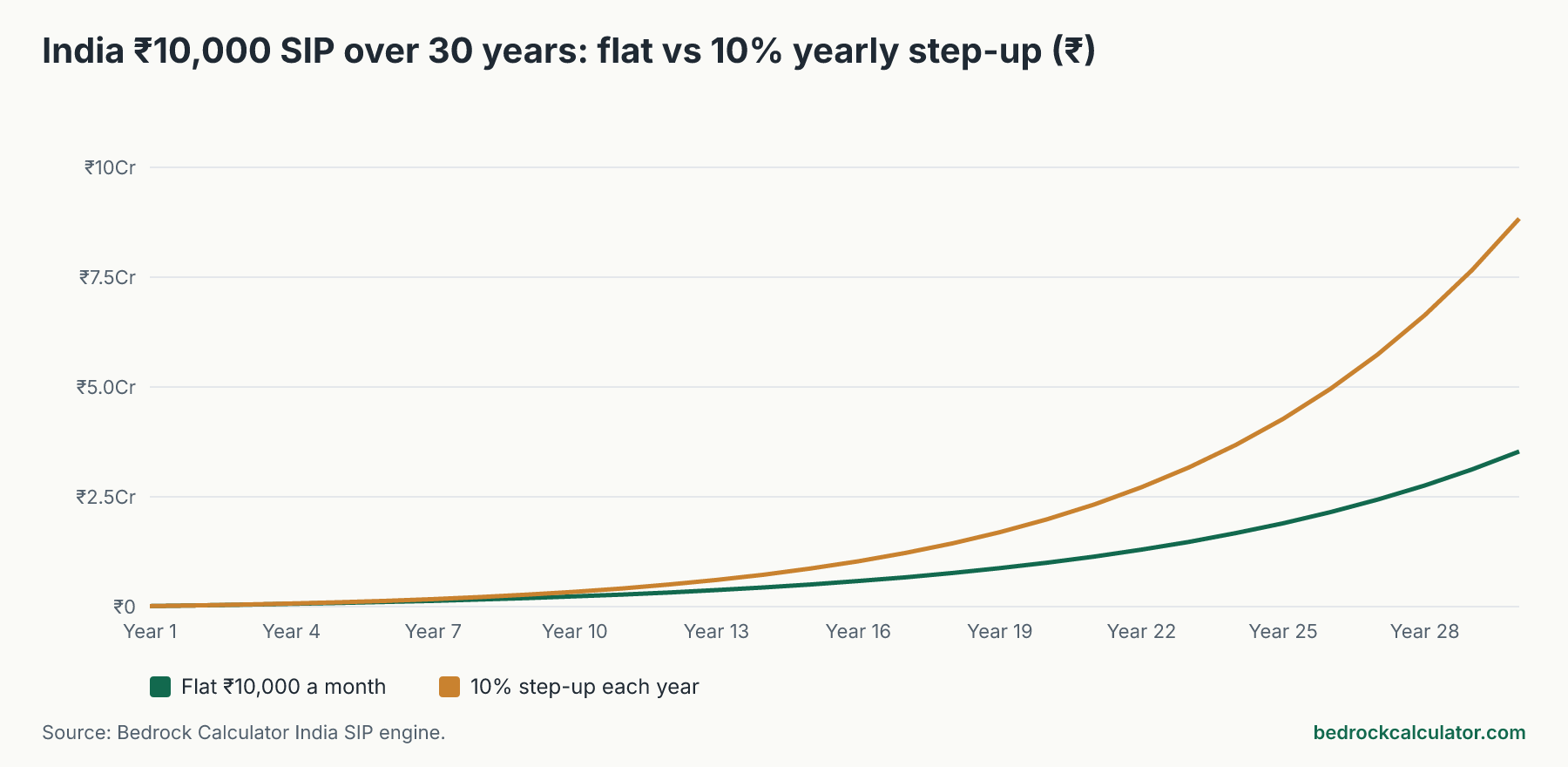
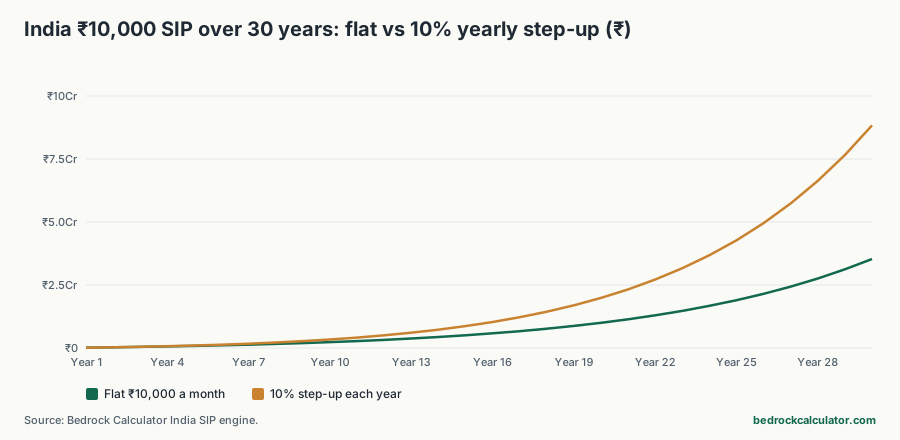
Most people's income rises, so a SIP that never changes shrinks as a share of pay. A step-up SIP raises the instalment by a fixed percentage at the start of each year. We used 10%.
India step-up SIP: 10% more each year, at 12% (₹)
Download CSVThe monthly instalment rises by the step-up at the start of every new year. Rupees.
| ₹5,000 | 10 | ₹11,61,695 | ₹9,56,245 | ₹16,87,163 |
| ₹10,000 | 10 | ₹23,23,391 | ₹19,12,491 | ₹33,74,326 |
| ₹25,000 | 10 | ₹58,08,477 | ₹47,81,227 | ₹84,35,816 |
| ₹5,000 | 20 | ₹49,95,740 | ₹34,36,500 | ₹99,44,358 |
| ₹10,000 | 20 | ₹99,91,479 | ₹68,73,000 | ₹1,98,88,715 |
| ₹5,000 | 30 | ₹1,76,49,569 | ₹98,69,641 | ₹4,41,70,618 |
| ₹25,000 | 20 | ₹2,49,78,698 | ₹1,71,82,500 | ₹4,97,21,789 |
| ₹10,000 | 30 | ₹3,52,99,138 | ₹1,97,39,283 | ₹8,83,41,236 |
| ₹25,000 | 30 | ₹8,82,47,844 | ₹4,93,48,207 | ₹22,08,53,089 |
Over 10 years a step-up on ₹10,000 a month takes the value from ₹23.23 lakh to ₹33.74 lakh. Over 20 years it goes from ₹99.91 lakh to ₹1.99 crore.
The 30-year step-up numbers need a warning. A 10% yearly increase for 30 years means the monthly SIP in the final year is ₹1,58,631, and you would have invested ₹1.97 crore in total. That is why the step-up value on ₹10,000 reaches ₹8.83 crore: you put in ₹1.61 crore more than the flat SIP. Few salaries rise fast enough to keep that up for three decades. A smaller step-up, or one that stops after 10 or 15 years, is more realistic.
What these SIP amounts are worth in today's rupees
A crore in 2056 won't buy what a crore buys now. At 6% inflation, the ₹3.53 crore from ₹10,000 a month for 30 years has the buying power of about ₹61.46 lakh today, and the 20-year figure of ₹99.91 lakh is worth about ₹31.15 lakh. Both still comfortably beat the money you put in, but they are better targets to plan against than the headline numbers.
Tax on SIP returns in India
None of the figures above take out tax. When you redeem an equity mutual fund held for more than 12 months, gains above ₹1,25,000 in a tax year are taxed as long-term capital gains at 12.5% for Tax Year 2026-27. Selling in pieces across several tax years uses that exemption more than once. Debt funds and short-term gains are taxed differently. If you want a tax deduction on the way in, an ELSS fund under the old regime is the option; the ELSS calculator covers it.
What the calculator leaves out
- Real markets. Returns arrive unevenly. The order of good and bad years changes the outcome even when the average return is the same.
- Missed or paused instalments. Each one costs more than its face value over a long horizon.
- Exit loads and stamp duty. Small, but not zero.
- Tax. As above, every value is before capital gains tax.
Running your own SIP numbers
Open the SIP calculator, enter your monthly amount, the years you plan to stay invested and a return you are comfortable defending, and try a step-up. If you want a guaranteed figure to compare against, the FD and RD calculator shows what a bank recurring deposit pays, and the PPF calculator shows the tax-free government-backed option.