How much tax do employees pay on ESOPs in India?
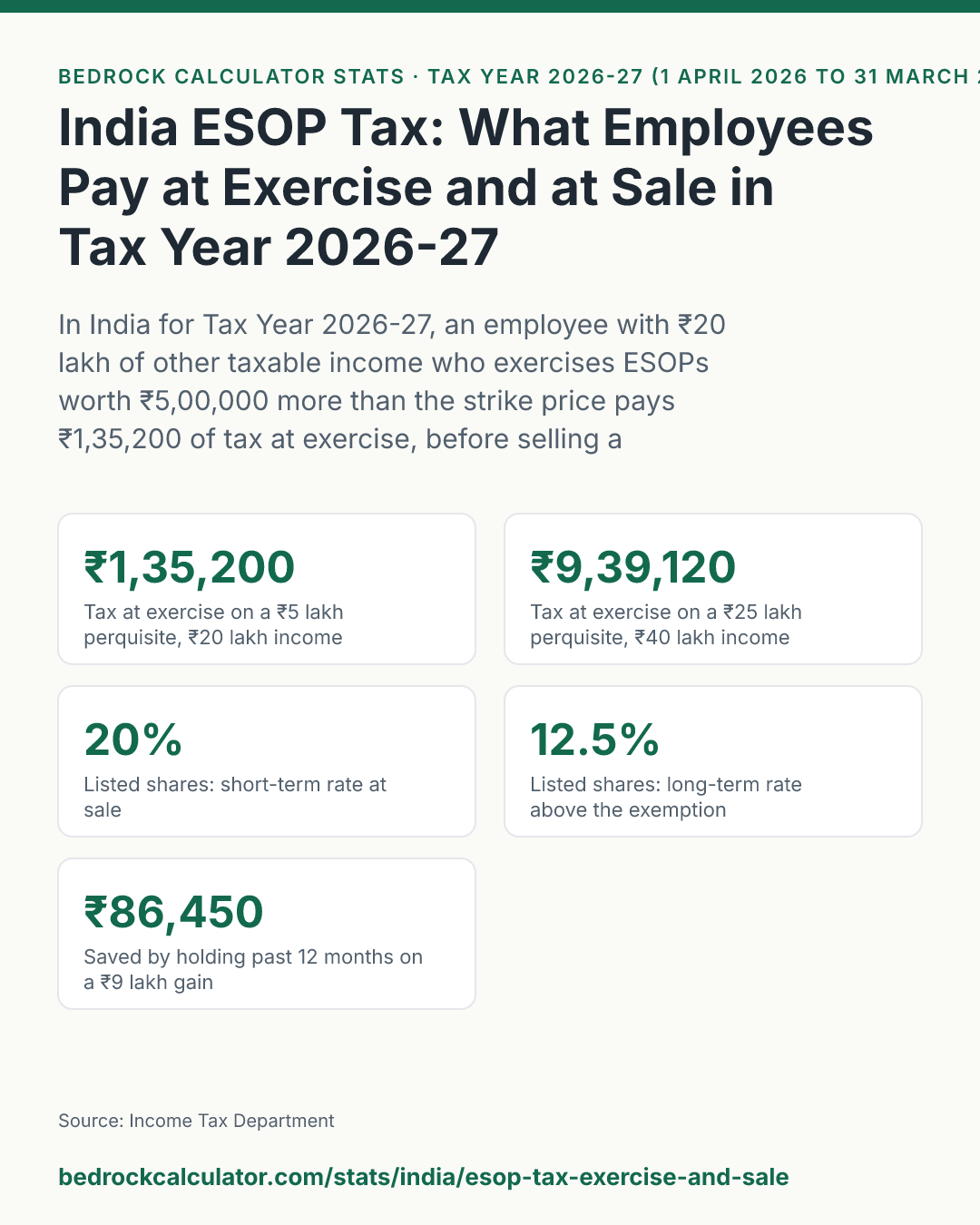
Employee stock options are taxed twice in India. The first bill arrives when you exercise, before you've sold anything: the gap between the share's market value and your strike price is treated as salary. With ₹20 lakh of other taxable income, a ₹5,00,000 gap adds ₹1,35,200 to your tax for Tax Year 2026-27 under the new regime.
The second bill comes when you sell, and only on the rise after exercise. For listed shares that's 20% if you sell within 12 months, or 12.5% above a ₹1,25,000 yearly exemption if you hold longer.
Stage one: tax at exercise
When you exercise, the perquisite is:
(market value on the exercise date minus strike price) times the number of shares
That amount is added to your salary for the year and taxed at your slab rates, with surcharge and the 4% cess. Your employer usually deducts the tax as TDS from your pay, which is why exercise months can bring a surprisingly small payslip.
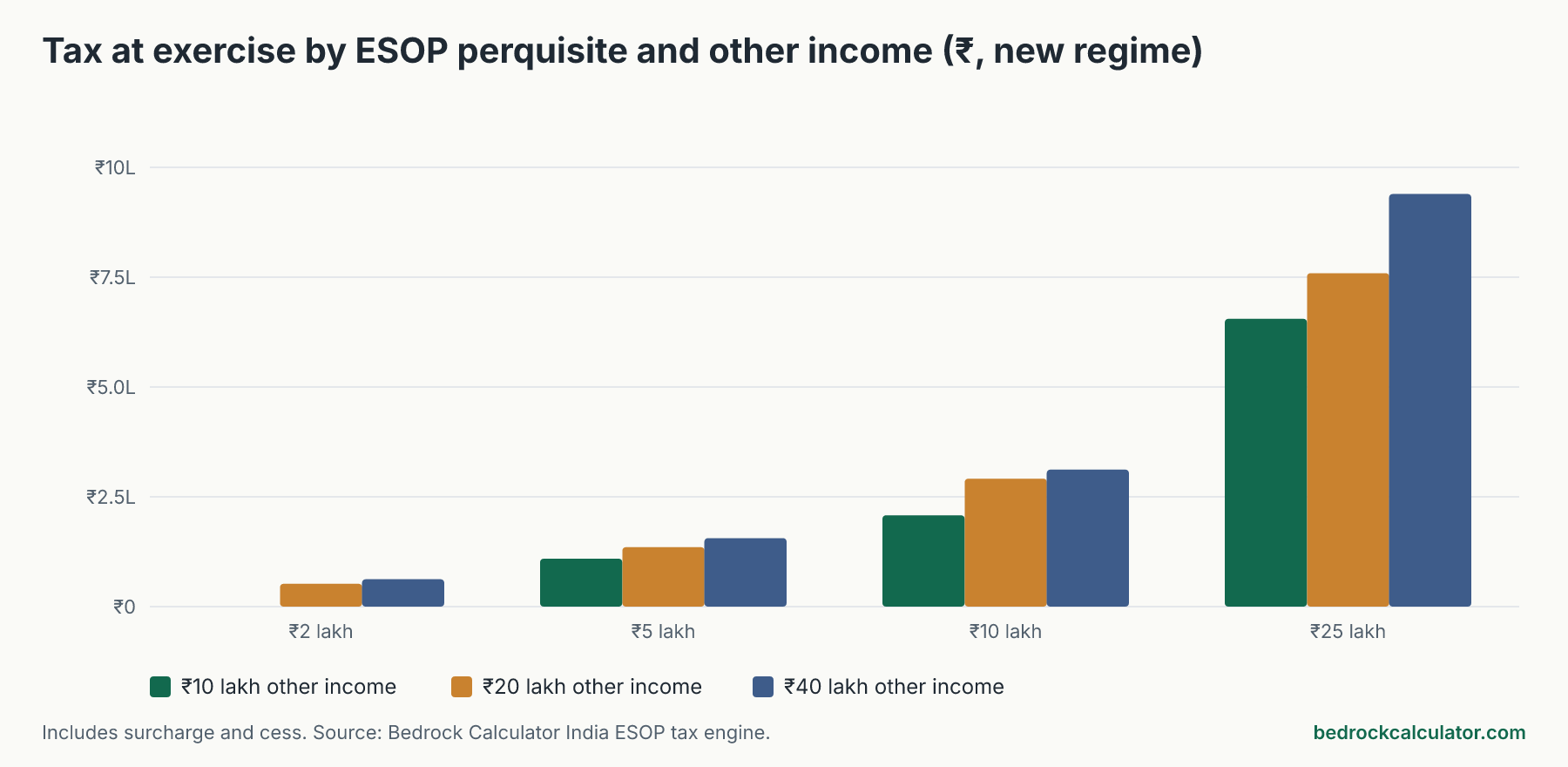
Here's what it costs on 1,000 shares with a strike of ₹100, at four different spreads and three levels of other income.
India: tax at exercise on ESOP perquisite, by spread and other income (₹, new regime, Tax Year 2026-27)
Download CSV1,000 shares at a strike of ₹100. Perquisite is (market value at exercise minus strike) times shares, taxed as salary on top of the other taxable income shown. Includes surcharge and 4% cess.
| ₹2 lakh | ₹10 lakh | ₹2,00,000 | ₹0 | 0.0% |
| ₹2 lakh | ₹20 lakh | ₹2,00,000 | ₹52,000 | 26.0% |
| ₹2 lakh | ₹40 lakh | ₹2,00,000 | ₹62,400 | 31.2% |
| ₹5 lakh | ₹10 lakh | ₹5,00,000 | ₹1,09,200 | 21.8% |
| ₹5 lakh | ₹20 lakh | ₹5,00,000 | ₹1,35,200 | 27.0% |
| ₹5 lakh | ₹40 lakh | ₹5,00,000 | ₹1,56,000 | 31.2% |
| ₹10 lakh | ₹10 lakh | ₹10,00,000 | ₹2,08,000 | 20.8% |
| ₹10 lakh | ₹20 lakh | ₹10,00,000 | ₹2,91,200 | 29.1% |
| ₹10 lakh | ₹40 lakh | ₹10,00,000 | ₹3,12,000 | 31.2% |
| ₹25 lakh | ₹10 lakh | ₹25,00,000 | ₹6,55,200 | 26.2% |
| ₹25 lakh | ₹20 lakh | ₹25,00,000 | ₹7,59,200 | 30.4% |
| ₹25 lakh | ₹40 lakh | ₹25,00,000 | ₹9,39,120 | 37.6% |
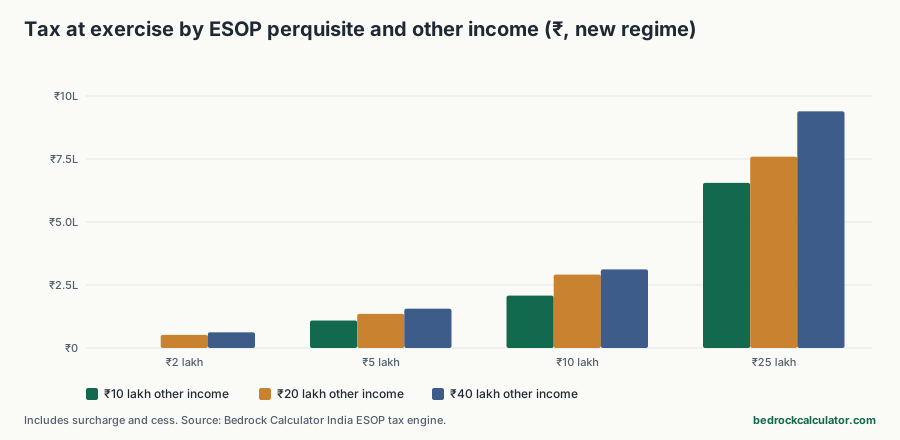
The pattern is simple: the more you already earn, the higher the slab the perquisite lands in. A ₹2 lakh perquisite on ₹10 lakh of other income costs nothing, because the total stays inside the new regime's rebate limit. The same ₹2 lakh on ₹20 lakh of income costs ₹52,000, or 26% of the perquisite, because it lands in a high slab.
At the far end, a ₹25 lakh perquisite on ₹40 lakh of other income adds ₹9,39,120, or 37.6% of the perquisite. At that level of total income surcharge kicks in, and it applies to the tax on your whole income, so the perquisite effectively carries the cost of that too.
The cash problem at exercise
The tax at exercise is due whether or not you sell. If your company is listed, you can sell some shares straight away to cover it. If it isn't, you may have to find the strike price and the tax from savings, for shares you can't yet sell. On our example of 1,000 shares at ₹100, the outlay is ₹1,00,000 plus ₹1,35,200 of tax on a ₹5,00,000 perquisite.
Stage two: tax when you sell
Your cost for capital gains is the market value on the exercise date, the same figure that was taxed as salary. So the gain at sale is only what the shares rose by after that.
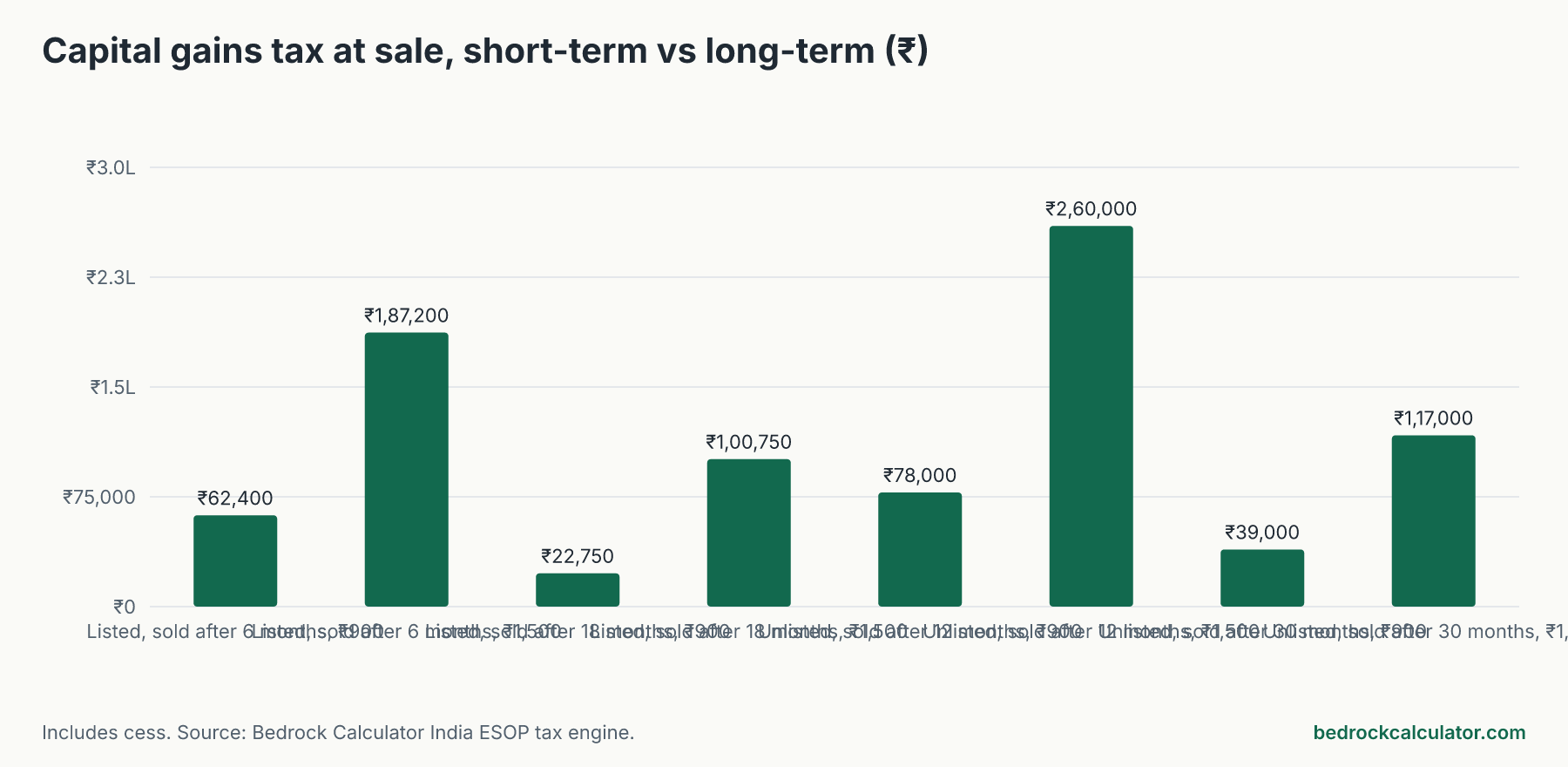
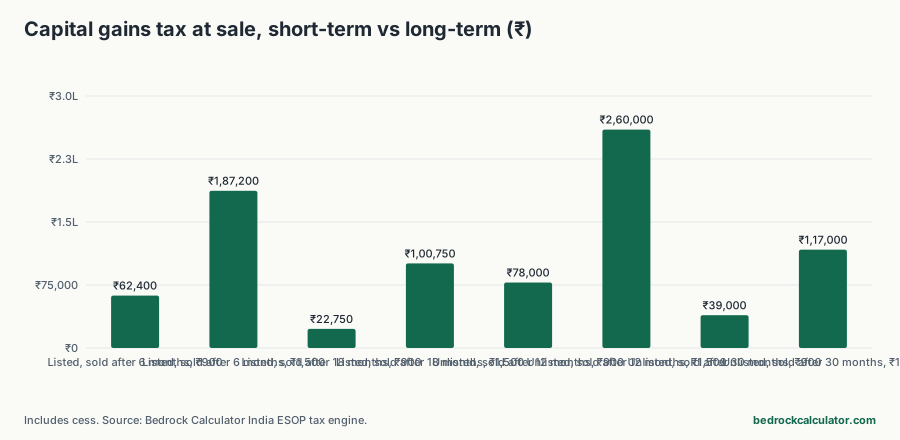
Tax at sale: 1,000 ESOP shares with a market value of ₹600 at exercise (₹)
Download CSVCost for capital gains is the market value at exercise, so only the rise after exercise is taxed again. Listed shares have STT paid and are taxed at flat rates; unlisted short-term gains at slab rates on top of the other income. All capital gains tax includes 4% cess. Total tax adds the perquisite tax at exercise on ₹20 lakh of other income.
| Listed, sold after 6 months | ₹900 | ₹3,00,000 | ₹62,400 | ₹1,97,600 | ₹6,02,400 |
| Listed, sold after 18 months | ₹900 | ₹3,00,000 | ₹22,750 | ₹1,57,950 | ₹6,42,050 |
| Unlisted, sold after 12 months | ₹900 | ₹3,00,000 | ₹78,000 | ₹2,13,200 | ₹5,86,800 |
| Unlisted, sold after 30 months | ₹900 | ₹3,00,000 | ₹39,000 | ₹1,74,200 | ₹6,25,800 |
| Listed, sold after 6 months | ₹1,500 | ₹9,00,000 | ₹1,87,200 | ₹3,22,400 | ₹10,77,600 |
| Listed, sold after 18 months | ₹1,500 | ₹9,00,000 | ₹1,00,750 | ₹2,35,950 | ₹11,64,050 |
| Unlisted, sold after 12 months | ₹1,500 | ₹9,00,000 | ₹2,60,000 | ₹3,95,200 | ₹10,04,800 |
| Unlisted, sold after 30 months | ₹1,500 | ₹9,00,000 | ₹1,17,000 | ₹2,52,200 | ₹11,47,800 |
Say you exercised 1,000 shares when they were worth ₹600 each and later sell at ₹900. The gain is ₹3,00,000. On listed shares sold within 12 months that's taxed at 20% plus the 4% cess: ₹62,400. Held for more than 12 months, it's ₹22,750, because the first ₹1,25,000 of long-term equity gains each year is exempt and the rest is taxed at 12.5% plus cess.
Sell at ₹1,500 instead and the gain is ₹9,00,000. Short-term that costs ₹1,87,200; long-term ₹1,00,750, a saving of ₹86,450. Across both stages, the long-term sale at ₹1,500 costs ₹2,35,950 and leaves you ₹11,64,050 after paying the strike price and both taxes.
Unlisted shares and startups
Shares in a private company are long-term only after 24 months, with no yearly exemption. Long-term gains are taxed at 12.5% plus cess, so the 30-month sale at ₹900 costs ₹39,000.
Sold within 24 months, the gain gets no special rate at all. It's added to your income and taxed at your slab rates. On ₹20 lakh of other income, selling at ₹900 after 12 months costs ₹78,000, about 26% of the gain.
Does the regime choice matter?
Only through the slab rates; the perquisite is taxed the same way in both. On ₹20 lakh of other income, the same ₹5,00,000 perquisite adds ₹1,56,000 under the old regime against ₹1,35,200 under the new one, before counting any old-regime deductions you might have.
How we worked out these numbers
Every figure comes from the ESOP tax calculator on this site. It works out the perquisite, then the extra income tax from stacking it on your other taxable income, using the regime's slabs, rebate, surcharge and cess. At sale it uses the market value at exercise as cost and applies the flat capital gains rates plus the 4% cess; a short-term gain on unlisted shares is stacked on your other income at slab rates instead.
The "other income" in our tables is taxable income, meaning after the standard deduction. We assume the sale falls in a later tax year than the exercise, so a short-term unlisted gain stacks on the other income alone, not on the perquisite as well. Surcharge on capital gains isn't included.
What this leaves out
Employees of eligible startups can defer the tax at exercise until they sell, leave the company, or a set number of years pass. The calculator doesn't model that deferral. It doesn't value unlisted shares for you; the market value has to come from a merchant banker's valuation. It also ignores foreign shares granted by an overseas parent company, which can involve foreign tax and disclosure rules, and RSUs, which are taxed differently at vesting.
Work out your own ESOP tax
Enter your shares, strike price, exercise value and other income in the ESOP tax calculator. If you've sold other shares this year, the equity LTCG and STCG calculator shows how much of the exemption is left. Since tax at exercise can push you into paying advance tax, check that too, and use the old vs new tax regime calculator to see which regime suits the year you exercise.