How long does Kisan Vikas Patra take to double your money?
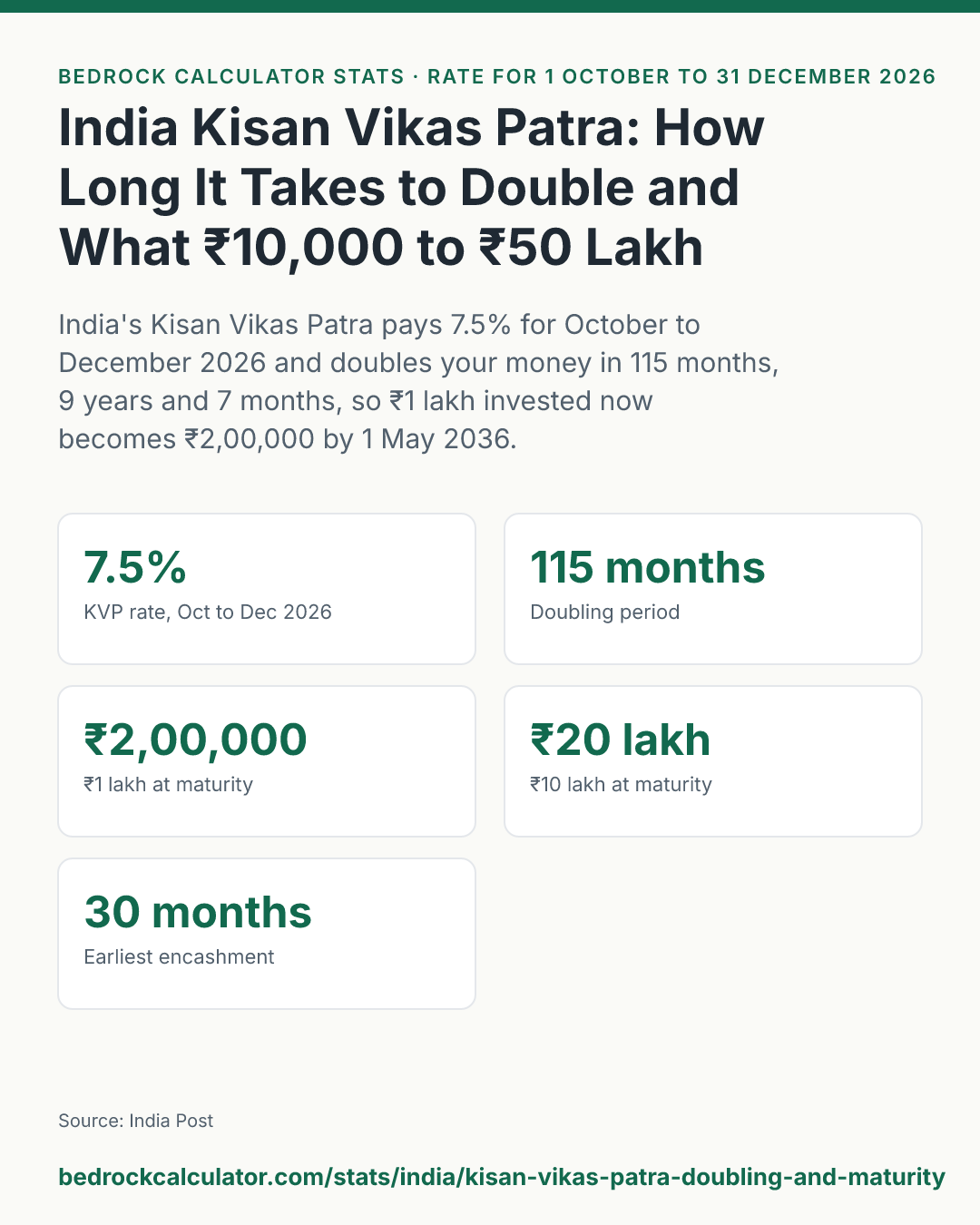
Kisan Vikas Patra (KVP) is the post office certificate that does one thing: it doubles your money. For certificates bought from 1 October to 31 December 2026 the rate is 7.5% a year, compounded yearly, and the money doubles in 115 months. That's 9 years and 7 months.
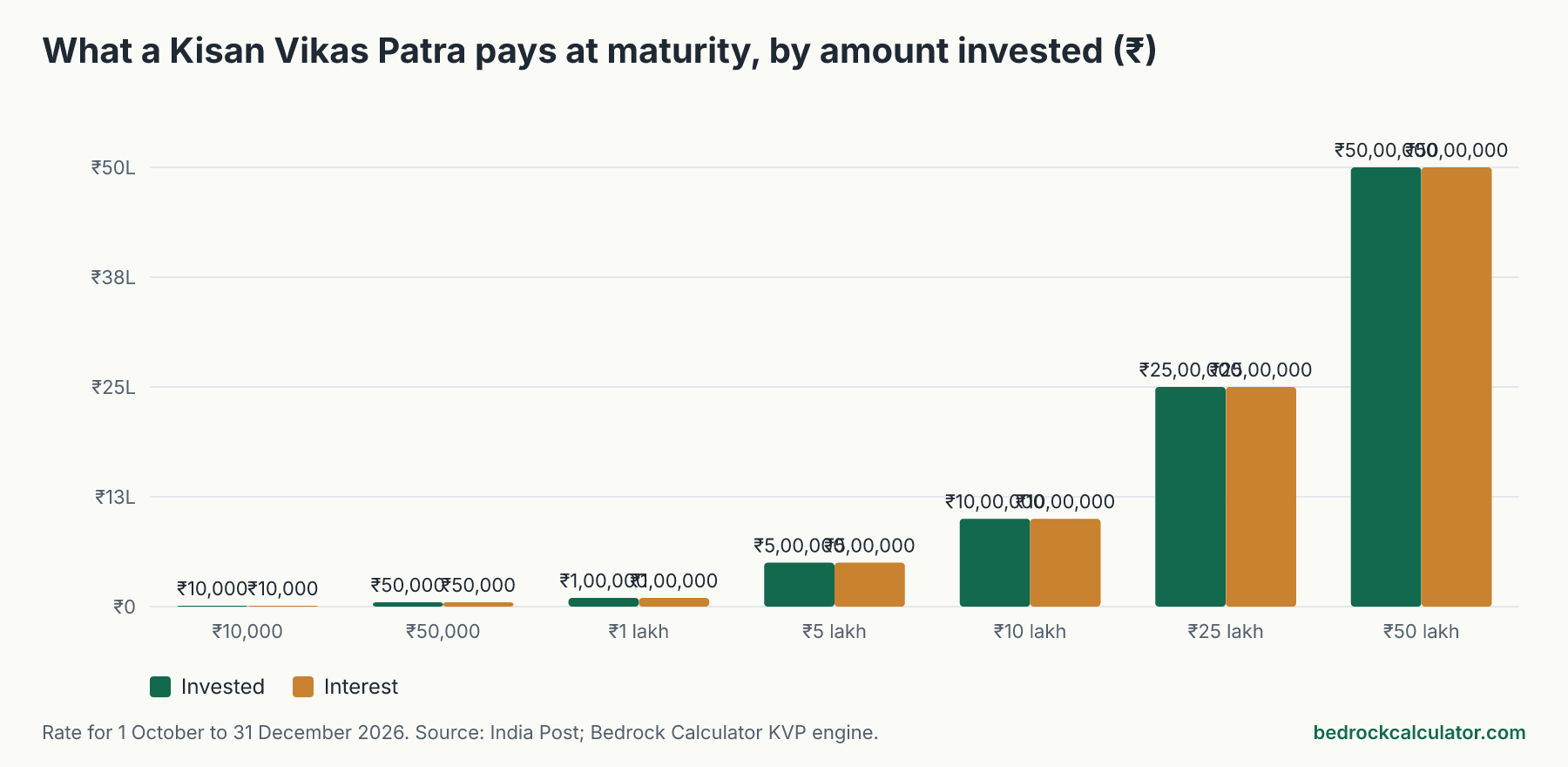
So ₹1 lakh invested at the start of the quarter becomes ₹2,00,000 on 1 May 2036. ₹10 lakh becomes ₹20 lakh, and ₹50 lakh becomes ₹1 crore.
How the doubling period works
Most deposits are sold on their interest rate. KVP is sold on its doubling period instead. When you buy a certificate, India Post fixes the maturity date from the rate in force that day, and on that date you get back exactly twice what you put in. The KVP calculator on this site works backwards from the doubling period: doubling in 115 months is the same as earning about 7.5% a year, compounded yearly, which matches the notified 7.5%.
Every month on or off the doubling period moves the rate noticeably. Run through the same calculator, doubling in 110 months works out to about 7.85% a year, 120 months to about 7.18%, and 124 months to about 6.94%. So when you compare KVP with an FD, convert the doubling period into a yearly rate first, the way the calculator does, rather than comparing months with percentages.
Because the doubling period is set by the rate on the day you buy, it can change from quarter to quarter. A certificate you already hold keeps its own maturity date, whatever happens to the rate later.
What each amount becomes
Click a column heading to sort.
India Kisan Vikas Patra maturity value after 115 months (₹)
Download CSVCertificate held to maturity at the rate for 1 October to 31 December 2026. The maturity period is fixed by the rate when the certificate is bought.
| ₹10,000 | ₹10,000 | ₹20,000 |
| ₹50,000 | ₹50,000 | ₹1,00,000 |
| ₹1,00,000 | ₹1,00,000 | ₹2,00,000 |
| ₹5,00,000 | ₹5,00,000 | ₹10,00,000 |
| ₹10,00,000 | ₹10,00,000 | ₹20,00,000 |
| ₹25,00,000 | ₹25,00,000 | ₹50,00,000 |
| ₹50,00,000 | ₹50,00,000 | ₹1,00,00,000 |
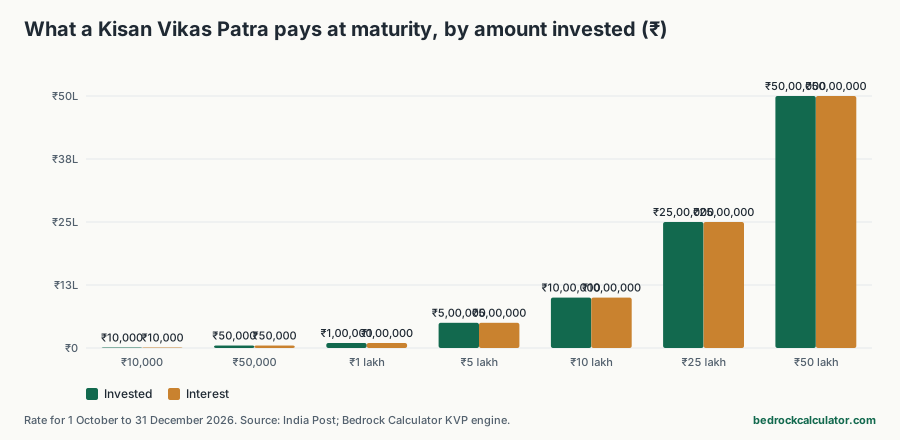
The interest always equals the amount you put in, because the certificate doubles. ₹10,000 becomes ₹20,000, ₹1 lakh becomes ₹2,00,000 and earns ₹1,00,000, and so on up the table. The minimum is ₹1,000, in multiples of ₹100, and there's no upper limit.
How KVP compares with other small savings rates
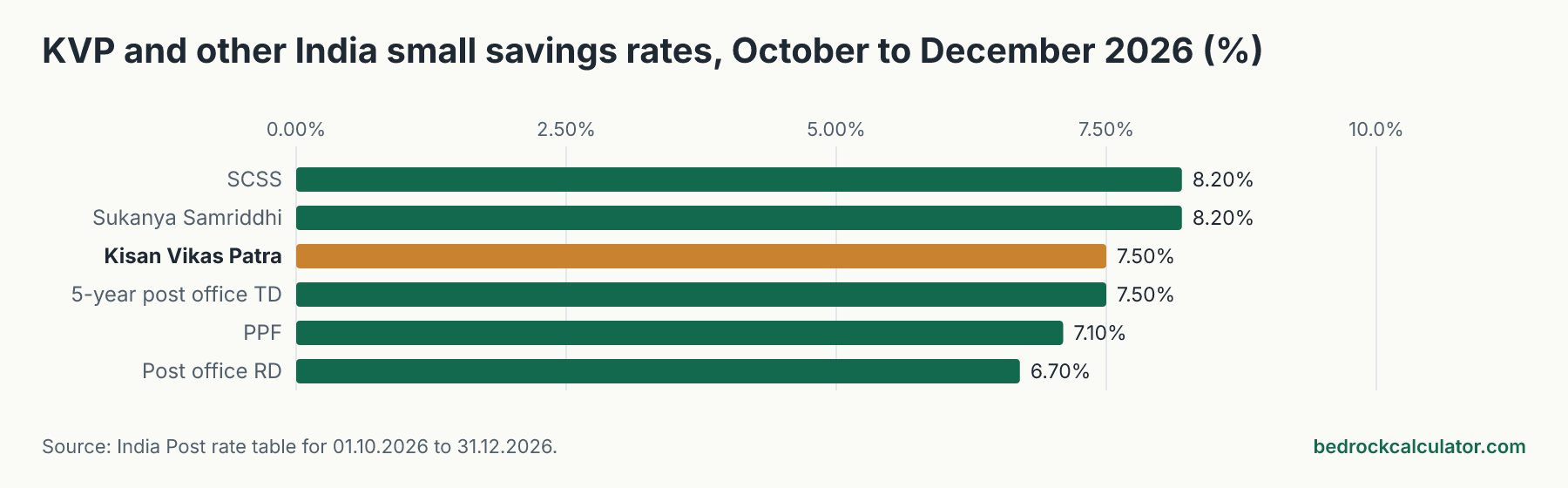
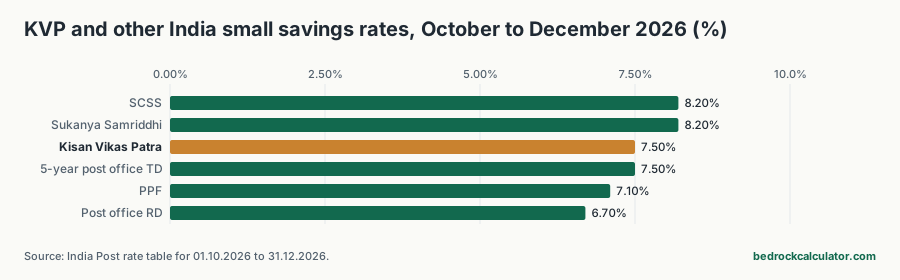
KVP sits in the middle of the small savings rates for this quarter.
India small savings rates for 1 October to 31 December 2026
Download CSVAnnual rates India Post lists for the quarter. How often each compounds or pays out differs; see the text.
| SCSS | 8.2% |
| Sukanya Samriddhi | 8.2% |
| Kisan Vikas Patra | 7.5% |
| 5-year post office TD | 7.5% |
| PPF | 7.1% |
| Post office RD | 6.7% |
Its 7.5% matches the 5-year post office TD at 7.5%, but they pay out differently. The TD pays its interest to you every year, and you have to reinvest it yourself to earn more on it. KVP keeps everything inside the certificate and compounds it, so the whole amount arrives in one go at the end. If you don't need an income along the way, that saves you the job of reinvesting.
KVP pays more than PPF at 7.1% and the RD at 6.7%, but PPF interest is tax-free and KVP interest isn't, which usually makes PPF better for anyone who pays tax, up to PPF's yearly limit. SCSS pays 8.2%, more than KVP, but only people aged 60 and over can open it.
When you can get your money out
KVP is meant to be held to maturity. You can encash a certificate early only after 2 years and 6 months, and then you get the value set out in the scheme rules for that point, which is less than the maturity amount. Before that, early encashment is allowed only on the death of a holder, forfeiture by a pledgee or a court order.
This is why the calculator and this page show only the maturity value. The amounts paid on early encashment come from a separate schedule in the rules, and working them out on a smooth curve would be wrong.
A certificate can also be pledged as security for a loan, or transferred in certain cases, which can help if you need cash without encashing.
Tax on KVP
The interest is taxable income. India Post doesn't list KVP among the schemes that qualify for the section 80C deduction, unlike PPF, the 5-year TD or SCSS. How much tax you pay depends on your slab and your regime.
Who KVP suits
KVP works best for money you're sure you won't need for about a decade and want kept completely safe. It's backed by the Government of India, it has no upper limit, and it needs no decisions once bought: no yearly payouts to reinvest, no deposits to keep up. That can make it a good fit for a lump sum set aside for a child's future or another long-range goal.
It suits people less well if they pay a high rate of tax, since all the interest is taxable, or if they might need the money early, since the early-encashment values are lower than the steady doubling suggests. For a regular income, SCSS or the 5-year TD pay out along the way, and for tax-free growth PPF usually comes out ahead for taxpayers.
How we worked out these numbers
- Every maturity figure comes from the KVP calculator, run for the full 115 months at the doubling period India Post lists for 1 October to 31 December 2026
- The maturity date assumes a certificate bought on 1 October 2026
- The other rates come from the same India Post table for the quarter, as held by the site's engine
What these numbers leave out
- Early encashment values. Not shown, because they follow a separate schedule.
- Holding past maturity. What happens if you leave a matured certificate uncollected isn't modelled.
- Tax. The interest is taxable, but this page doesn't compute your tax.
- Rate changes. A certificate bought in a later quarter may have a different doubling period.
Run your own numbers
The KVP calculator shows the maturity value for any amount. To compare, try the post office RD and TD calculator, the PPF calculator, or for anyone over 60 the SCSS calculator.