How much leave encashment is tax-free at retirement in India?
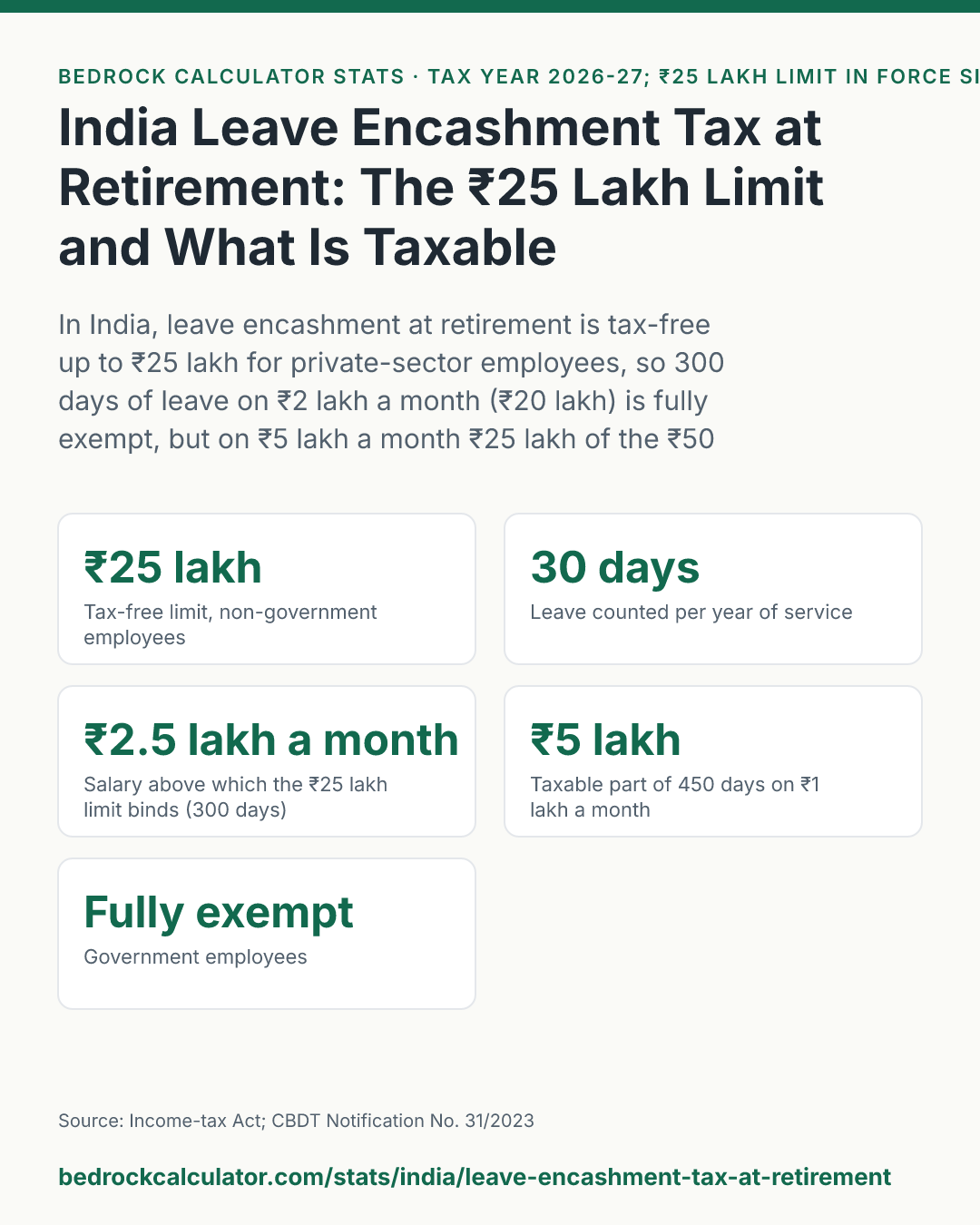
When you retire from a private-sector job in India, the payout for your unused earned leave is partly or wholly tax-free. The tax-free amount is capped at ₹25 lakh, and for Tax Year 2026-27 that limit still stands under the new Income-tax Act, 2025. Central and state government employees pay no tax on it at all.
For most people the ₹25 lakh isn't the limit that bites. Encashing 300 days of leave on ₹2 lakh a month pays ₹20 lakh, all of it tax-free. The ceiling only starts to matter above ₹2.5 lakh a month. What catches more people is a quieter rule: no more than ten months of salary can be tax-free, so a large leave balance is often partly taxable even on a modest salary.
The four limits
For an employee who isn't with the central or a state government, the tax-free part of leave encashment at retirement is the least of four amounts:
- What you actually receive for the leave.
- ₹25 lakh, the limit the government has notified.
- Ten months' average salary, using the average for the ten months before you retire.
- The cash value of your leave, counting at most 30 days of leave for each year of actual service.
"Salary" here means basic pay, plus dearness allowance if your terms of employment include it, but no other allowances or perquisites. The leave is earned leave, not sick or casual leave. Whatever you receive above the least of the four is added to your salary income and taxed at your normal rates.
300 days of leave, by salary
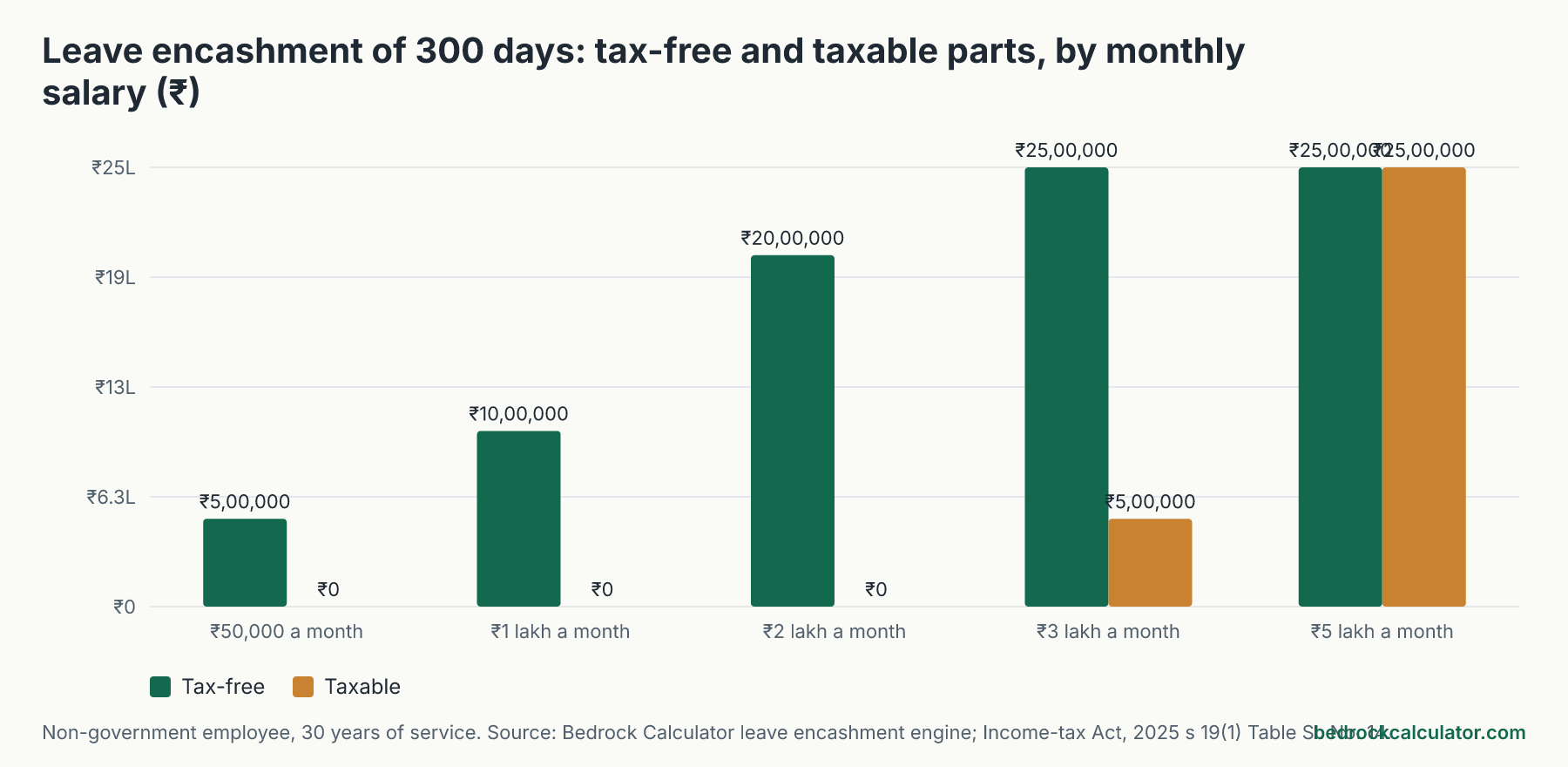
Take someone retiring after 30 years with 300 days of earned leave, and an employer who pays the leave at their average monthly salary. Three hundred days is ten months of salary, so limits 1, 3 and 4 are all the same amount. Only the ₹25 lakh ceiling can cut in.
India leave encashment at retirement: 300 days of leave, by salary (₹)
Download CSVNon-government employee, 30 years of service, payout equal to the leave valued at the average monthly salary (basic plus DA) of the last 10 months.
| ₹50,000 | ₹5,00,000 | ₹5,00,000 | ₹0 | Whole payout |
| ₹1,00,000 | ₹10,00,000 | ₹10,00,000 | ₹0 | Whole payout |
| ₹2,00,000 | ₹20,00,000 | ₹20,00,000 | ₹0 | Whole payout |
| ₹3,00,000 | ₹30,00,000 | ₹25,00,000 | ₹5,00,000 | ₹25 lakh ceiling |
| ₹5,00,000 | ₹50,00,000 | ₹25,00,000 | ₹25,00,000 | ₹25 lakh ceiling |
Up to ₹2 lakh a month everything is tax-free. At ₹3 lakh a month the payout is ₹30 lakh and ₹5 lakh is taxable, because the ceiling binds. At ₹5 lakh a month the payout is ₹50 lakh and ₹25 lakh is taxable. With ₹10 lakh of other taxable income in the year, that taxable part adds ₹1,09,200 of tax at ₹3 lakh a month and ₹6,55,200 at ₹5 lakh.
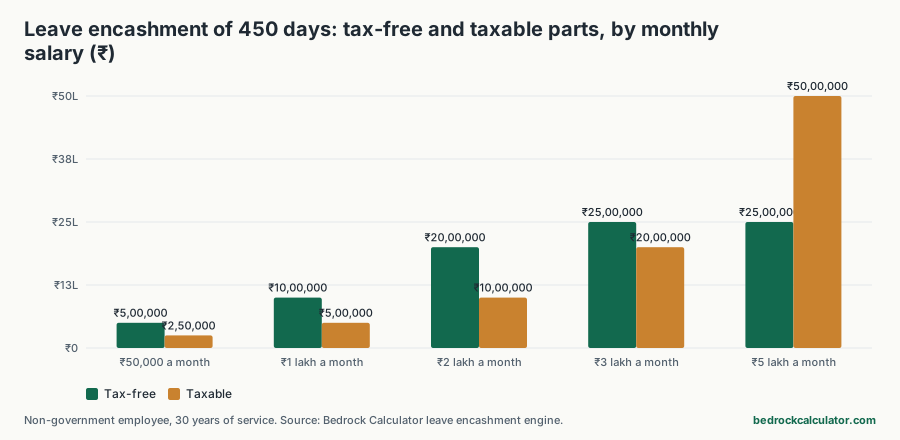
450 days of leave: where the ten-months rule bites
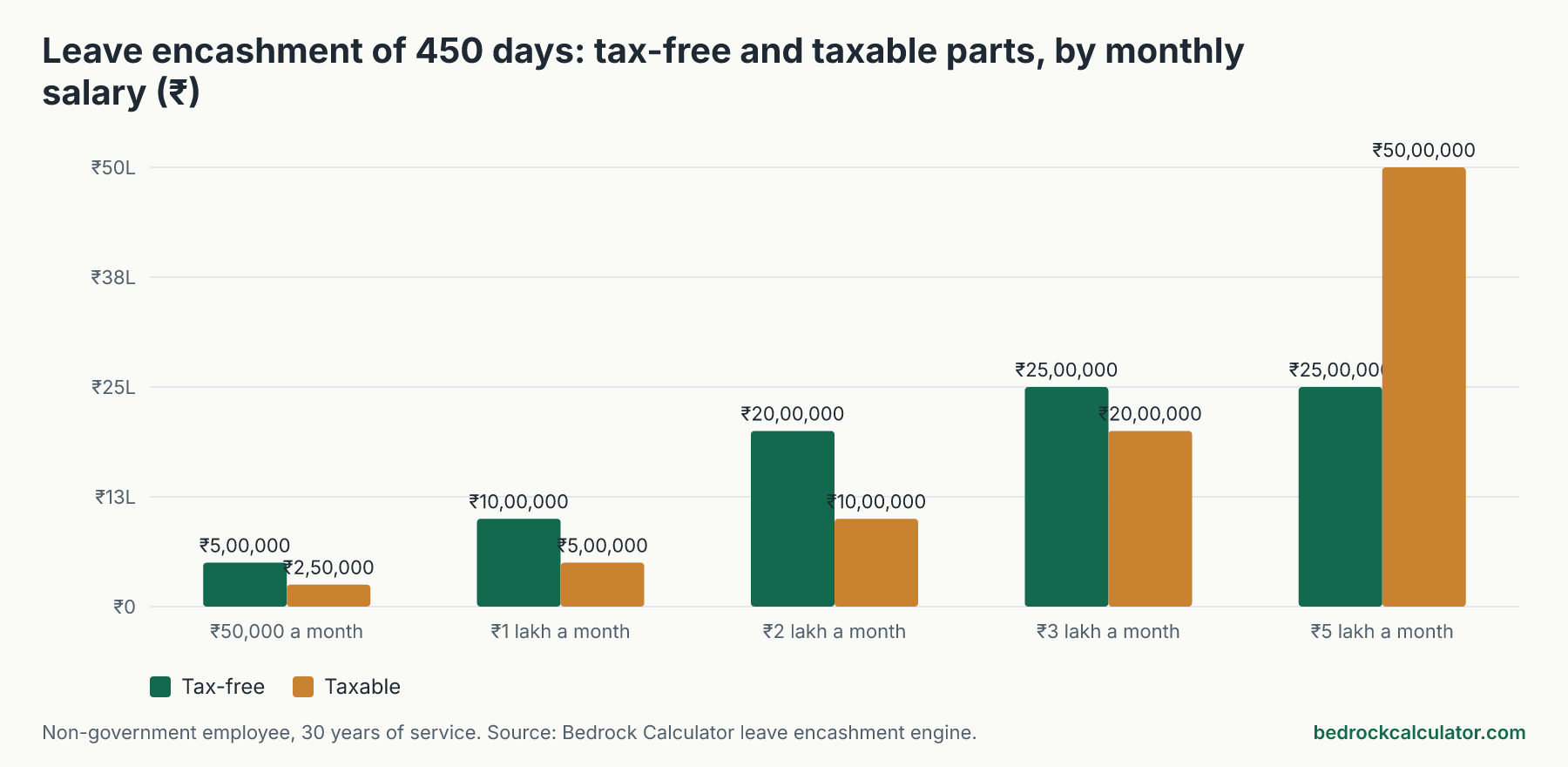
Plenty of long-serving employees retire with more than ten months of leave. Four hundred and fifty days is fifteen months of salary, and only ten of those months can be tax-free.
India leave encashment at retirement: 450 days of leave, by salary (₹)
Download CSVSame as above with 450 days of leave, worth 15 months' salary. Extra tax is on the taxable part, new regime, Tax Year 2026-27, with ₹10 lakh of other taxable income, including cess.
| ₹50,000 | ₹7,50,000 | ₹5,00,000 | ₹2,50,000 | ₹52,000 | 10 months' salary |
| ₹1,00,000 | ₹15,00,000 | ₹10,00,000 | ₹5,00,000 | ₹1,09,200 | 10 months' salary |
| ₹2,00,000 | ₹30,00,000 | ₹20,00,000 | ₹10,00,000 | ₹2,08,000 | 10 months' salary |
| ₹3,00,000 | ₹45,00,000 | ₹25,00,000 | ₹20,00,000 | ₹4,99,200 | ₹25 lakh ceiling |
| ₹5,00,000 | ₹75,00,000 | ₹25,00,000 | ₹50,00,000 | ₹15,78,720 | ₹25 lakh ceiling |
On ₹50,000 a month the payout is ₹7.5 lakh, and ₹2.5 lakh of it is taxable even though the whole amount is far below ₹25 lakh. On ₹1 lakh a month the payout is ₹15 lakh, only ₹10 lakh is tax-free, and ₹5 lakh is taxable, which adds ₹1,09,200 to the year's tax with ₹10 lakh of other income. At ₹5 lakh a month both the ceiling and the size of the payout matter: ₹75 lakh paid, ₹50 lakh taxable, ₹15,78,720 of extra tax.
A government employee in the same position pays nothing. The calculator treats the whole ₹75 lakh as exempt, under a separate entry in the same table of the Act.
The new Act and the new regime
Under the Income-tax Act, 2025, which applies from 1 April 2026, leave encashment at retirement sits in the table of deductions from salary in section 19, at serial number 14 for non-government employees and serial number 13 for government employees. The ₹25 lakh figure isn't written into the Act itself: the Act refers to an amount the government notifies, and the notification of 24 May 2023 that set ₹25 lakh from 1 April 2023 continues under the new Act's transition rules.
The exemption also survives the new tax regime. The regime switches off a long list of exemptions and deductions, but this one isn't among them, so the calculation is the same whichever regime you pick.
How we worked out these numbers
Every figure comes from the leave encashment calculator on this site:
- Non-government employee, 30 years of service, so the 30-days-a-year cap never limits 300 or 450 days
- The employer pays the leave at the average monthly salary, which is the calculator's own cash value of the leave
- Extra tax is from the site's income tax engine: new regime, Tax Year 2026-27, resident under 60, with ₹10 lakh of other taxable income, including cess
What these numbers leave out
- More than one employer. The ₹25 lakh limit is a lifetime figure across employers. Any exemption claimed on earlier leave encashment reduces what's left.
- Your employer's own formula. Some employers pay leave on a different salary base or day count. Enter your actual payout in the calculator.
- Relief for arrears. If a lump sum pushes you into a higher slab, relief for salary received in arrears or in advance may reduce the tax. The section 89 relief calculator covers it.
- Leave encashed while in service. That's fully taxable and not covered here.
Run your own numbers
Enter your salary, leave balance, years of service and payout in the leave encashment calculator to see your tax-free and taxable parts. If you're retiring, the gratuity calculator works out the other big lump sum, and the income tax regime calculator shows the tax on your whole year.