How much tax is due under presumptive taxation in India?
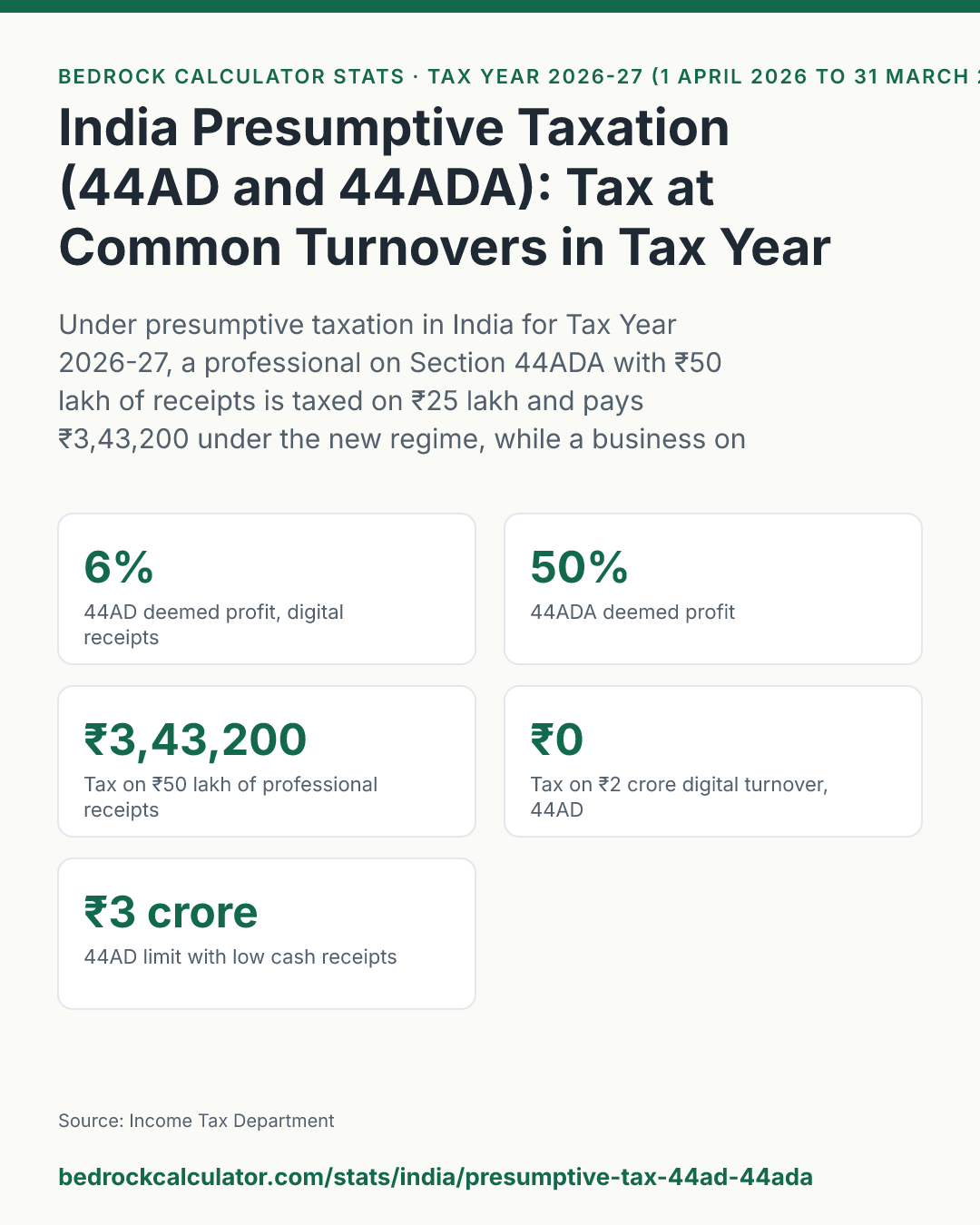
Presumptive taxation lets small businesses and professionals in India skip detailed accounts and pay tax on a fixed share of what they take in. For Tax Year 2026-27, a business under Section 44AD is taxed on 6% of turnover received by bank or UPI and 8% of cash turnover.
A professional under Section 44ADA is taxed on 50% of gross receipts.
Under the new regime, with no other income, that works out to no tax at all on up to ₹2 crore of fully digital business turnover. A consultant with ₹50 lakh of receipts is taxed on ₹25 lakh and pays ₹3,43,200.
How the presumptive scheme works
Instead of adding up real expenses, you declare a fixed share of turnover as your profit, and that profit is taxed at your normal slab rates. Nothing else comes off it: the presumed percentage is treated as profit after every expense.
The engine uses these rules:
- Section 44AD (eligible businesses): 6% of receipts by bank transfer, cheque or digital payment, and 8% of cash receipts. Turnover limit ₹2 crore, or ₹3 crore if cash receipts are no more than 5% of turnover.
- Section 44ADA (specified professions such as doctors, lawyers, engineers, architects, accountants and technical consultants): 50% of gross receipts. Limit ₹50 lakh, or ₹75 lakh on the same cash test.
India's Income-tax Act, 2025 renumbered many sections from Tax Year 2026-27. The site's engine still labels these schemes 44AD and 44ADA, the names most people search for, so we've used them here.
Tax under 44ADA for freelancers and professionals
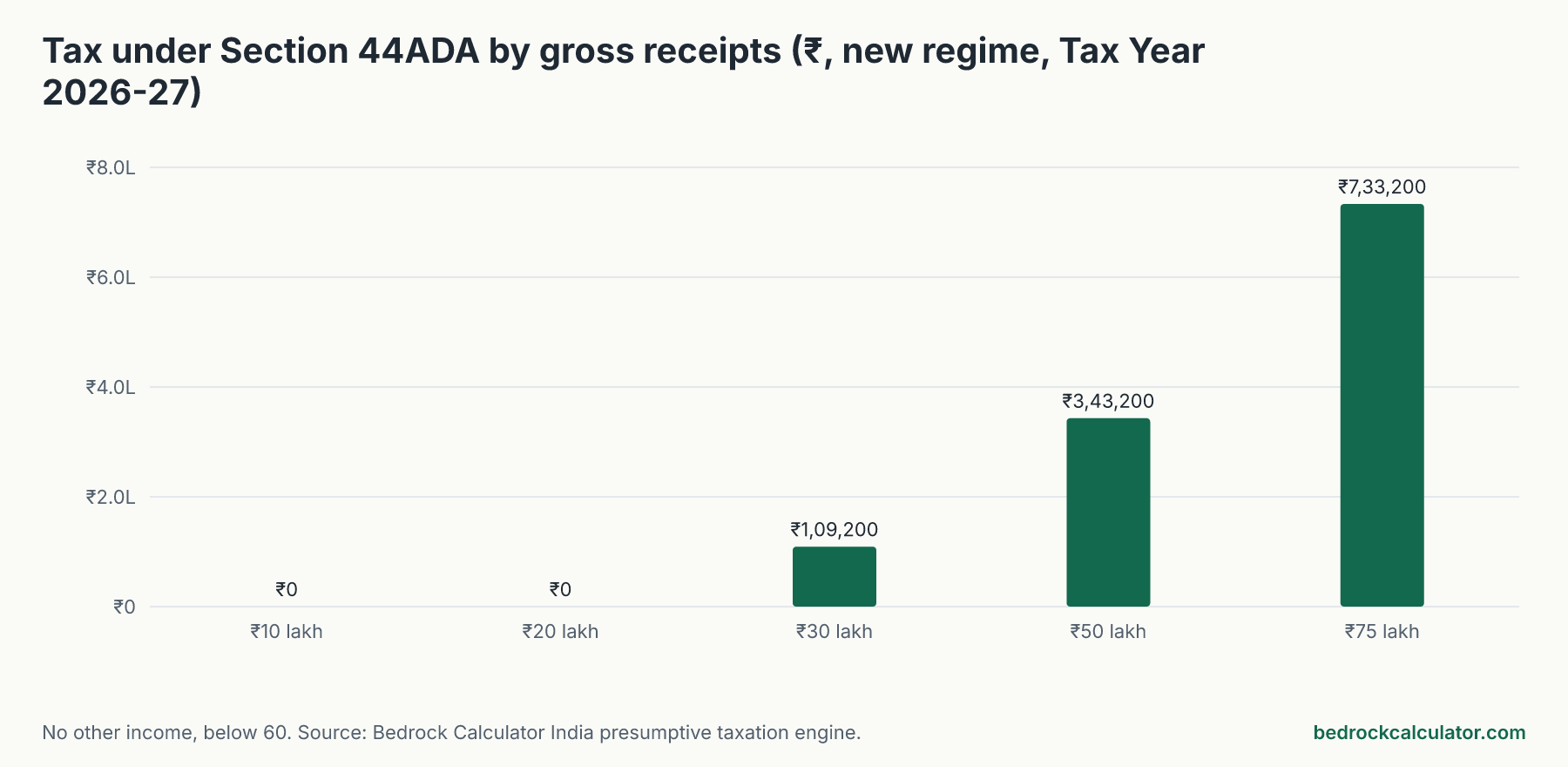
India: tax under Section 44ADA by gross receipts, Tax Year 2026-27 (₹, new regime, no other income)
Download CSVDeemed profit is 50% of gross receipts. Receipts almost entirely by bank or digital modes, so the higher limit applies. Tax includes the 87A rebate, surcharge and 4% cess.
| ₹10 lakh | ₹5,00,000 | ₹0 | 0.0% |
| ₹20 lakh | ₹10,00,000 | ₹0 | 0.0% |
| ₹30 lakh | ₹15,00,000 | ₹1,09,200 | 3.6% |
| ₹50 lakh | ₹25,00,000 | ₹3,43,200 | 6.9% |
| ₹75 lakh | ₹37,50,000 | ₹7,33,200 | 9.8% |
Up to ₹20 lakh of receipts, deemed income is ₹10 lakh or less, which sits inside the new regime's rebate limit, so the tax is nil. At ₹30 lakh, deemed income is ₹15 lakh and the tax is ₹1,09,200, about 3.6% of receipts. At ₹75 lakh, the top of the scheme for someone paid almost entirely by bank transfer, deemed income is ₹37.5 lakh and tax is ₹7,33,200, or 9.8% of receipts.
That's a light burden for anyone whose real expenses are well under half their fees, which is true for many consultants and software freelancers. If your real costs are higher than half, keeping books and paying tax on actual profit could cost less.
Tax under 44AD for businesses, digital vs cash
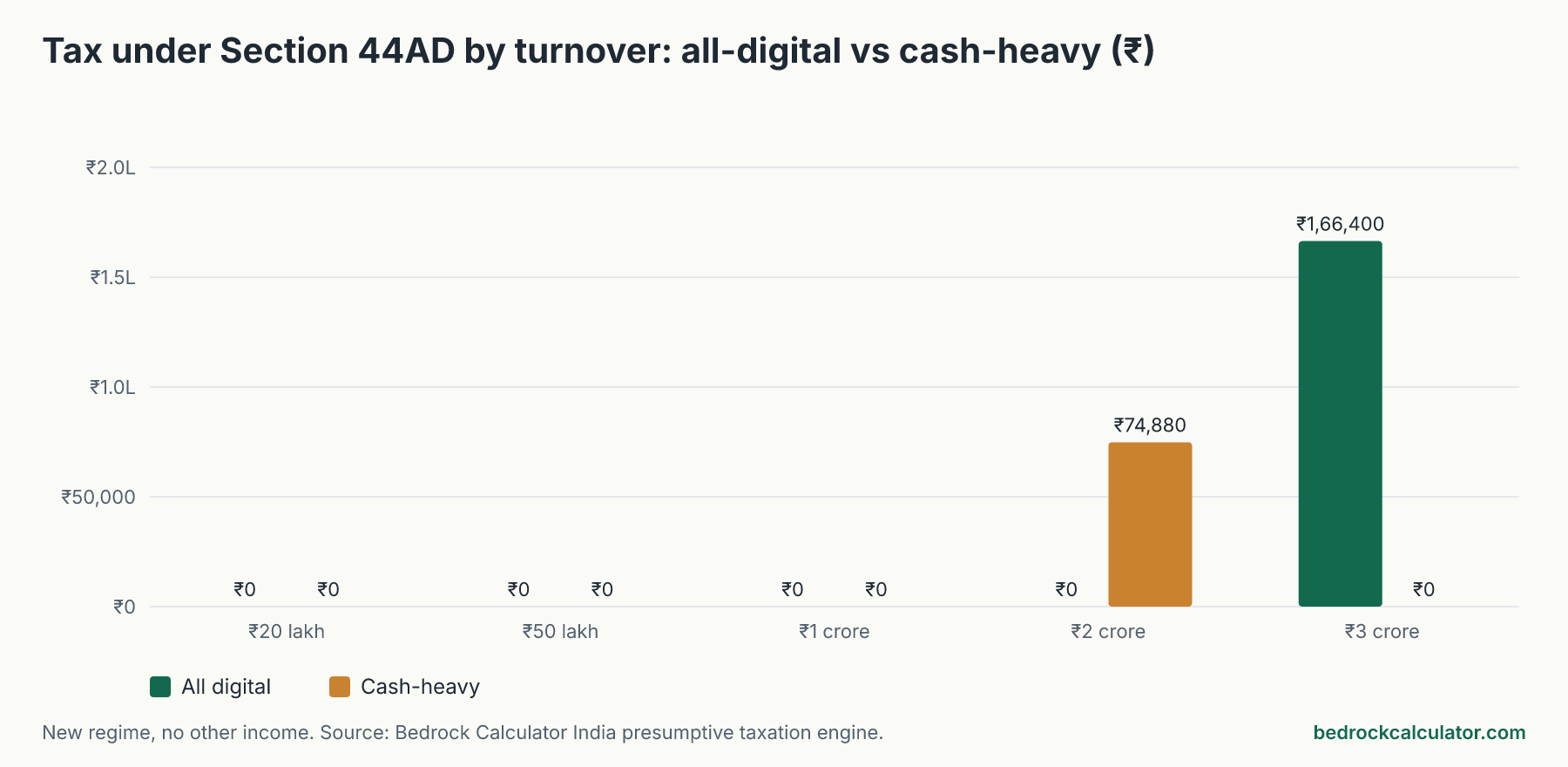
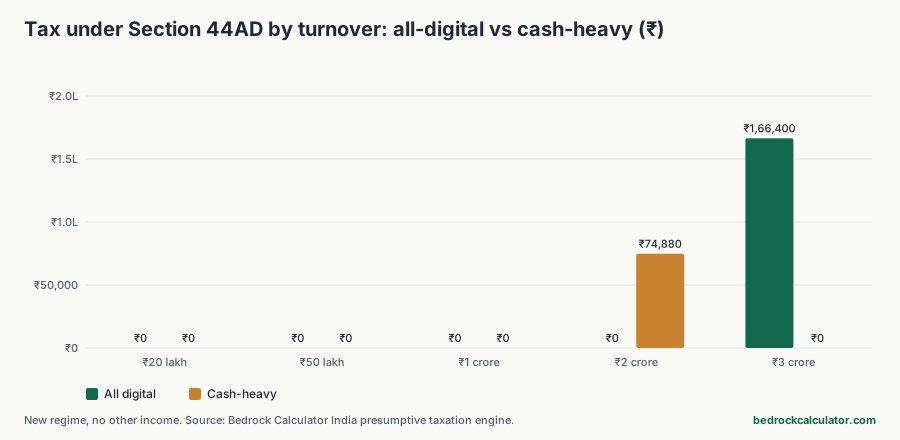
India: tax under Section 44AD by turnover, Tax Year 2026-27 (₹, new regime, no other income)
Download CSVDeemed profit is 6% of receipts by bank or digital modes and 8% of cash receipts. Cash-heavy column assumes 20% of turnover in cash. Tax includes the 87A rebate, surcharge and 4% cess. "No" means turnover is above the limit, so the scheme cannot be used and the cells show n/a.
| ₹20 lakh | ₹1,20,000 | ₹0 | ₹1,28,000 | ₹0 | Yes |
| ₹50 lakh | ₹3,00,000 | ₹0 | ₹3,20,000 | ₹0 | Yes |
| ₹1 crore | ₹6,00,000 | ₹0 | ₹6,40,000 | ₹0 | Yes |
| ₹2 crore | ₹12,00,000 | ₹0 | ₹12,80,000 | ₹74,880 | Yes |
| ₹3 crore | ₹18,00,000 | ₹1,66,400 | n/a | n/a | No |
The digital rate makes a real difference. At ₹1 crore of turnover, all-digital receipts give deemed profit of ₹6 lakh; with 20% in cash it's ₹6.4 lakh. Both still pay no tax. At ₹2 crore, all-digital deemed profit of ₹12 lakh stays at nil tax, while the cash-heavy business pays ₹74,880.
The cash share also decides whether you can use the scheme at all. With little cash, a ₹3 crore business qualifies, has deemed profit of ₹18 lakh and pays ₹1,66,400. With a fifth of turnover in cash, the limit falls back to ₹2 crore, so the same business can't use 44AD and has to keep full accounts.
Who should use the presumptive scheme?
It suits you if your real profit margin is at or above the presumed rate, you want simple filing, and your turnover is within the limit. Many traders work on thin margins, though. If your actual profit is below the presumed rate, you can declare it, but then you generally need to maintain books and may need an audit.
There's also a lock-in on 44AD. If you use it one year and then declare lower profit within the next few years, you can be shut out of the scheme for several years after that, and need full books in the meantime. The presumptive taxation calculator lets you enter your actual profit to compare the two.
How we worked out these numbers
Every figure comes from the presumptive taxation calculator on this site. It works out deemed income from your turnover and how it was received, checks the turnover limit, then taxes the deemed income with the same engine as our old vs new tax regime calculator: slabs, the 87A rebate with marginal relief, surcharge and the 4% cess.
We assumed a resident individual below 60, on the new regime, with no other income. For the "all digital" column there's no cash at all; for "cash-heavy", 20% of turnover is in cash.
What this leaves out
Professional tax, GST and any other income aren't included; add other income in the calculator to see its effect. The calculator doesn't check whether your trade or profession is eligible: commission agents, brokers and LLPs, for example, can't use 44AD, and 44ADA is only for specified professions. Under these schemes, advance tax can be paid in a single instalment by 15 March, which the advance tax calculator doesn't model. If you're registered for GST, the GST calculator covers that side.
Work out your own figure
Enter your turnover, how much came in cash, and any other income in the presumptive taxation calculator. If you're close to the zero-tax line, our guide to the highest income with zero tax shows where it sits for non-salary income.