How long does it take to pay off a credit card with minimum payments?
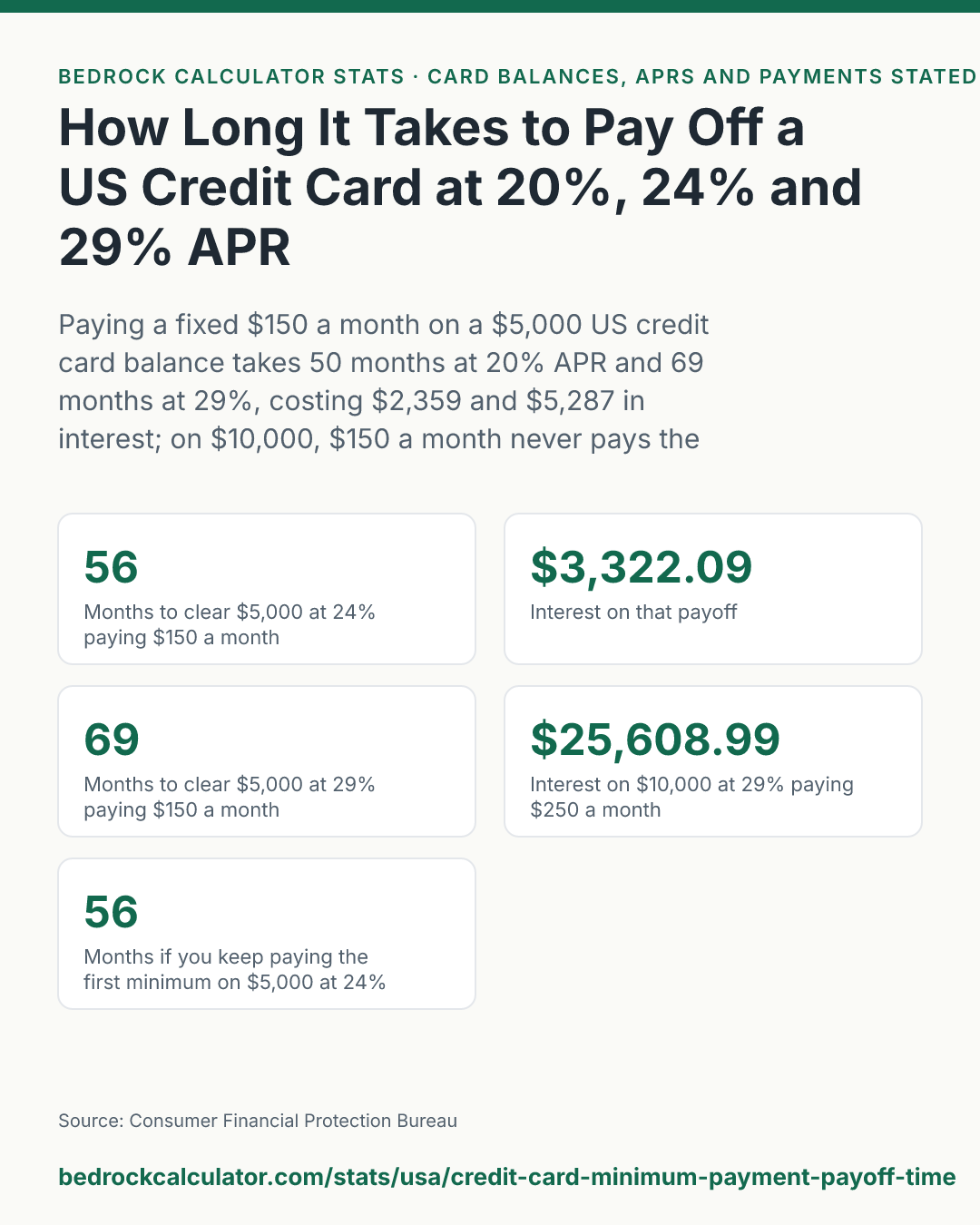
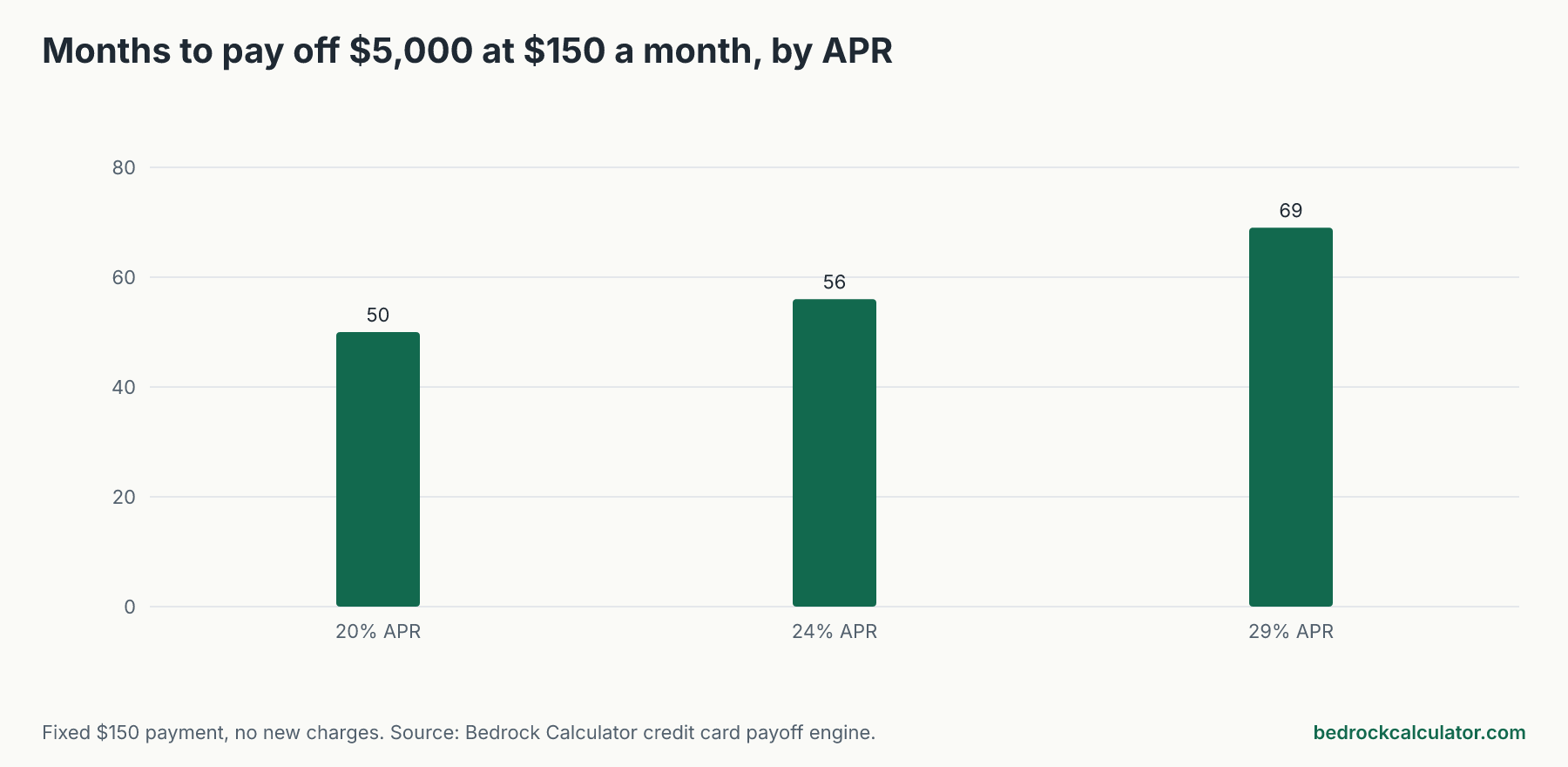
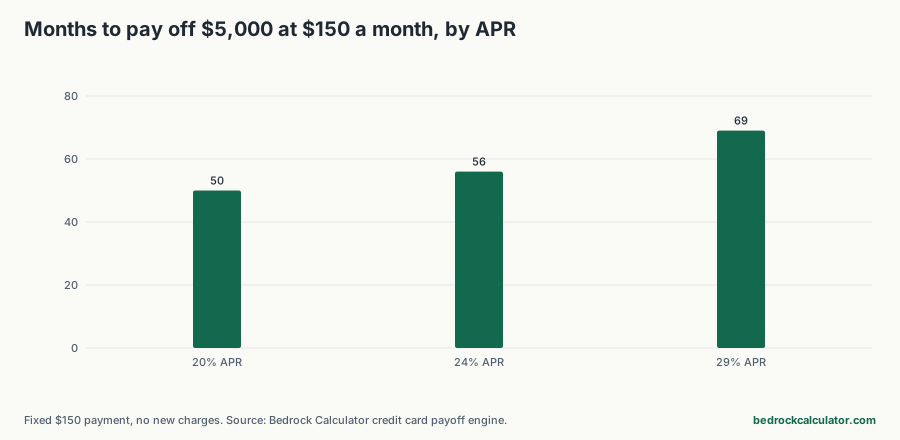
At typical US credit card rates, a $5,000 balance paid down at $150 a month takes 50 months at 20% APR, 56 months at 24% and 69 months at 29%. The interest on that last one is $5,287.24, against $2,359.09 at 20%.
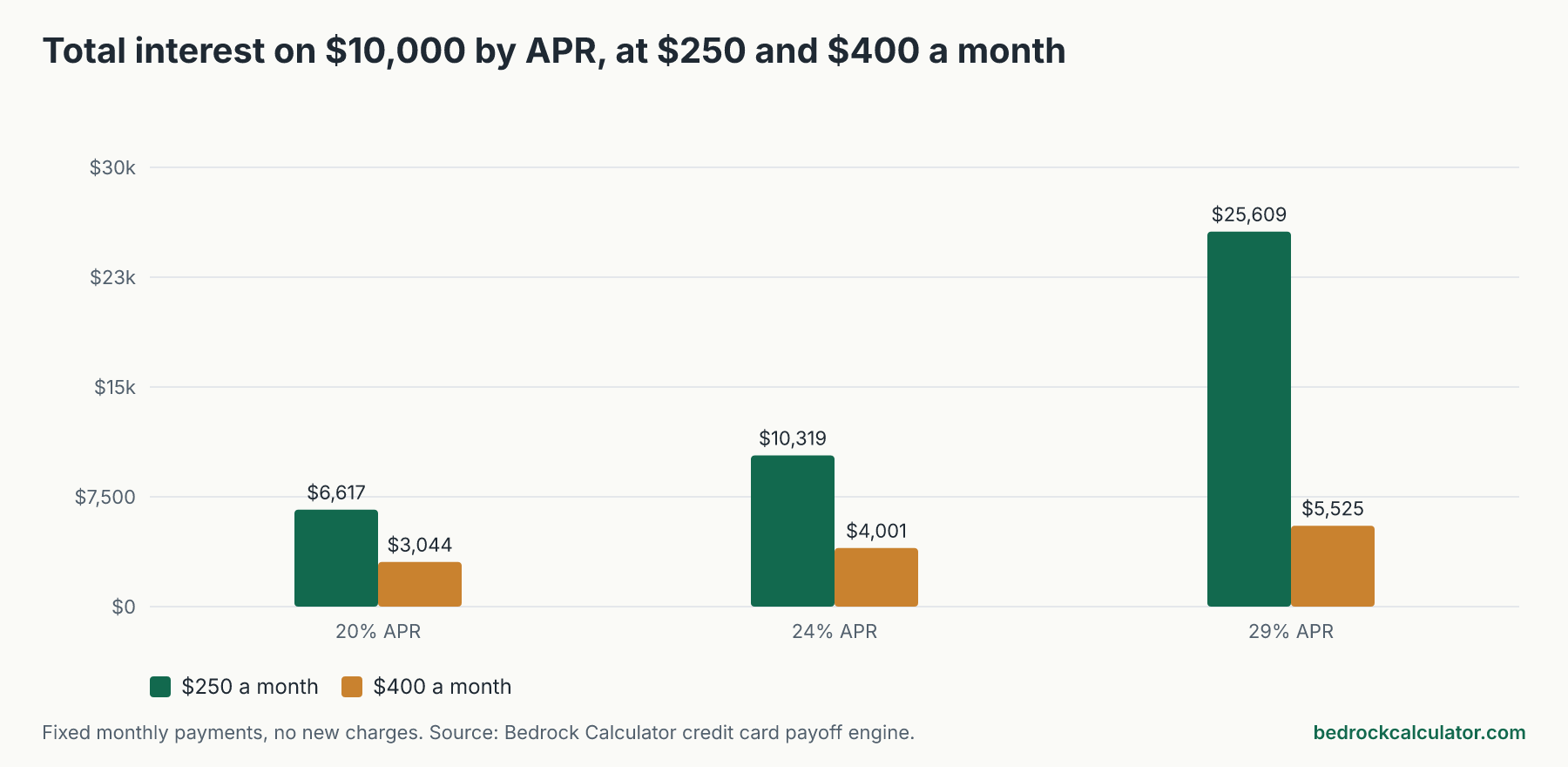
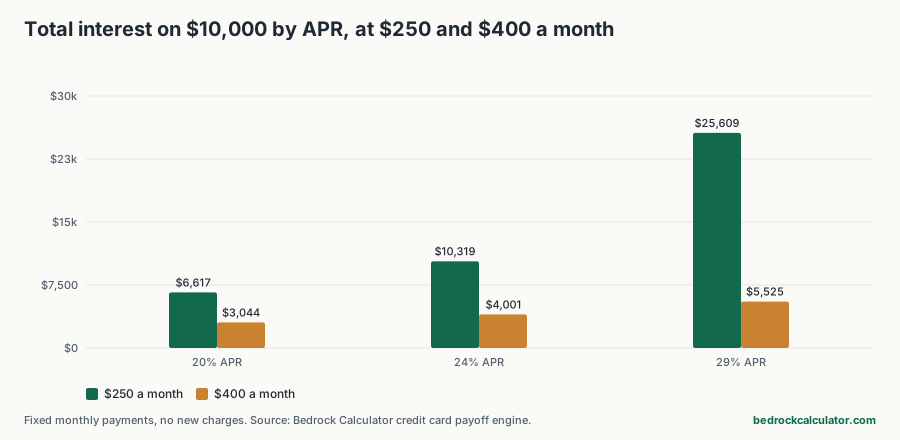
On $10,000, $150 a month never clears the card at any of these rates, because the monthly interest alone is more than the payment. At $250 a month and 29% APR, $10,000 takes 143 months and costs $25,608.99 in interest, more than the original balance.
How we worked out these numbers
We ran the credit card payoff calculator on this site for balances of $5,000 and $10,000 at 20%, 24% and 29% APR, with fixed payments of $150, $250 and $400 a month. Each month the calculator charges interest at the APR divided by 12 on the remaining balance, subtracts your payment, and repeats until the balance is gone. It assumes you make no new purchases and pay no fees.
The calculator stops after 360 months. Where the balance was still there at that point, which happens only when the payment doesn't cover the interest, we show the payoff as n/a rather than a number.
What about true minimum payments?
Here's an important limit. A card's real minimum payment usually shrinks as the balance falls, because it's figured as a percentage of whatever you owe that month. The calculator holds the payment fixed, so it can't follow a shrinking minimum. A real minimum-only payoff takes longer than anything in this article, often many years longer.
What we can show is the next best thing: what happens if you take your first month's minimum and keep paying that same amount. We set that first minimum at 1% of the balance plus the first month's interest. That's a formula we chose to represent a low minimum, not any particular issuer's rule, so check your card agreement and statement for yours.
Keep paying that first minimum on $5,000 at 24% and the card is clear in 56 months, with $3,322.09 in interest. That's one of the simplest ways to escape the minimum trap: when your minimum drops, don't let your payment drop with it.
Every balance, rate and payment
Sort by any column. The "Minimum-sized" rows are the fixed first-minimum payment described above.
Credit card payoff time on $5,000 and $10,000 by APR and monthly payment
Download CSVFixed payment every month, no new purchases or fees, interest at APR divided by 12. "Minimum-sized" is 1% of the starting balance plus the first month's interest, held fixed. n/a means the payment never clears the balance.
| $5,000 | 20% | Minimum-sized | $133.33 | 60 | $2,912.23 |
| $5,000 | 20% | Fixed | $150.00 | 50 | $2,359.09 |
| $5,000 | 20% | Fixed | $250.00 | 25 | $1,133.03 |
| $5,000 | 20% | Fixed | $400.00 | 15 | $653.73 |
| $5,000 | 24% | Minimum-sized | $150.00 | 56 | $3,322.09 |
| $5,000 | 24% | Fixed | $150.00 | 56 | $3,322.09 |
| $5,000 | 24% | Fixed | $250.00 | 26 | $1,449.36 |
| $5,000 | 24% | Fixed | $400.00 | 15 | $811.97 |
| $5,000 | 29% | Minimum-sized | $170.83 | 52 | $3,790.60 |
| $5,000 | 29% | Fixed | $150.00 | 69 | $5,287.24 |
| $5,000 | 29% | Fixed | $250.00 | 28 | $1,914.17 |
| $5,000 | 29% | Fixed | $400.00 | 16 | $1,024.84 |
| $10,000 | 20% | Minimum-sized | $266.67 | 60 | $5,824.04 |
| $10,000 | 20% | Fixed | $150.00 | n/a | n/a |
| $10,000 | 20% | Fixed | $250.00 | 67 | $6,616.65 |
| $10,000 | 20% | Fixed | $400.00 | 33 | $3,044.21 |
| $10,000 | 24% | Minimum-sized | $300.00 | 56 | $6,644.17 |
| $10,000 | 24% | Fixed | $150.00 | n/a | n/a |
| $10,000 | 24% | Fixed | $250.00 | 82 | $10,318.98 |
| $10,000 | 24% | Fixed | $400.00 | 36 | $4,001.13 |
| $10,000 | 29% | Minimum-sized | $341.67 | 52 | $7,580.69 |
| $10,000 | 29% | Fixed | $150.00 | n/a | n/a |
| $10,000 | 29% | Fixed | $250.00 | 143 | $25,608.99 |
| $10,000 | 29% | Fixed | $400.00 | 39 | $5,524.86 |
Why the payment matters more than anything else
Interest each month is the balance times the APR divided by 12. At 29% APR on $10,000 that's $241.67 in the first month alone. Your payment has to beat that before a single dollar comes off what you owe.
That's why $150 on $10,000 goes nowhere, and why $250 at 29% crawls. Most of that $250 goes to interest in the early months. Raise the payment to $400 and the same $10,000 at 29% is gone in 39 months, with $5,524.86 of interest. That's 143 months cut to 39.
How much the rate matters
At the same $150 payment on $5,000, going from 20% to 29% APR adds 19 months and raises the interest from $2,359.09 to $5,287.24. On $10,000 at $250 a month, it's $6,616.65 at 20% against $25,608.99 at 29%.
That's why a lower rate is worth chasing. A balance transfer card, a call to your issuer, or a lower-rate personal loan can all cut the cost, as long as you don't run the balance back up.
If you have more than one card
When you owe on several cards, where the extra money goes matters. Paying the highest-rate card first saves the most interest; paying the smallest balance first gives quicker wins. We worked through a typical example on our page about debt snowball vs avalanche.
What this leaves out
- Shrinking minimums. As explained above, the calculator holds the payment fixed.
- New purchases, fees and penalty rates. Any new spending, annual fee, late fee or penalty APR makes the payoff slower.
- Daily interest. Many issuers charge interest on the average daily balance at a daily rate. The calculator uses the APR divided by 12 on the month's balance, which gives very close but not identical figures.
- Promotional rates. Zero-interest periods and balance transfer fees aren't modeled.
Run your own numbers
Enter your own balance, APR and payment in the credit card payoff calculator. If you have several debts, the debt snowball vs avalanche calculator shows the order that saves the most. And if you're comparing a consolidation loan, the loan payoff calculator works out a fixed-rate loan's payment and interest.