How much will your 401(k) be worth at 65?
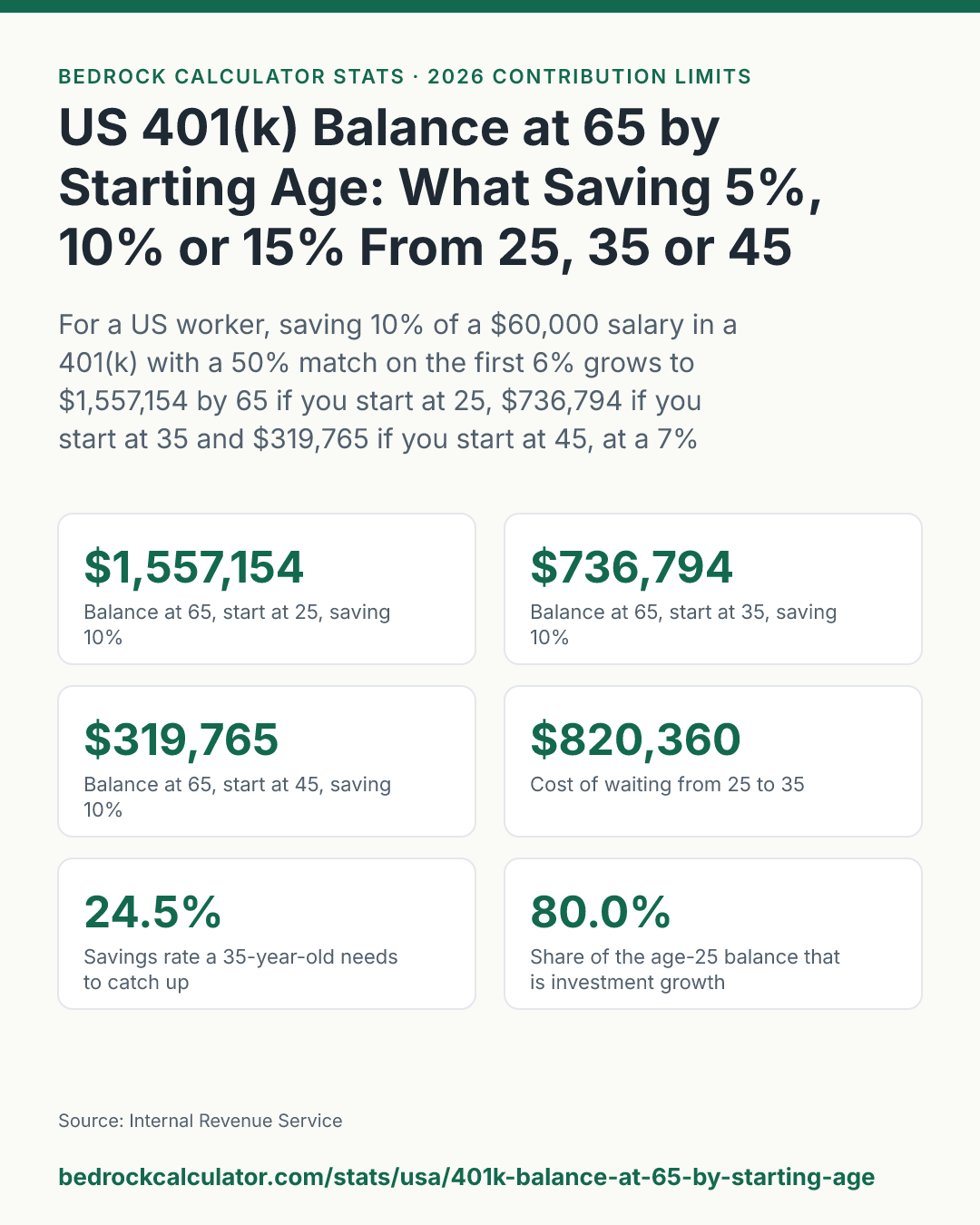
If you're a US worker and put 10% of a $60,000 salary into a 401(k) from age 25, collect a 50% match on the first 6% of pay, earn 7% a year, and you reach 65 with about $1,557,154. Start the same habit at 35 and you get $736,794. Start at 45 and it's $319,765.
Waiting ten years, from 25 to 35, costs $820,360 by retirement. That's more than the 25-year-old ever puts in.
How we worked out these numbers
All figures are for the United States and use US rules for 2026.
Every figure here comes from running the site's 401(k) calculator with the same inputs and changing only the starting age, the savings rate and, in one table, the return. Nothing was estimated by hand.
The fixed inputs are:
- A $60,000 salary that stays flat for the whole career
- An empty account on the day you start
- An employer match of 50% on whatever you defer, up to 6% of pay
- A 7% annual return, applied every year with no ups and downs
- Retirement at 65
The return is an assumption, not a forecast. No government agency publishes an expected stock market return, so we picked one figure and show what happens at others further down.
The calculator credits each year's deferrals and match at the end of the year, after that year's growth. It caps your own deferrals at the 2026 limit of $24,500, raised by the catch-up allowed from age 50 and the larger one at ages 60 to 63. It doesn't model raises, and it treats the return as net of fund fees. The balances are before tax: a traditional 401(k) is taxed as income when you withdraw it.
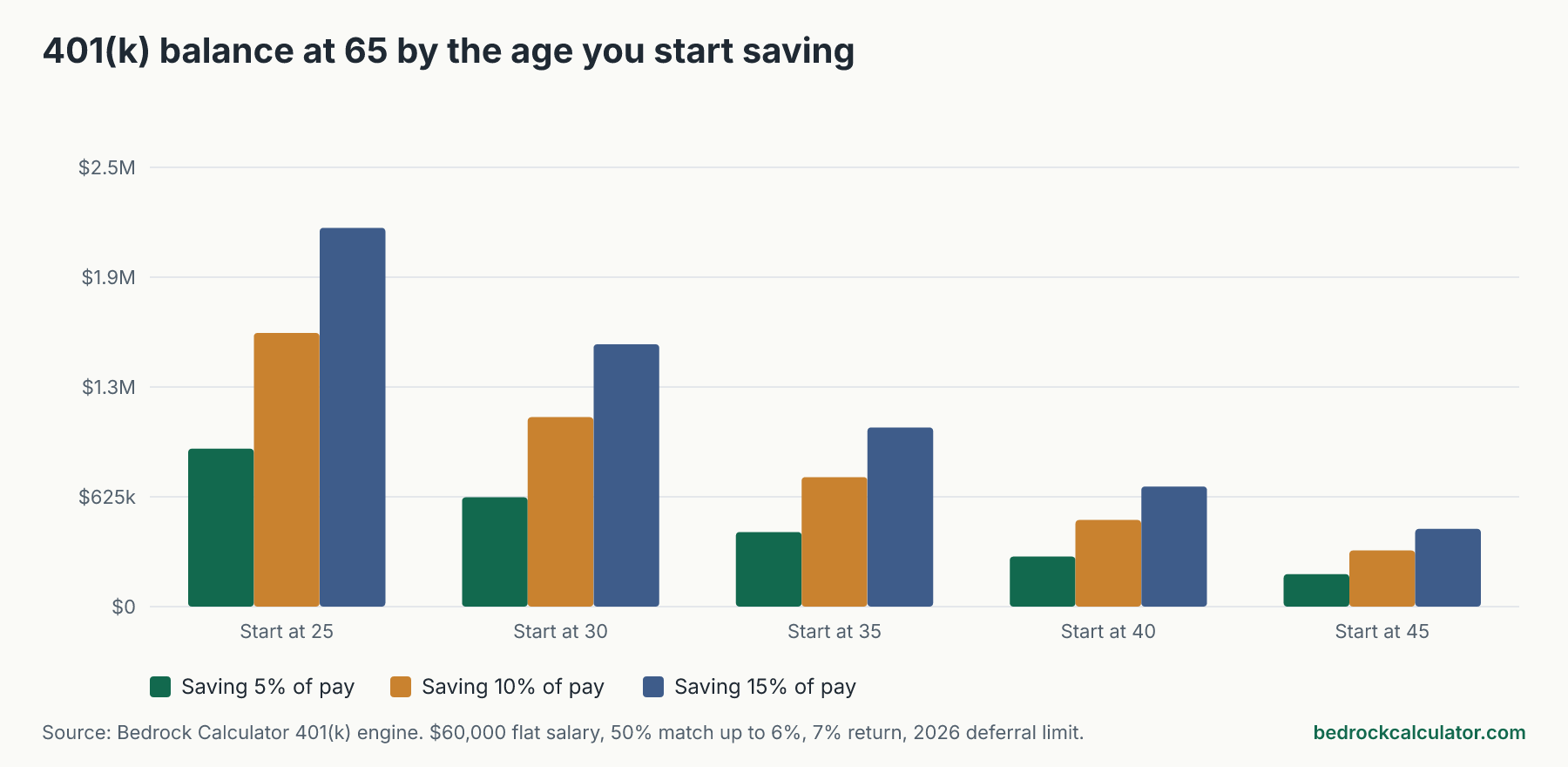
401(k) balance at 65 by starting age and savings rate
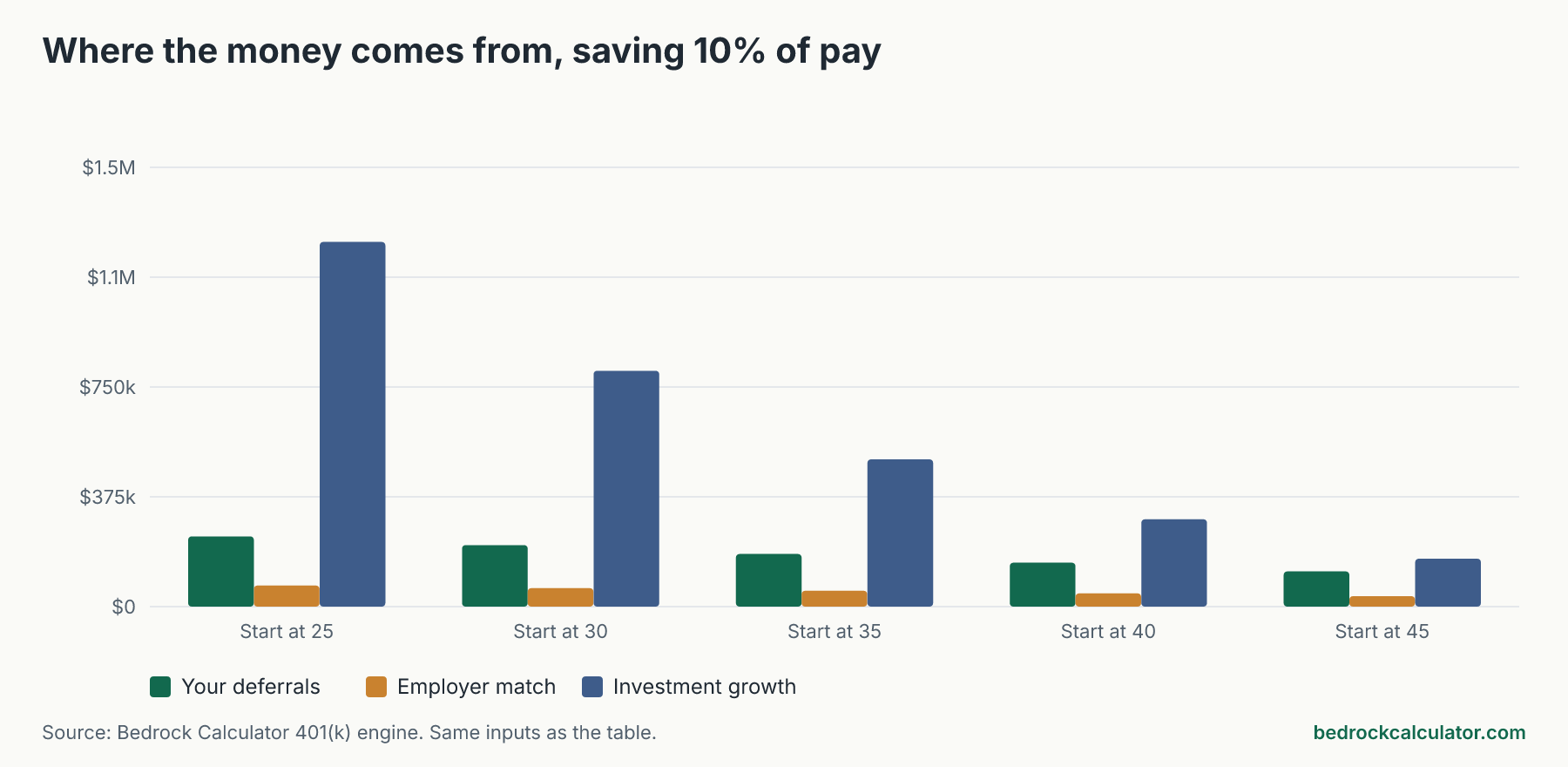
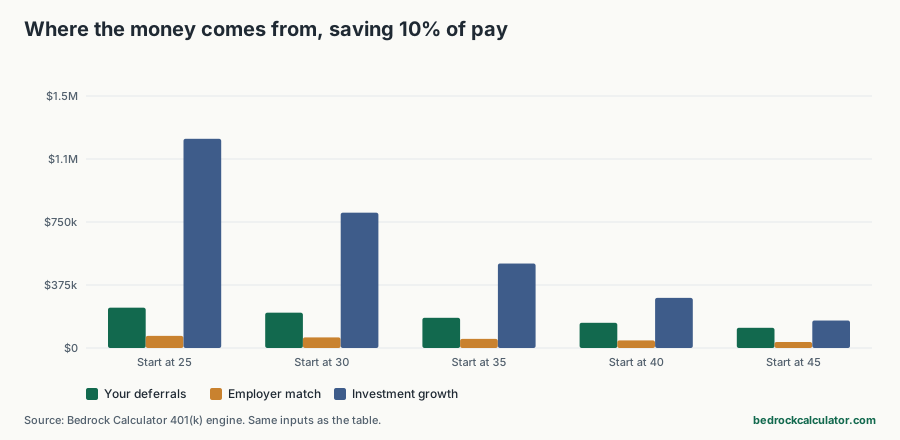
Click a heading to sort. The last two columns break down the 10% row so you can see how much is the match and how much is growth.
401(k) balance at 65 by starting age and savings rate
Download CSV$60,000 salary held flat, 50% employer match on deferrals up to 6% of pay, 7% annual return, $0 starting balance.
| 25 | 40 | $898,358 | $1,557,154 | $2,156,059 | $72,000 | $1,245,154 |
| 30 | 35 | $622,066 | $1,078,248 | $1,492,958 | $63,000 | $805,248 |
| 35 | 30 | $425,074 | $736,794 | $1,020,176 | $54,000 | $502,794 |
| 40 | 25 | $284,621 | $493,342 | $683,090 | $45,000 | $298,342 |
| 45 | 20 | $184,480 | $319,765 | $442,751 | $36,000 | $163,765 |
A few things stand out. At 5% of pay, a 25-year-old still ends up with $898,358, which is more than a 45-year-old saving 15% ($442,751). And at 25, going from 10% to 15% of pay adds $598,905 by 65, for an extra $3,000 a year out of your paycheck.
Why starting at 25 instead of 35 matters so much
The 25-year-old saving 10% contributes $240,000 of their own money over 40 years, and the employer adds $72,000. Everything else, $1,245,154, is investment growth. That's 80.0% of the final balance.
The 45-year-old saving 10% puts in $120,000 and gets $36,000 of match, and growth is only 51.2% of what they end with. Compounding needs time more than it needs money. The early decades do most of the work because every dollar invested at 25 compounds for 40 years, and a dollar invested at 45 gets 20.
That's also why the cost of waiting is so lopsided. Starting at 30 instead of 25 costs $478,906 by 65. Starting at 35 costs $820,360. The 25-year-old's final balance is 4.9 times the 45-year-old's, even though they only saved for twice as long.
Can you catch up if you start late?
Partly. To match the 25-year-old who saves 10%, a 35-year-old on the same salary would have to defer about 24.5% of pay every year until 65. That's hard but possible.
A 45-year-old can't close the gap on a $60,000 salary, at least not inside a 401(k). Even deferring every dollar the 2026 rules allow, $24,500 a year plus catch-up contributions from age 50, every year until 65, gets them to $1,317,807.
How much the return assumption changes things
401(k) balance at 65 at different annual returns (saving 10%)
Download CSVSame saver as above, saving 10% of a $60,000 salary with a 50% match up to 6%. Only the assumed return changes.
| 25 | $942,238 | $1,207,143 | $1,557,154 | $2,020,641 |
| 30 | $704,498 | $869,191 | $1,078,248 | $1,344,071 |
| 35 | $518,223 | $616,654 | $736,794 | $883,609 |
| 40 | $372,271 | $427,943 | $493,342 | $570,226 |
| 45 | $257,914 | $286,928 | $319,765 | $356,943 |
The return you assume is the biggest unknown in any 401(k) projection. For the 25-year-old saving 10%, a 5% return leaves $942,238 at 65 and an 8% return leaves $2,020,641. That's a gap of $1,078,403 from a three-point change in one input.
The late starter is less exposed to that swing. For someone starting at 45, the same range runs from $257,914 to $356,943. Less time means less compounding, in both directions.
None of these returns is guaranteed. Real markets don't deliver a smooth 7% every year, and a bad run of years just before you retire can leave you with less than a flat-return projection suggests, even at the same average.
What the balance is worth in today's money
These are future dollars. If prices rise 2.5% a year, the $1,557,154 that the 25-year-old has at 65 buys about what $579,932 buys now. The 45-year-old's $319,765 is worth about $195,143 in today's money. If you want a projection in today's dollars, the retirement calculator converts its result for you and tests it against the income you want to live on.
Getting your own number
Your figure will differ from these if your salary is higher or lower, if you get raises, if your employer's match formula is different, or if you already have money saved. Open the 401(k) calculator, enter your own salary, balance and match, and try a few returns.
If you're weighing a Roth IRA alongside your 401(k), the Roth IRA calculator shows how much tax-free growth the same habit builds. And for a plain look at how money compounds over time, try the compound interest calculator.
The pattern holds whatever your numbers are. The first ten years of saving decide more of your balance at 65 than the last twenty, so the cheapest way to retire with more is to start sooner, and the second cheapest is to take the full employer match from your first paycheck.