How much do you keep from an early 401(k) withdrawal?
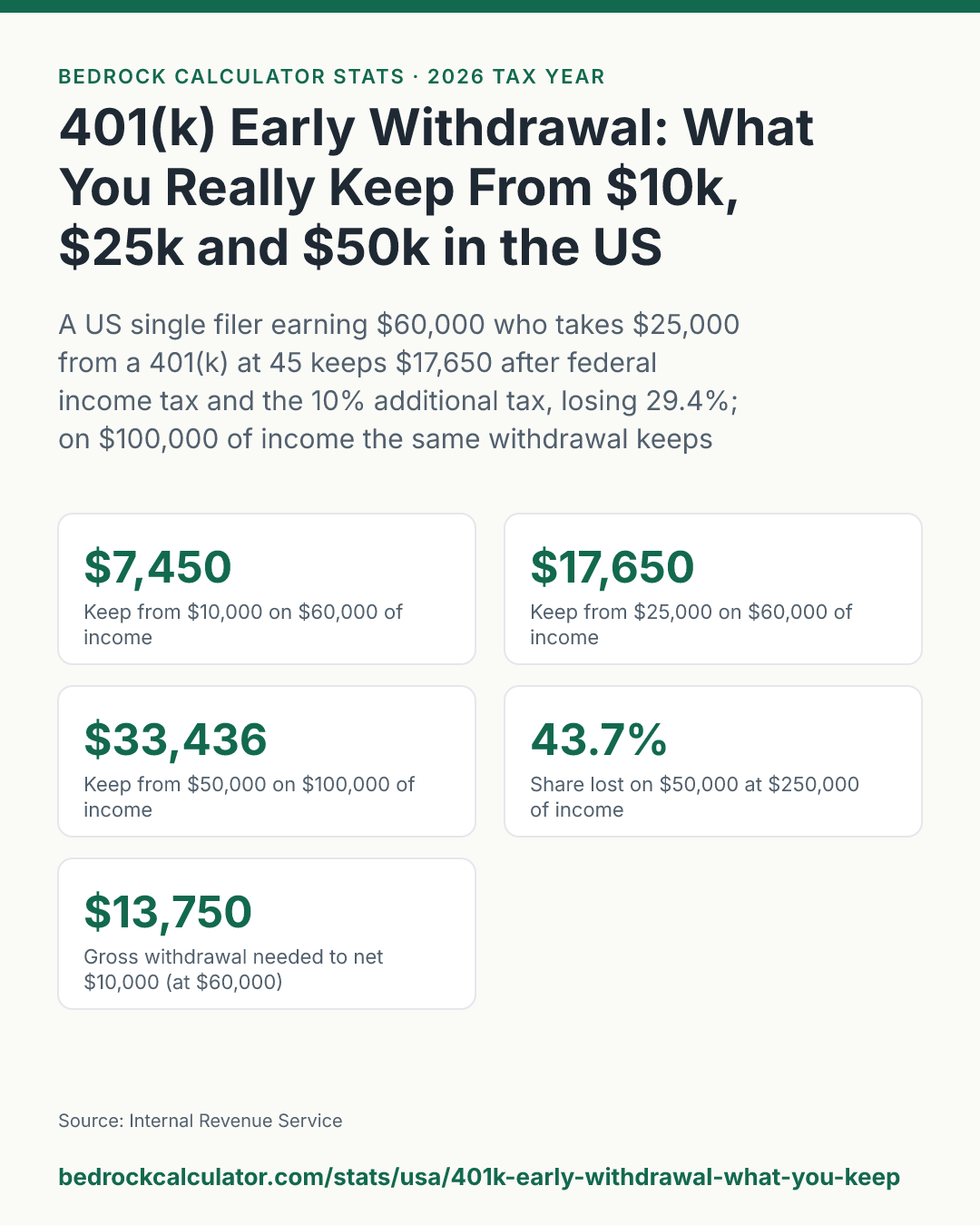
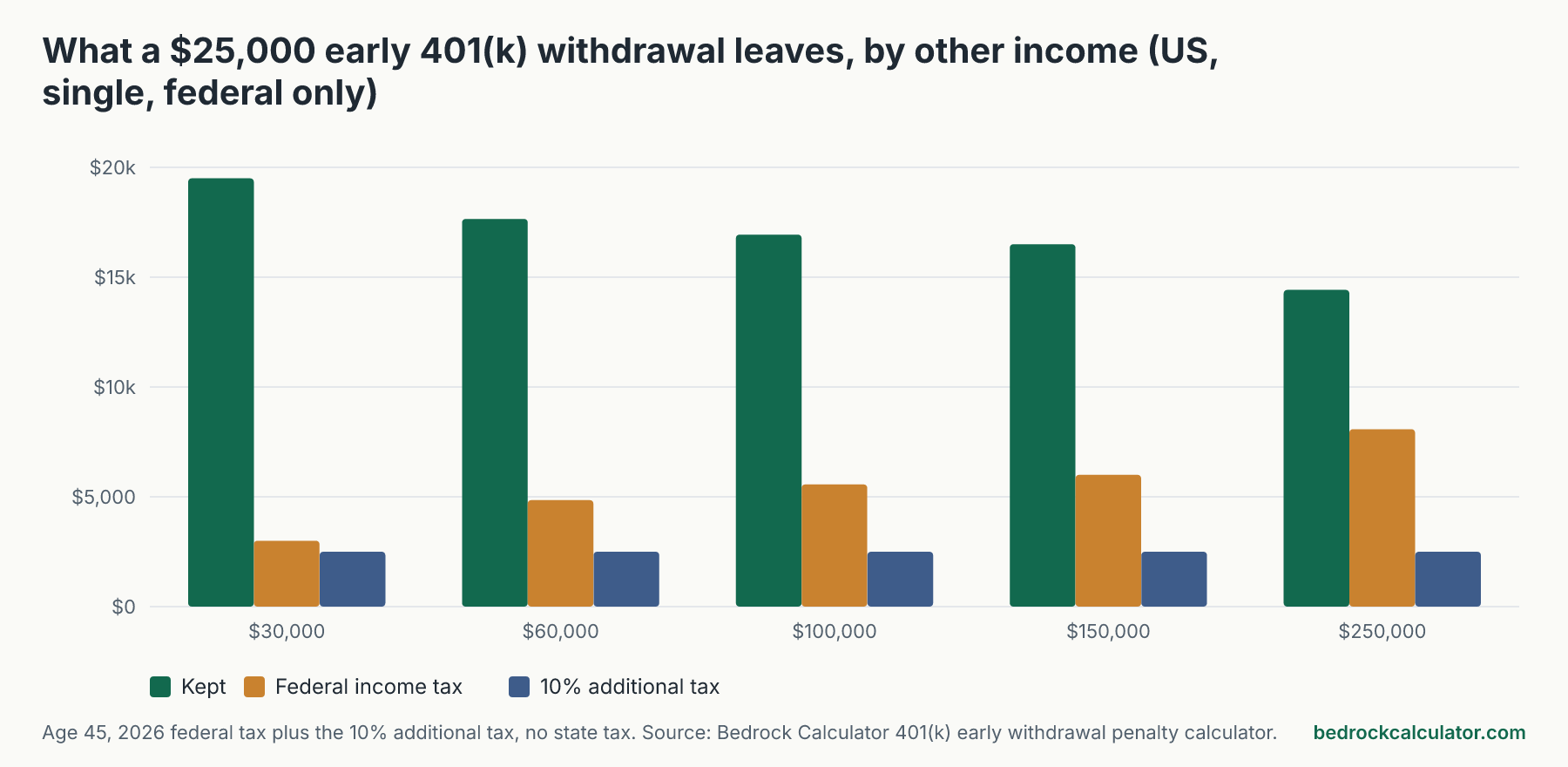
Taking money out of a 401(k) before age 59 and a half costs more than most people expect. In the US, a single filer earning $60,000 who withdraws $25,000 at 45 keeps $17,650. The rest goes to federal income tax ($4,850) and the 10% additional tax ($2,500). That's 29.4% of the withdrawal gone before any state tax.
The higher your other income, the more you lose. The same $25,000 leaves $16,936 at $100,000 of income and $14,420 at $250,000.
How we worked out these numbers
We ran the site's 401(k) early withdrawal penalty calculator for three withdrawal sizes, $10,000, $25,000 and $50,000, at five levels of other income for a single filer, plus three levels for a married couple filing jointly. Every run uses:
- Age 45, so the 10% additional tax on early distributions applies
- A traditional, pre-tax 401(k), so the whole withdrawal is taxable income
- 2026 federal tax brackets and standard deduction
- The withdrawal stacked on top of the year's other income, so it's taxed at your top rates, not your lowest
"Other income" here means wages and other ordinary income before the standard deduction.
What these figures leave out
State income tax. We didn't add it, and that was a deliberate choice. Someone in Texas or Florida keeps exactly what the table shows, because those states have no income tax. But states treat retirement plan withdrawals in very different ways. Some tax them like wages, some exclude part or all of them, and at least one adds its own early-withdrawal penalty. The engine we use for state tax applies each state's wage schedule and has none of those retirement rules, so a 50-state table from it would be wrong for exactly the states where the rules matter. Check your own state's revenue department before you count on the federal figure.
Penalty exceptions. The calculator always charges the additional tax before 59 and a half. Several situations are exempt, covered further down.
Withholding. Your plan will withhold part of the payout for federal tax up front. That's a prepayment of the tax shown here, not an extra cost, but it means the check you receive can be smaller than what you finally keep after filing.
What you keep at each income level
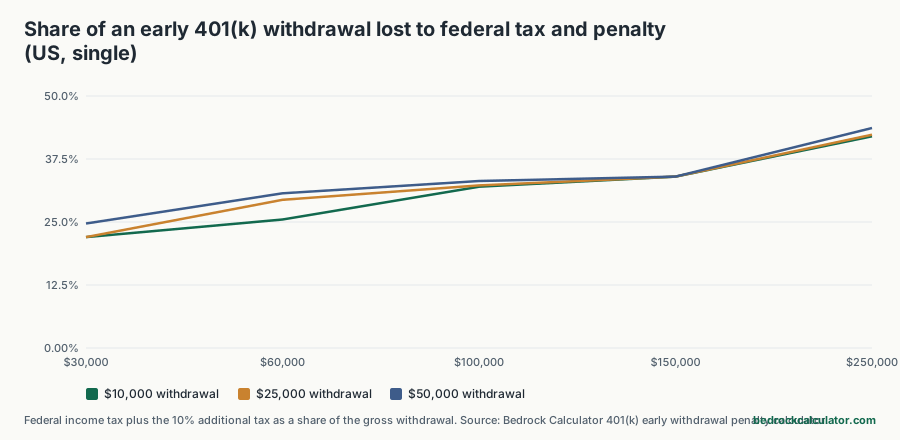
What you keep from a 401(k) early withdrawal in the US, single filer, 2026 (federal only)
Download CSVAge 45, so the 10% additional tax applies. The withdrawal is stacked on the other income shown and taxed at 2026 federal rates after the standard deduction. No state tax, which most states would add.
| $30,000 | 12% | $7,800 | 22.0% | $19,500 | 22.0% | $37,650 | 24.7% |
| $60,000 | 12% | $7,450 | 25.5% | $17,650 | 29.4% | $34,650 | 30.7% |
| $100,000 | 22% | $6,800 | 32.0% | $16,936 | 32.3% | $33,436 | 33.1% |
| $150,000 | 24% | $6,600 | 34.0% | $16,500 | 34.0% | $33,000 | 34.0% |
| $250,000 | 32% | $5,800 | 42.0% | $14,420 | 42.3% | $28,170 | 43.7% |
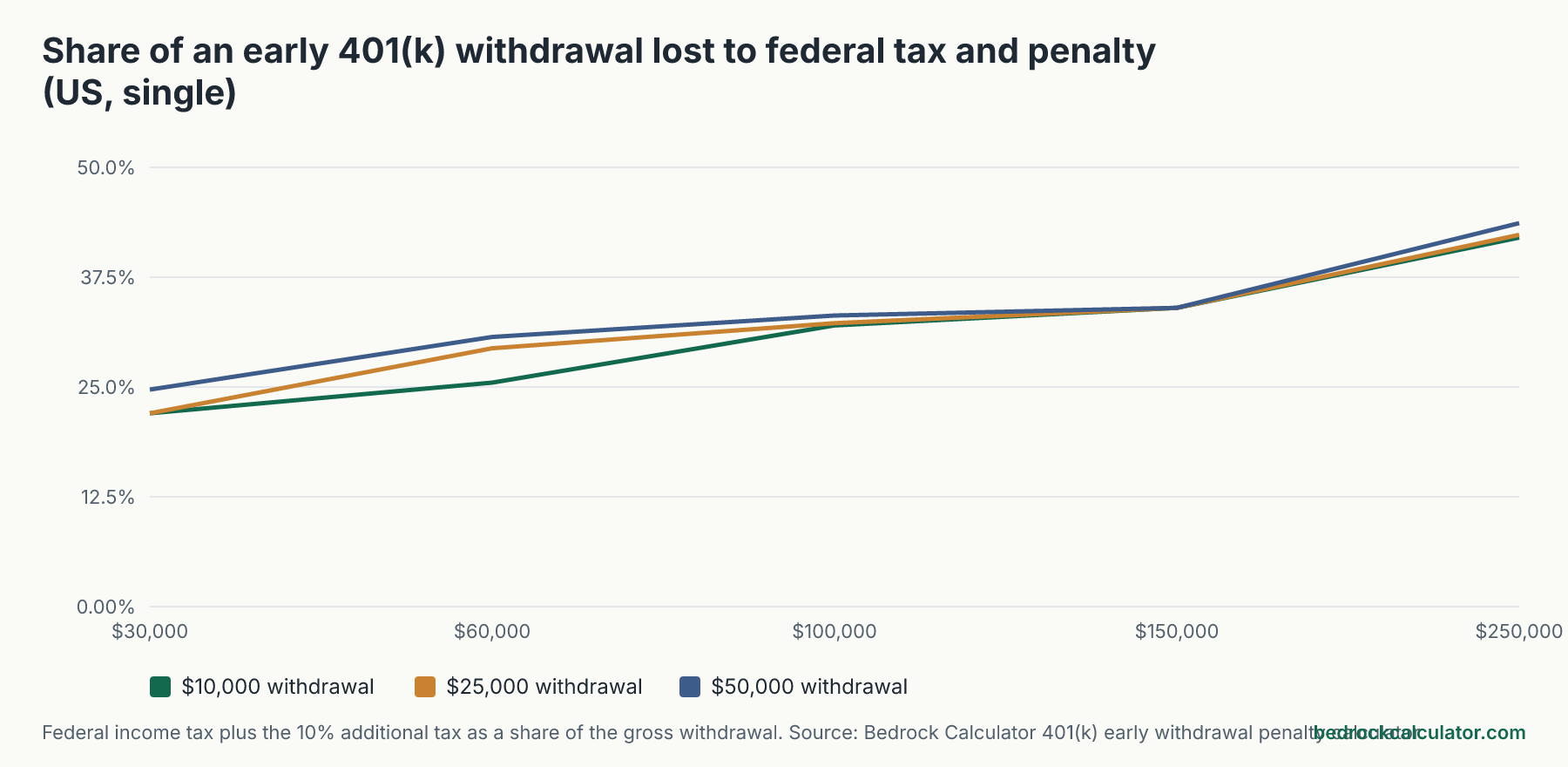
Read along the $60,000 row to see how much of a typical early withdrawal survives: $7,450 from $10,000, $17,650 from $25,000 and $34,650 from $50,000. The share lost rises with the size of the withdrawal, from 25.5% to 30.7%, because a bigger withdrawal pushes more of itself into higher brackets.
Why your tax bracket matters so much
The penalty is flat. It's always 10% of what you take out. The income tax is what changes. A single filer with $30,000 of other income sits in the 12% federal bracket, so a $10,000 withdrawal costs $1,200 in income tax and 22.0% in total. At $150,000 of income the top bracket is 24%, and the same withdrawal costs 34.0%. At $250,000 it's 32%, and 42.0% of the money is gone.
A big withdrawal can also cross into a higher bracket by itself. At $100,000 of income, a single filer starts in the 22% bracket. A $50,000 withdrawal pushes part of it into the next bracket up, so the tax is $11,564 plus a $5,000 penalty, leaving $33,436.
Married couples filing jointly have wider brackets, so they usually lose less. A $25,000 early withdrawal on $120,000 of joint income keeps $18,300, a loss of 26.8%. A single filer on $60,000, half that income, loses 29.4%.
How much to take out to net what you need
People usually think in terms of the cash they need, not the gross withdrawal. To end up with $10,000 in hand, a single filer with $60,000 of other income would need to withdraw about $13,750, before any state tax. That gap is why a 401(k) loan, if your plan offers one, is often worth checking first: you repay yourself instead of paying tax and a penalty, as long as you keep up the repayments.
When the 10% penalty doesn't apply
Waiting until 59 and a half removes the additional tax, though not the income tax. The same $25,000 on $60,000 of income keeps $20,150 at age 60, which is $2,500 more than at 45.
The IRS also lists exceptions before that age. The ones that most often apply to a 401(k) are:
- Leaving your job in or after the year you turn 55. This applies only to the 401(k) of the employer you left, not to IRAs.
- Substantially equal periodic payments, a fixed schedule of withdrawals over your life expectancy.
- Total and permanent disability.
- Unreimbursed medical expenses above a set share of your adjusted gross income.
- A qualified domestic relations order in a divorce, for the money paid to a former spouse.
- Newer exceptions for a birth or adoption, a small emergency withdrawal once a year, and certain disaster losses.
Each has conditions, so check the IRS list of exceptions before you count on one. Income tax still applies to all of them.
Before you cash out
A 401(k) withdrawal isn't only the tax. Money taken out stops growing, and you can't put it back except in limited cases. Some lower-cost options are worth checking first: a loan from the plan if it allows one, a hardship withdrawal if you qualify (still taxed, but sometimes without the penalty if an exception also applies), or a Roth IRA, where your own contributions can come out without tax or penalty.
Run your own numbers
Enter your withdrawal, your age, your other income and your filing status in the 401(k) early withdrawal penalty calculator. To see your whole tax picture, the federal income tax calculator works with any income, and the 401(k) calculator shows what the money would grow to if you left it alone. Your state's paycheck calculator shows how its income tax treats wages, but check how your state treats retirement withdrawals before using that rate.