How is alimony taxed in the US?
In the US, how alimony is taxed depends on one fact: the date your divorce or separation agreement was signed. If it was signed by 31 December 2018 and hasn't been changed to adopt the new rules, the payor deducts alimony and the recipient pays tax on it.
If it was signed after 2018, neither happens: the payor gets no deduction and the recipient owes nothing.
Child support is simpler. It has never been deductible for the parent who pays or taxable for the parent who receives it, under either set of rules.
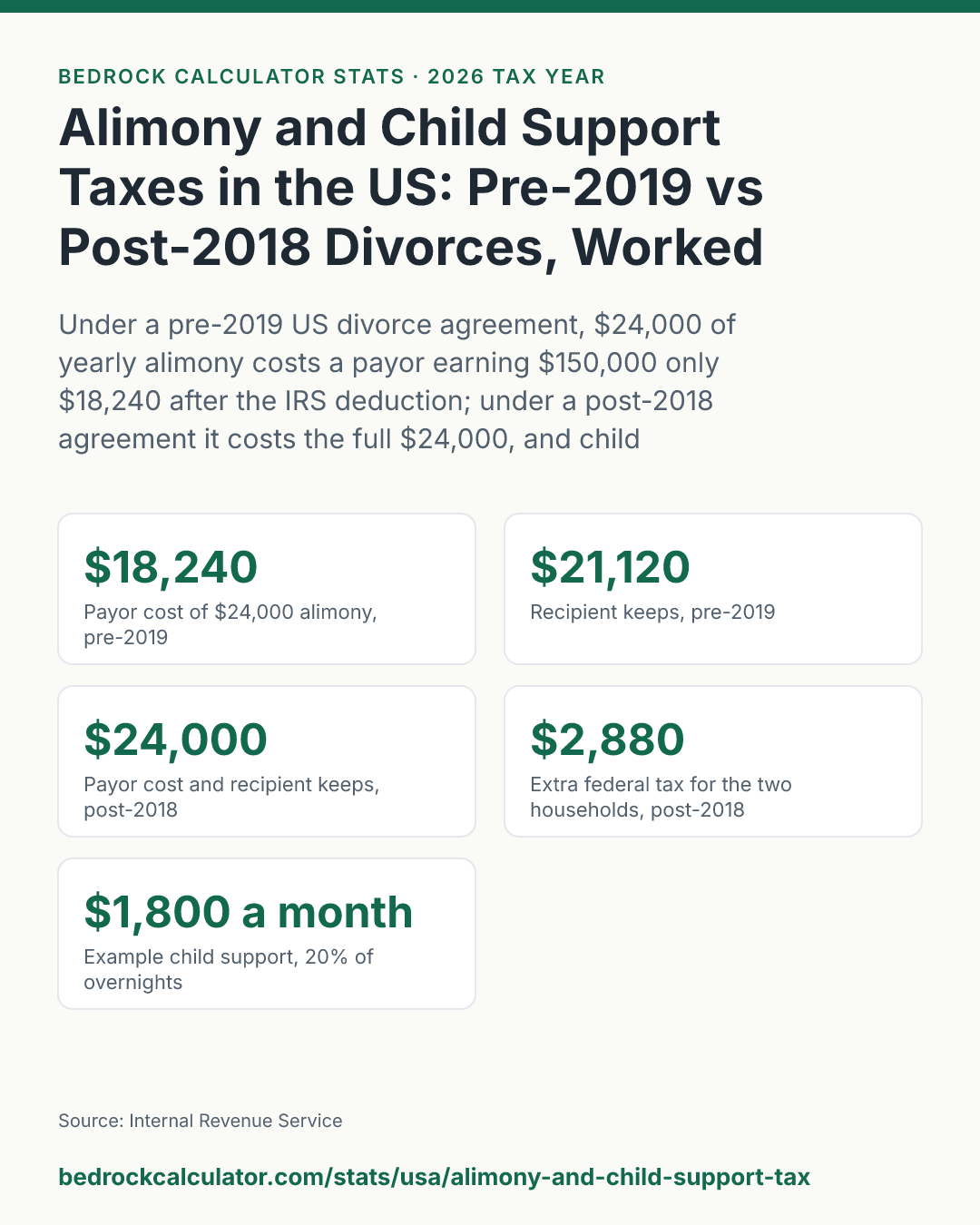
In our example, a payor earning $150,000 who pays $24,000 a year of alimony under an old agreement really gives up $18,240 after the deduction. Under a new agreement, the same payment costs the full $24,000.
How we worked out these numbers
All figures are US federal figures for the 2026 tax year, from two of the site's calculators.
Alimony. The alimony tax calculator works out federal income tax for both people, with and without the alimony, using the 2026 brackets and standard deduction. In our example the payor earns $150,000 and the recipient earns $40,000, both file as single and neither itemizes. We ran each payment under both sets of rules.
The calculator leaves out state income tax (some states still treat alimony the old way), the recapture rule for front-loaded payments under old agreements, and the knock-on effects of a different income on credits and other deductions.
Child support. The child support estimate calculator is a generic income shares model, not any state's guideline. Every state publishes its own schedule, and this calculator doesn't contain any of them. Its key input, the share of combined income that goes to the children, is something you supply. We used its example inputs: monthly incomes of $4,000 and $6,000, 20% of combined income for the children, $800 of childcare and $200 of health premiums a month, a parenting-time credit that starts above 30% of overnights, and a $1,200 self-support reserve. The figures show how the arithmetic works, not what a court in your state would order.
Alimony under pre-2019 vs post-2018 agreements
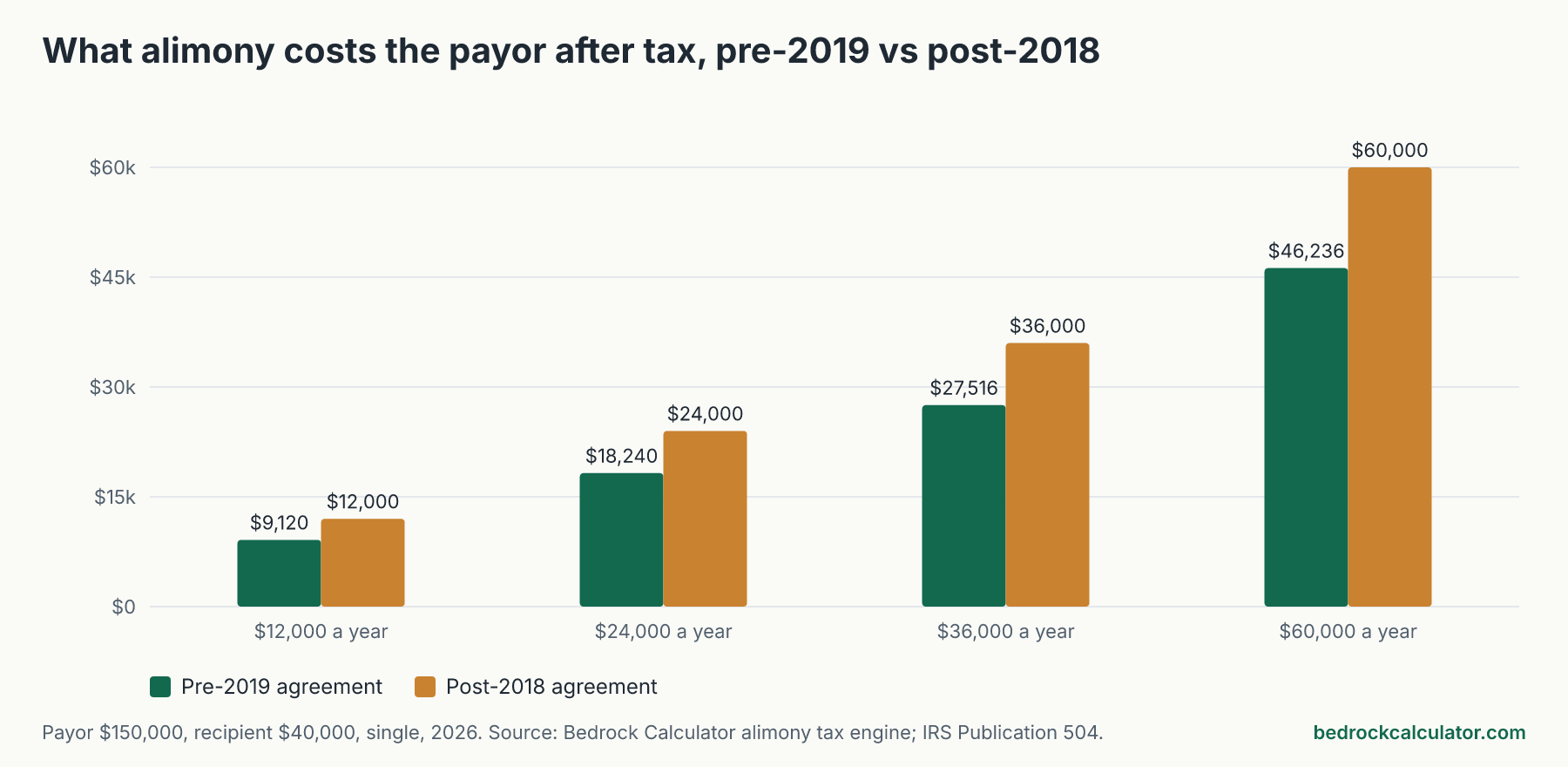
Alimony after US federal tax: pre-2019 vs post-2018 agreements
Download CSVPayor earns $150,000, recipient $40,000, both single, 2026 brackets and standard deduction. Federal only.
| $12,000 | $9,120 | $10,560 | $12,000 | $1,440 |
| $24,000 | $18,240 | $21,120 | $24,000 | $2,880 |
| $36,000 | $27,516 | $30,730 | $36,000 | $3,214 |
| $60,000 | $46,236 | $49,450 | $60,000 | $3,214 |
Under an old agreement, alimony shifts income from the payor's tax return to the recipient's. In our example the payor is in the 24% bracket and the recipient is in the 12% bracket, so each dollar moved is taxed at the lower rate. That's why, for $24,000 of alimony, the payor's real cost is $18,240 while the recipient keeps $21,120: the recipient ends up with more than the payment costs the payor. Together the two households pay $2,880 less federal tax than under the new rules.
Under a new agreement there's no shift. The payor pays tax on the money as their own income, and the recipient gets $24,000 tax-free. The extra combined tax grows with the payment, from $1,440 at $12,000 a year to $3,214 at $60,000, though it levels off once the payments push the recipient into the same bracket as the payor.
Should alimony be lower under a post-2018 agreement?
Often it is, and the reason is in the numbers. Under the new rules the recipient doesn't pay tax on alimony, so a smaller tax-free payment can leave them just as well off. In our example, $21,120 tax-free matches $24,000 of taxable alimony under the old rules, a difference of $2,880.
Copying an old-style figure into a new agreement without adjusting for tax overpays the recipient compared with the old deal.
A pre-2019 agreement only moves to the new rules if a later modification expressly says the new rules apply. An ordinary change to the payment amount doesn't do it.
Is child support taxable?
No. Child support is not deductible by the parent who pays it and not taxable to the parent who receives it, under both the old and new rules. If a payment labeled as alimony stops or drops when a child reaches a certain age or milestone, the IRS can treat that part as child support instead.
Other tax benefits for children, like the child tax credit and head of household filing status, follow their own rules about which parent claims them, and the child support calculator doesn't allocate them.
How the overnight split changes child support
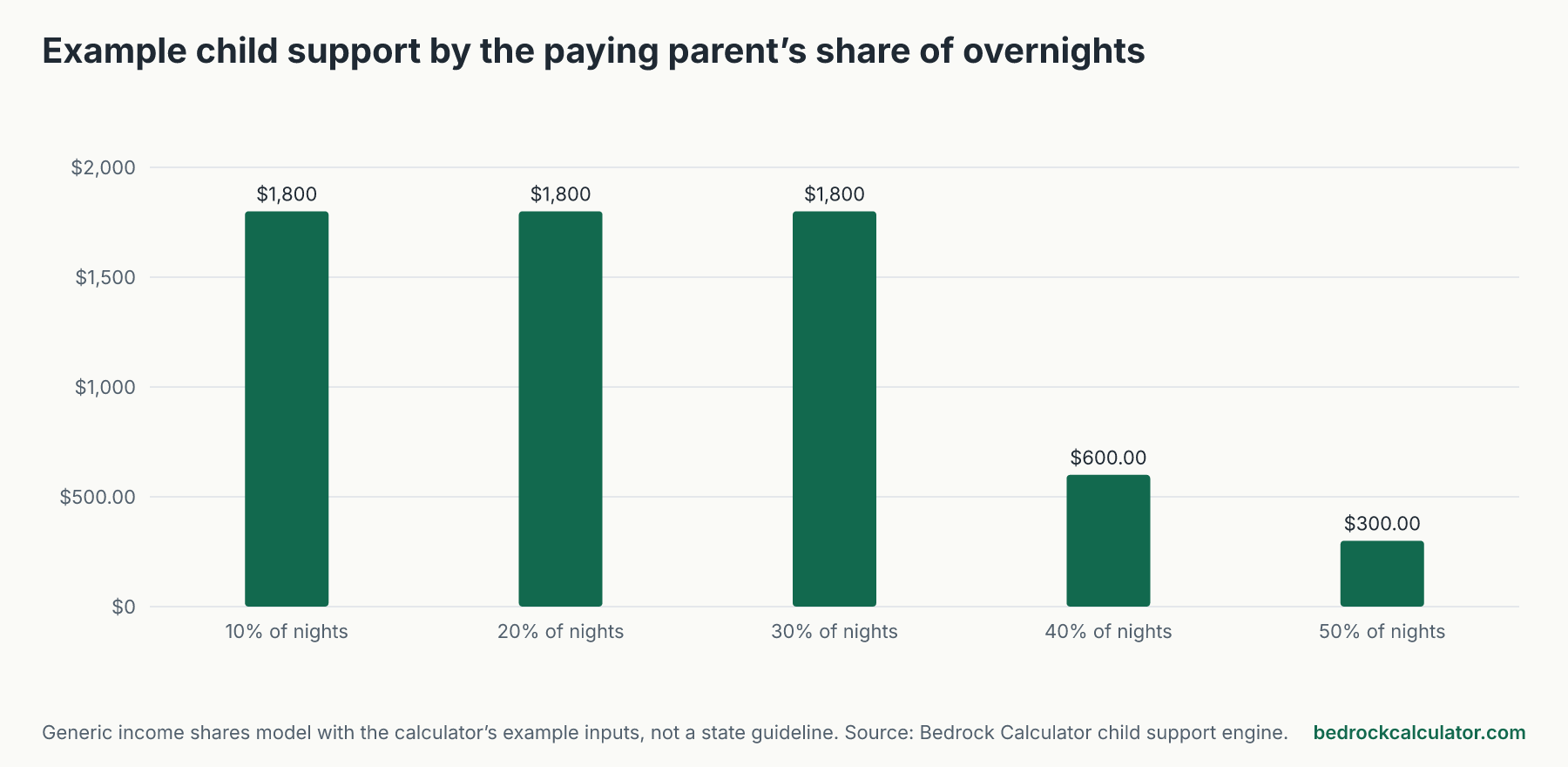
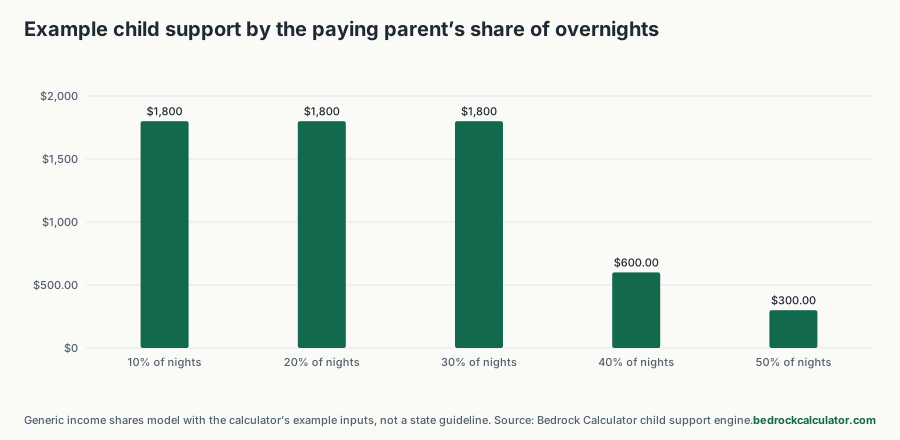
Example child support by the paying parent’s share of overnights (generic model)
Download CSVChild support estimate calculator example inputs; not any state’s guideline. Not deductible by the payer and not taxable to the recipient.
| 10% | $1,800 | $21,600 |
| 20% | $1,800 | $21,600 |
| 30% | $1,800 | $21,600 |
| 40% | $600 | $7,200 |
| 50% | $300 | $3,600 |
In the generic model with the example inputs, the paying parent has 60.00% of combined income and pays $1,800 a month, or $21,600 a year. That stays the same at any overnight share up to the 30% threshold. Above it, a parenting-time credit kicks in and the payment falls sharply: $600 a month at 40% of overnights and $300 at an even split.
The share of combined income that goes to the children matters even more. Setting it at 10% instead of the example's 20% gives $1,200 a month, and 30% gives $2,400. That's the number a real state schedule decides, which is why your state's guideline calculator is the place to get an actual figure.
Getting your own numbers
For alimony, enter both incomes, filing statuses and the date of your agreement in the alimony tax calculator. For child support, the child support estimate calculator shows how the income shares model responds to each input, but use your state's official guideline for an amount you can rely on. Your overall federal tax after a divorce, including a new filing status, is easiest to check in the federal income tax calculator, and the paycheck calculator shows how your take-home pay changes.