How much of a bonus do you keep after tax?
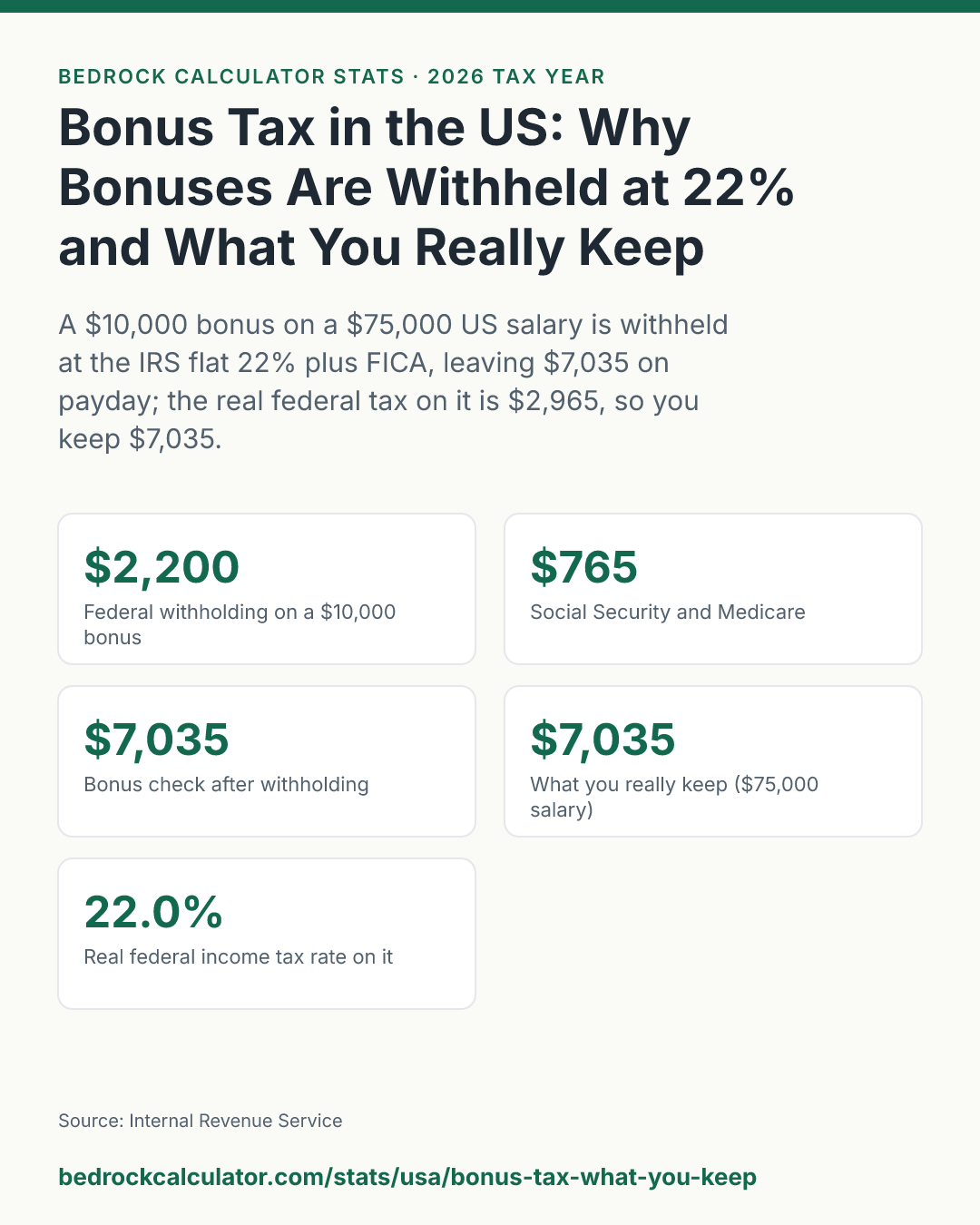
When a US employer pays a bonus separately from your regular paycheck, it usually withholds federal income tax at a flat 22%, plus Social Security and Medicare. On a $10,000 bonus that's $2,200 of federal withholding and $765 of FICA, leaving a check for $7,035.
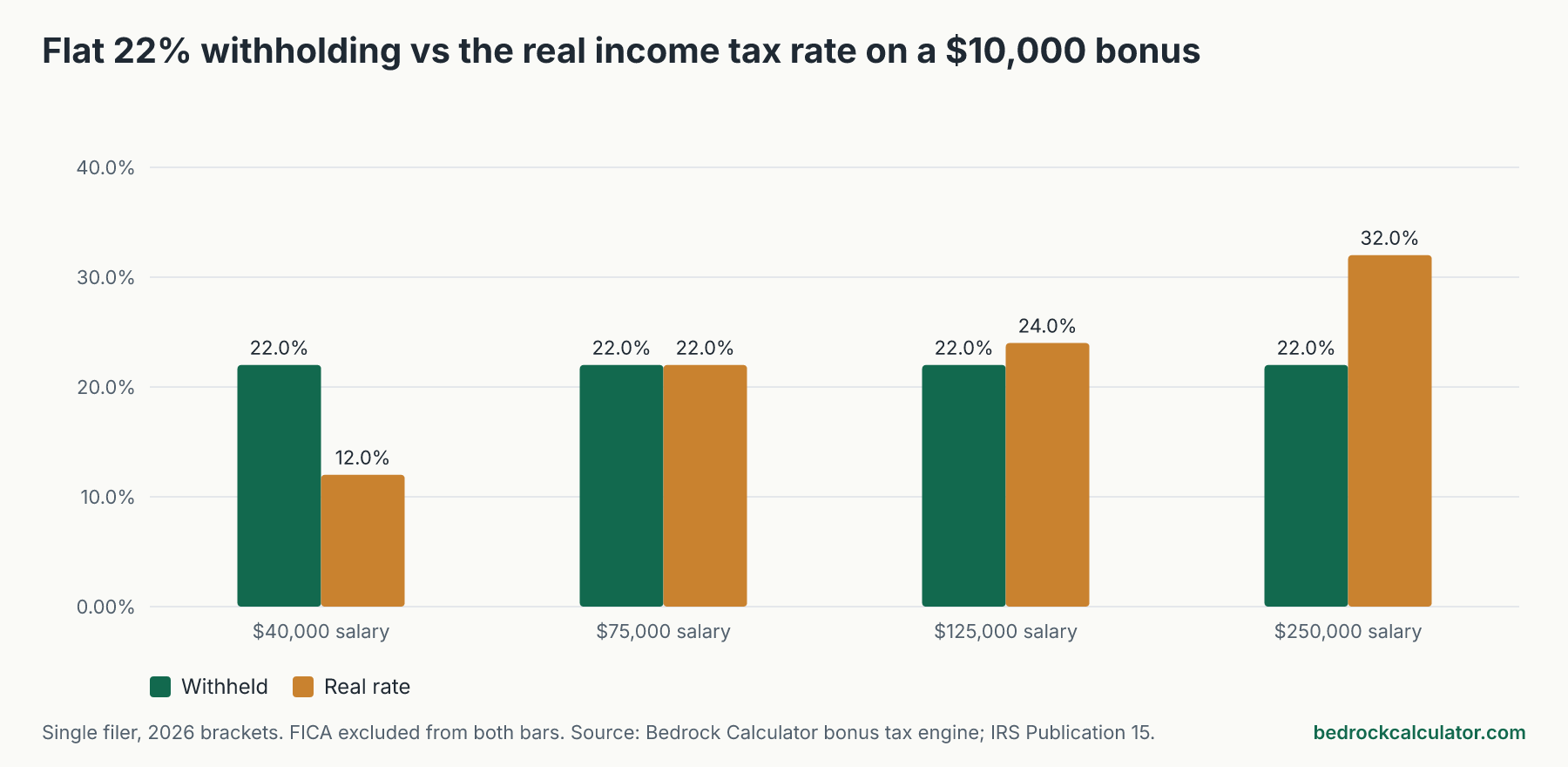
The 22% is a withholding shortcut, not your tax rate. Your bonus is taxed at your real bracket when you file. For a single filer on a $75,000 salary the two happen to match, so you keep $7,035. Earn less and you get some back. Earn more and you owe more in April.
How we worked out these numbers
All figures are for the US 2026 tax year, from the site's bonus tax calculator. For each salary and bonus, it does two things:
- Withholding at payment. 22% federal withholding on the bonus, the IRS flat rate for supplemental wages up to $1 million a year, plus Social Security and Medicare tax.
- Tax actually owed. It stacks the bonus on top of your salary, runs both through the 2026 federal brackets and standard deduction, and takes the difference. Then it adds the same FICA, which is withheld exactly.
"What you keep" is the bonus minus the tax actually owed. Every run is for a single filer with no other bonuses that year.
What's left out: state and local income tax, which most states also withhold from bonuses, often at their own flat rate. Any 401(k) or other pre-tax deduction your employer takes from the bonus. Credits and deductions beyond the standard deduction. And the aggregate method, where some employers fold the bonus into a regular paycheck and withhold on the combined amount instead of using the flat rate.
Why bonuses are withheld at 22%
The IRS gives employers a simple option for bonuses, commissions and other supplemental pay: withhold a flat 22% of federal income tax, or 37% on any supplemental wages above $1 million in a year. It saves payroll from having to estimate where the bonus lands in your brackets.
Both rates match brackets in the ordinary income tax schedule. If your bonus really does land in the 22% bracket, the flat rate is about right. For everyone else it's off, in one direction or the other.
What you really keep from a bonus
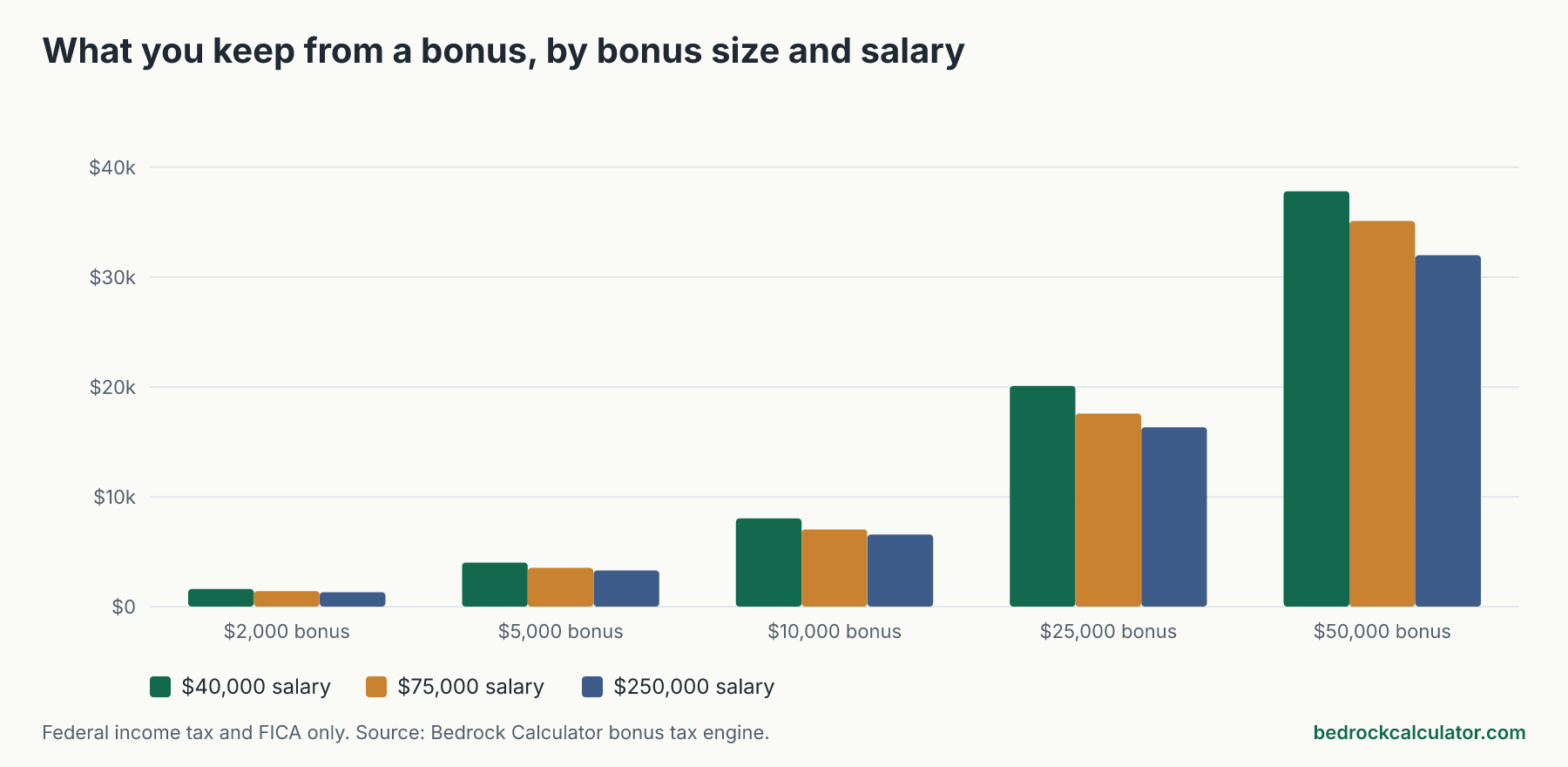
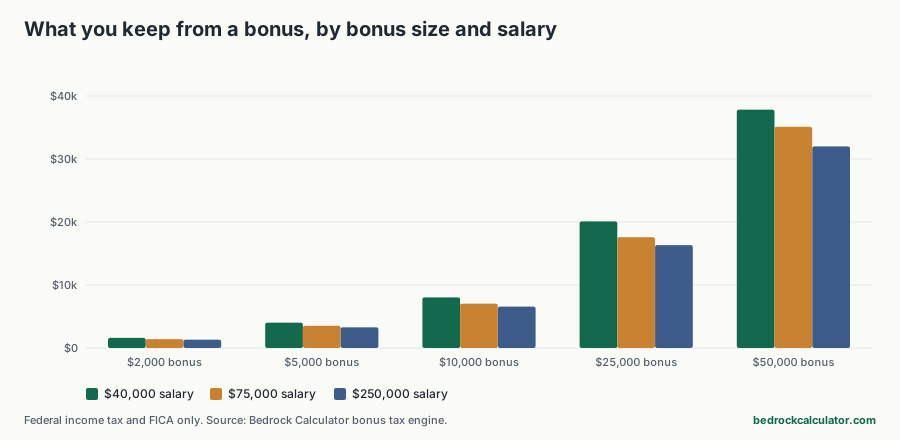
What you keep from a bonus after US federal tax, by salary and bonus size
Download CSVSingle filer, 2026 federal brackets and standard deduction, plus Social Security and Medicare. State tax not included.
| $40,000 | $1,607 | $4,018 | $8,035 | $20,088 | $37,825 |
| $75,000 | $1,407 | $3,518 | $7,035 | $17,588 | $35,111 |
| $125,000 | $1,367 | $3,418 | $6,835 | $17,088 | $34,175 |
| $250,000 | $1,313 | $3,283 | $6,565 | $16,332 | $31,995 |
Read across a row to see how the keep changes with bonus size, and down a column to see how it changes with salary. The higher your salary, the higher the bracket your bonus falls in, so you keep less of the same bonus.
A $50,000 bonus on a $125,000 salary leaves $34,175 after federal tax and FICA. Taxed at 24.0% in your real bracket, it falls $1,000 short of what the flat withholding covered.
Will you owe money on your bonus at tax time?
Withheld at payment vs owed at filing, $10,000 bonus
Download CSVFlat 22% federal supplemental withholding plus FICA. A positive gap means you owe more at filing; negative means a refund.
| $40,000 | $7,035 | $1,965 | $8,035 | -$1,000 | 12.0% |
| $75,000 | $7,035 | $2,965 | $7,035 | $0 | 22.0% |
| $125,000 | $7,035 | $3,165 | $6,835 | $200 | 24.0% |
| $250,000 | $7,565 | $3,435 | $6,565 | $1,000 | 32.0% |
If your salary is low, the bonus may be taxed below 22%. A single filer on a $40,000 salary pays a real rate of 12.0% on a $5,000 bonus. Payroll withholds 22%, so the check is $3,518, but after filing you keep $4,018. The $500 difference comes back as part of your refund.
If your salary is high, you'll owe. On a $250,000 salary, a $25,000 bonus is taxed at 32.3% once you file, and the 22% withholding falls $2,580 short. The check looks generous at $18,913, partly because Social Security tax stops once your wages pass the yearly wage base, so FICA on the bonus is only $588. But what you keep after filing is $16,332.
If you expect to owe, you can avoid a surprise by raising your withholding for the rest of the year on Form W-4, or by setting aside part of the bonus.
Are bonuses taxed more than regular pay?
No. A bonus is ordinary wages, taxed under the same brackets and the same FICA rates as your salary. There's no special bonus tax.
It can look that way because withholding is a flat 22% instead of the method used for your regular checks, and because the bonus is the top layer of your income for the year, so it's taxed at your highest bracket. Spread the same money across your regular paychecks and the total tax would be the same.
Getting your own number
Enter your bonus and year-to-date salary in the bonus tax calculator to see the withholding, the real tax and the gap. For the state side, run the bonus through the paycheck calculator for your state. Your full-year federal bill, bonus included, is easiest to check in the federal income tax calculator. And if your bonus comes as stock, the RSU tax calculator applies the same supplemental rules to shares at vesting.