Is an EV or a gas car cheaper to own over 5 and 10 years?
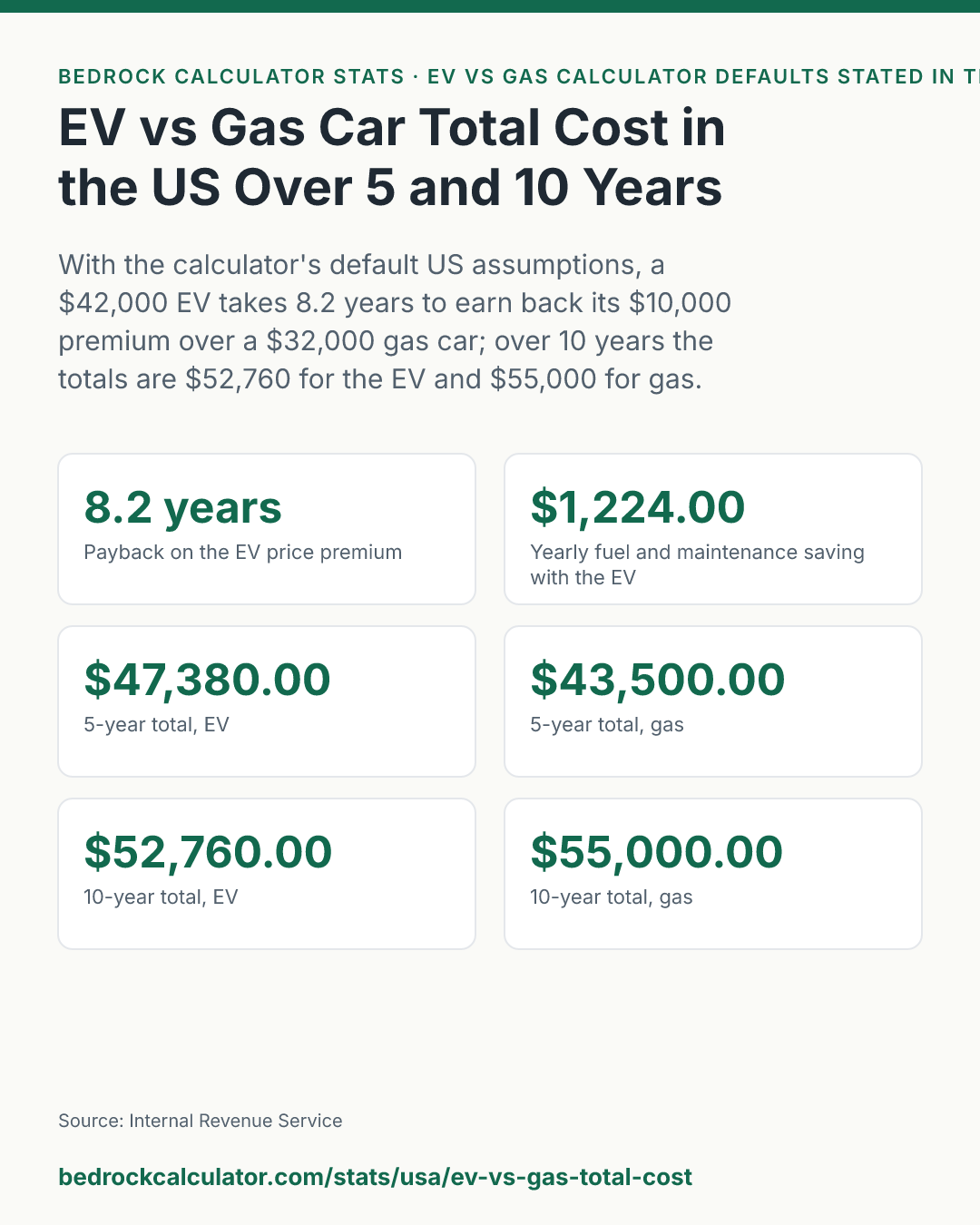
Using the default assumptions in our US EV vs gas calculator, a $42,000 electric car costs $10,000 more upfront than a comparable $32,000 gas car, and saves $1,224.00 a year on fuel and maintenance. That earns back the premium in 8.2 years.
So the answer depends on how long you keep the car. Over 5 years the totals are $47,380.00 for the EV and $43,500.00 for gas, so the gas car by $3,880.00. Over 10 years they're $52,760.00 and $55,000.00, and the EV by $2,240.00.
How we worked out these numbers
We ran the EV vs gas calculator on this site at its default inputs, for 5 and 10 years of ownership, then changed one input at a time to see what moves the result. These are the defaults, so you can see exactly what's being compared:
- Prices: $42,000 for the EV, $32,000 for the gas car.
- Federal tax credit: $0. The federal new and used clean vehicle credits ended for vehicles acquired after September 30, 2025. State incentive: none by default.
- Driving: 12,000 miles a year.
- EV: 30 kWh per 100 miles, electricity at $0.16 per kWh, maintenance $500 a year.
- Gas car: 30 miles per gallon, gas at $3.50 a gallon, maintenance $900 a year.
With those inputs, charging the EV costs $576.00 a year and fueling the gas car costs $1,400.00.
The "total cost" on this page is the purchase price after incentives, plus electricity or gas, plus maintenance. The calculator doesn't model anything else, and we cover what that leaves out below.
The 5 and 10-year totals
EV vs gas: purchase, energy and maintenance over 5 and 10 years
Download CSVCalculator defaults. Totals are purchase price after incentives plus fuel or electricity plus maintenance; nothing else is included.
| Electricity or gas per year | $576.00 | $1,400.00 |
| Maintenance per year | $500.00 | $900.00 |
| Purchase price after incentives | $42,000.00 | $32,000.00 |
| Total over 10 years | $52,760.00 | $55,000.00 |
| Total over 5 years | $47,380.00 | $43,500.00 |
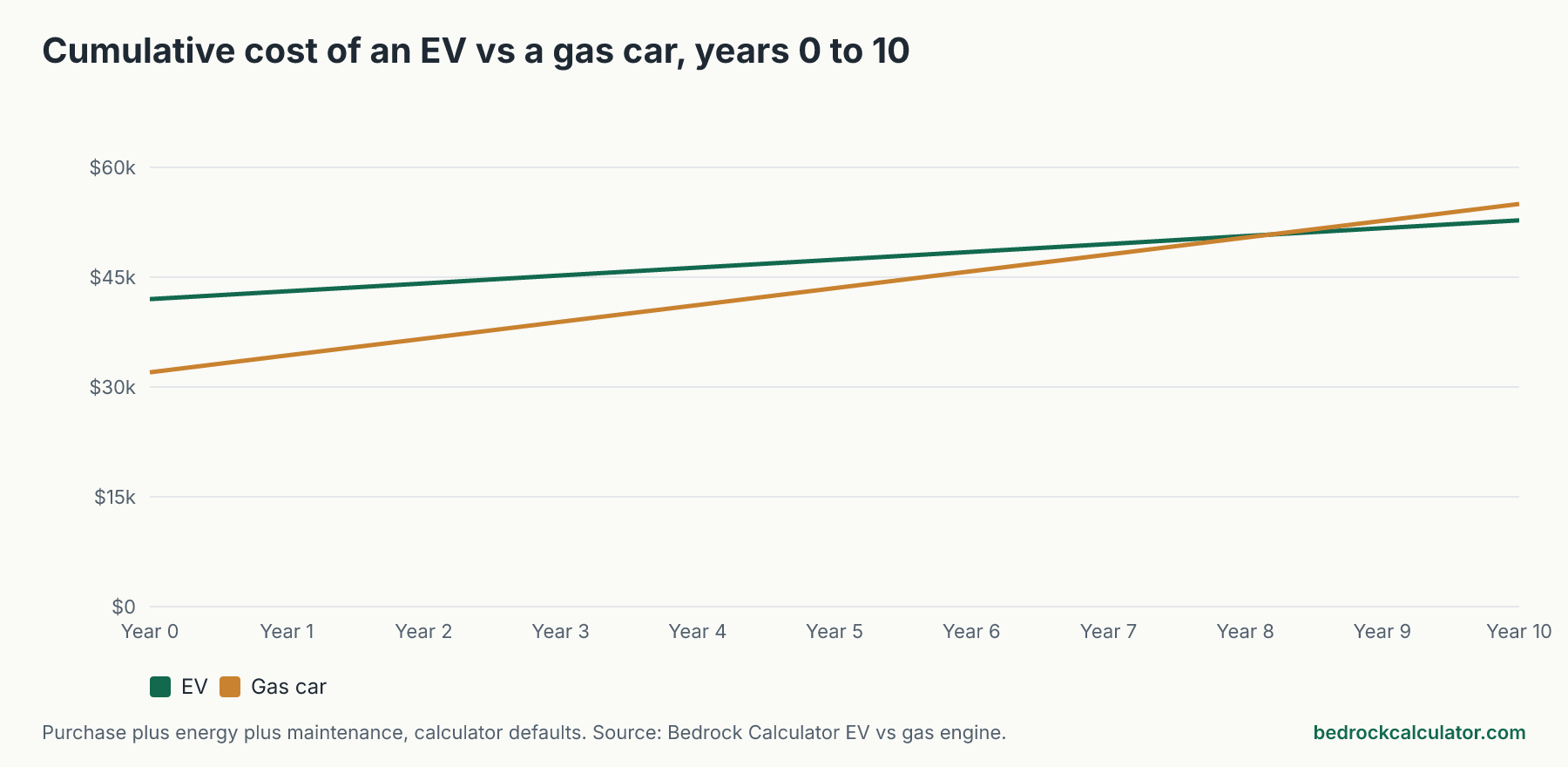
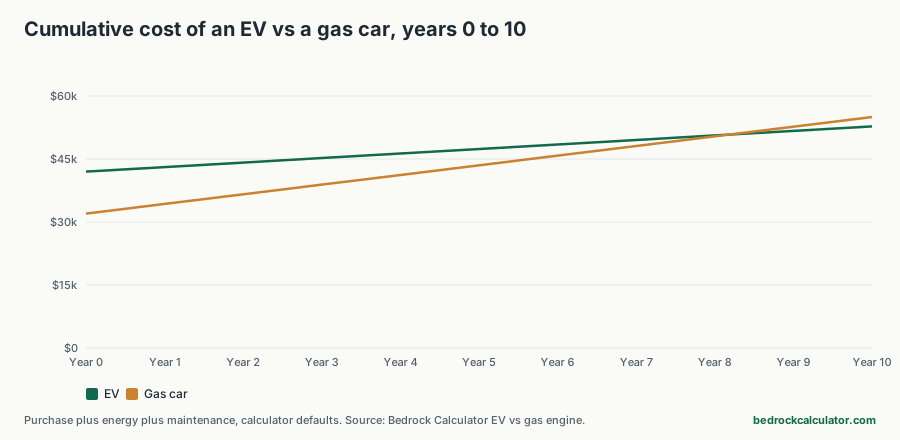
The EV starts behind by its price premium and closes the gap a little every year. At these inputs the lines cross in year 8 or 9, which is why a 5-year owner comes out behind on the EV and a 10-year owner comes out ahead.
What changes the answer
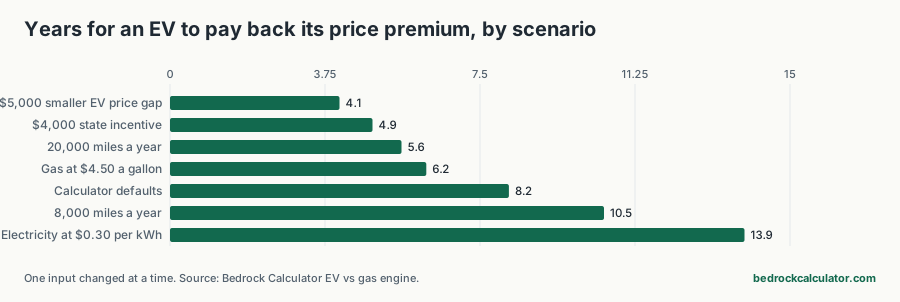
What changes the EV payback
Download CSVOne input changed at a time from the calculator defaults. Positive net figures mean the gas car is cheaper over that period.
| $4,000 state incentive | 4.9 years | $1,224.00 | -$120.00 | -$6,240.00 |
| $5,000 smaller EV price gap | 4.1 years | $1,224.00 | -$1,120.00 | -$7,240.00 |
| 20,000 miles a year | 5.6 years | $1,773.33 | $1,133.35 | -$7,733.30 |
| 8,000 miles a year | 10.5 years | $949.33 | $5,253.35 | $506.70 |
| Calculator defaults | 8.2 years | $1,224.00 | $3,880.00 | -$2,240.00 |
| Electricity at $0.30 per kWh | 13.9 years | $720.00 | $6,400.00 | $2,800.00 |
| Gas at $4.50 a gallon | 6.2 years | $1,624.00 | $1,880.00 | -$6,240.00 |
Positive figures in the last two columns mean the gas car was cheaper over that period; negative figures mean the EV was.
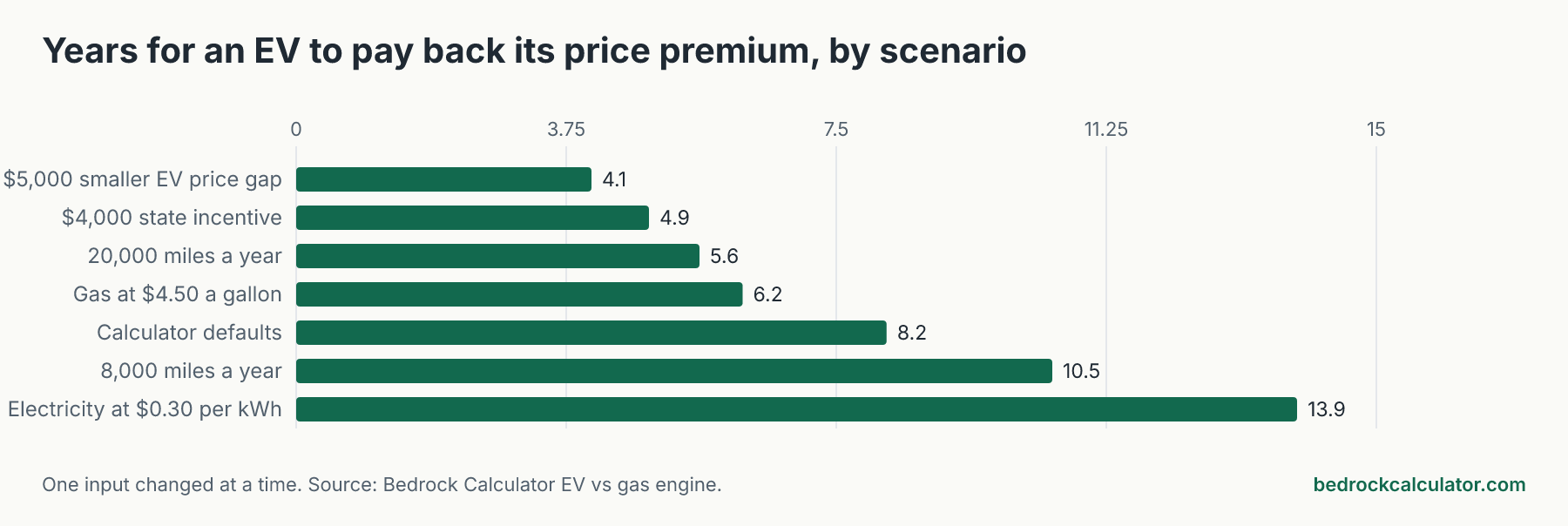
How much you drive. At 20,000 miles a year the EV pays back in 5.6 years, and over 10 years it's $7,733.30 cheaper. At 8,000 miles a year, payback stretches to 10.5 years, and the gas car is still $506.70 cheaper after 10 years.
Gas prices. If gas costs $4.50 a gallon instead of $3.50, payback drops to 6.2 years.
Electricity prices. Charging at home is usually cheapest. If you rely on public fast charging, you can pay far more per kWh. At $0.30 per kWh, payback stretches to 13.9 years and the gas car stays $2,800.00 cheaper over 10 years.
Incentives and price. A $4,000 state incentive cuts payback to 4.9 years. Finding an EV $5,000 cheaper relative to the gas car does even more, bringing it to 4.1 years. The upfront price gap is the single biggest lever.
What this leaves out
The calculator compares only the costs above. Several real costs can swing the result either way:
- Depreciation and resale value. Often the largest cost of owning any car, and EVs and gas cars can lose value at different rates. Not modeled.
- Insurance. EV premiums are sometimes higher. Not modeled.
- Financing. If you borrow, the higher EV price means more interest. The car loan calculator shows that cost, and our page on car loan cost by term and credit tier shows how much it varies.
- Home charger installation, registration fees and taxes. Some states charge EVs an extra registration fee. Not modeled.
- Battery replacement and big repairs. Maintenance is a flat yearly estimate for each car.
- Changing prices. Gas, electricity and maintenance costs are held flat for every year.
Run your own numbers
Enter your own prices, mileage, local electricity and gas prices, and any state incentive in the EV vs gas calculator. Your electricity rate is on your utility bill; if you'll charge mostly away from home, use the public charging price. To see the loan side of either car, use the auto loan calculator, which includes sales tax and fees.