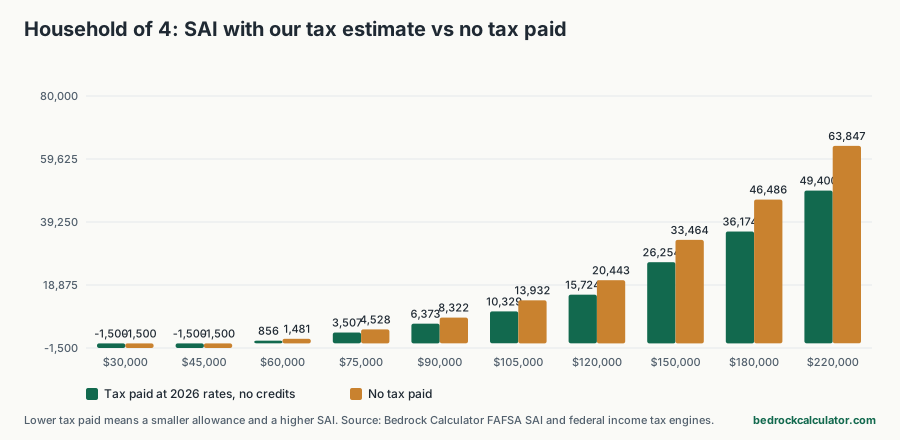
What is the FAFSA Student Aid Index at each family income?
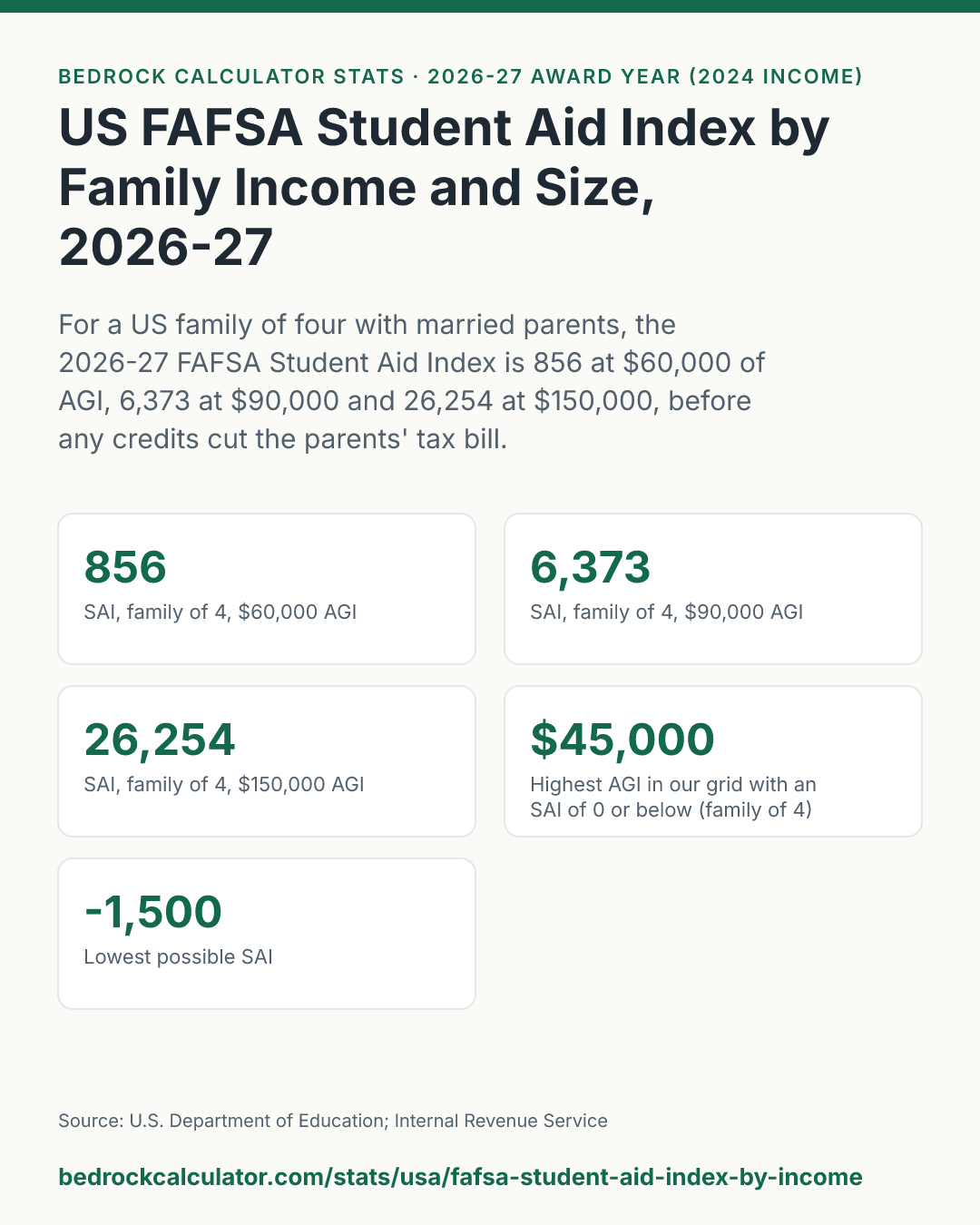
The Student Aid Index, or SAI, is the number the US FAFSA produces to decide how much need-based aid a student gets. For a dependent student with married parents in a household of four, our run of the 2026-27 formula gives an SAI of 856 at $60,000 of parents' AGI, 6,373 at $90,000, 15,724 at $120,000 and 26,254 at $150,000.
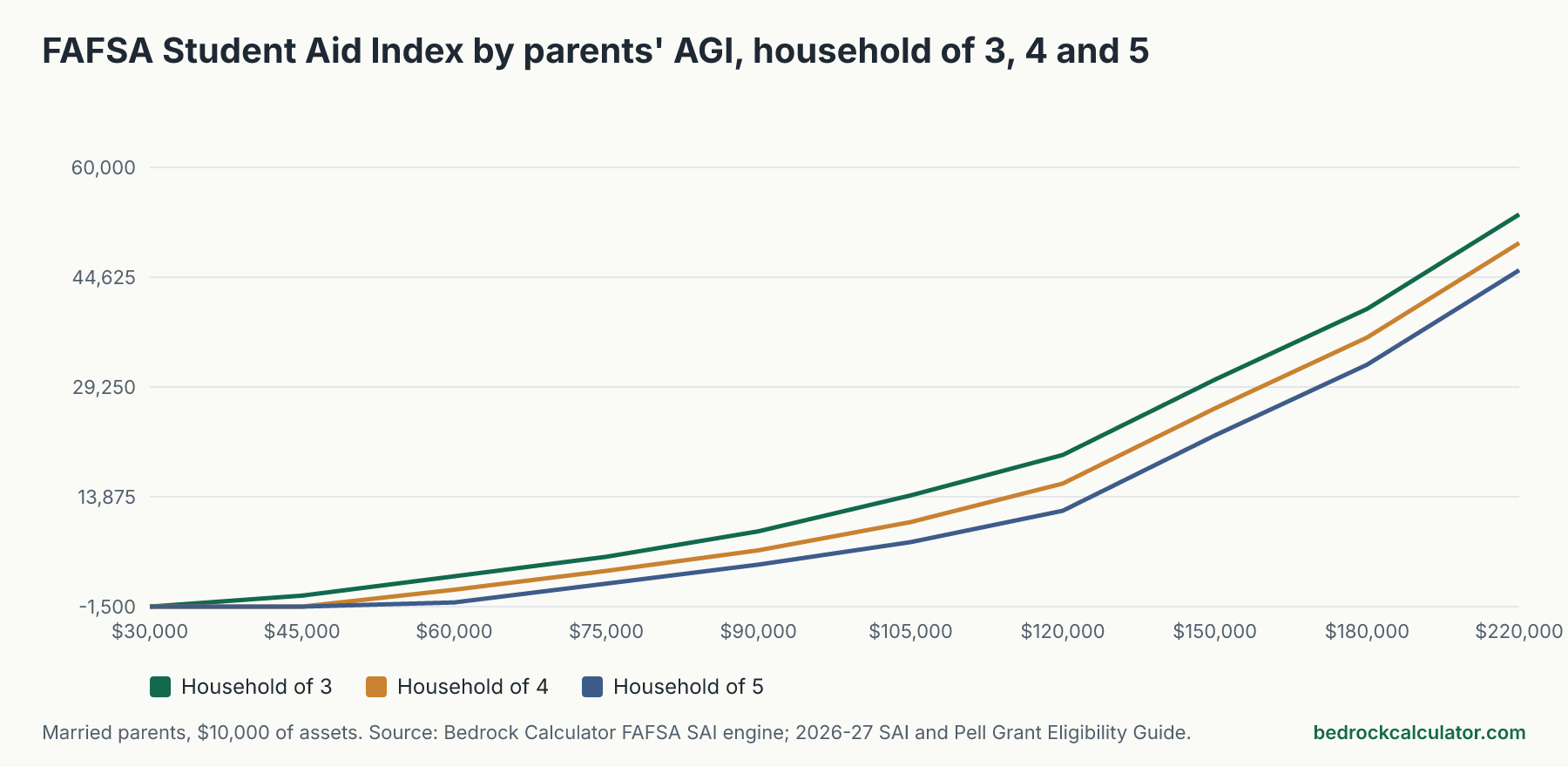
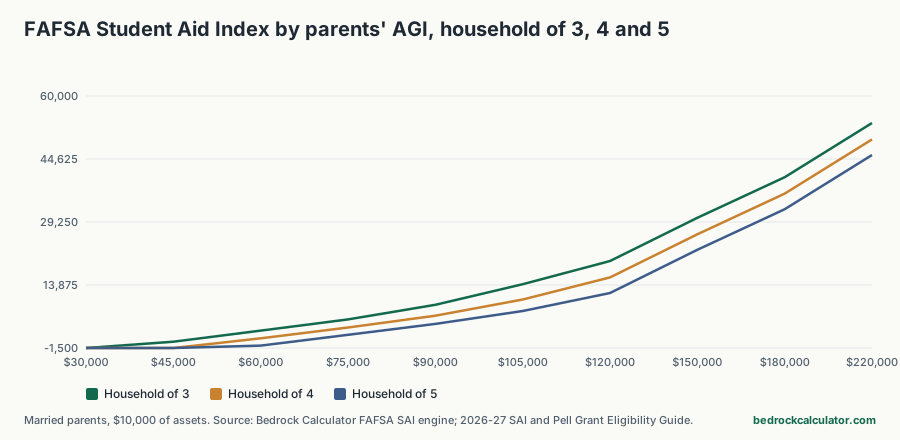
Bigger households score lower at the same income, and the SAI can go below zero, down to -1,500. An SAI of 0 or less qualifies a student for the maximum Pell Grant.
How we worked out these numbers
We ran the FAFSA Student Aid Index calculator on this site at ten levels of parents' AGI, from $30,000 to $220,000, for households of three, four and five, counting the student. The calculator follows the Department of Education's Formula A for dependent students, and every allowance and rate in it matches the 2026-27 SAI and Pell Grant Eligibility Guide.
The family in every run:
- Married parents filing a joint return
- $10,000 of parent savings and investments, not counting the home or retirement accounts
- A student with no income and no savings of their own
The formula also needs the federal income tax the parents paid, which it subtracts as an allowance. That's a figure from your own return, so we had to pick one. We used the federal income tax calculator to work out the tax on each AGI at 2026 rates with the standard deduction and no credits. At $90,000 that's $6,440.00.
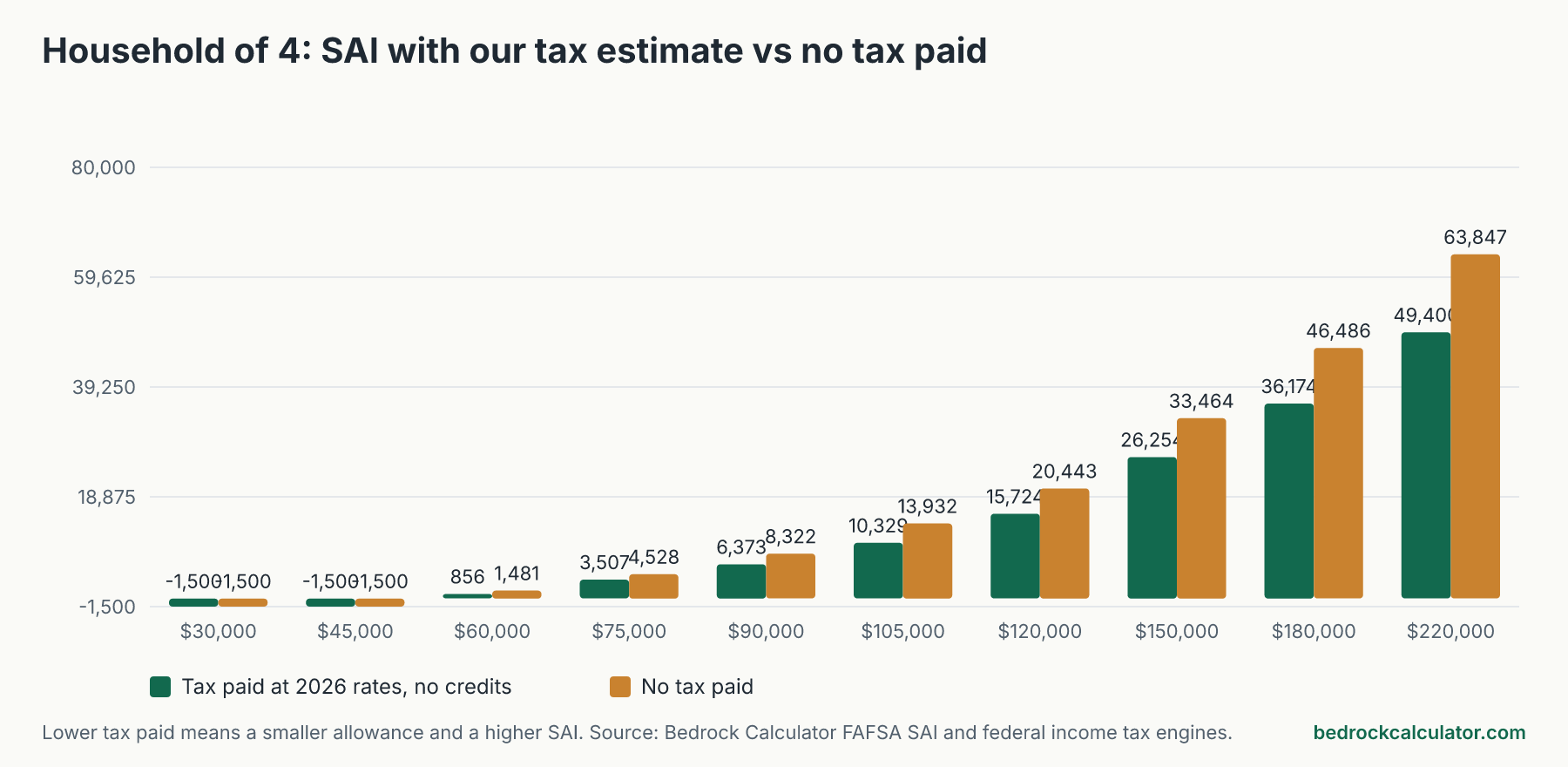
Here's the catch, and it's a big one. The 2026-27 FAFSA uses your 2024 return, and the tax you actually paid will usually be lower than our figure, mostly because of the child tax credit. Less tax paid means a smaller allowance and a higher SAI. So we also ran every family with zero tax paid. Your real SAI should fall somewhere between the two.
Every income and household size
Sort by any column. The last column is the household of four with no tax paid.
2026-27 FAFSA Student Aid Index by parents' AGI and household size (US)
Download CSVDependent student, married parents filing jointly, $10,000 of parent assets, no student income or assets. Tax paid is the federal income tax calculator's figure on that AGI at 2026 rates with no credits.
| $30,000 | $0.00 | -1,500 | -1,500 | -1,500 | -1,500 |
| $45,000 | $1,280.00 | 32 | -1,500 | -1,500 | -1,500 |
| $60,000 | $2,840.00 | 2,737 | 856 | -920 | 1,481 |
| $75,000 | $4,640.00 | 5,469 | 3,507 | 1,732 | 4,528 |
| $90,000 | $6,440.00 | 9,039 | 6,373 | 4,384 | 8,322 |
| $105,000 | $8,240.00 | 14,078 | 10,329 | 7,527 | 13,932 |
| $120,000 | $10,040.00 | 19,743 | 15,724 | 11,931 | 20,443 |
| $150,000 | $15,340.00 | 30,273 | 26,254 | 22,461 | 33,464 |
| $180,000 | $21,940.00 | 40,192 | 36,174 | 32,381 | 46,486 |
| $220,000 | $30,740.00 | 53,418 | 49,400 | 45,607 | 63,847 |
Why household size matters so much
The biggest allowance in the formula is the income protection allowance, which grows with the household. It's $36,330 for three people and $52,950 for five. Every dollar of that is a dollar of income the formula doesn't count.
At $120,000 of AGI the SAI is 19,743 for a household of three and 11,931 for a household of five, a gap of 7,812. One thing that no longer helps: the old Expected Family Contribution used to split the parents' share among siblings in college at the same time. The current SAI formula has no such divisor, so two children in college each get the full parent contribution.
How fast the SAI climbs with income
Once a family's available income passes the protected amount, the formula takes a growing share of each extra dollar, up to nearly half at the top of the parent contribution table. That's why the steps in the table get bigger as you go. For a household of four, going from $90,000 to $105,000 of AGI adds 3,956 to the SAI. Going from $150,000 to $180,000 adds 9,920.
What the tax paid assumption changes
At low incomes it doesn't matter much, because the SAI hits its floor either way. In the middle it matters a lot. For a household of four, dropping the tax paid from our estimate to zero raises the SAI by 1,021 at $75,000 and 4,719 at $120,000. At $90,000 the two figures are 6,373 and 8,322. If you claimed a sizable child tax credit in 2024, expect your SAI to sit closer to the higher one.
Savings count, but less than income
Parent savings are added at 12% of their value, and in 2026-27 there's no asset protection allowance at all, for any age. In our run, $10,000 of parent savings adds $1,200.00 to the parents' available income. Another $10,000 raises a family of four's SAI at $120,000 of AGI by 564. Retirement accounts and the family home aren't counted.
The student's own money is treated much more harshly. Student savings are assessed at a higher rate with no allowance, and student income above a protected amount is assessed at half. Our runs set both to zero, so a working student will have a higher SAI than shown.
What this leaves out
The calculator is a close implementation of the official formula with a few simplifications, and we've added one assumption of our own.
- Tax paid is our estimate, as explained above, not your 2024 figure.
- AGI stands in for total income. The official worksheet adds back things like tax-exempt interest and untaxed IRA or pension money, and subtracts taxable scholarships, education credits and work-study.
- Income from work is assumed to equal AGI for the payroll tax and employment expense allowances.
- Businesses, farms and child support received aren't modeled.
- Rounding. The official worksheet rounds each step to whole dollars. We round only the final SAI, so the official figure can differ by a few dollars.
- Automatic maximum Pell. Low-income families, and parents who didn't file a return, can qualify for a maximum Pell Grant through income tests the calculator doesn't run.
- Independent students use different formulas, which this page doesn't cover.
What your SAI means for aid
Your SAI isn't a bill. Colleges subtract it from their cost of attendance to find your financial need, then build an aid package from grants, work-study and loans. A lower SAI means more need at the same school, and a more expensive school can show need even at a high SAI. Your official SAI arrives on the FAFSA Submission Summary after you file.
Run your own numbers
Enter your own AGI, tax paid, household and savings in the FAFSA Student Aid Index calculator, using the tax figure from your 2024 return. If you're still saving for college, the 529 plan calculator shows what regular contributions grow to. And our page on 529 monthly savings for college works through what to put aside each month.