How much should you save each month in a 529 plan for college?
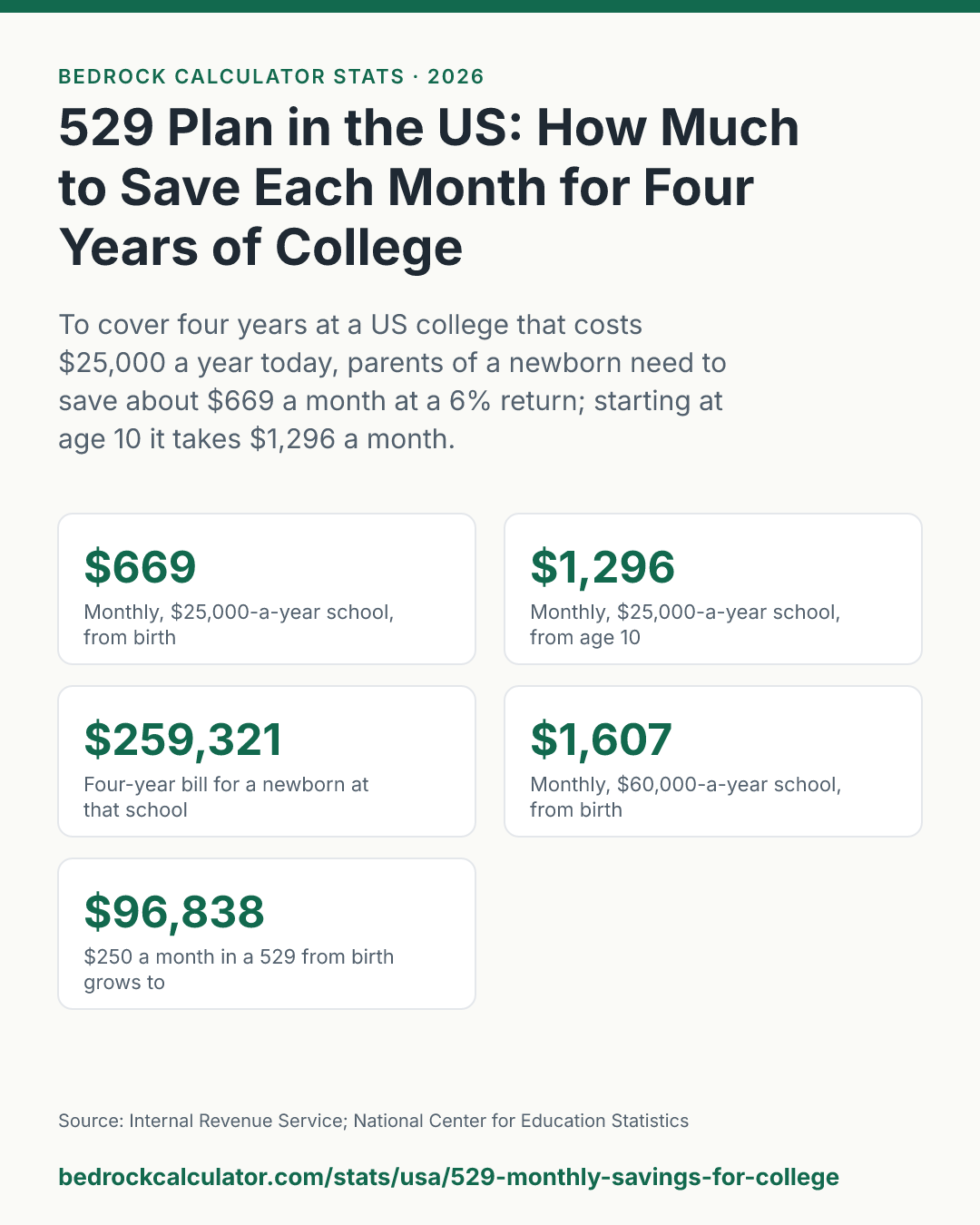
To pay for four years at a US college that costs $25,000 a year today, parents of a newborn need to put away about $669 a month, assuming a 6% return and college costs rising 5% a year. Wait until the child is 10 and it takes $1,296 a month.
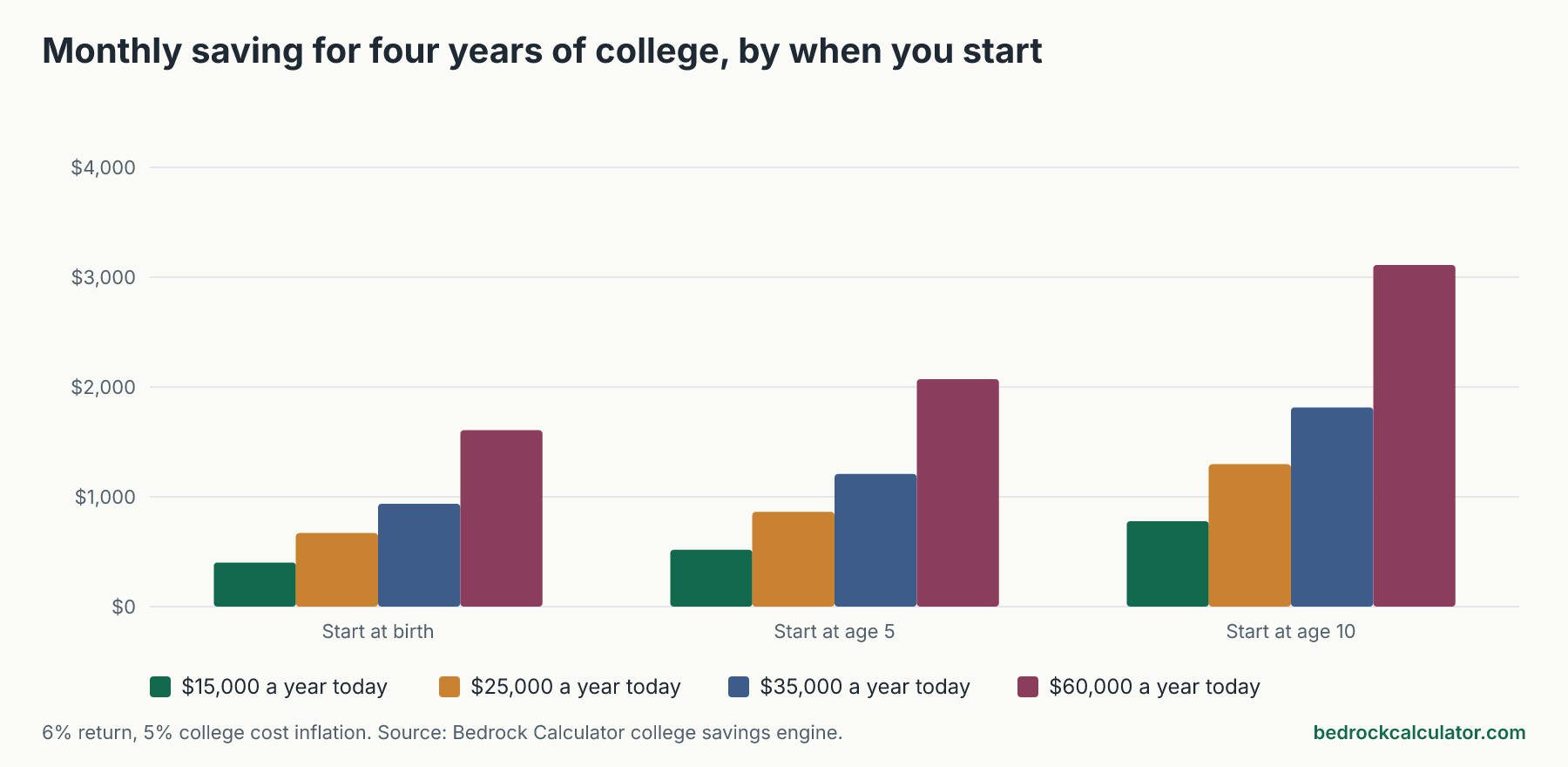
The price of the school moves the answer more than anything else. A $15,000-a-year school needs $402 a month from birth. A $60,000-a-year school needs $1,607.
How we worked out these numbers
There are two calculators behind this page.
The monthly amounts come from the college savings calculator. It takes what a year of college costs today, grows that price by 5% a year until your child starts, adds up all four years with the price still rising during college, and then works out the steady monthly deposit that reaches the full total by the first day of freshman year. Our settings:
- $0 saved today
- A 6% yearly return, compounded monthly
- College costs rising 5% a year
- Four years of enrollment, with 100 percent of the bill paid from savings
The yearly prices, $15,000, $25,000, $35,000, $60,000, are scenarios we picked, not averages. The calculator holds no college price data, and published prices vary enormously between an in-state public school where the student lives at home and a private college with room and board. Look up the cost of attendance for schools you have in mind on the federal College Navigator site and use the row closest to it.
The second table comes from the 529 plan calculator, which runs the other direction: you pick a monthly deposit and it shows what that grows to.
Neither the 6% return nor the 5% cost increase is a forecast. Both are the calculators' defaults, and no official source predicts either one.
How much to save per month for college, by age
Monthly saving needed for four years of college in the US, by cost today and child's age
Download CSVStarting from $0, 6% return, college costs rising 5% a year, the full four-year bill funded by the first day of college. Annual costs today are scenario inputs.
| $15,000 | $402 | $518 | $778 | $155,592 |
| $25,000 | $669 | $863 | $1,296 | $259,321 |
| $35,000 | $937 | $1,208 | $1,815 | $363,049 |
| $60,000 | $1,607 | $2,071 | $3,111 | $622,370 |
Starting at birth gives the money 18 years to grow, and that does a lot of the work. For the $25,000-a-year school, investment growth supplies 44.2% of the $259,321 four-year bill when you start at birth. Start at age 10 and growth supplies only 21.8%.
That's why the monthly amount climbs so fast as you wait. For the same school, it's $669 from birth, $863 from age 5, and $1,296 from age 10. Waiting ten years costs $627 more every month, even though the bill itself is smaller in today's dollars when you start later.
If you kept the money in cash and earned nothing, the newborn's monthly figure for a $25,000 school would be $1,201 instead of $669.
How much four years of college will cost
The bills in the table look huge because they're in future dollars. A school that costs $25,000 a year today will charge $60,165 for freshman year 18 years from now if prices rise 5% a year, and $259,321 for all four years. For a $60,000-a-year school, the four-year total is $622,370.
Your income will rise over 18 years too, so the real burden isn't as extreme as those totals suggest. But the savings target has to be set in the dollars you'll actually pay with.
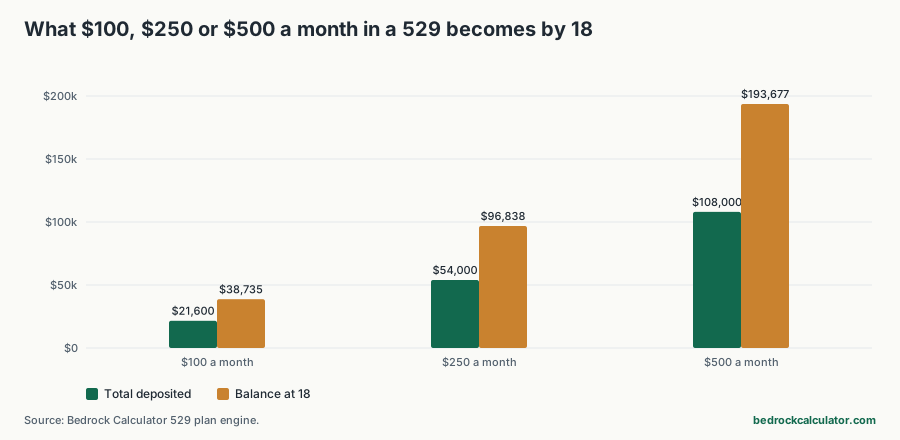
What $100, $250 or $500 a month in a 529 becomes
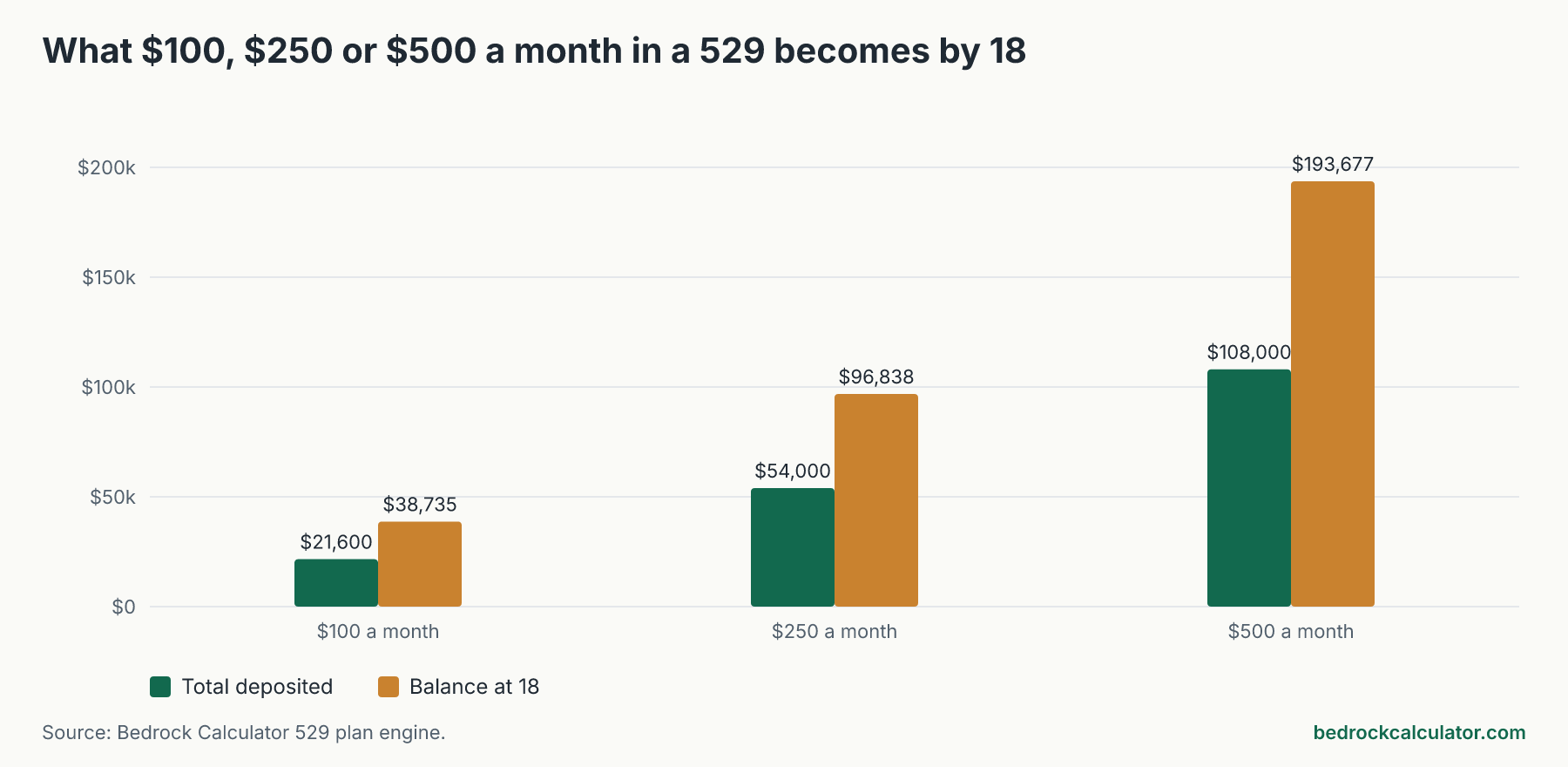
What steady 529 deposits from birth grow to by 18
Download CSV529 plan calculator: $0 to start, fixed monthly deposit for 18 years, 6% return, no tax on growth.
| $100 | $21,600 | $17,135 | $38,735 | 14.9% |
| $250 | $54,000 | $42,838 | $96,838 | 37.3% |
| $500 | $108,000 | $85,677 | $193,677 | 74.7% |
Plenty of families can't save the full amount, and that's normal. $250 a month in a 529 from birth grows to about $96,838 by 18 at a 6% return, from $54,000 of deposits. That covers 37.3% of the four-year bill at a $25,000-a-year school.
$100 a month grows to $38,735, and $500 a month to $193,677. In each case, close to half the final balance is growth rather than money you put in.
That growth is the main reason to use a 529 rather than a regular account. Earnings in a 529 aren't taxed while they build up, and withdrawals for qualified education costs such as tuition, fees, books and room and board aren't taxed either. Many states also give a state income tax deduction for contributions to their own plan.
Should you aim to cover the whole bill?
Most families don't. The college savings calculator lets you choose a share of the cost to cover, and covering half halves the monthly figure. Financial aid, scholarships, the student's own work and federal student loans fill in the rest for many families.
There's also a reason not to overshoot. Money taken out of a 529 for non-qualified spending is taxed on its earnings and usually hit with a penalty, although there are now more ways to use leftover money than there used to be, including some rollovers to a Roth IRA for the student.
What this leaves out
- Financial aid and scholarships. The calculator plans for the full published price. Many students pay far less after grants and aid.
- Money arriving year by year. The calculator assumes the entire four-year total must be in the account on day one. In reality you pay one year at a time, so the money for later years keeps growing during college. That makes these monthly figures a little higher than strictly necessary.
- A changing return. A single fixed return is used every month. A market fall just before college, when the balance is largest, can hurt a lot. Many 529 plans shift to safer investments as the start date approaches for this reason, which also lowers the return in those years.
- Rising deposits. The calculator holds the monthly amount flat. If you raise it as your pay rises, you can start smaller.
- State tax breaks. State deductions or credits for 529 contributions aren't included.
Working out your own plan
Look up the cost of attendance for a school or two, then enter it in the college savings calculator along with your child's age and what you already have saved. It'll show the monthly deposit and how much of the bill growth will cover. To see what a monthly amount you can actually afford would grow to, use the 529 plan calculator, and if you're weighing saving now against borrowing later, the student loan vs 529 calculator compares the two. The student loan payoff time page shows what borrowing the difference would mean.