How much do you need to retire at each age?
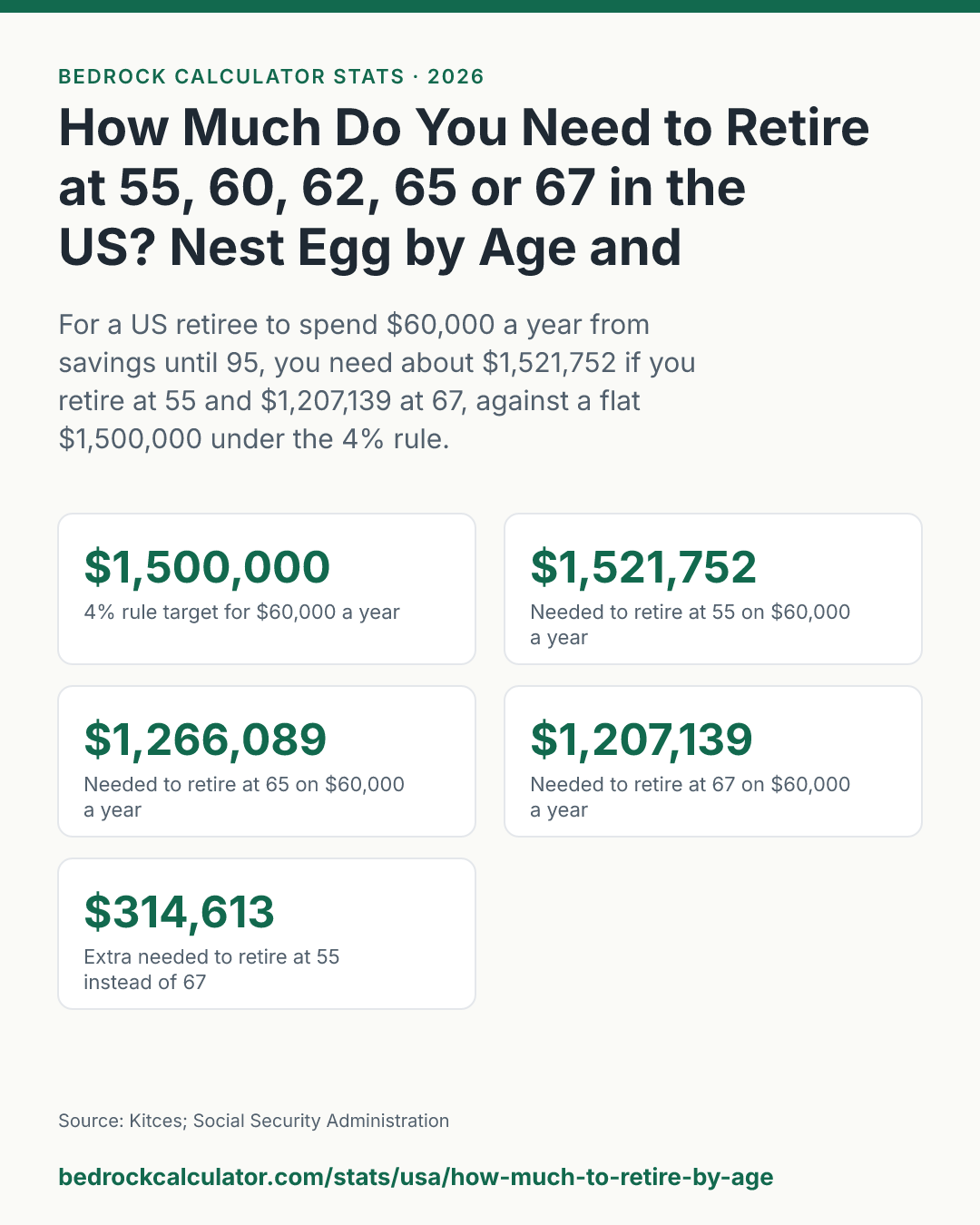
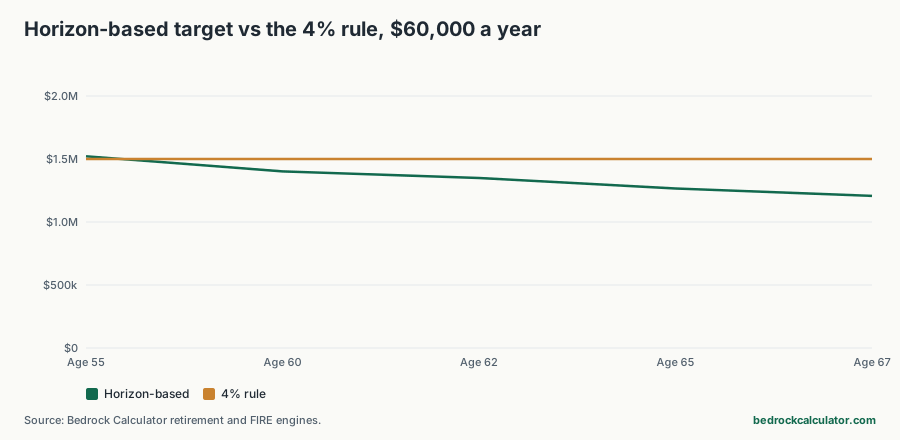
If you're retiring in the US and want to take $60,000 a year from your savings, rising with inflation, and make it last until 95, you need about $1,521,752 if you retire at 55, $1,349,354 at 62, $1,266,089 at 65 and $1,207,139 at 67.
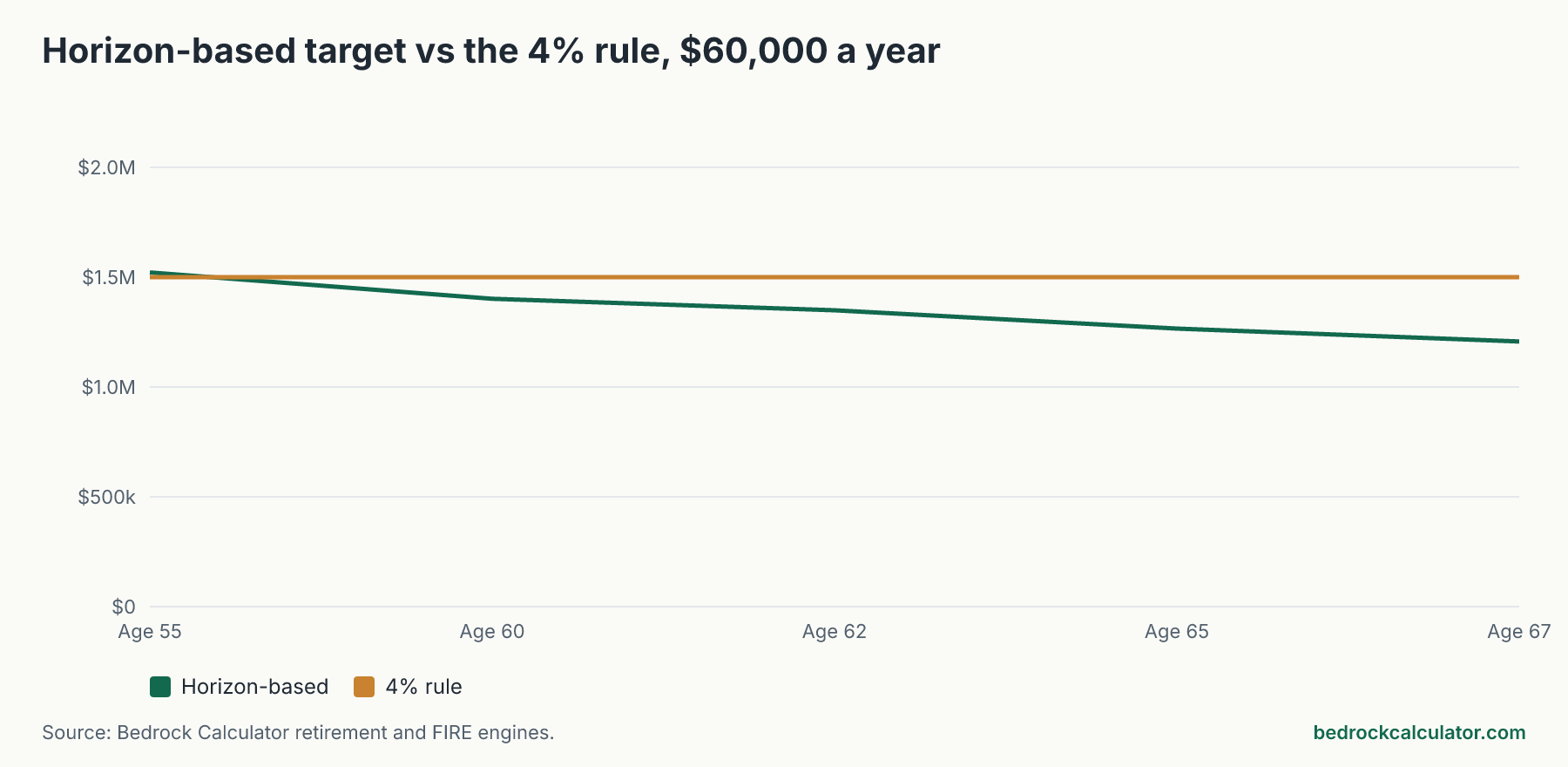
The popular 4% rule gives one answer for every age: 25 times your spending, or $1,500,000 for $60,000 a year. That's a little light for a 55-year-old and more than a 65-year-old strictly needs under our assumptions.
How we worked out these numbers
All figures are for the United States and use US rules for 2026.
We used two methods, both from the site's own calculators.
The 4% rule. Take 4% of your portfolio in your first year of retirement and raise that dollar amount with inflation each year after. Turned around, the rule says your nest egg should be your yearly spending divided by 0.04, which is the target the FIRE calculator reports. It doesn't care how old you are.
A horizon-based figure. This is the method the retirement calculator uses for "capital actually required". It asks how much money, earning a 5.0% return, would fund a withdrawal that grows 2.5% a year with inflation and runs out exactly at 95. In real terms that's a 2.44% return. The answer depends on how many years you need to fund, so it changes with your retirement age.
The same assumptions run through every row:
- Withdrawals are taken at the end of each year
- The portfolio earns the same 5.0% every year, with no market swings
- Inflation is a steady 2.5%
- The money is meant to last until 95, with nothing left over
- No taxes on withdrawals and no investment fees
That last point matters. If your savings are in a traditional 401(k) or IRA, every withdrawal is taxed as income, so the spending figures here are before tax. To net $60,000 after tax you'd need to withdraw more. And these figures are what you need from savings after Social Security and any pension, not your total budget.
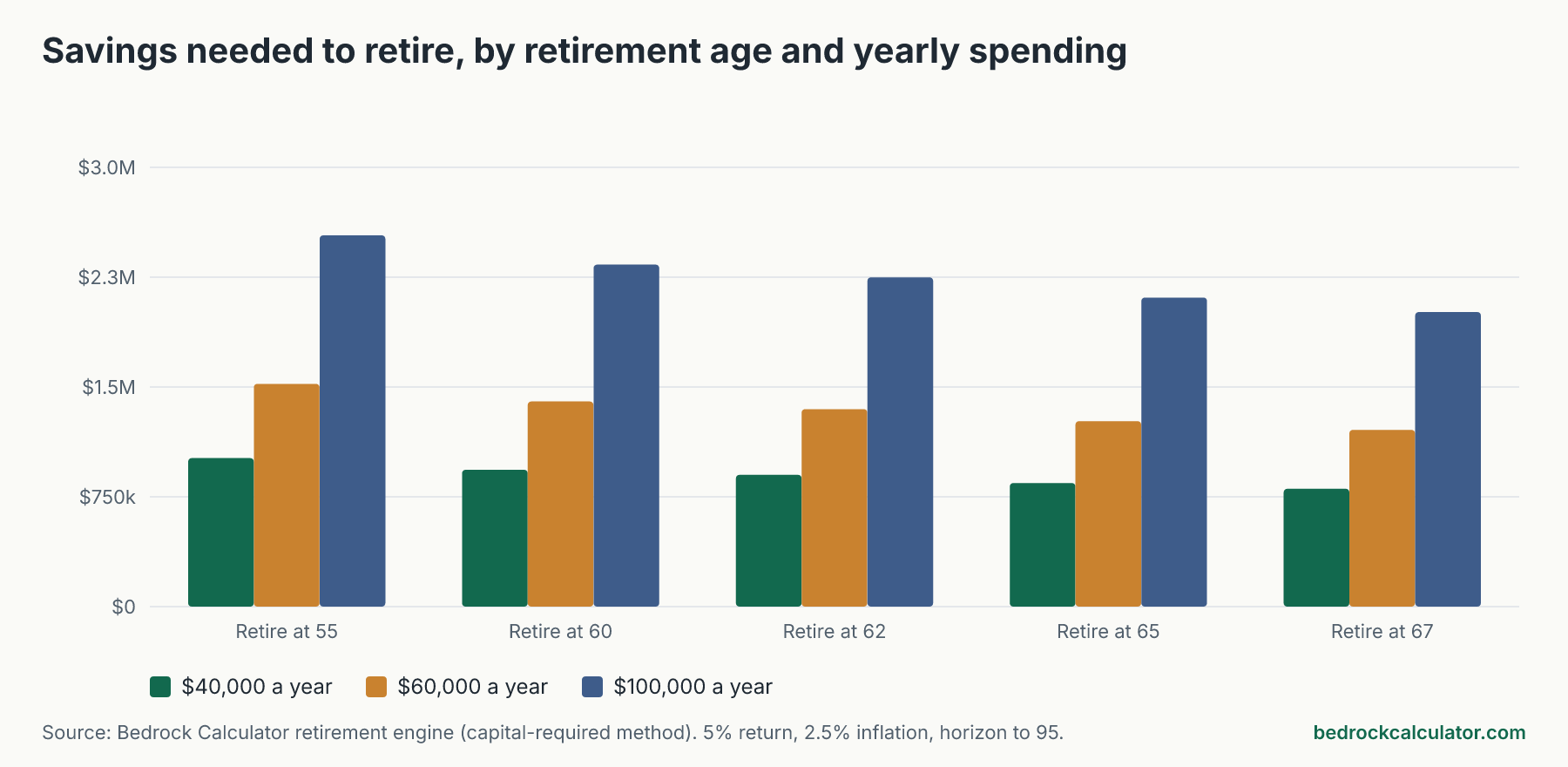
How much you need to retire at 55, 60, 62, 65 and 67
Each column is a level of yearly spending from savings. Click a heading to sort.
Savings needed at retirement to fund spending until 95
Download CSVWithdrawal rises 2.5% a year with inflation; portfolio earns 5% a year; money runs out at 95. Spending is what you take from savings after Social Security and any pension.
| 55 | 40 | $1,014,501 | $1,521,752 | $2,029,002 | $2,536,253 |
| 60 | 35 | $934,408 | $1,401,612 | $1,868,816 | $2,336,020 |
| 62 | 33 | $899,569 | $1,349,354 | $1,799,138 | $2,248,923 |
| 65 | 30 | $844,059 | $1,266,089 | $1,688,118 | $2,110,148 |
| 67 | 28 | $804,759 | $1,207,139 | $1,609,518 | $2,011,898 |
Retiring at 55 on $60,000 a year takes $1,521,752. Retiring at 67 takes $1,207,139. The difference, $314,613, is the cost of funding twelve more years.
Put another way, a 55-year-old needs about 25.4 times a year of spending, a 65-year-old about 21.1 times, and a 67-year-old about 20.1 times.
How this compares with the 4% rule
The 4% rule says $1,500,000 for $60,000 a year whatever your age. That lines up almost exactly with our horizon figure for someone retiring at 55, which is $21,752 higher. For a 65-year-old the rule asks for $233,911 more than our method does.
That pattern makes sense. The rule came out of research on 30-year retirements using historical market returns, including bad decades. Our horizon method assumes a steady 5.0% return, which is kinder than real markets. The rule builds in a buffer for bad luck. Our figure doesn't.
The 4% rule target, by spending level
Download CSVSpending divided by 0.04, from the FIRE calculator. The rule gives the same answer at every retirement age.
| $40,000 | $1,000,000 | $1,014,501 | $844,059 |
| $60,000 | $1,500,000 | $1,521,752 | $1,266,089 |
| $80,000 | $2,000,000 | $2,029,002 | $1,688,118 |
| $100,000 | $2,500,000 | $2,536,253 | $2,110,148 |
So which number should you plan around? If you're retiring at 65 or later, the 4% rule is a cautious target and our horizon figure is a lean one. If you're retiring at 55, the two are close, and both assume a smooth ride that real markets won't give you. Early retirees often plan around a lower withdrawal rate for that reason.
Testing the 4% rule with spending guardrails
The safe withdrawal rate calculator uses the Guyton-Klinger rules. You start at 4%, raise the withdrawal with inflation, and then cut it by 10% if your withdrawal rate drifts 20% above where it started, or raise it by 10% if it drifts 20% below.
We ran a 4% rule portfolio for $60,000 a year through those rules for each retirement age, up to 95.
Testing a 4% rule portfolio with Guyton-Klinger guardrails ($60,000 first-year withdrawal)
Download CSVSafe-withdrawal-rate calculator: 4% initial rate, 5% return, 2.5% inflation, 20% guardrails, 10% cuts or raises, horizon to 95.
| 55 | 0 | 7 | $72,058 | $66,067 | $1,666,716 |
| 60 | 0 | 6 | $71,459 | $65,260 | $1,652,776 |
| 62 | 0 | 5 | $71,370 | $64,937 | $1,641,455 |
| 65 | 0 | 5 | $70,888 | $64,456 | $1,635,631 |
| 67 | 0 | 4 | $70,836 | $64,141 | $1,623,351 |
Even with a steady return, the guardrails have work to do. A 5.0% return barely covers a 4% draw that grows 2.5% a year, so the withdrawal rate creeps up until it hits the upper guardrail. Retiring at 55, that happens 7 times over 40 years. Retiring at 65 it happens 5 times, and at 67 4 times. The prosperity rule never triggers here, because the portfolio never grows fast enough to pull the rate down.
The cuts are what keep the money from running out. From 55, the average withdrawal works out to $72,058 and the portfolio still holds $1,666,716 at 95. Those are nominal dollars, so both figures include decades of inflation, and the leftover balance is worth much less in today's money than it looks.
The honest limit of this test is the same as before. A constant return never produces the bad first decade that causes real retirements to fail. The calculator holds the return flat, so its guardrails can't show how deep the cuts would be after a crash. Treat this as a check on the arithmetic, not a stress test.
What if you retire before Social Security starts?
Social Security retirement benefits can start at 62 at the earliest, with a permanent reduction for claiming before full retirement age. If you retire at 55 or 60, your savings have to carry the whole budget until benefits begin, and then a smaller share after.
The spending columns here are what you need from savings. If you'll get Social Security later, the draw in your early years is higher than in your later ones. The retirement calculator lets you enter an expected benefit and works out the gap for you.
Getting your own number
Start with what you actually spend, subtract any pension or Social Security you expect, and that's the yearly draw on savings. Then:
- Use the retirement calculator to see whether your current savings plan reaches the capital you need, in today's dollars.
- Use the FIRE calculator if you're aiming to retire early and want to see how many years of saving it takes.
- Use the safe withdrawal rate calculator to see how a guardrail plan behaves with your own portfolio.
- If most of your savings are in a workplace plan, the 401(k) calculator projects where your balance is heading.
Try a lower return too. Dropping the assumed return by a point raises the nest egg you need noticeably, especially for a 40-year retirement.