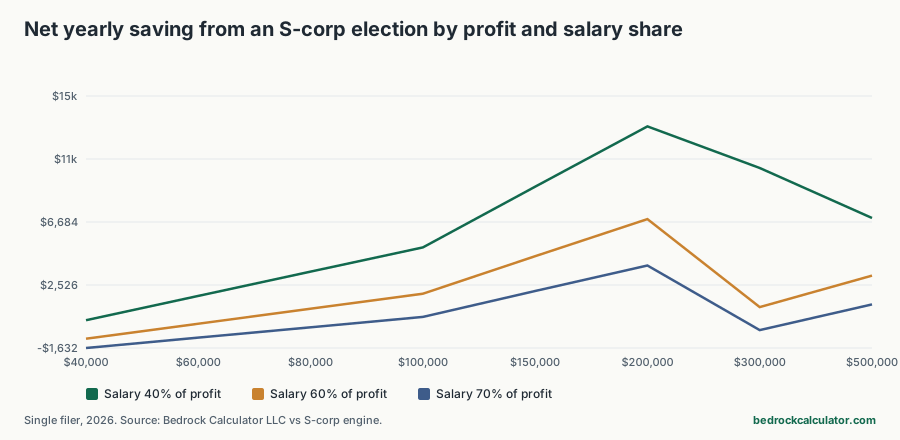
At what profit does an S-Corp election start saving tax?
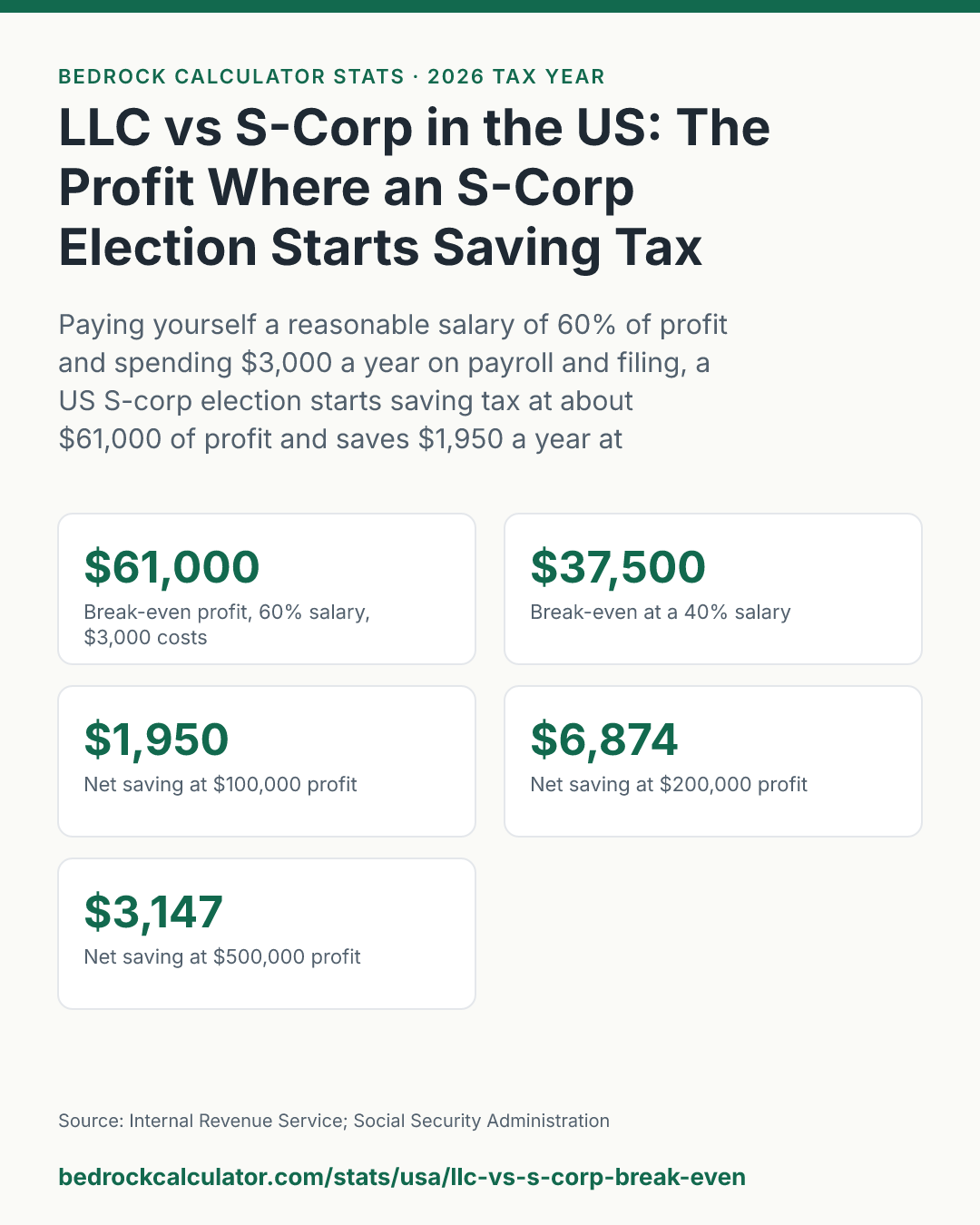
For a US single-member LLC, electing S-corp status saves tax only once profit is high enough for the payroll tax saving to beat the cost of running payroll. If you pay yourself a reasonable salary of 60% of profit and spend $3,000 a year on payroll and an extra tax return, that point is about $61,000 of net profit.
Above it, the saving grows to $1,950 a year at $100,000 of profit and $6,874 at $200,000. The salary you pay yourself is the biggest lever: at 40% of profit the break-even drops to $37,500, and at 70% it rises to $88,000.
How we worked out these numbers
All figures are for the US 2026 tax year, from the site's LLC vs S-corp tax calculator. For each profit level it compares two ways of being taxed:
- Default LLC. All net profit is subject to self-employment tax: Social Security and Medicare on nearly all of it, with Social Security stopping at the yearly wage base.
- S-corp election. The business pays you a salary, and only that salary carries Social Security and Medicare tax, both the employee and employer halves. Whatever's left comes out as a distribution with no payroll tax.
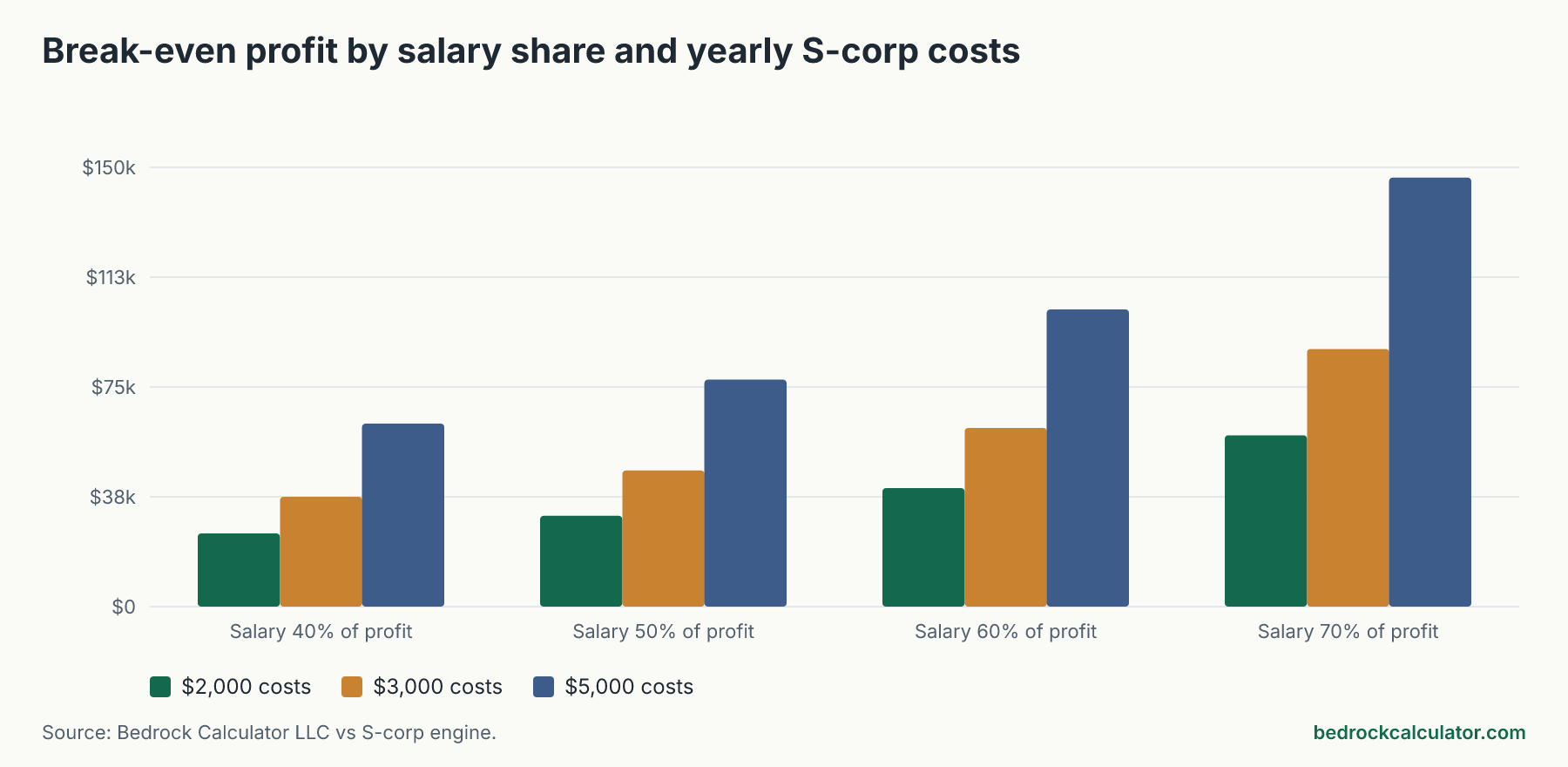
The net saving is the difference in payroll tax, minus the yearly cost of being an S-corp: payroll processing, bookkeeping and the separate Form 1120-S return. We used $3,000 a year as the main case. At a 60% salary, cheaper costs of $2,000 bring the break-even down to $40,500, and costs of $5,000 push it up to $101,500. Every run is for a single filer.
The reasonable salary is the assumption everything hinges on, so we state it as a share of profit and show four of them. The IRS doesn't set a percentage. It expects you to pay yourself what the business would pay someone else for the same work.
The calculator treats income tax as the same either way, which isn't quite true. It doesn't model the qualified business income deduction, which S-corp wages reduce. It doesn't model state taxes on S-corps or LLCs, such as California's franchise tax, or the effect on retirement plan contribution limits. Those can move the answer in either direction, so a close call deserves a look from a tax professional.
Break-even profit by salary and S-corp costs
Profit at which an S-corp election starts saving tax
Download CSVSingle-member LLC, single filer, 2026 FICA. Break-even is the first profit (in $500 steps) where payroll tax saved exceeds the yearly compliance cost.
| 40% | $25,000 | $37,500 | $62,500 |
| 50% | $31,000 | $46,500 | $77,500 |
| 60% | $40,500 | $61,000 | $101,500 |
| 70% | $58,500 | $88,000 | $146,500 |
Two things push the break-even point around. A higher reasonable salary means more profit is still taxed through payroll, so you need more profit before the saving covers the costs. And higher yearly costs need a bigger saving to pay for them. At a 70% salary with $3,000 of costs, the break-even is $88,000. With the same salary and costs of $5,000, it's $146,500.
How much an S-corp saves at different profits
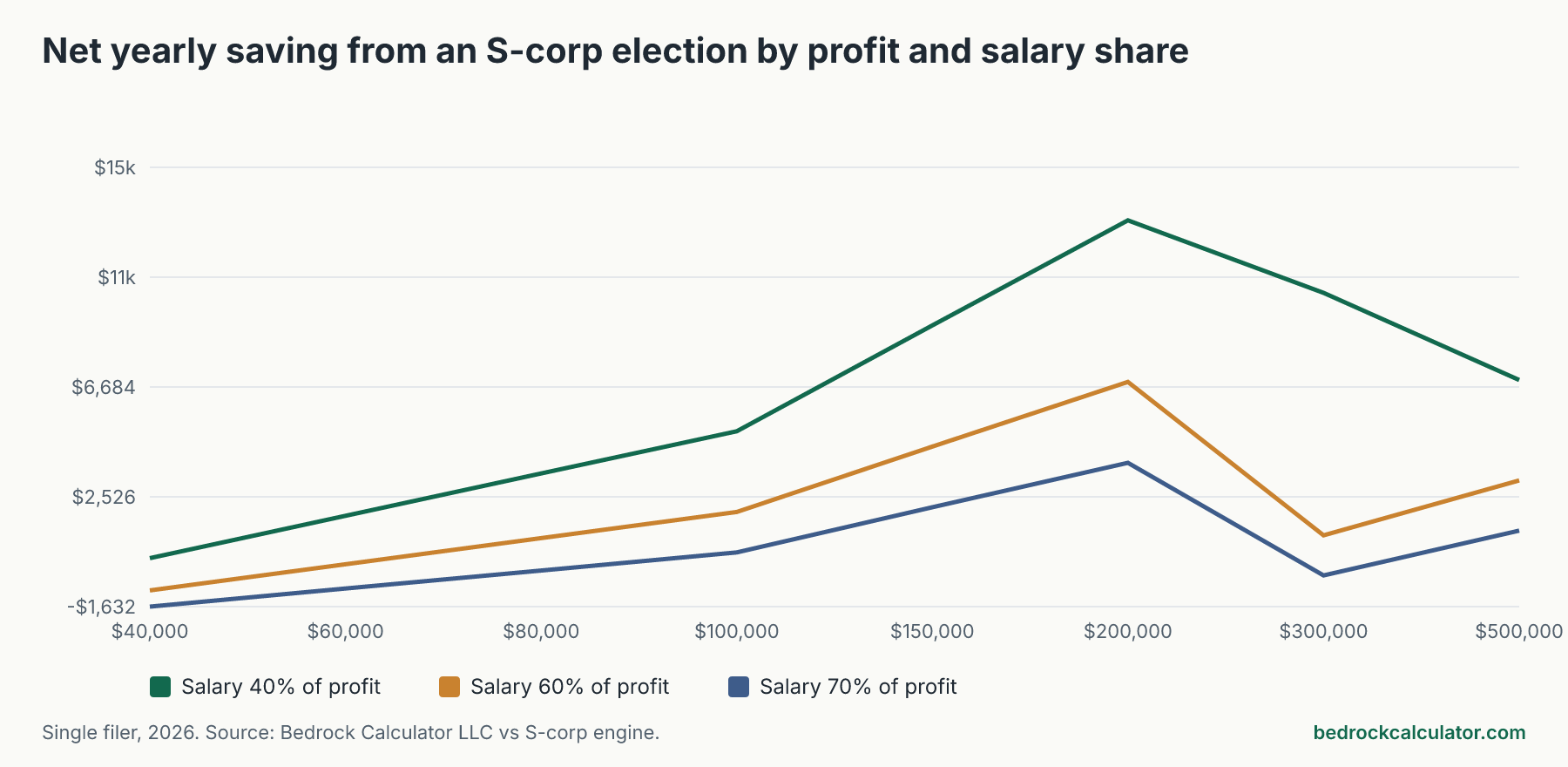
S-corp vs LLC payroll tax by profit (salary 60% of profit, $3,000 costs)
Download CSVLLC pays self-employment tax on all profit; S-corp pays employee and employer FICA on the salary only. Income tax assumed equal.
| $40,000 | $24,000 | $5,652 | $3,672 | $1,980 | -$1,020 |
| $60,000 | $36,000 | $8,478 | $5,508 | $2,970 | -$30 |
| $80,000 | $48,000 | $11,304 | $7,344 | $3,960 | $960 |
| $100,000 | $60,000 | $14,130 | $9,180 | $4,950 | $1,950 |
| $150,000 | $90,000 | $21,194 | $13,770 | $7,424 | $4,424 |
| $200,000 | $120,000 | $28,234 | $18,360 | $9,874 | $6,874 |
| $300,000 | $180,000 | $31,606 | $27,540 | $4,066 | $1,066 |
| $500,000 | $300,000 | $38,625 | $32,478 | $6,147 | $3,147 |
At $100,000 of profit and a $60,000 salary, the LLC owner pays $14,130 of self-employment tax. The S-corp pays $9,180 of FICA on the salary, saving $4,950. After $3,000 of costs, that's $1,950 a year.
The saving doesn't keep rising forever. With the salary at 60% of profit, it's highest of our profit levels at $200,000 and then drops to $1,066 at $300,000. The reason is the Social Security wage base. An LLC owner stops paying Social Security tax once their self-employment earnings pass the base, so their tax grows slowly at high profits. But a $180,000 salary sits just under the base, so the S-corp still pays the full Social Security tax on almost all of it, on both sides. At a 70% salary the S-corp actually costs $452 more than staying an LLC at that profit, once costs are counted.
Further up, at $500,000, the salary passes the base too and the saving recovers to $3,147. The lesson is that a fixed percentage rule for salary can give odd results at high incomes. What matters is the actual salary number relative to the wage base.
Is an S-corp worth it?
For many sole owners with steady profit well above the break-even, yes. But a few things eat into the paper saving:
- Reasonable salary scrutiny. Setting your salary low raises the saving and also the audit risk. If the IRS treats some distributions as wages, you owe the payroll tax, plus penalties and interest.
- Lower QBI deduction. The qualified business income deduction is figured on profit after your salary, so an S-corp can shrink it. The QBI deduction calculator shows how much.
- Less Social Security credit. Paying less Social Security tax also means lower earnings on your record, which can mean a smaller benefit later.
- State costs. Some states charge S-corps a franchise or entity tax, and payroll means state unemployment registration too.
- Uneven profit. If profit drops below the break-even in a slow year, you still pay the costs.
Getting your own number
Enter your expected profit, the salary you could defend, and a real quote for payroll and tax preparation in the LLC vs S-corp tax calculator. The S-corp vs LLC calculator shows the same comparison without compliance costs, along with your income tax bracket. If you're staying an LLC, the self-employment tax calculator gives the full Schedule SE figure.