When is a pension lump sum worth taking?
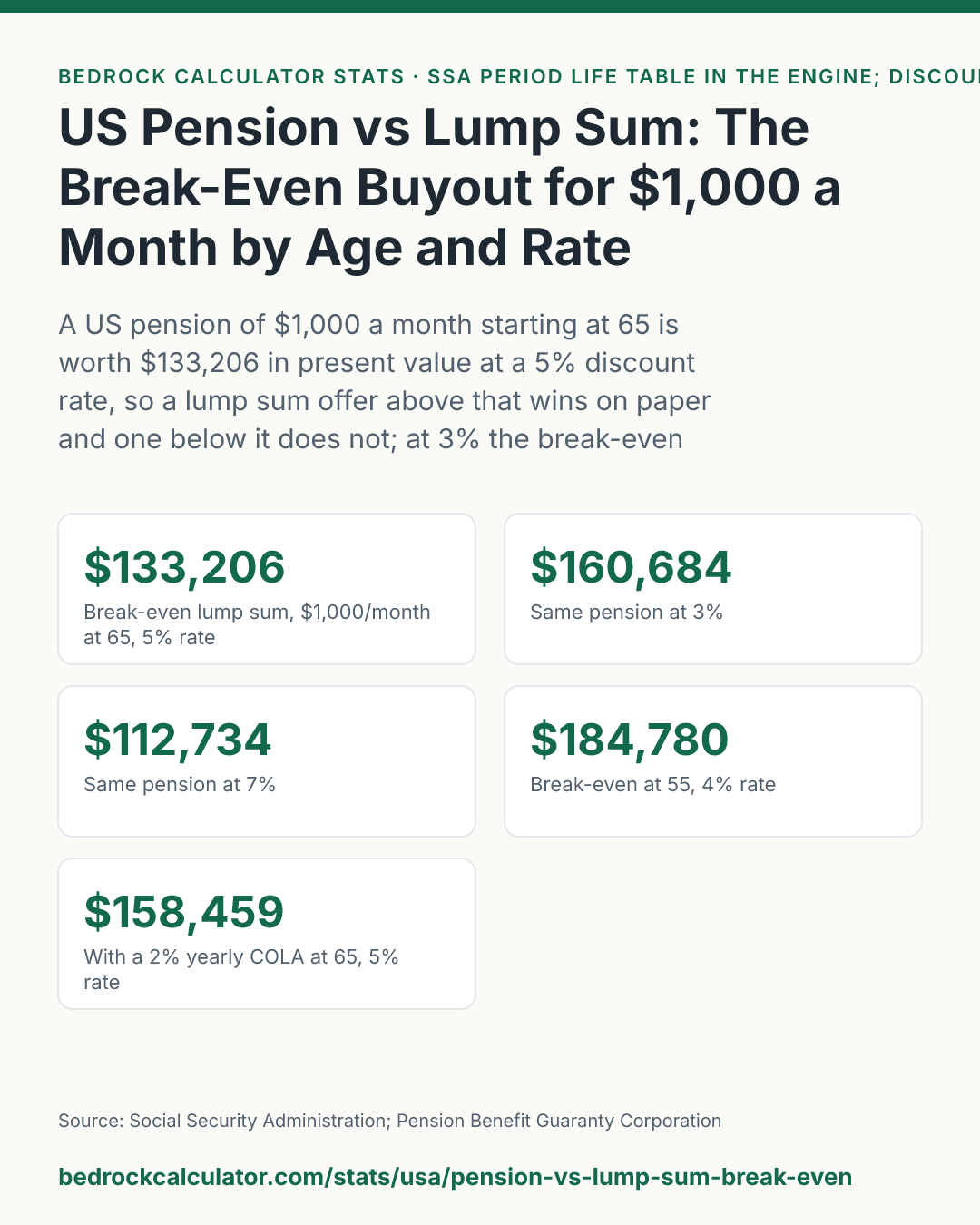
When a US employer offers to buy out your pension, the question is whether the lump sum is worth more than the stream of checks. For a pension of $1,000 a month for life starting at 65, the break-even is about $133,206 if you'd expect to earn 5% a year on the money.
Offered more than that, the lump sum wins on paper. Offered less, the pension does.
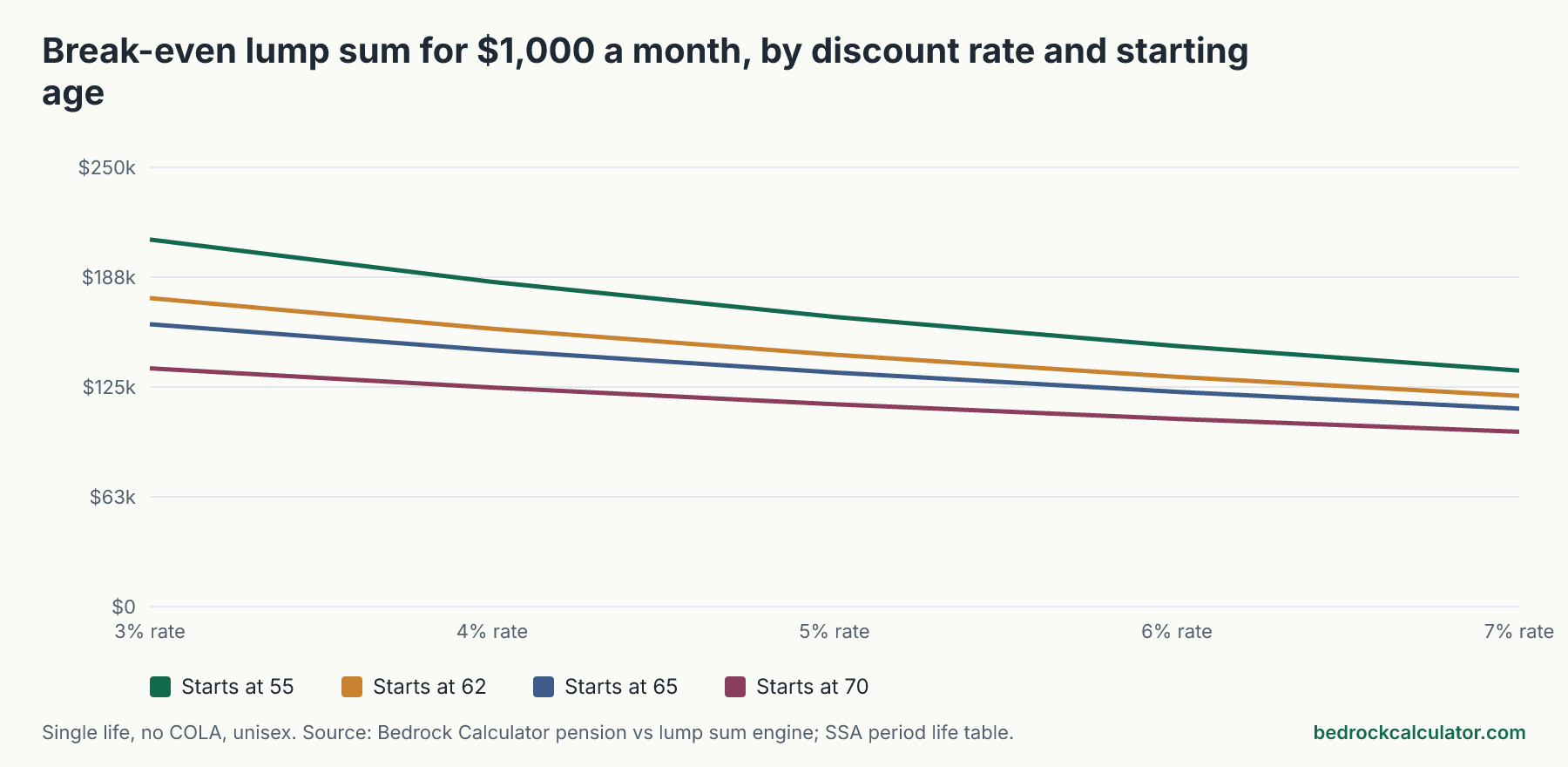
The rate you assume moves the answer a lot. At 3% the same pension is worth $160,684, and at 7% it's worth $112,734. Starting younger raises it too: at 55 and 4% it's $184,780.
What "break-even" means here
A pension pays you as long as you live. A lump sum pays you once. To compare them, the pension vs lump sum calculator on this site works out what the pension's future checks are worth today, its present value, in three steps:
- Each year's pension. $12,000 a year for a $1,000 monthly pension, growing each year if the pension has a cost-of-living raise.
- The chance you're alive to collect it. Each year's payment is weighted by the probability of surviving to that age, from the Social Security Administration's period life table.
- What that's worth today. Each weighted payment is discounted back at the rate you could earn on the lump sum.
Add those up and you get the lump sum that would be exactly as valuable as the pension, for someone with average life expectancy. That's the break-even offer.
The break-even at every age and rate
Each figure is for $1,000 a month. Pensions scale in a straight line, so for $2,500 a month multiply by 2.5: at 65 and 5% that's $333,015, which is what the calculator returns when you enter $2,500 directly.
Break-even lump sum for a $1,000-a-month US pension, by age and discount rate
Download CSVPresent value of a single-life pension with no COLA, unisex SSA period life table. Multiply by your monthly pension in thousands for your own figure.
| 55 | $208,933 | $184,780 | $164,859 | $148,266 | $134,315 | 27.5 |
| 60 | $185,340 | $166,073 | $149,867 | $136,124 | $124,381 | 23.3 |
| 62 | $175,575 | $158,155 | $143,387 | $130,774 | $119,924 | 21.7 |
| 65 | $160,684 | $145,894 | $133,206 | $122,251 | $112,734 | 19.4 |
| 70 | $135,570 | $124,719 | $115,228 | $106,883 | $99,511 | 15.7 |
A handy way to read the table is as a multiple of a year's pension. At 65 and 5%, the break-even is about 11.1 times the yearly pension. At 55 and 4% it's about 15.4 times, because you'd collect for longer and each check is discounted less. At 70 and 6% it's about 8.9 times.
Why the discount rate matters so much
The discount rate is the return you think you could earn if you took the lump sum and invested it. A higher rate makes future checks worth less today, so the break-even falls. For $1,000 a month at 65, going from 3% to 7% cuts the break-even by $47,950.
That makes the rate the easiest place to fool yourself. If you assume you'll earn 7% to justify taking the lump sum, you also need to accept the risk that comes with chasing 7%. A pension check doesn't fall when markets do. A fair comparison uses a rate you could earn with similar safety, which usually means a lower one.
Men, women and inflation raises
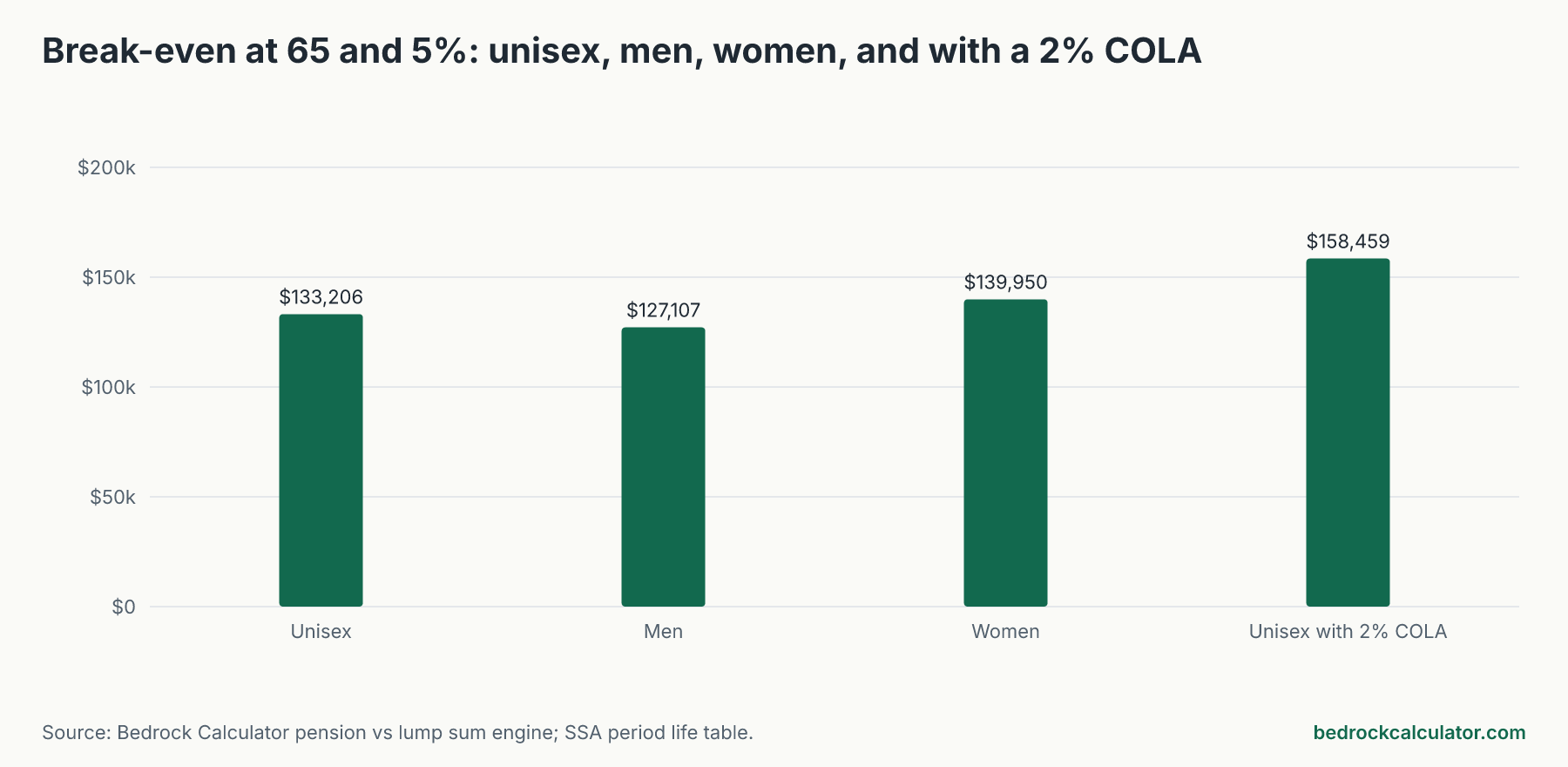
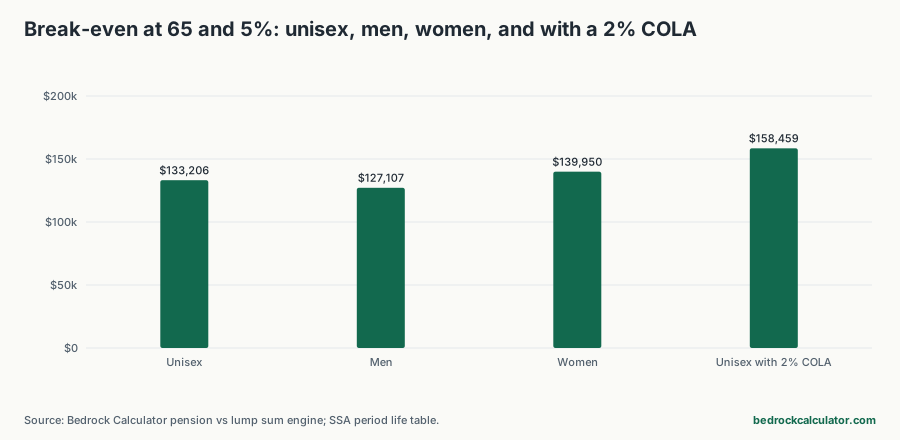
Women live longer on average, so a lifetime pension is worth more to them. At 65 and 5%, the break-even is $127,107 on the men's table and $139,950 on the women's, a gap of $12,842. The unisex figure in the main table is the average of the two.
A cost-of-living raise matters even more. A 2% yearly increase lifts the break-even at 65 and 5% from $133,206 to $158,459, an extra $25,253. If your pension has one, make sure the offer accounts for it.
Things the numbers can't weigh for you
- Your own health. The life table knows nothing about you. At 65 it gives about 19.4 more years on average. If you're in poor health, the pension is worth less to you. If your family tends to live into their 90s, it's worth more.
- Running out of money. The pension keeps paying however long you live. A lump sum has to be made to last, and bad market years early in retirement can do lasting damage. The sequence of returns risk calculator shows how.
- Your employer's health. If a plan fails, the Pension Benefit Guaranty Corporation steps in, but it guarantees benefits only up to legal limits, so some people get less than they were promised.
- A spouse. A joint-and-survivor pension keeps paying after you die. The calculator values one life only.
- Taxes. Pension checks are taxed as you receive them. A lump sum rolled into an IRA is taxed as you withdraw it. Taken as cash, it can be taxed all at once.
How we worked out these numbers
We ran the pension vs lump sum calculator for a $1,000-a-month single-life pension at five starting ages and five discount rates, with no cost-of-living raise and the unisex life table, plus the men's, women's and 2% raise variations at 65.
Two details of how the calculator works. It treats each year's twelve payments as one payment at the end of the year, which slightly understates a pension paid monthly from the first month. And its survival chances come from a smooth curve fitted to SSA death rates between ages 60 and 90, extended outside that range, so the youngest and oldest ages are a little less exact. Payments are counted up to age 100.
Run your own numbers
Enter your pension, the lump sum offer, your age and a realistic rate in the pension vs lump sum calculator to see which wins on present value. To see the income a lump sum could buy, the annuity payout calculator works out the payment from a given amount. And the retirement calculator shows how either choice fits your wider plan.