What are the 2026 income limits for Roth and traditional IRA contributions?
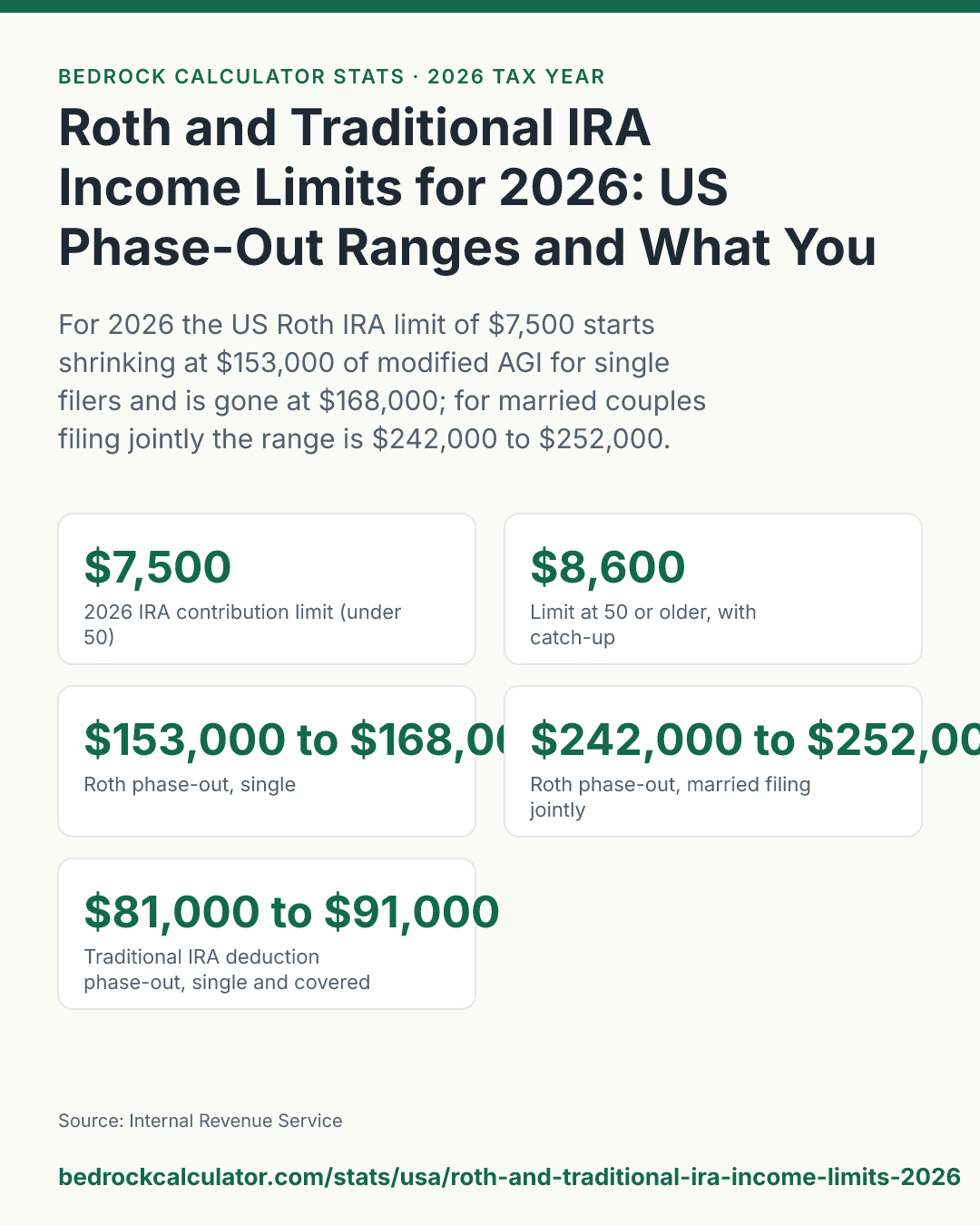
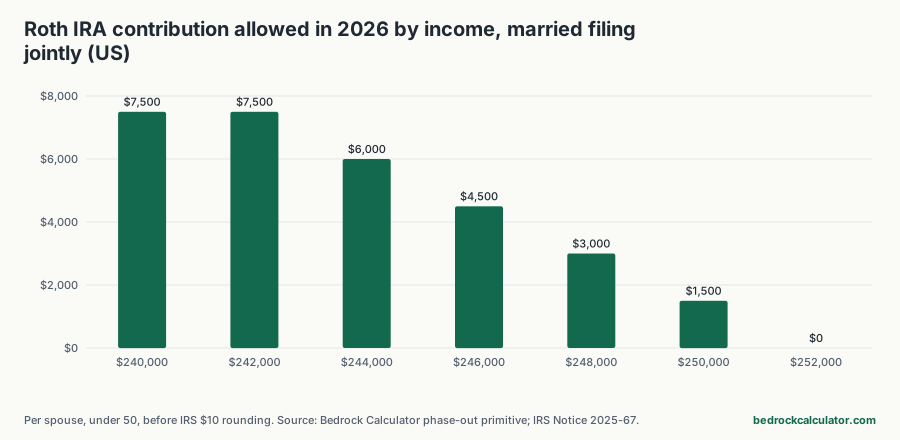
For the 2026 tax year, the IRS lets you put up to $7,500 into IRAs, or $8,600 if you're 50 or older. A single filer can put all of it into a Roth IRA until modified AGI reaches $153,000. Above that the limit shrinks, and at $168,000 it's gone. Married couples filing jointly have a range of $242,000 to $252,000.
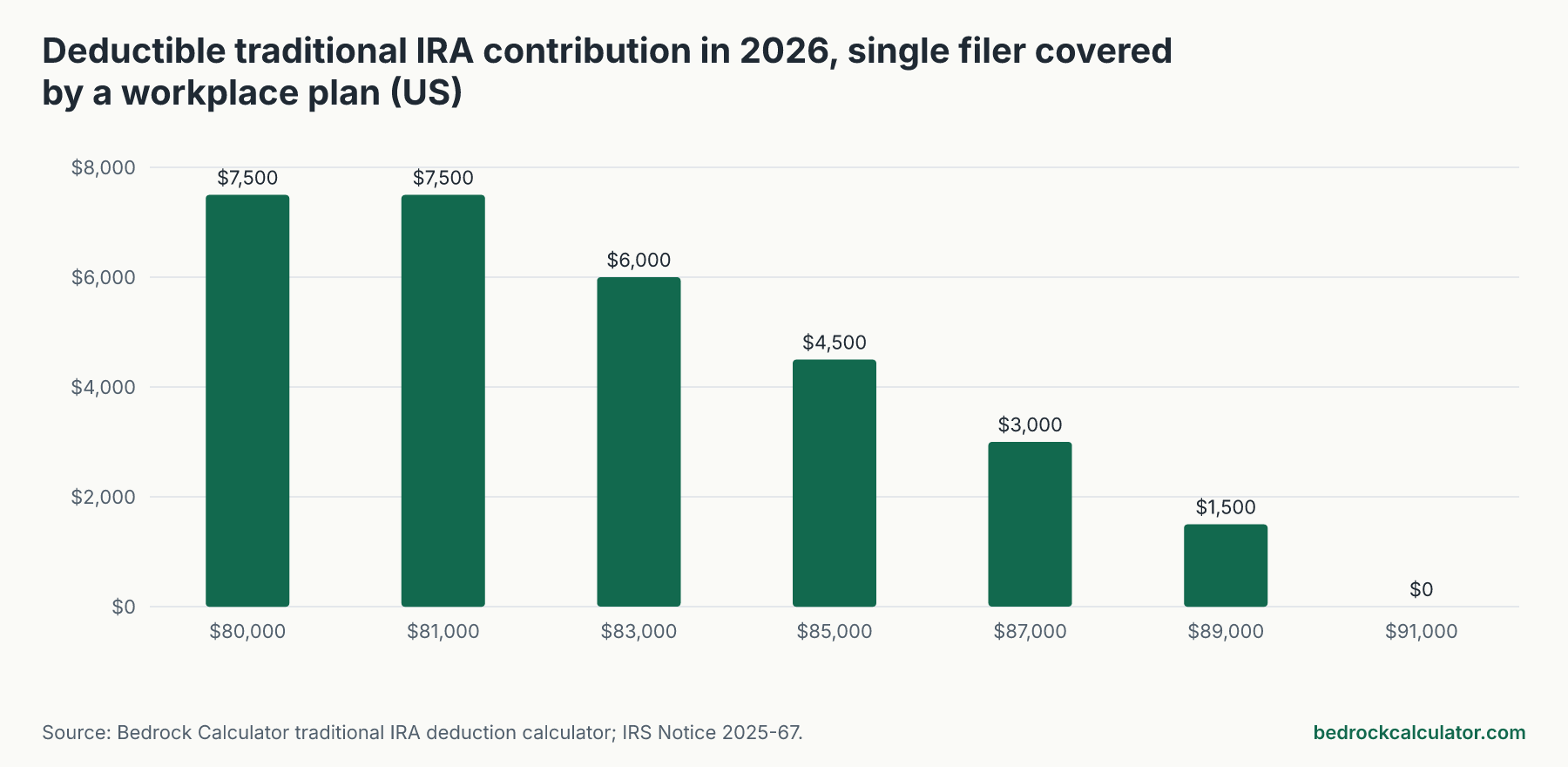
Traditional IRAs work differently. Anyone with earned income can contribute. The income limits only decide whether you can deduct the contribution, and they apply only when you or your spouse has a workplace retirement plan. For a single filer with a 401(k) at work, the deduction phases out between $81,000 to $91,000.
Where these numbers come from
The ranges come from IRS Notice 2025-67, which sets the 2026 retirement plan and IRA figures. We checked the numbers held in this site's calculators against the IRS announcement of that notice and against the 2026 section of IRS Publication 590-A before writing, and they match.
The in-between amounts, such as how much you can put in a Roth IRA at a particular income, are worked out the way the IRS worksheets do it: the limit falls in a straight line across the range. The traditional IRA deduction calculator produced the deduction figures. For the Roth figures we used the same phase-out function on the Roth ranges, because the Roth IRA calculator projects growth and assumes you're eligible.
One small difference from your tax return: the IRS rounds a reduced amount up to the next $10, and if anything is left at all, it lets you contribute or deduct at least $200. Our figures are the straight-line amount before that rounding, so your real number can be a few dollars higher.
All the 2026 IRA phase-out ranges
2026 IRA income limits in the US: where the phase-out starts and ends (modified AGI)
Download CSVBelow the first column you get the full amount; at or above the second you get none. Source: IRS Notice 2025-67, as held in the Bedrock Calculator engine.
| Roth IRA contribution | Single, head of household, or married filing separately and lived apart all year | $153,000 | $168,000 |
| Roth IRA contribution | Married filing jointly or qualifying surviving spouse | $242,000 | $252,000 |
| Roth IRA contribution | Married filing separately, lived with spouse | $0 | $10,000 |
| Traditional IRA deduction | Single or head of household, covered by a workplace plan | $81,000 | $91,000 |
| Traditional IRA deduction | Married filing jointly, you are covered by a workplace plan | $129,000 | $149,000 |
| Traditional IRA deduction | Married filing jointly, you are not covered but your spouse is | $242,000 | $252,000 |
| Traditional IRA deduction | Married filing separately, covered, lived with spouse | $0 | $10,000 |
Below the "phase-out starts" figure you get the full amount. At or above "fully phased out" you get nothing. In between, you get a share.
A few rules that trip people up:
- Head of household uses the single range, for both the Roth and the deduction.
- Married filing separately is harsh. If you lived with your spouse at any point in the year, the Roth range runs from $0 to $10,000, and so does the deduction range when either of you has a workplace plan. Almost any income rules you out. If you lived apart all year, you use the single range instead.
- Modified AGI isn't your salary. It starts from adjusted gross income, which already has things like 401(k) contributions taken out, then adds back a few items. Publication 590-A has the worksheet.
How much you can put in a Roth IRA at your income
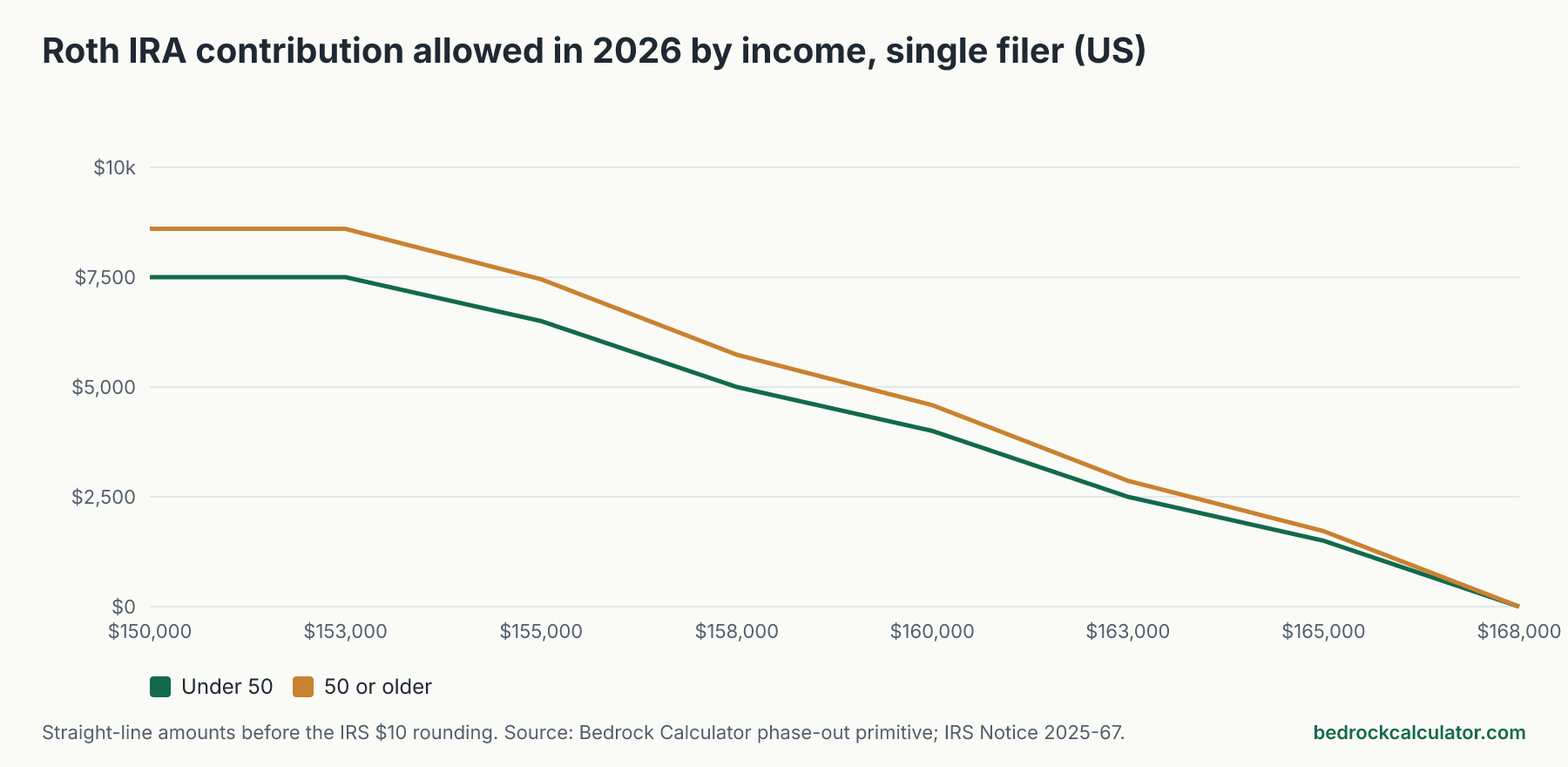
How much you can put in a Roth IRA in 2026 by income, single filer (US)
Download CSVStraight-line reduction across the phase-out range. The IRS rounds the result up to the next $10 and allows at least $200 if anything is left, which this table does not apply.
| $150,000 | $7,500 | $8,600 |
| $153,000 | $7,500 | $8,600 |
| $155,000 | $6,500 | $7,453 |
| $158,000 | $5,000 | $5,733 |
| $160,000 | $4,000 | $4,587 |
| $163,000 | $2,500 | $2,867 |
| $165,000 | $1,500 | $1,720 |
| $168,000 | $0 | $0 |
Inside the single range, every $1,000 of income above $153,000 trims $500 from a $7,500 limit, because the limit has to drop to zero over a $15,000 range. At $153,000 you can put in the full amount. At $155,000 it's $6,500, at $160,000 it's $4,000, and at $165,000 it's $1,500.
If you're 50 or older, the starting point is the higher $8,600, so you can put in more at the same income: $4,587 at $160,000.
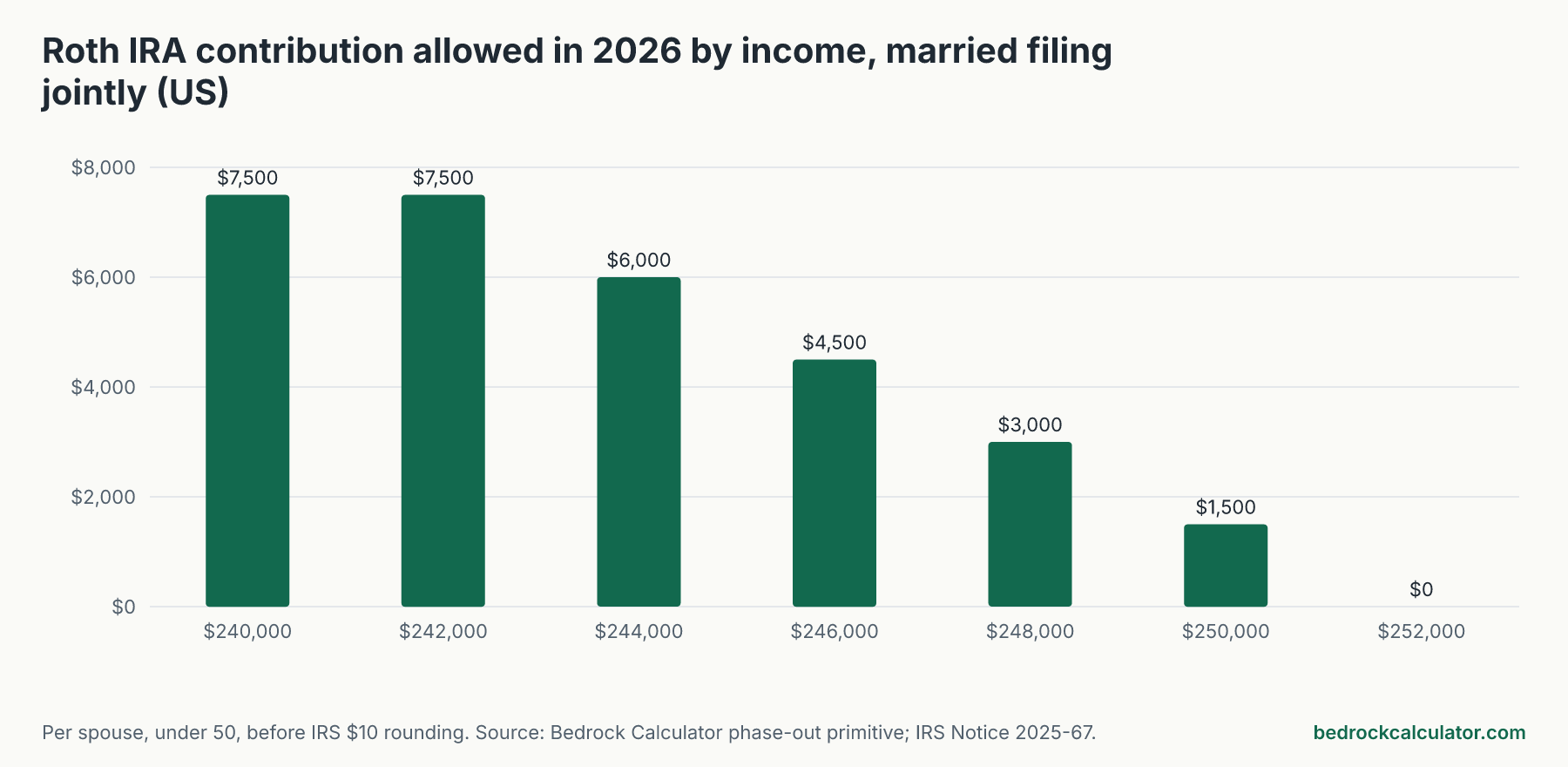
The married range is narrower, only $10,000 wide, so the limit falls faster: $750 for every $1,000 of income. Each spouse's limit is figured on the couple's joint modified AGI.
When a traditional IRA is still deductible
The deduction rules depend on who has a workplace plan, such as a 401(k), 403(b), SEP or SIMPLE IRA, or a government pension plan. Your W-2 shows if a workplace plan covers you: look for the Retirement plan box in box 13.
You're covered. A single filer deducts the full $7,500 with modified AGI under $81,000. At $85,000 the deduction is $4,500, and the other $3,000 becomes a nondeductible contribution you track on Form 8606. At $89,000 it's $1,500. Married couples filing jointly where you're the covered spouse use $129,000 to $149,000, so at $139,000 the deduction is $3,750.
Your spouse is covered and you aren't. Your deduction uses a much higher range, $242,000 to $252,000 of joint modified AGI. At $247,000 you'd deduct $3,750.
Neither of you is covered. There's no income limit on the deduction at all. A single filer with no workplace plan deducts the full $7,500 even at $300,000 of income.
What high earners do instead
If your income is above the Roth range, the usual route is a backdoor Roth: contribute to a traditional IRA without deducting it, then convert it to a Roth. Contributions and conversions have no income limit. The catch is the pro-rata rule. If you already hold pre-tax money in any traditional, SEP or SIMPLE IRA, part of the conversion is taxable. The backdoor Roth IRA calculator works through that math.
If you're near the bottom of a range, lowering your modified AGI can restore the full limit. Putting more into a pre-tax 401(k) is the most common way, since it reduces adjusted gross income dollar for dollar.
Mistakes worth avoiding
Contributing the full Roth amount, then earning more than expected. If a bonus pushes you into the phase-out, the excess contribution carries an excise tax for every year it stays in the account. You can withdraw it with its earnings before your filing deadline, or recharacterize it as a traditional IRA contribution.
Assuming your 401(k) kills the IRA deduction at any income. It only applies above $81,000 for a single filer, and a non-covered spouse has far more room.
Forgetting the age 50 catch-up. At 50 or older the limit is $8,600, which includes a $1,100 catch-up.
Run your own numbers
Use the traditional IRA deduction calculator with your modified AGI, filing status and plan coverage to see exactly how much you can deduct. The Roth IRA calculator shows what a full $7,500 a year could grow to, and the retirement calculator puts IRA saving in the context of your whole plan.