Which leaves you more at retirement, Roth or traditional?
For US savers, Roth or traditional comes down to one comparison: your federal tax rate when the money goes in against your tax rate when it comes out. If the rate is higher later, Roth wins. If it's lower later, traditional wins. If it's the same, they tie to the dollar.
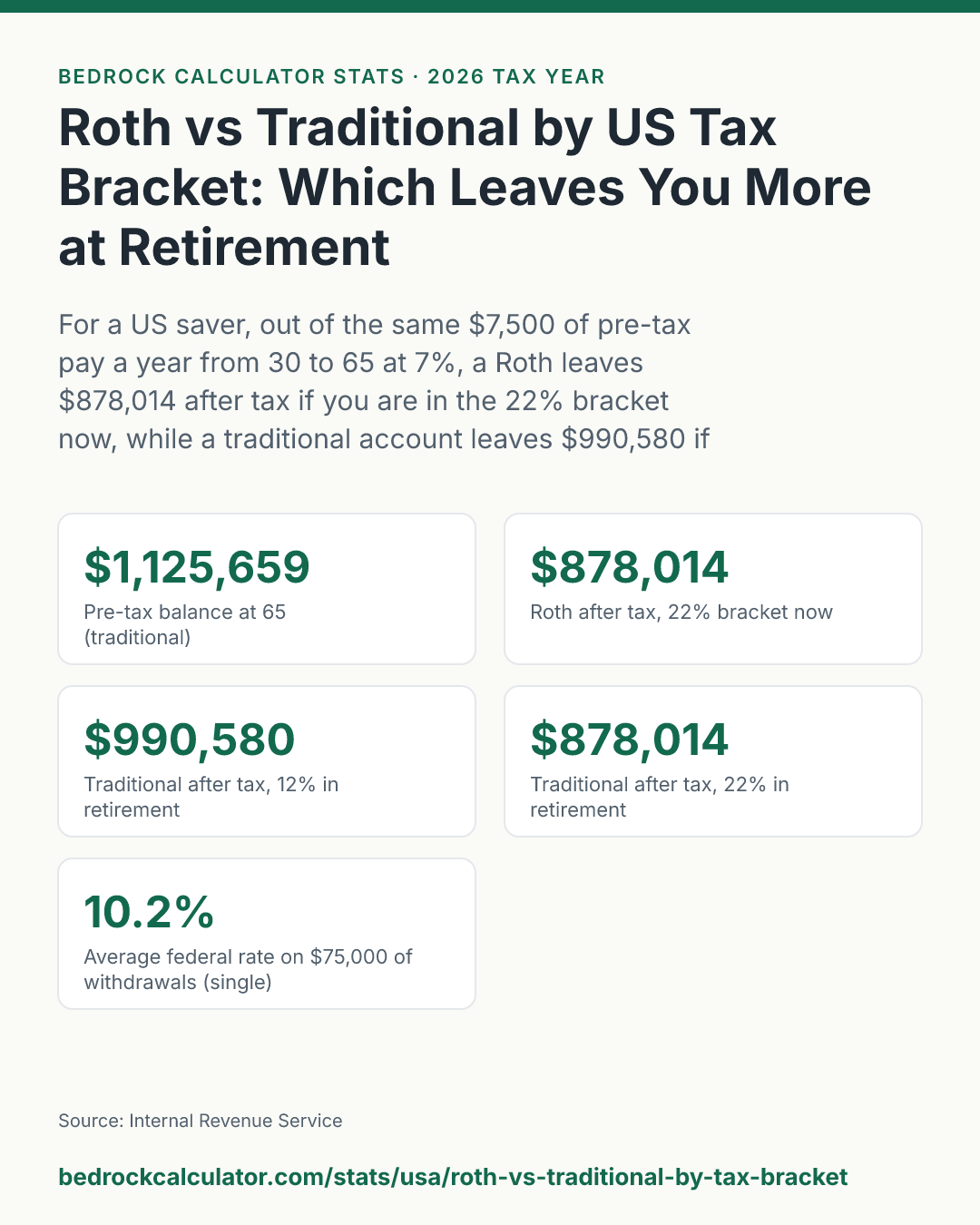
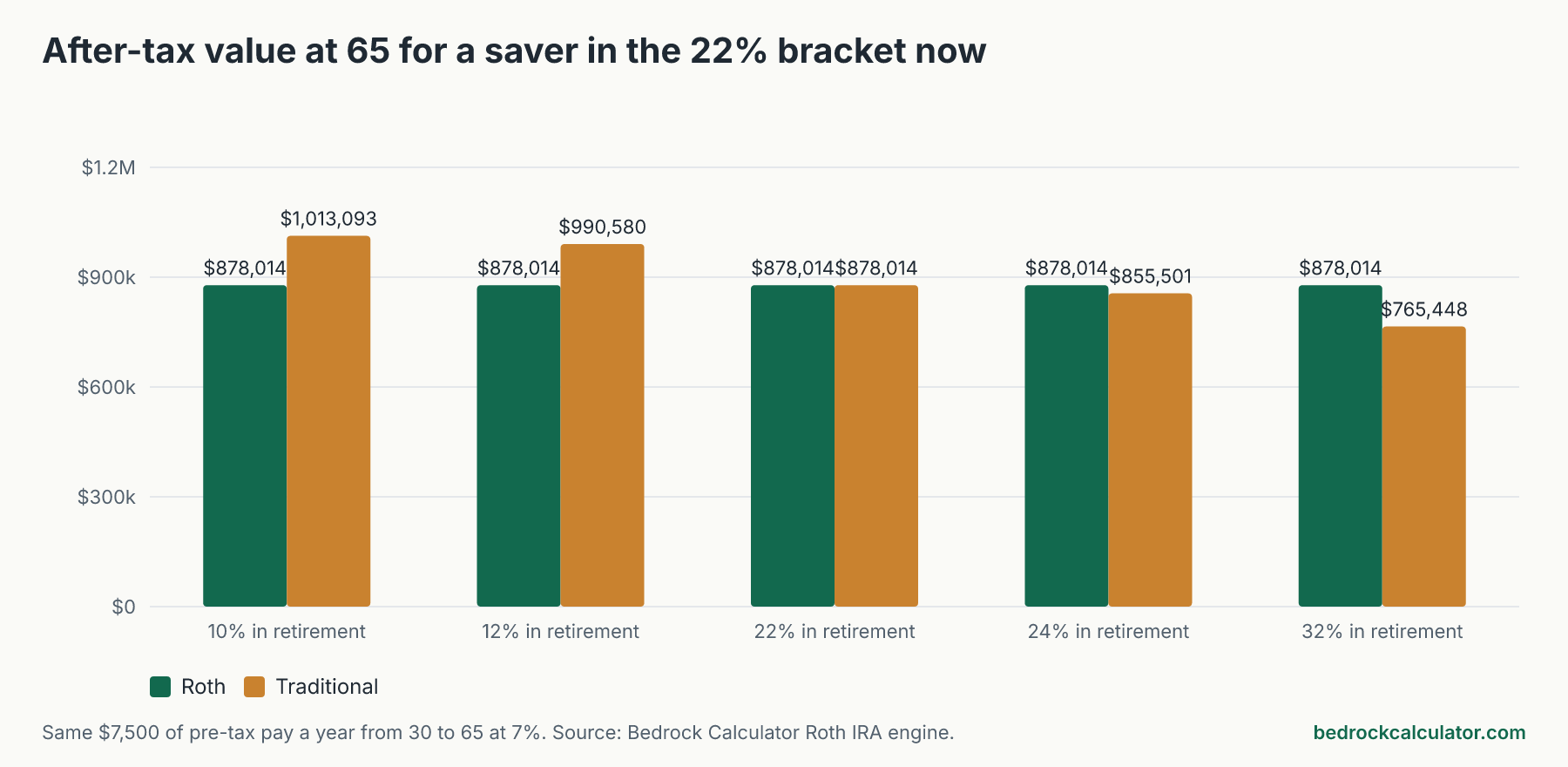
In our example, someone in the 22% bracket today who sets aside $7,500 of pre-tax pay a year from 30 to 65 ends up with $878,014 after tax in a Roth. The same money in a traditional account leaves $990,580 if they retire in the 12% bracket, but $855,501 if they retire in the 24% bracket.
How we worked out these numbers
All figures are for the United States and use US rules for 2026.
We ran the site's Roth IRA calculator for each case. To compare fairly, both accounts get the same slice of pre-tax pay, $7,500 a year:
- Traditional: the whole $7,500 goes in, because the contribution is deductible. The account grows, and every dollar is taxed at your retirement rate when you take it out. That's the calculator's after-tax traditional value.
- Roth: you pay tax on the $7,500 first, at today's bracket, and put in what's left. At 22% that's $5,850 a year. Then it grows and comes out tax-free.
Both accounts start empty at 30, get monthly deposits, earn 7% a year and stop at 65. Before any tax, the traditional account is worth $1,125,659 at 65.
The calculator applies one flat rate to the whole balance at retirement. It doesn't model state income tax, required minimum distributions, the income limits on Roth IRA contributions or on deducting a traditional IRA, or what you'd do with the tax you save upfront on a traditional contribution. It assumes you spend it. If you invest that tax saving instead, traditional looks somewhat better than shown.
Roth vs traditional at every pair of brackets
Each cell is the Roth's after-tax value minus the traditional account's. A positive number means the Roth leaves more. A negative number means traditional does.
Roth minus traditional, after tax at 65, by current and retirement bracket
Download CSVPositive means the Roth leaves more; negative means traditional leaves more. $7,500 of pre-tax pay a year from 30 to 65, 7% return, monthly deposits.
| 12% | -$22,513 | $0 | $112,566 | $135,079 | $225,132 |
| 22% | -$135,079 | -$112,566 | $0 | $22,513 | $112,566 |
| 24% | -$157,592 | -$135,079 | -$22,513 | $0 | $90,053 |
| 32% | -$247,645 | -$225,132 | -$112,566 | -$90,053 | $0 |
| 35% | -$281,415 | -$258,902 | -$146,336 | -$123,823 | -$33,770 |
Look along the diagonal: whenever the bracket now equals the bracket in retirement, the difference is $0. That's the math working exactly as it should. Paying 22% now or 22% later on the same pre-tax dollars gives the same result, because multiplication doesn't care about order.
Off the diagonal, the gaps get big. Dropping from 22% now to 12% in retirement makes traditional $112,566 better. Rising from 12% now to 22% later makes Roth $112,566 better. Even a two-point move, from 22% to 24%, is worth $22,513 over 35 years.
Should you do Roth if you're in the 12% bracket?
Usually, yes. The 12% bracket is about as low as federal tax gets for a working adult, and the odds of being lower in retirement are slim. From 12% now, the Roth ties if you stay at 12%, loses only if you drop to the bottom 10% bracket, and wins against every higher one.
If you end up at 24% in retirement, it's ahead by $135,079.
This is the case for Roth contributions early in a career, when pay is lower. You lock in today's low rate on money that may grow for 40 years.
When traditional wins
Traditional is the better bet when you're in a high bracket now and expect a lower one later. A saver in the 32% bracket who retires in the 22% bracket keeps $112,566 more with traditional. At 32% now and 24% later, traditional is ahead by $90,053.
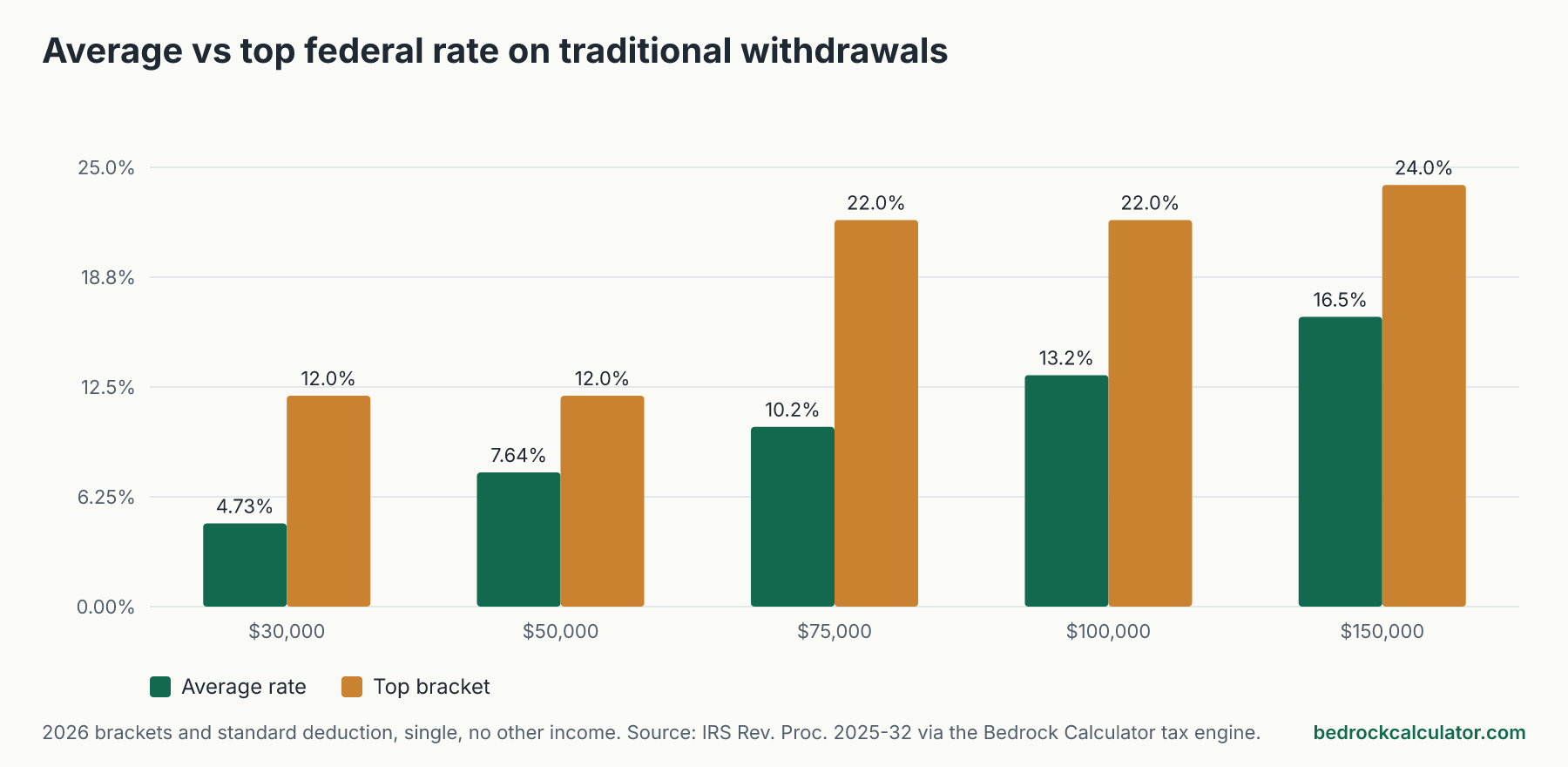
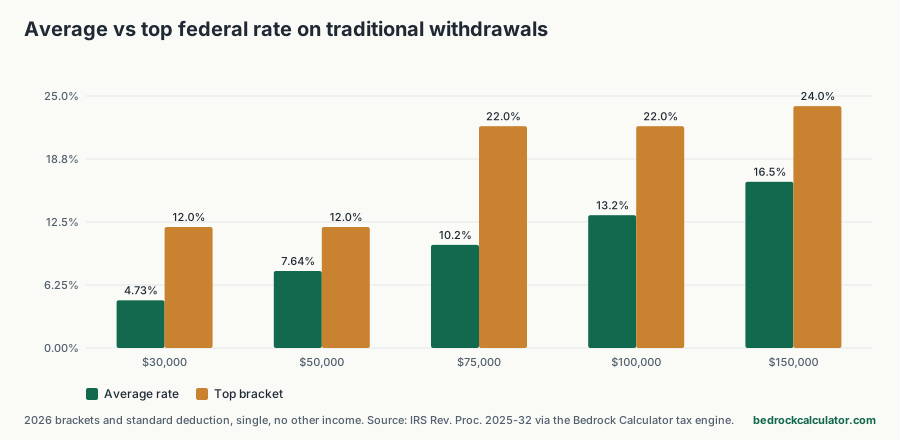
There's a second reason traditional often does better than people expect. Your bracket in retirement isn't the rate on every dollar you take out. Withdrawals fill the brackets from the bottom, after the standard deduction, so the average rate is lower than the top bracket you reach.
Average vs top federal rate on a year of traditional withdrawals (2026, single)
Download CSV2026 federal brackets and standard deduction, single filer, no other income. Ignores the extra deduction for people 65 and over and the tax on Social Security.
| $30,000 | $1,420 | 4.7% | 12.0% |
| $50,000 | $3,820 | 7.6% | 12.0% |
| $75,000 | $7,670 | 10.2% | 22.0% |
| $100,000 | $13,170 | 13.2% | 22.0% |
| $150,000 | $24,734 | 16.5% | 24.0% |
A single retiree taking $75,000 a year from a traditional account, with no other income, reaches the 22.0% bracket but pays an average of 10.2% in 2026 federal tax. On $50,000 the average is 7.6%. The $16,100 standard deduction alone shelters the first slice entirely.
So which rate should you compare? If traditional withdrawals are your only income, the average rate is a fair guide. But if Social Security, a pension or part-time work already fills the lower brackets, your withdrawals land on top and are taxed nearer your top rate. Our guide to marginal vs effective tax rates explains the difference in more detail, and the 2026 federal tax brackets guide lists every threshold.
What the matrix doesn't capture
A few real-world details can tip a close call:
- Contribution limits. The 2026 IRA limit is $7,500, and it applies to the amount you put in. A Roth dollar is worth more than a traditional dollar, so maxing out a Roth shelters more money than maxing out a traditional account.
- Deductibility. If you or your spouse are covered by a workplace plan, your traditional IRA deduction phases out above certain incomes. Without the deduction, traditional loses its main advantage. The traditional IRA deduction calculator checks where you stand.
- Required minimum distributions. Traditional accounts force withdrawals later in life, which can push you into a higher bracket. Roth IRAs don't have them for the original owner.
- Flexibility. Having both kinds of account lets you choose each year which to draw from, to manage your bracket. Many people split contributions for that reason.
- Conversions. You can move money from traditional to Roth later and pay the tax then, in a low-income year. The Roth conversion ladder calculator shows how that works for early retirees.
Getting your own answer
Work out your marginal bracket today with the federal income tax calculator. Then make an honest guess about your income in retirement, including Social Security and any pension, and see which bracket that falls in. If retirement looks lower, lean traditional. If it looks the same or higher, or you genuinely can't tell, Roth or a mix of both is a reasonable hedge.