How accurate is the Rule of 72?
The Rule of 72 is a quick way to estimate how long it takes money to double: divide 72 by the annual return. It's one of the first things many US savers learn about compound interest, and it holds up well.
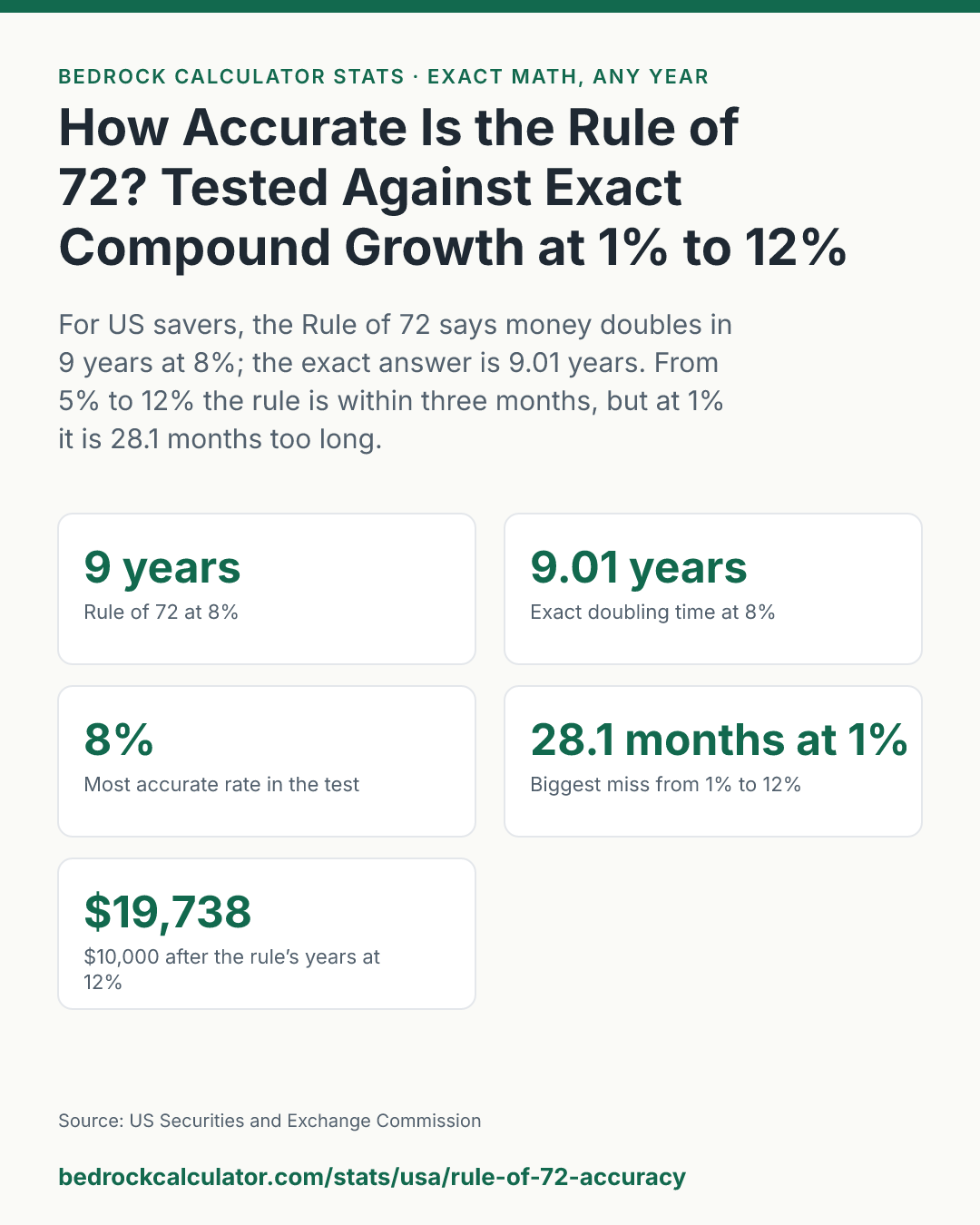
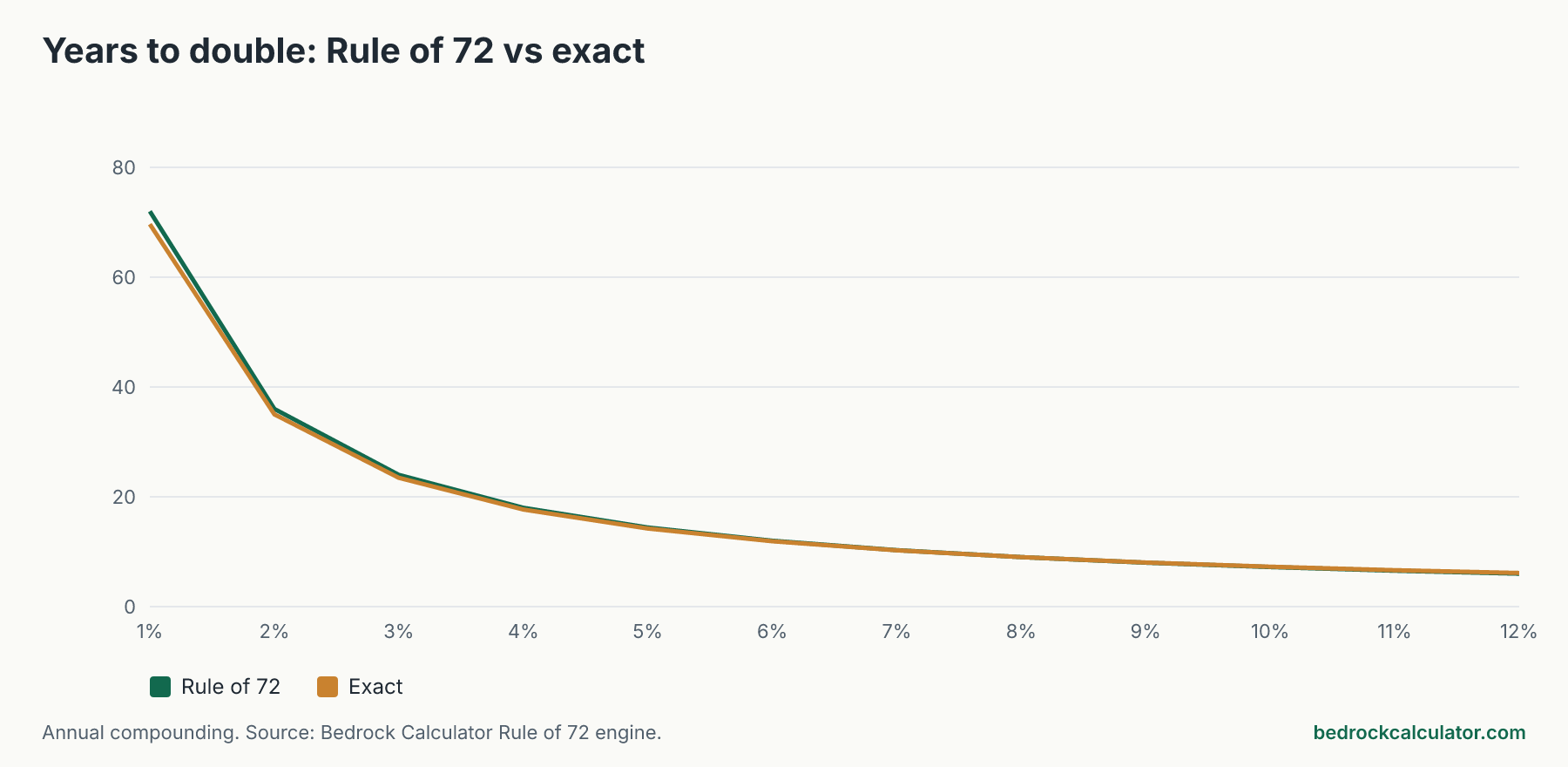
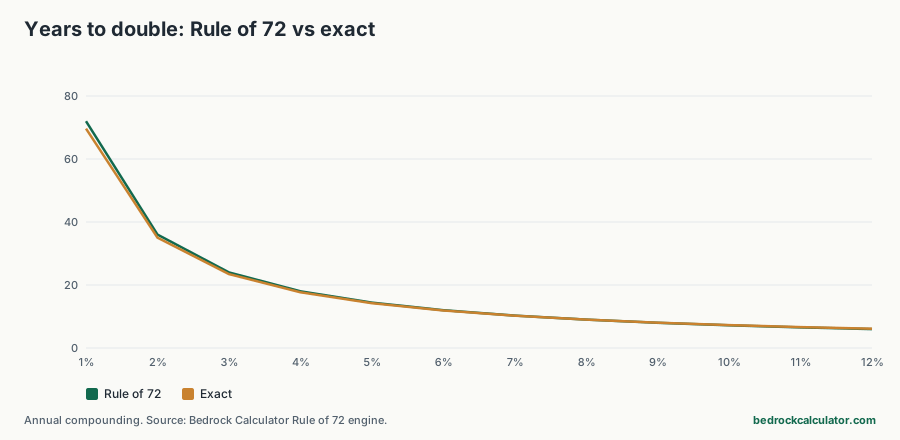
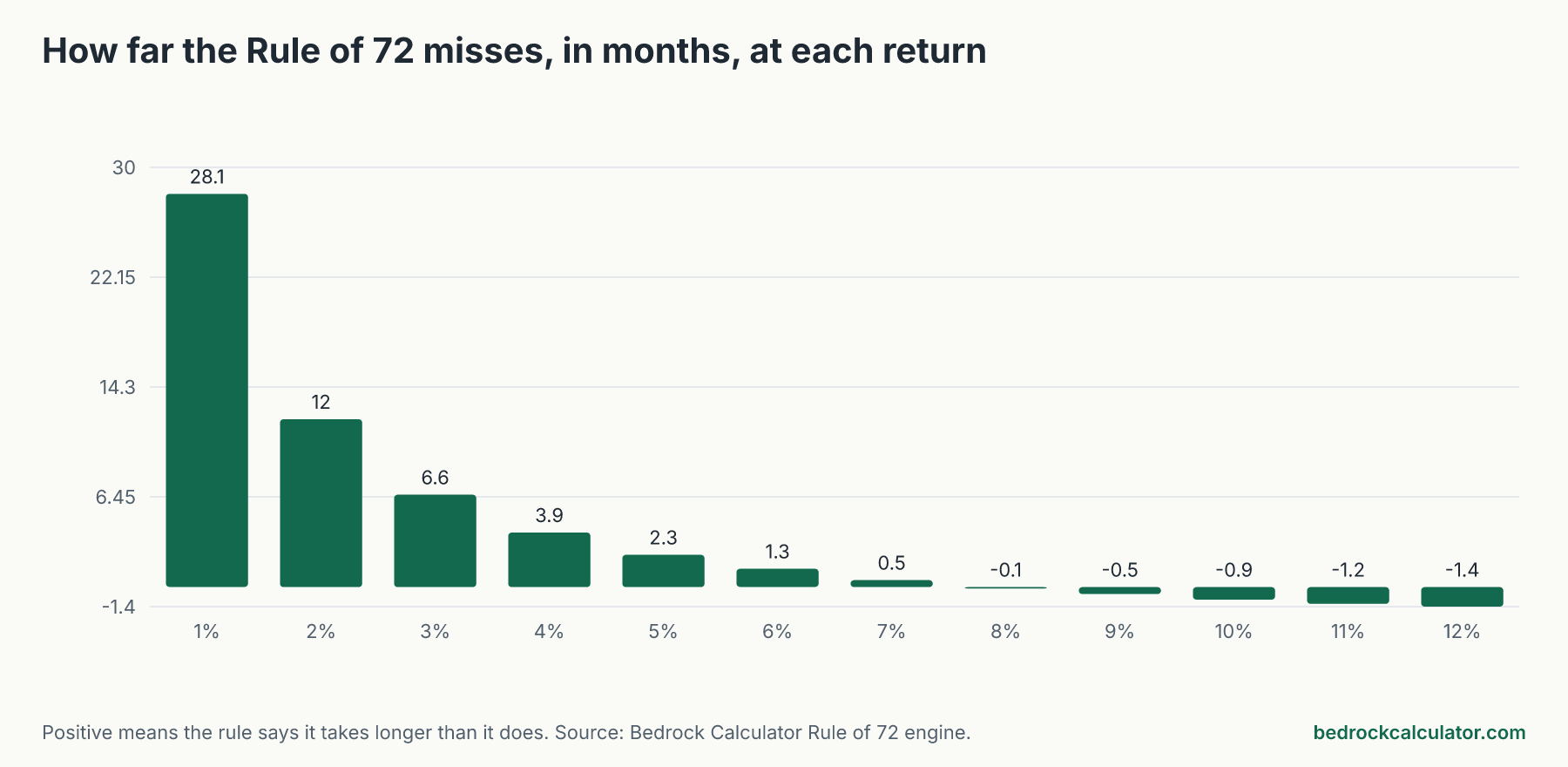
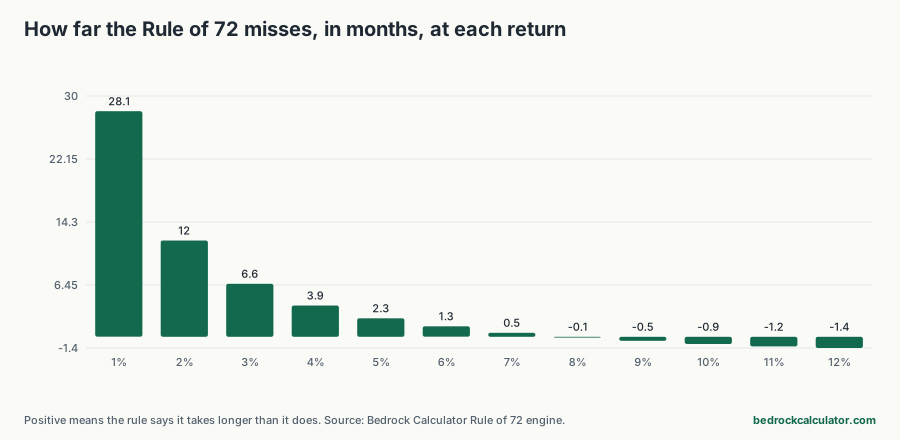
At 8% a year, the rule says 9 years. The exact answer with annual compounding is 9.01 years. From 5% to 12% a year, the rule lands within three months of the true doubling time. It only drifts at very low returns: at 1% it says 72 years when the real answer is 69.66, about 28.1 months too long.
How we tested it
We ran the site's Rule of 72 calculator at every whole-number return from 1% to 12%. For each one it reports three figures:
- The Rule of 72: 72 divided by the rate
- The Rule of 69.3: 69.3 divided by the rate, a variant sometimes recommended for accuracy
- The exact doubling time: the number of years at which (1 + r) raised to that power equals 2, which works out to ln(2) divided by ln(1 + r)
All three assume the return compounds once a year at a steady rate. Then, to show what the rule's error means in dollars, we grew $10,000 for the rule's estimated number of years at the same rate. If the rule were perfect, you'd have exactly $20,000.
Everything here is pure arithmetic, so it applies to any account, in the US or anywhere else. What it leaves out is everything real investing adds: taxes, fees, and returns that change from year to year.
Rule of 72 vs exact doubling time, 1% to 12%
Rule of 72 vs exact doubling time, 1% to 12% a year
Download CSVAnnual compounding. Exact time is ln(2) / ln(1 + r). Error is the Rule of 72 minus the exact time; positive means the rule overstates it.
| 1% | 72 | 69.3 | 69.66 | 28.1 | $20,471 |
| 10% | 7.2 | 6.93 | 7.27 | -0.9 | $19,862 |
| 11% | 6.55 | 6.3 | 6.64 | -1.2 | $19,800 |
| 12% | 6 | 5.78 | 6.12 | -1.4 | $19,738 |
| 2% | 36 | 34.65 | 35 | 12 | $20,399 |
| 3% | 24 | 23.1 | 23.45 | 6.6 | $20,328 |
| 4% | 18 | 17.33 | 17.67 | 3.9 | $20,258 |
| 5% | 14.4 | 13.86 | 14.21 | 2.3 | $20,190 |
| 6% | 12 | 11.55 | 11.9 | 1.3 | $20,122 |
| 7% | 10.29 | 9.9 | 10.24 | 0.5 | $20,055 |
| 8% | 9 | 8.66 | 9.01 | -0.1 | $19,990 |
| 9% | 8 | 7.7 | 8.04 | -0.5 | $19,926 |
The error column is the rule minus the exact answer, in months. A positive number means the rule says doubling takes longer than it does. A negative one means it's too optimistic.
Where the Rule of 72 is most accurate
The rule is almost perfect at 8%, where it misses by 0.1 months. That's no accident. The number 72 was chosen because it fits the returns people most often deal with, and it's the sweet spot for annual compounding.
Below that, the rule runs long. At 4% it says 18 years against an exact 17.67. At 6% it says 12 against 11.9. These misses are small enough to ignore for planning.
Above it, the rule runs a little short. At 12% it says 6 years and the real answer is 6.12, a gap of 1.4 months.
What the error means in dollars
Grow $10,000 for the number of years the rule gives you, and here's what you'd actually have:
- At 1%: $20,471, because the rule overshoots and you get extra time
- At 8%: $19,990, almost exactly double
- At 12%: $19,738, slightly short of double
So even at its worst in the typical range, the rule is off by a few hundred dollars on $10,000. For a back-of-the-envelope estimate, that's plenty.
Rule of 72 vs Rule of 69.3
The Rule of 69.3 comes from continuous compounding, where the exact doubling constant is the natural log of 2, about 0.693. It's the better rule at very low rates: at 1% it gives 69.3 years against an exact 69.66.
But most savings and investment returns are quoted with annual compounding, and at ordinary rates 72 does better. At 8%, the Rule of 69.3 says 8.66 years against the true 9.01, while the Rule of 72 says 9. At 12% it says 5.78.
There's a practical reason too. 72 divides evenly by 2, 3, 4, 6, 8, 9 and 12, so the mental math is easy.
Using the Rule of 72 for inflation and debt
The same math works for anything that compounds:
- Inflation. At 4% inflation, prices double in about 18 years. That means a dollar loses half its buying power over the same stretch.
- Debt. A balance that isn't paid down doubles at the same pace as an investment at the same rate. At high credit card rates, that happens fast.
- Fees. A yearly fee works in reverse, shrinking the rate your money compounds at, which pushes the doubling date out.
When to use something more precise
The rule assumes one steady rate. Real portfolios swing from year to year, and two investments with the same average return can end up in different places. And if you're adding money regularly, as most people do with a 401(k) or IRA, doubling time isn't really the right question.
For that, use the compound interest calculator, which handles monthly contributions and inflation. If you're planning for retirement, the 401(k) calculator and the retirement calculator put the same compounding to work with your actual savings.