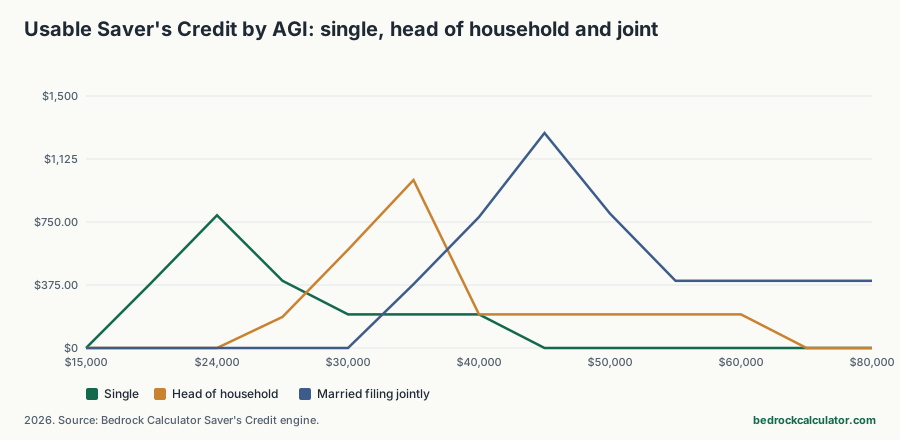
How much Saver's Credit can you actually use at each income?
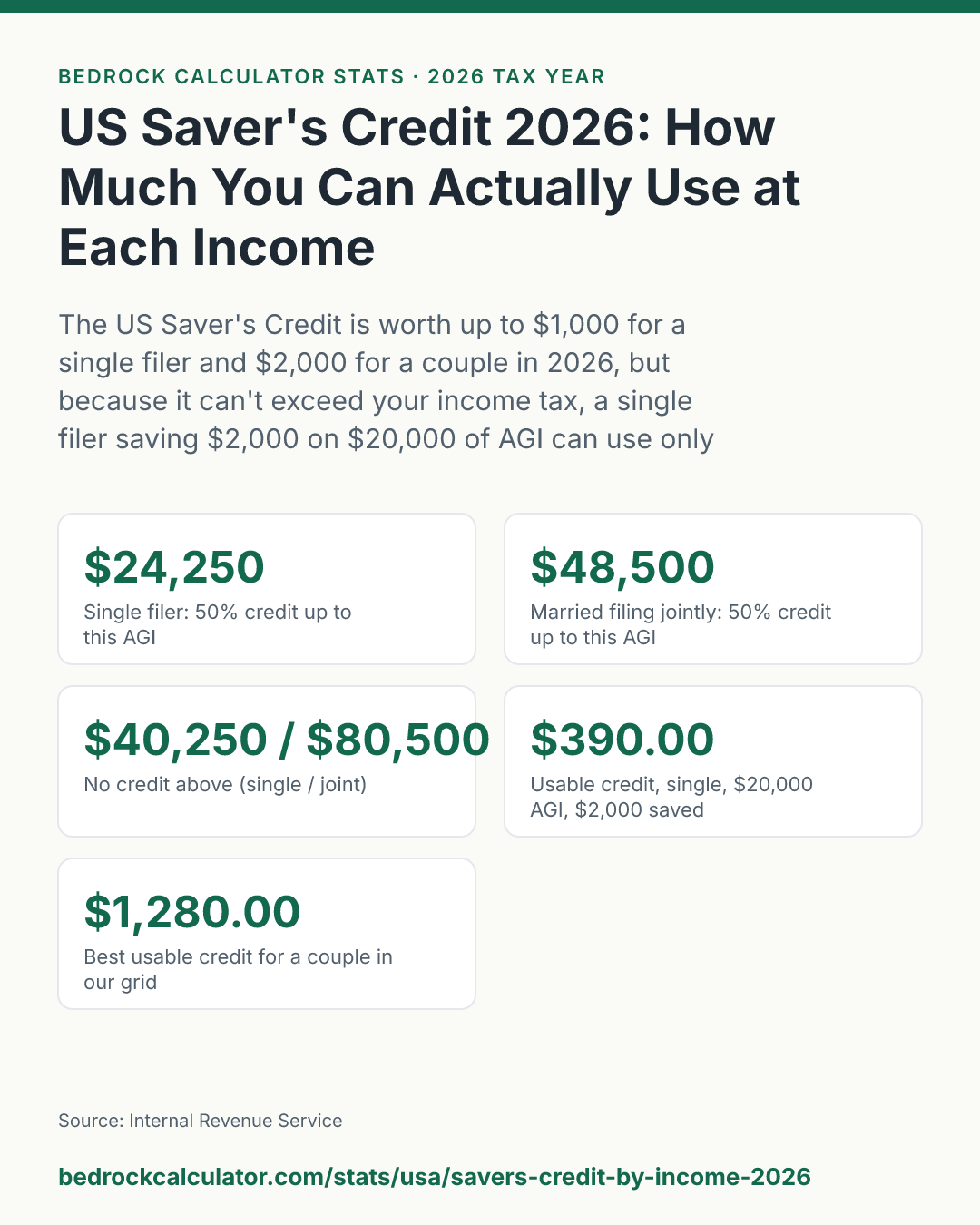
The US Saver's Credit pays you back part of what you put into a retirement account, worth up to $1,000.00 for a single filer and $2,000.00 for a married couple in tax year 2026. For a single filer the full 50% rate applies up to $24,250 of AGI, and the credit disappears above $40,250.
For a couple filing jointly the same edges are $48,500 and $80,500.
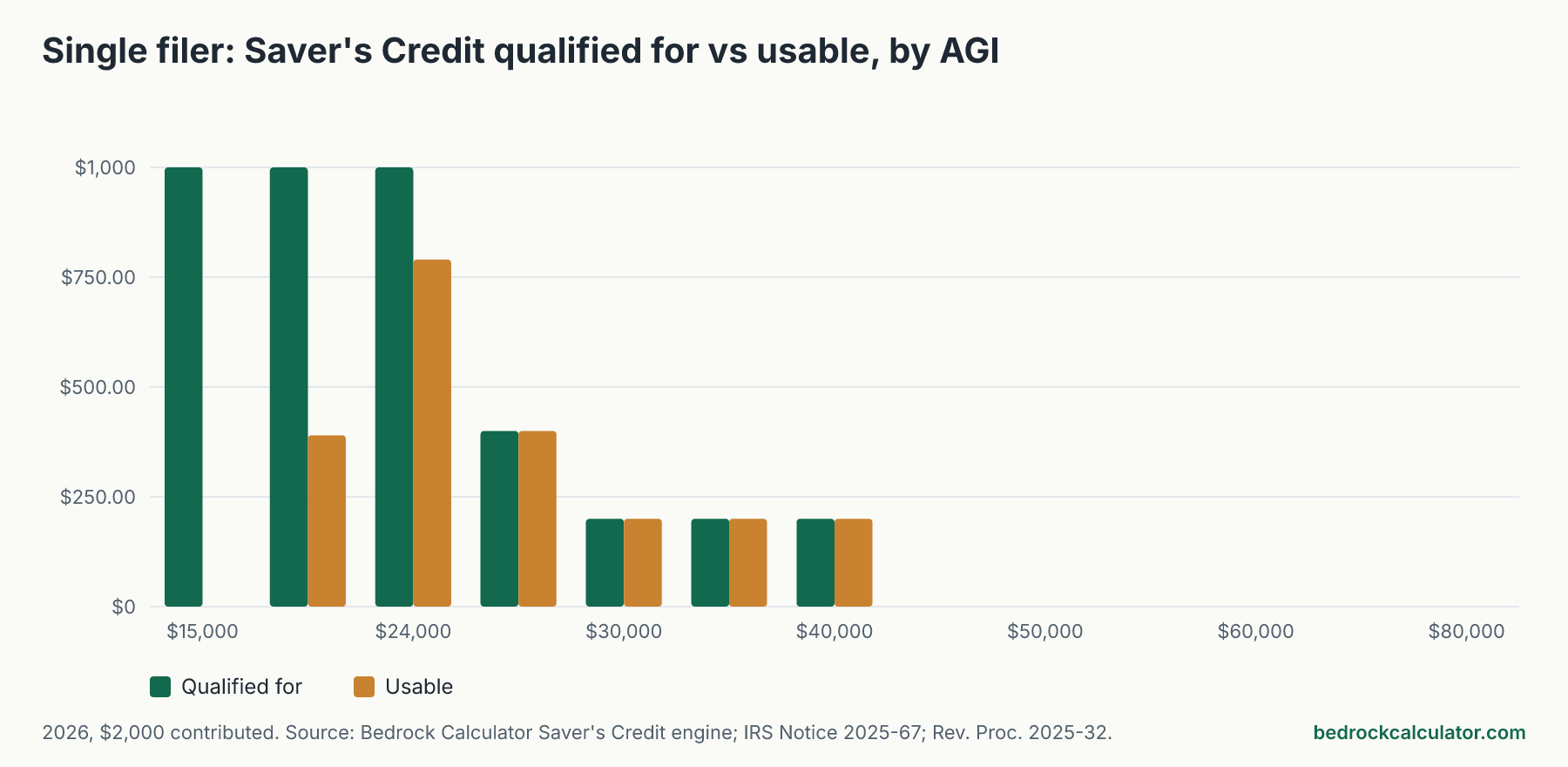
The catch is that it's non-refundable. It can only cut your income tax to zero, and the people who qualify for the biggest credit often owe little tax. A single filer who saves $2,000 on $20,000 of AGI qualifies for $1,000.00 but can use only $390.00.
The 2026 income limits
The IRS sets three AGI bands each year. Your band decides the rate, and the rate applies to the first $2,000 each person contributes.
- Single and married filing separately: 50% up to $24,250, 20% up to $26,250, 10% up to $40,250.
- Head of household: 50% up to $36,375, 20% up to $39,375, 10% up to $60,375.
- Married filing jointly: 50% up to $48,500, 20% up to $52,500, 10% up to $80,500.
Contributions to a traditional or Roth IRA, a 401(k), 403(b) or 457(b), and similar workplace plans count. On a joint return each spouse's contributions are capped at $2,000 separately, which is how a couple reaches $2,000.00.
How much you can actually use at each income
Sort by any column. "Credit qualified for" is the rate times your contributions. "Credit you can use" is the smaller of that and your federal income tax.
Saver's Credit by AGI and filing status, US tax year 2026
Download CSV$2,000 contributed per person (both spouses on a joint return), no retirement distributions. Tax is federal income tax after the standard deduction, before credits.
| $15,000 | Single | 50% | $1,000.00 | $0.00 | $0.00 | $1,000.00 |
| $15,000 | Head of household | 50% | $1,000.00 | $0.00 | $0.00 | $1,000.00 |
| $15,000 | Married filing jointly | 50% | $2,000.00 | $0.00 | $0.00 | $2,000.00 |
| $20,000 | Single | 50% | $1,000.00 | $390.00 | $390.00 | $610.00 |
| $20,000 | Head of household | 50% | $1,000.00 | $0.00 | $0.00 | $1,000.00 |
| $20,000 | Married filing jointly | 50% | $2,000.00 | $0.00 | $0.00 | $2,000.00 |
| $24,000 | Single | 50% | $1,000.00 | $790.00 | $790.00 | $210.00 |
| $24,000 | Head of household | 50% | $1,000.00 | $0.00 | $0.00 | $1,000.00 |
| $24,000 | Married filing jointly | 50% | $2,000.00 | $0.00 | $0.00 | $2,000.00 |
| $26,000 | Single | 20% | $400.00 | $990.00 | $400.00 | $0.00 |
| $26,000 | Head of household | 50% | $1,000.00 | $185.00 | $185.00 | $815.00 |
| $26,000 | Married filing jointly | 50% | $2,000.00 | $0.00 | $0.00 | $2,000.00 |
| $30,000 | Single | 10% | $200.00 | $1,420.00 | $200.00 | $0.00 |
| $30,000 | Head of household | 50% | $1,000.00 | $585.00 | $585.00 | $415.00 |
| $30,000 | Married filing jointly | 50% | $2,000.00 | $0.00 | $0.00 | $2,000.00 |
| $36,000 | Single | 10% | $200.00 | $2,140.00 | $200.00 | $0.00 |
| $36,000 | Head of household | 50% | $1,000.00 | $1,185.00 | $1,000.00 | $0.00 |
| $36,000 | Married filing jointly | 50% | $2,000.00 | $380.00 | $380.00 | $1,620.00 |
| $40,000 | Single | 10% | $200.00 | $2,620.00 | $200.00 | $0.00 |
| $40,000 | Head of household | 10% | $200.00 | $1,585.00 | $200.00 | $0.00 |
| $40,000 | Married filing jointly | 50% | $2,000.00 | $780.00 | $780.00 | $1,220.00 |
| $45,000 | Single | 0% | $0.00 | $3,220.00 | $0.00 | $0.00 |
| $45,000 | Head of household | 10% | $200.00 | $2,148.00 | $200.00 | $0.00 |
| $45,000 | Married filing jointly | 50% | $2,000.00 | $1,280.00 | $1,280.00 | $720.00 |
| $50,000 | Single | 0% | $0.00 | $3,820.00 | $0.00 | $0.00 |
| $50,000 | Head of household | 10% | $200.00 | $2,748.00 | $200.00 | $0.00 |
| $50,000 | Married filing jointly | 20% | $800.00 | $1,780.00 | $800.00 | $0.00 |
| $55,000 | Single | 0% | $0.00 | $4,420.00 | $0.00 | $0.00 |
| $55,000 | Head of household | 10% | $200.00 | $3,348.00 | $200.00 | $0.00 |
| $55,000 | Married filing jointly | 10% | $400.00 | $2,280.00 | $400.00 | $0.00 |
| $60,000 | Single | 0% | $0.00 | $5,020.00 | $0.00 | $0.00 |
| $60,000 | Head of household | 10% | $200.00 | $3,948.00 | $200.00 | $0.00 |
| $60,000 | Married filing jointly | 10% | $400.00 | $2,840.00 | $400.00 | $0.00 |
| $70,000 | Single | 0% | $0.00 | $6,570.00 | $0.00 | $0.00 |
| $70,000 | Head of household | 0% | $0.00 | $5,148.00 | $0.00 | $0.00 |
| $70,000 | Married filing jointly | 10% | $400.00 | $4,040.00 | $400.00 | $0.00 |
| $80,000 | Single | 0% | $0.00 | $8,770.00 | $0.00 | $0.00 |
| $80,000 | Head of household | 0% | $0.00 | $6,348.00 | $0.00 | $0.00 |
| $80,000 | Married filing jointly | 10% | $400.00 | $5,240.00 | $400.00 | $0.00 |
Notice the pattern. At the lowest incomes the standard deduction ($16,100 for a single filer, $24,150 for a head of household, $32,200 for a couple) wipes out most or all of the tax, so most of the credit is lost. In our grid, 9 of the combinations qualify for a credit and can use none of it.
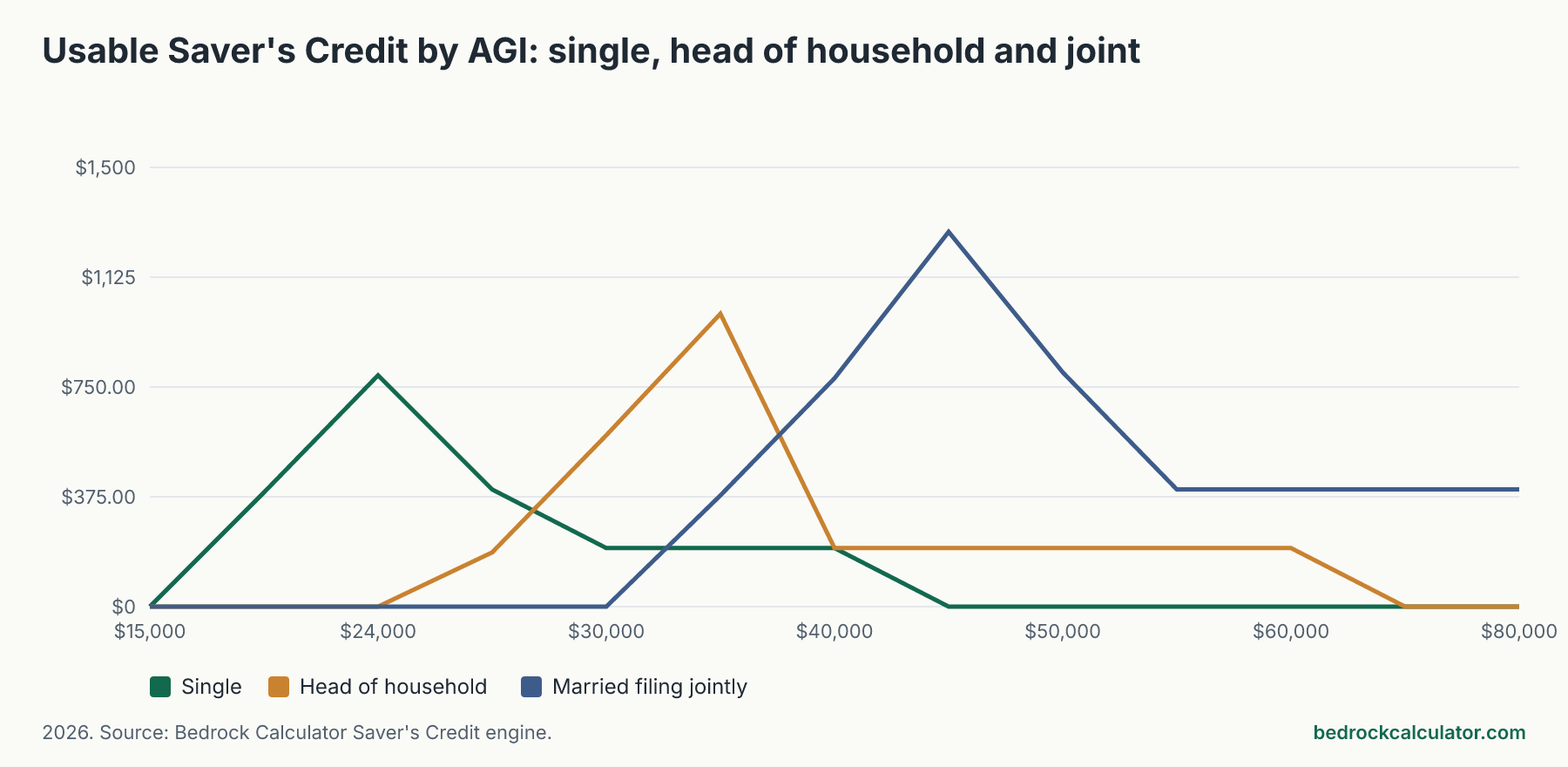
As income rises, tax rises and more of the credit becomes usable, right up until the rate drops. That's why the usable credit peaks in the middle. A single filer in our grid does best at $24,000 of AGI, using $790.00. A married couple does best at $45,000, using $1,280.00.
The band edges are cliffs
The Saver's Credit doesn't phase out smoothly. One dollar over a band edge and the rate drops for your whole contribution. A married couple who each save $2,000 can use $1,630.00 at exactly $48,500 of AGI and $800.00 one dollar higher, losing $830.00. A single filer at exactly $24,250 can use $815.00, and $400.00 one dollar over.
The fix is often the contribution itself. Money you put into a traditional 401(k) or 403(b) through payroll comes out of your AGI, and a deductible traditional IRA contribution lowers it too. If you're just above an edge, saving a little more can drop you into the higher band and raise the credit. Roth contributions count for the credit but don't lower AGI.
Who gets the most from it
The credit works best for people with enough income to owe some tax but not so much that the rate falls. Looking at the table:
- Single filers between about $26,250 and $40,250 of AGI get the 10% rate, and their tax is high enough to use all of it.
- Heads of household do best near the top of the 50% band. At $36,000 of AGI the whole $1,000.00 is usable. Lower down it shrinks fast: at $30,000 only $585.00 of the $1,000.00 credit can be used, and at $20,000 none of it. Between $39,375 and $60,375 the 10% rate applies and all of it is usable.
- Couples in the 50% band can use more of it as AGI climbs toward $48,500, because their tax is rising.
If your tax is zero, the credit is worth nothing to you this year. It's still worth saving, but the credit isn't the reason. A couple on $20,000 of AGI, for example, qualifies for $2,000.00 and can use none of it, because their tax before credits is $0.00. If your income is likely to rise next year, the same contribution then could be worth far more.
How we worked out these numbers
We ran the Saver's Credit calculator at thirteen AGIs from $15,000 to $80,000 for single, head of household and joint filers. Each person contributed $2,000, both spouses on a joint return, with no retirement withdrawals. The calculator uses the 2026 AGI limits from IRS Notice 2025-67 and works out the income tax that caps the credit from AGI, the 2026 standard deduction and the 2026 brackets.
What the calculator leaves out:
- Eligibility tests. You must be 18 or older, not a full-time student and not claimed as someone else's dependent. The calculator doesn't check.
- Withdrawals. Retirement distributions you took in the two prior years, this year, or before your return is due reduce the contributions that count. We set them to zero.
- Other credits. Some other non-refundable credits are applied before this one and can use up the tax first. Refundable credits like the EITC aren't considered.
- Itemized deductions. The standard deduction is always used.
Run your own numbers
Enter your AGI, filing status, contributions and any withdrawals in the Saver's Credit calculator to see your credit and how much of it you can use. The federal income tax calculator shows the tax the credit has to offset. If you're deciding where to save, the 401(k) calculator and the Roth IRA calculator show what the contributions grow to.