How much do high-yield savings and CDs earn after tax?
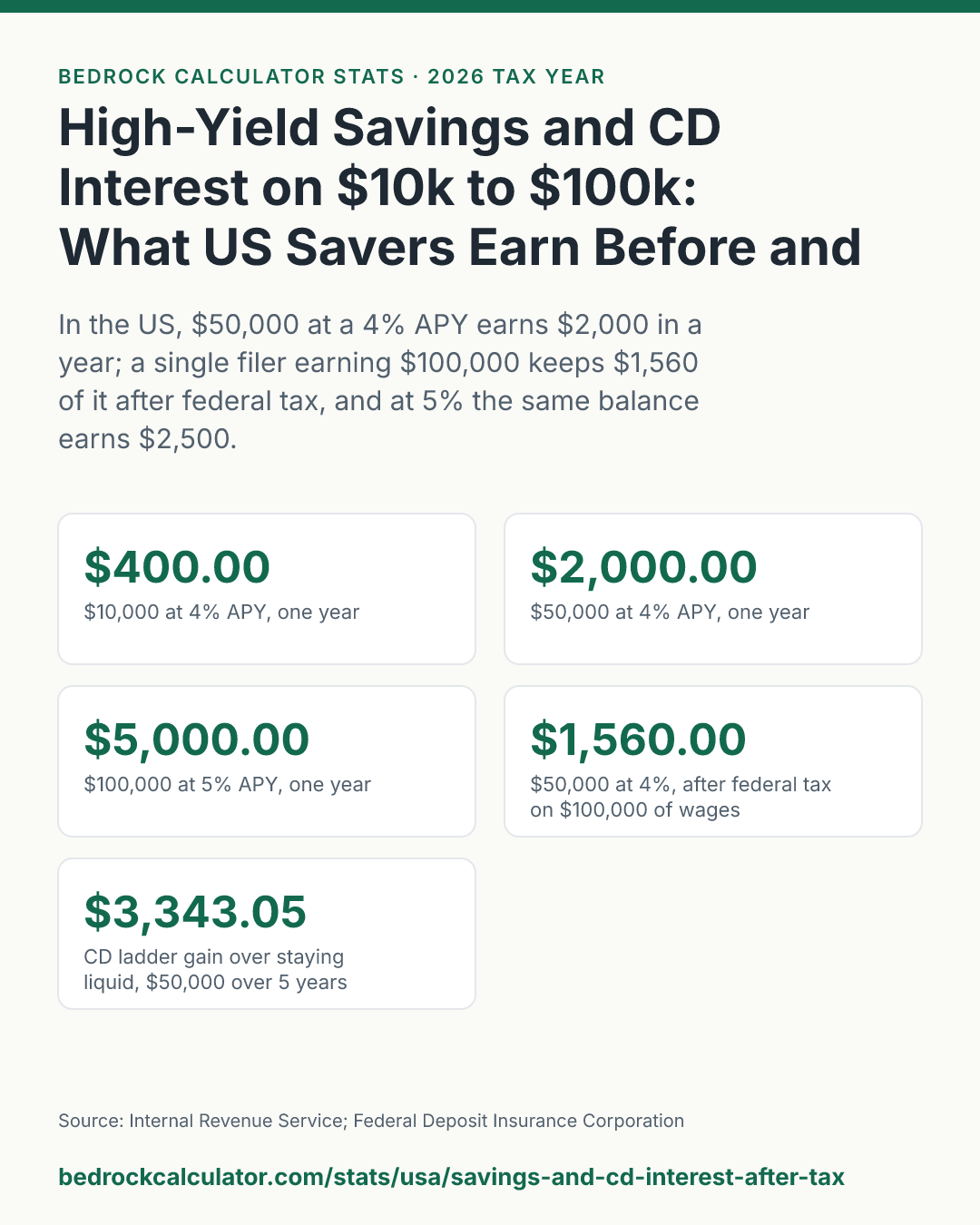
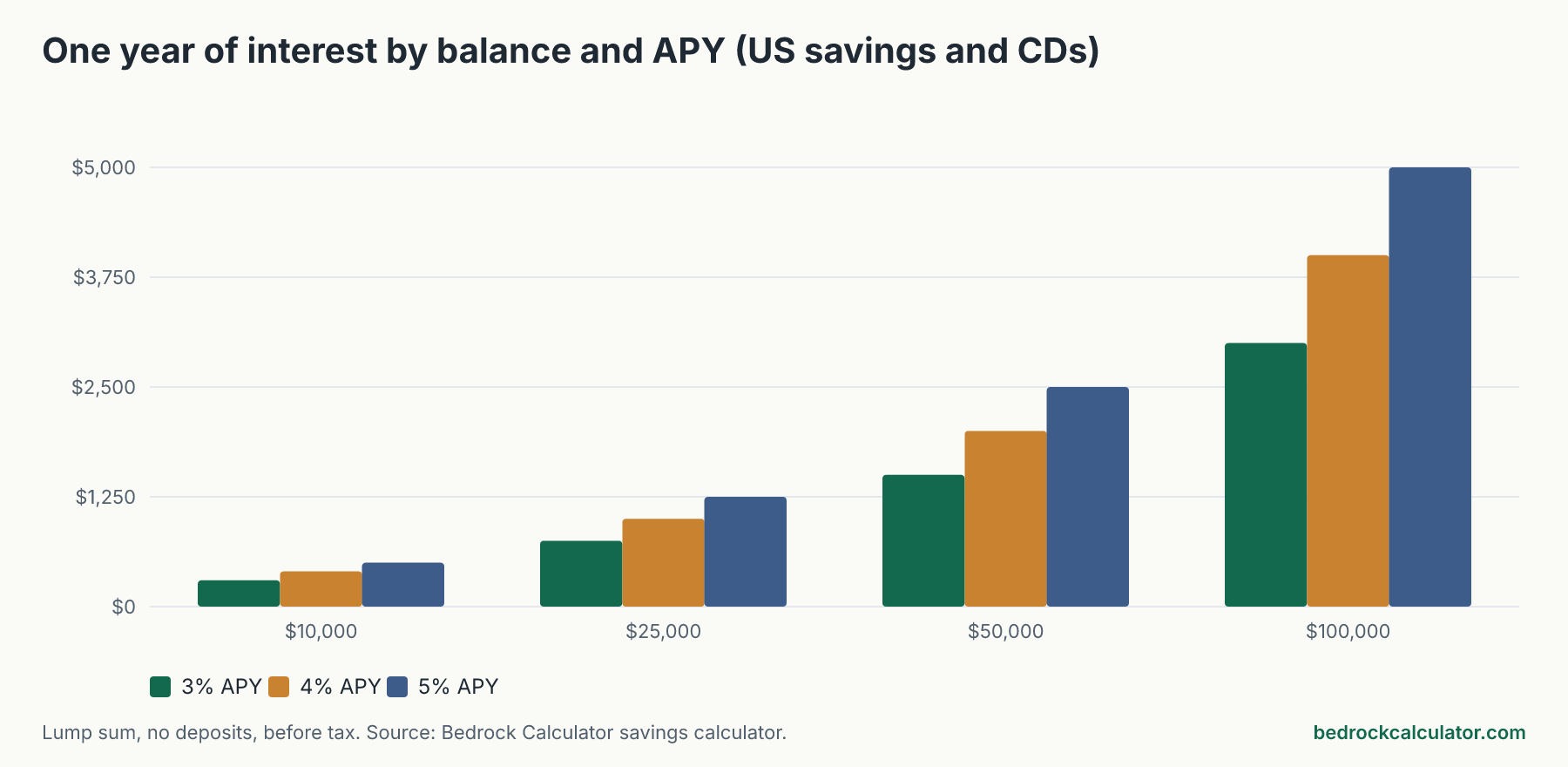
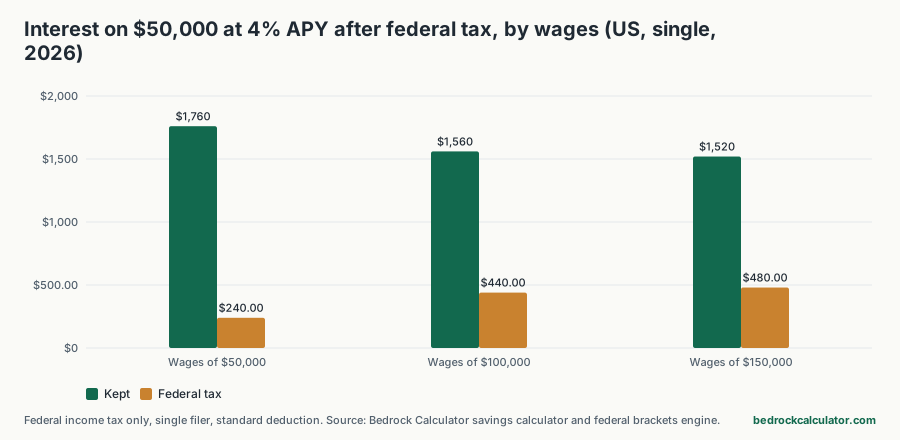
Put $50,000 in a US high-yield savings account or CD paying a 4% APY and you'll earn $2,000.00 in a year. If you're a single filer earning $100,000, federal income tax takes $440.00 of that, so you keep $1,560.00. At a 5% APY the same balance earns $2,500.00; at 3% it's $1,500.00.
On a smaller balance the numbers are smaller but the shape is the same. $10,000 at 4% earns $400.00 a year, and after federal tax at $100,000 of wages you keep $312.00.
How we worked out these numbers
The interest figures come from the site's savings calculator. We entered each balance as a lump sum with no further deposits, chose an APY, and ran it for one year. The calculator converts the advertised APY to the matching monthly rate before compounding, so one year at a 4% APY earns exactly 4% of the balance. That's the point of an APY: it already includes compounding.
The APYs of 3%, 4% and 5% are examples, not today's rates. Savings account rates can change at any time, and CD rates vary by bank and term. Plug in the rate you're actually offered.
For the after-tax figures, we used the 2026 federal tax brackets and standard deduction for a single filer. We worked out the federal tax on wages alone, then on wages plus the year's interest, and took the difference. That's the extra tax the interest causes, at your top rate.
What's not included:
- State income tax. Most states tax bank interest too, which would lower the after-tax figures further. A few states have no income tax at all.
- The net investment income tax. Higher earners can owe an extra federal tax on interest. Our examples stop at $150,000 of wages, where it doesn't apply, but it can at higher incomes.
- Deposits during the year, fees and rate changes. The calculator holds the rate steady for the whole year.
Interest and after-tax interest by balance
One year of interest on savings in the US, before and after federal tax (2026, single filer)
Download CSVLump sum, no deposits. "After tax" uses a 4% APY and federal income tax only, for a single filer whose wages are shown. No state tax.
| $10,000 | $300.00 | $400.00 | $500.00 | $352.00 | $312.00 | $304.00 |
| $25,000 | $750.00 | $1,000.00 | $1,250.00 | $880.00 | $780.00 | $760.00 |
| $50,000 | $1,500.00 | $2,000.00 | $2,500.00 | $1,760.00 | $1,560.00 | $1,520.00 |
| $100,000 | $3,000.00 | $4,000.00 | $5,000.00 | $3,520.00 | $3,120.00 | $3,040.00 |
Interest scales directly with the balance and the rate. On $10,000, each extra point of APY adds $100.00 to a year's earnings. On $100,000 the same step is the gap between $4,000.00 and $5,000.00.
Over several years the interest compounds. $25,000 left at 4% for five years earns $5,416.32 in total, and $100,000 earns $21,665.29, before tax. Tax is due each year as the interest is credited, so the after-tax total over five years would be lower than these numbers.
How much federal tax takes from your interest
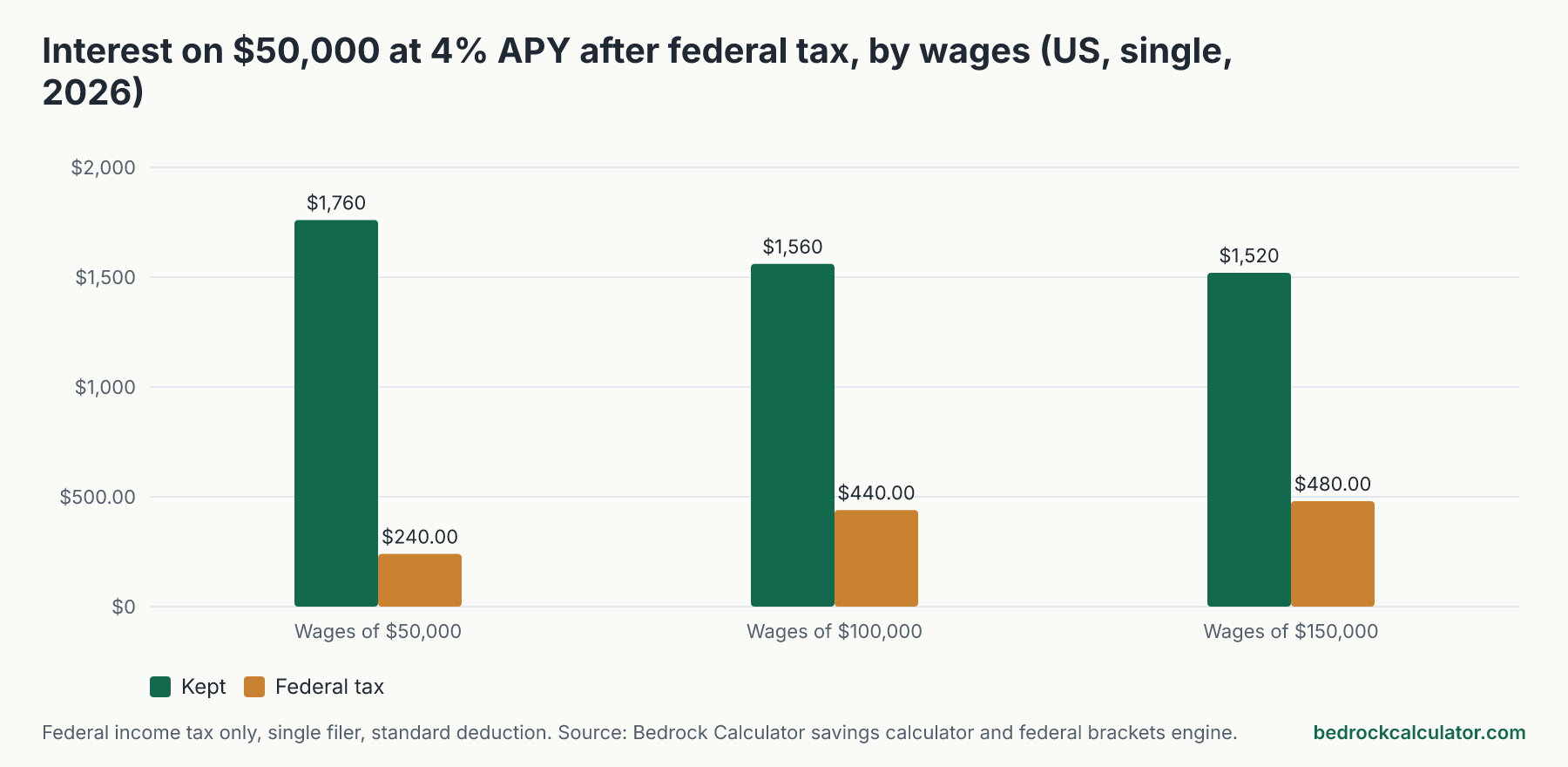
Bank interest is taxed as ordinary income, in the same brackets as your wages. So the tax rate on your interest is your top federal bracket. For a single filer that's 12% at $50,000 of wages, 22% at $100,000 and 24% at $150,000.
That turns a 4% APY into a lower after-tax yield. With $50,000 of wages you keep the equivalent of 3.52% a year. With $100,000 it's 3.12%, and with $150,000 it's 3.04%. On $50,000 in savings, that's $1,760.00, $1,560.00 or $1,520.00 for the year.
Interest from a CD is taxed the same way, and the timing can catch people out. A multi-year CD that credits interest each year is taxed on that interest every year, even though you can't spend it until the CD matures. Your bank reports it on Form 1099-INT.
CD ladder or high-yield savings?
A CD ladder splits your money across several CDs that mature one after another, so part of it comes free each year while the rest earns longer-term rates.
We ran the CD ladder calculator at its default settings: 5 rungs a year apart, rates running from 4% on the shortest CD to 4.8% on the longest, and a liquid savings rate of 3.5% to compare against. Each CD is reinvested at the longest rate when it matures.
With $50,000, the ladder ends 5 years later at $62,727.37, a blended yield of about 4.63%. Leaving the whole amount in savings at 3.5% would give $59,384.32, so the ladder earns $3,343.05 more. Putting everything into the longest CD would have earned another $481.27, but tied up all the money for the full term.
Whether a ladder beats savings depends entirely on the rates you're offered. The calculator's defaults assume CDs pay more than savings, which isn't always true. When savings rates match or beat CD rates, the flexibility of a savings account usually wins. The ladder also assumes rates stay the same when CDs renew, which they rarely do.
What this means for your emergency fund and savings
For money you might need soon, like an emergency fund, a high-yield savings account keeps it available while it earns interest. Going from a near-zero account to a 4% APY on $25,000 adds $1,000.00 a year before tax, which is real money for no extra risk, as long as the bank is federally insured and you stay within the insurance limits.
For money you won't need for a set number of years, a CD or ladder can lock in a rate. Either way, budget for the tax: you'll owe it on the interest each year, even if you never withdraw a cent.
Run your own numbers
Enter your balance, monthly deposits and APY in the savings calculator to see your interest and how long it takes to reach a goal. The CD ladder calculator compares a ladder with savings and with a single long CD at the rates you're quoted. To see your tax on interest alongside the rest of your income, use the federal income tax calculator, and for longer-term growth try the compound interest calculator.