How much self-employment tax do you pay on your net profit in 2026?
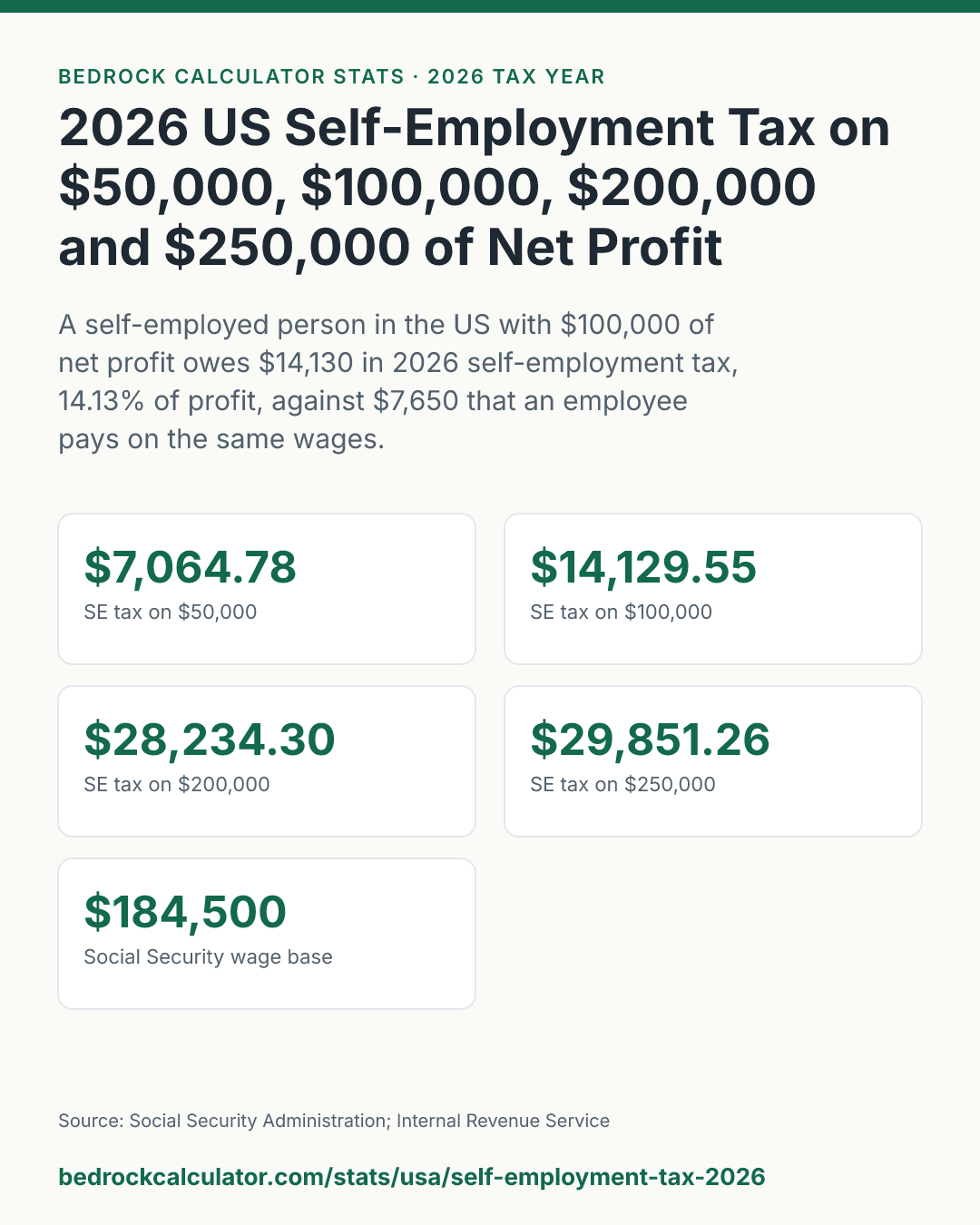
If you work for yourself in the US, you pay self-employment tax instead of having Social Security and Medicare taken from a paycheck. In 2026 it's $7,064.78 on $50,000 of net profit, $14,129.55 on $100,000, $28,234.30 on $200,000 and $29,851.26 on $250,000, for a single filer.
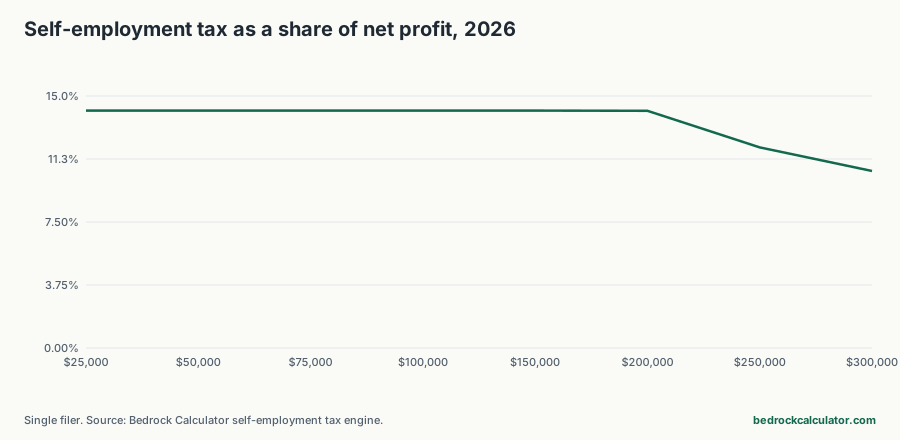
That's roughly 14.13% of profit up to the Social Security wage base of $184,500, and nearly twice what an employee pays on the same wages, because you cover both the employee's and the employer's share.
How we worked out these numbers
We ran the self-employment tax calculator on this site at eight levels of net profit for a single filer with no wages from a job, then again for a side business alongside a day job. The rates and the wage base come from the 2026 FICA table in the site's engine, which uses the SSA's published wage base.
Here's how the calculation works, step by step, as the calculator does it:
- Start with net profit from Schedule C, after business expenses.
- Multiply by 92.35%. Only that share is taxed, which mirrors the fact that an employee is never taxed on the employer's half of FICA.
- Charge 12.4% Social Security tax on that amount, up to the $184,500 wage base, minus any W-2 wages that already used part of it.
- Charge 2.9% Medicare tax on all of it, with no cap.
- Add the 0.9% Additional Medicare Tax on combined wages and self-employment earnings above $200,000 for a single filer.
Half of the regular tax, the Social Security and base Medicare parts, is deductible when you work out your income tax.
What's left out: federal and state income tax on the same profit, the quarterly payment schedule and its penalties, and partnership or S corporation income, which follows different rules. The calculator also assumes a single filer for the Additional Medicare threshold; married couples filing jointly have a higher one of $250,000.
Self-employment tax at every level of profit
2026 self-employment tax by net profit (single filer)
Download CSVSchedule SE: tax on 92.35% of net profit. Social Security stops at the wage base; Additional Medicare Tax starts above the single-filer threshold. Employee column is what a W-2 employee pays on the same wages.
| $25,000 | $2,862.85 | $669.54 | $0.00 | $3,532.39 | 14.13% | $1,766.20 | $1,912.50 |
| $50,000 | $5,725.70 | $1,339.08 | $0.00 | $7,064.78 | 14.13% | $3,532.39 | $3,825.00 |
| $75,000 | $8,588.55 | $2,008.61 | $0.00 | $10,597.16 | 14.13% | $5,298.58 | $5,737.50 |
| $100,000 | $11,451.40 | $2,678.15 | $0.00 | $14,129.55 | 14.13% | $7,064.78 | $7,650.00 |
| $150,000 | $17,177.10 | $4,017.23 | $0.00 | $21,194.33 | 14.13% | $10,597.17 | $11,475.00 |
| $200,000 | $22,878.00 | $5,356.30 | $0.00 | $28,234.30 | 14.12% | $14,117.15 | $14,339.00 |
| $250,000 | $22,878.00 | $6,695.38 | $277.88 | $29,851.26 | 11.94% | $14,786.69 | $15,514.00 |
| $300,000 | $22,878.00 | $8,034.45 | $693.45 | $31,605.90 | 10.54% | $15,456.23 | $16,689.00 |
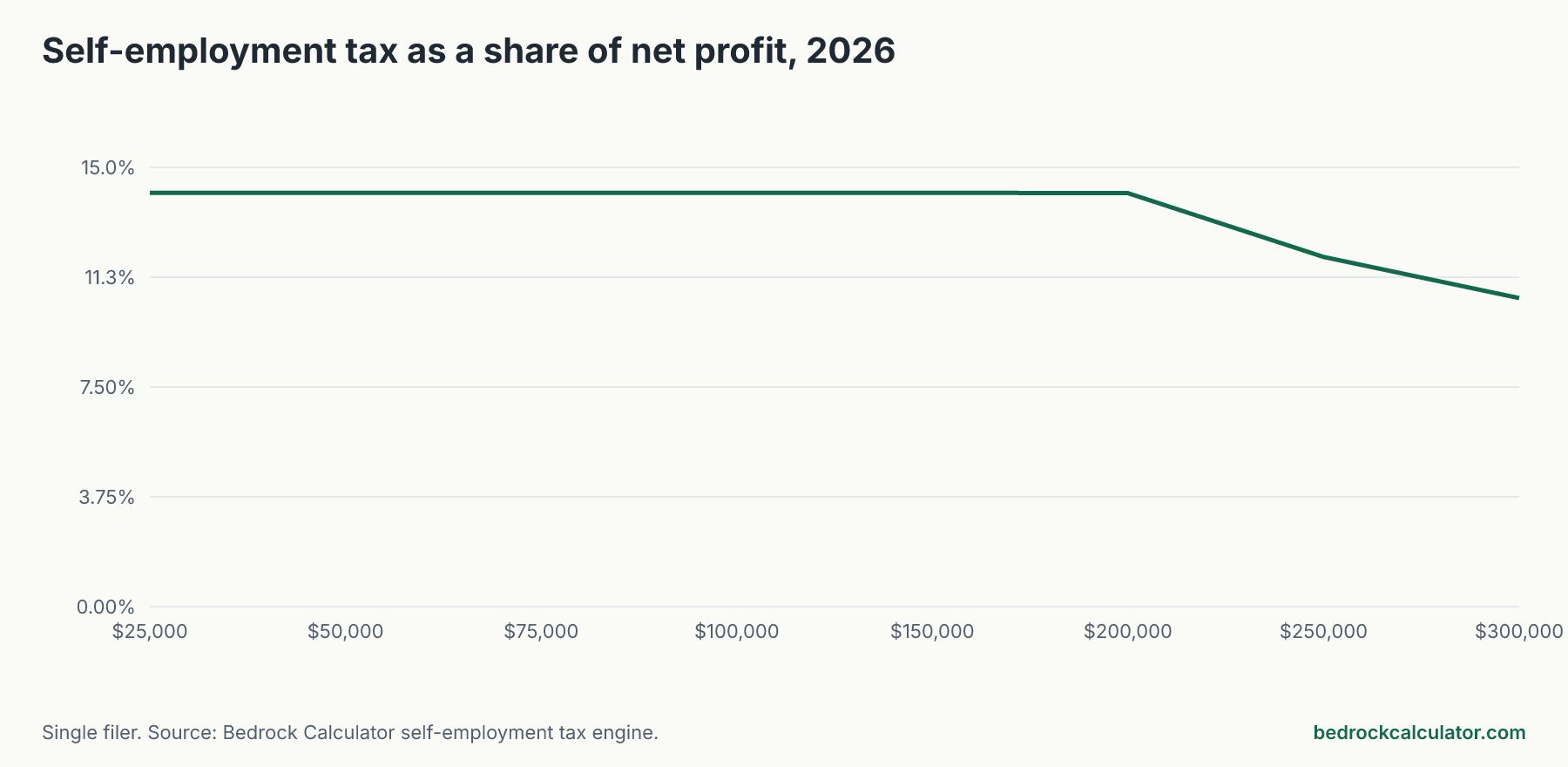
Up to about $200,000 the tax is a nearly constant 14.13% of profit, because the full 15.3% rate is applied to 92.35% of it. Past the wage base, Social Security stops growing at $22,878.00 and only Medicare keeps going, so the share falls: 11.94% at $250,000 and 10.54% at $300,000.
Self-employment tax vs FICA: why it costs more than a job
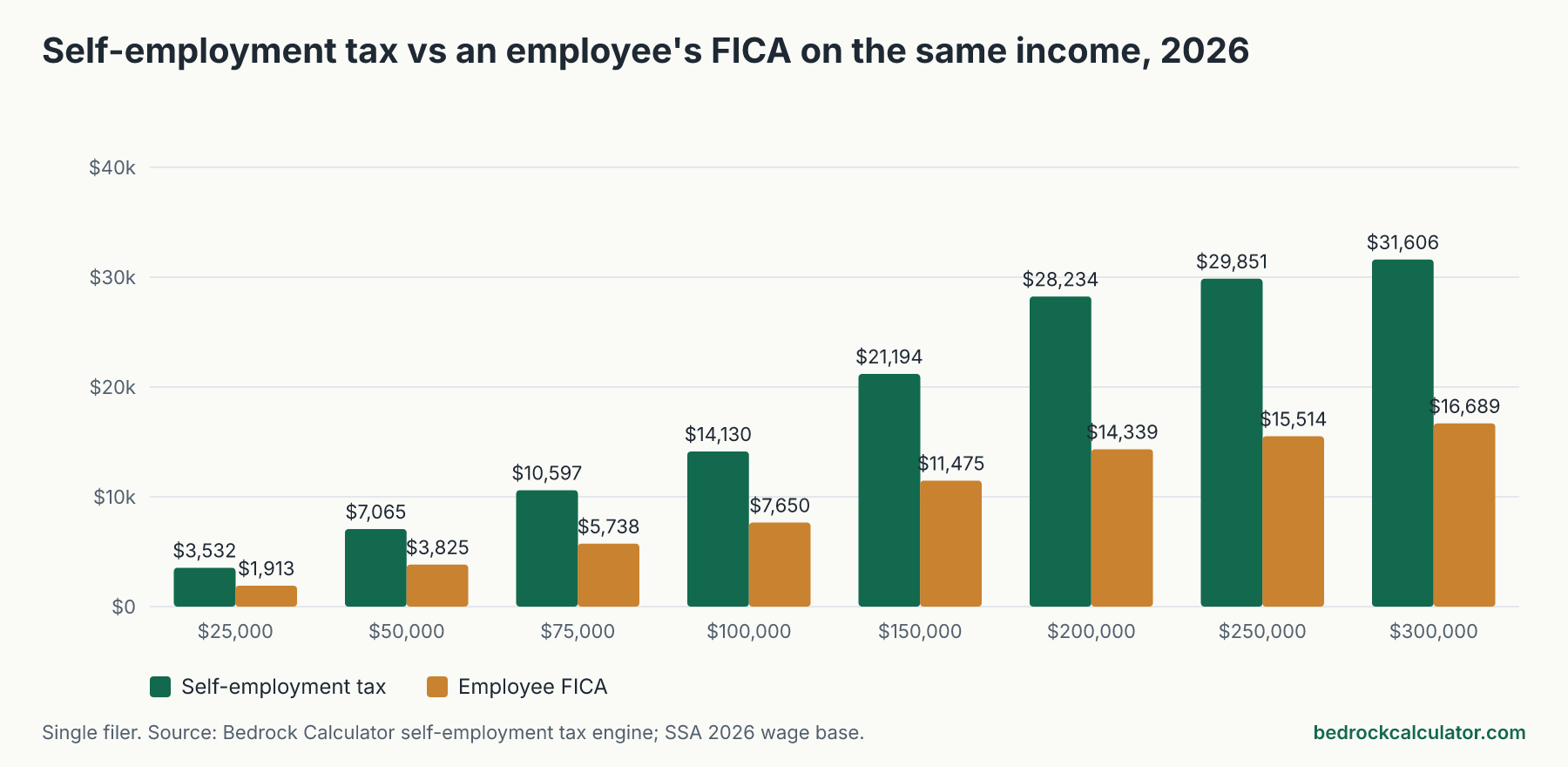
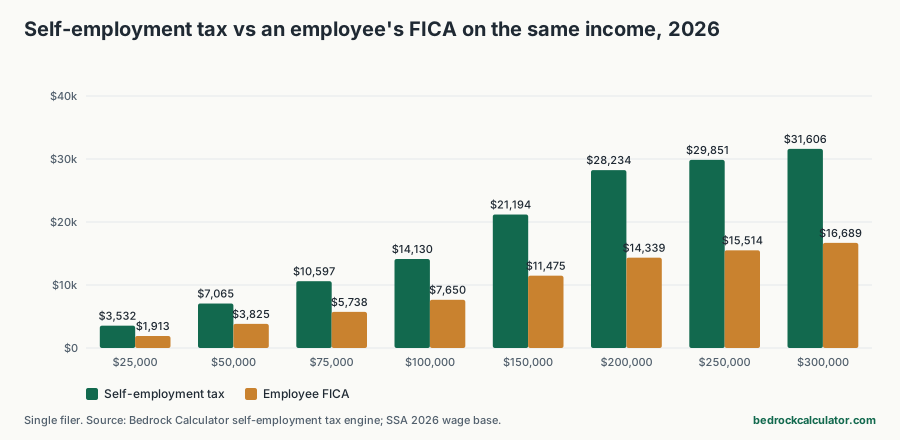
An employee pays 7.65% of wages in FICA, and the employer pays the same again without it ever appearing on the pay stub. The self-employed pay both halves. On $100,000 that's $14,129.55 for the self-employed person against $7,650.00 for an employee, a difference of $6,479.55.
The comparison isn't quite like for like. An employer's share of FICA is a cost of hiring you, and many economists think it comes out of wages in the end. The self-employed also get to deduct half of their self-employment tax, worth $7,064.78 of deduction on $100,000, and the 92.35% rule shrinks the base. Even so, the cash difference is real, and it's the main reason a first year of freelancing often comes with an unexpected tax bill.
Self-employment tax on a side business
If you have a full-time job and a side business, the Social Security wage base is shared between them. Wages already taxed for Social Security use up part of it, and the side income only pays Social Security on what's left.
Self-employment tax on a $50,000 side business, by W-2 wages from a day job
Download CSVWages already taxed for Social Security use up the same wage base, so less of the side income is taxed for Social Security.
| $0 | $5,725.70 | $1,339.08 | $0.00 | $7,064.78 |
| $100,000 | $5,725.70 | $1,339.08 | $0.00 | $7,064.78 |
| $150,000 | $4,278.00 | $1,339.08 | $0.00 | $5,617.08 |
| $175,000 | $1,178.00 | $1,339.08 | $190.58 | $2,707.66 |
| $200,000 | $0.00 | $1,339.08 | $415.58 | $1,754.66 |
On a $50,000 side business with no other job, the tax is $7,064.78. With a $150,000 salary it's $5,617.08, because only part of the side income fits under the wage base. At $200,000 of wages there's no room left, so the side income pays only Medicare and the Additional Medicare Tax, $1,754.66 in total.
Even if your employer withholds correctly from your paycheck, nothing is withheld from side income. You'll usually need to make quarterly estimated payments or raise your W-4 withholding to cover it.
What to do with this number
Self-employment tax is only part of what you owe. Income tax comes on top, at your ordinary federal rate plus any state tax. To plan payments through the year, the quarterly estimated tax calculator combines both and works out the safe-harbor amount.
The biggest lever most self-employed people have is a retirement plan. Contributions to a SEP-IRA or Solo 401(k) cut income tax, though not self-employment tax, and can shelter far more than an IRA. For how the employee version of these taxes works, see our 2026 Social Security and Medicare tax guide.