How much bigger is a Social Security check at 67 or 70 than at 62?
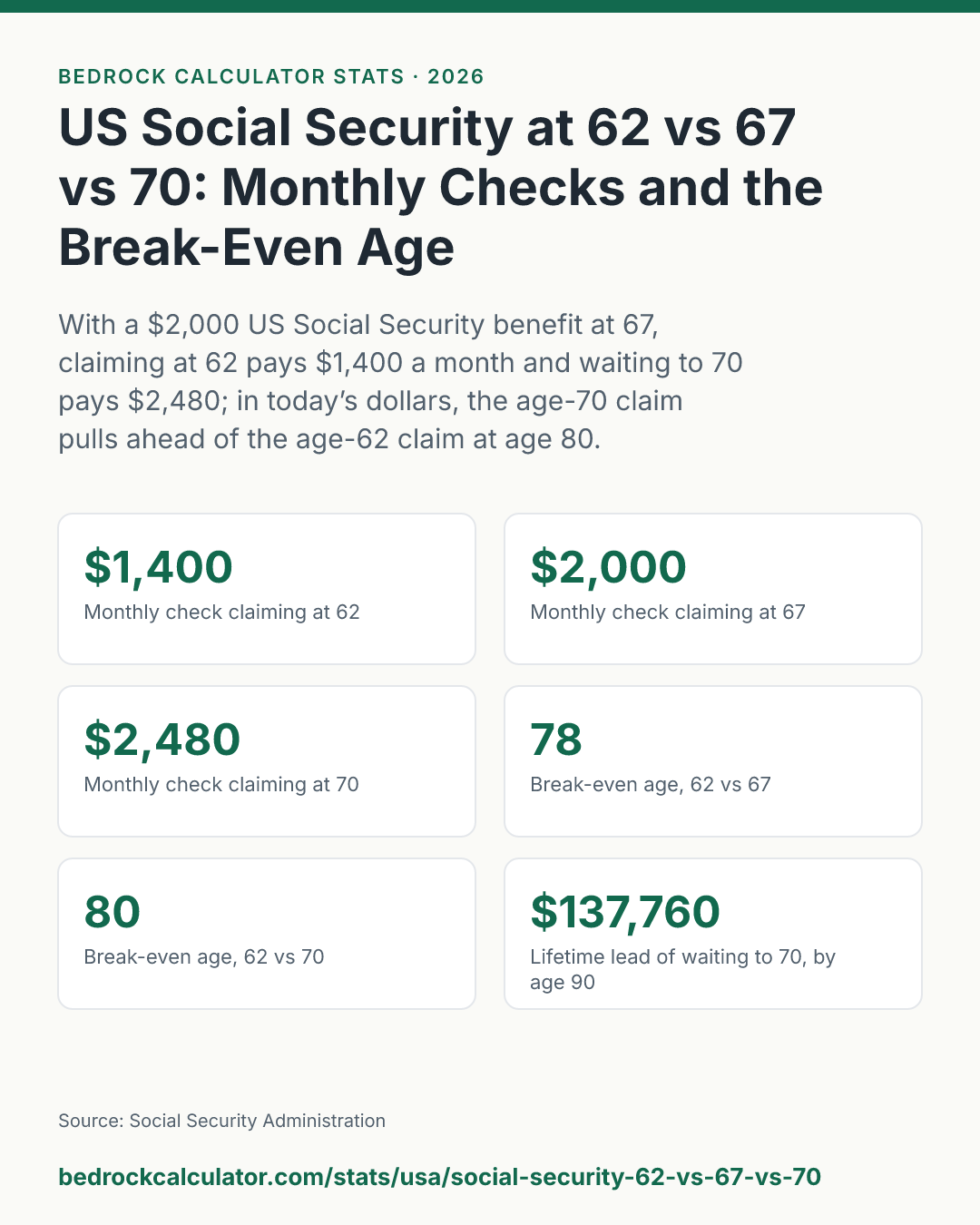
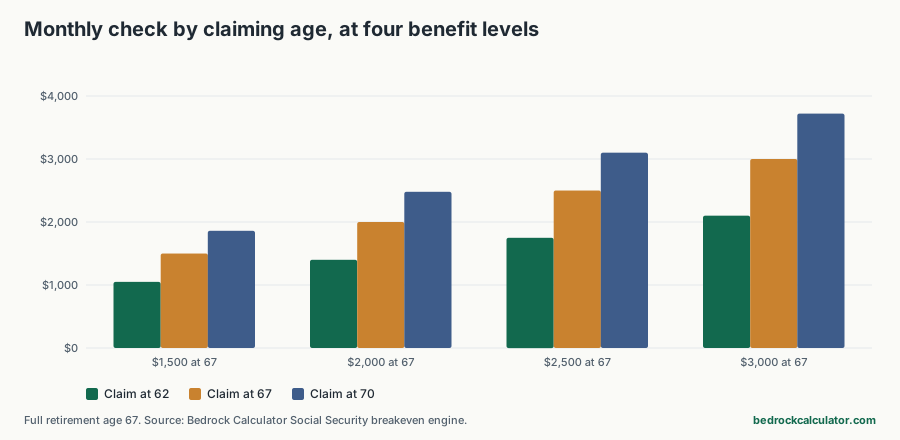
If your US Social Security benefit at full retirement age 67 is $2,000 a month, claiming at 62 pays you $1,400 a month and waiting until 70 pays $2,480. That's $1,080 more every month for the rest of your life.
The person who claims at 62 collects more money at first. In today's dollars, the person who waits until 70 catches up at age 80. Against claiming at 67, the 62 claimer is overtaken at 78.
How we worked out these numbers
All figures are for the United States and use US rules for 2026.
We ran the Social Security breakeven calculator on this site. It needs two inputs: your monthly benefit at full retirement age, which Social Security calls your primary insurance amount, and a yearly cost-of-living adjustment (COLA).
For anyone born in 1960 or later, full retirement age is 67. The calculator then applies two fixed factors:
- Claiming at 62 pays 70.0% of the full benefit. That's the permanent reduction for starting five years early.
- Claiming at 70 pays 124.0% of the full benefit. That's three years of delayed retirement credits.
It adds up twelve checks for every year of age from 62 to 95 under each choice and reports the first age at which the later claim's running total passes the earlier one.
For the main results we set the COLA to zero. That's the same as reading every figure in today's dollars, which is how your Social Security statement shows your estimates. There's a good reason to do it that way, which we explain below.
What the calculator leaves out: spousal and survivor benefits, the earnings test that withholds benefits if you claim early and keep working, income tax on benefits, Medicare premiums deducted from your check, and the time value of money. It also assumes you live to collect every check up to the age shown.
Monthly checks at 62, 67 and 70
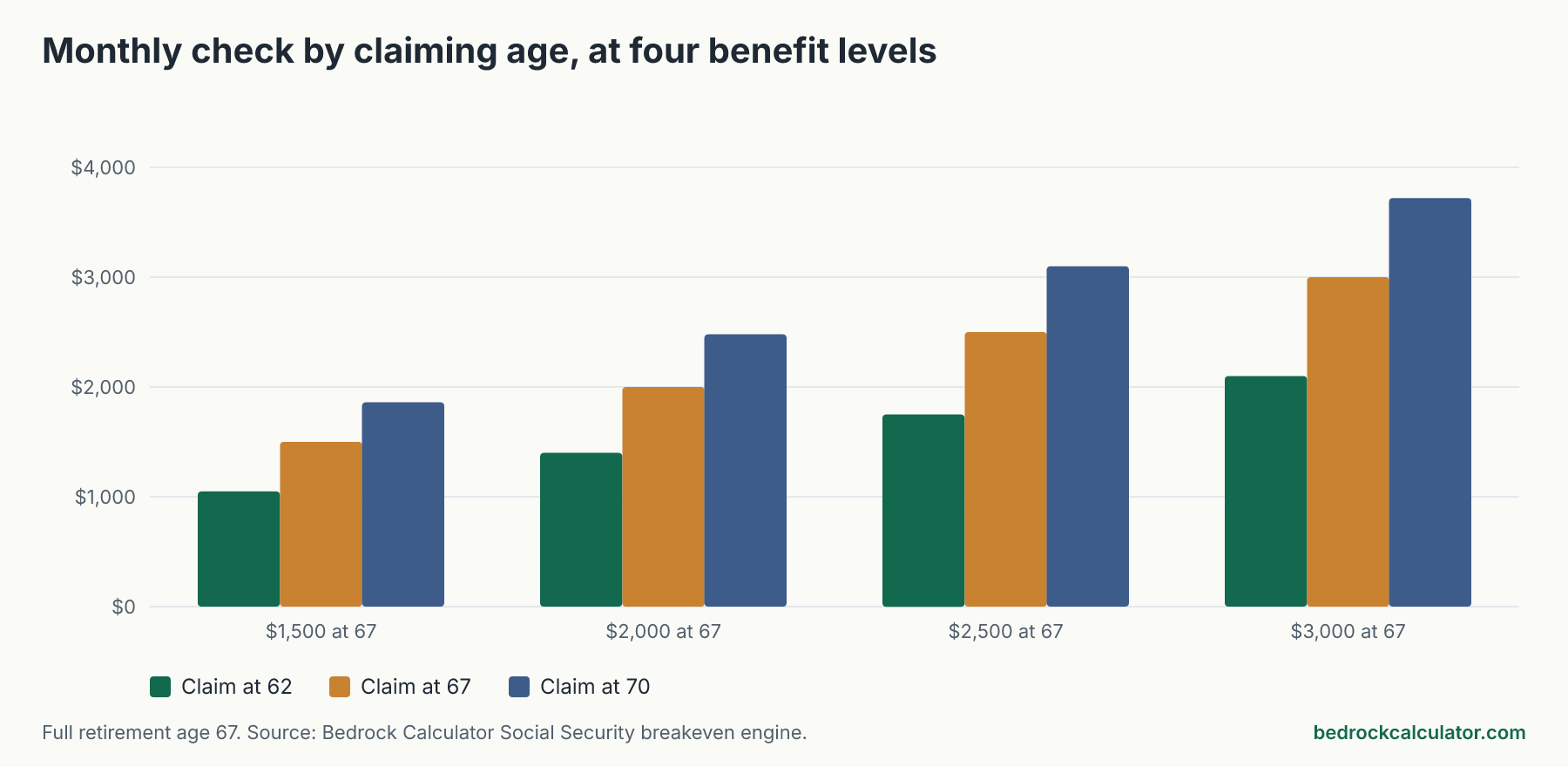
Monthly Social Security check by claiming age
Download CSVFull retirement age 67. Claiming at 62 pays 70% of the full benefit; claiming at 70 pays 124%. Today’s dollars.
| $1,500 | $1,050 | $1,500 | $1,860 | 78 | 80 |
| $2,000 | $1,400 | $2,000 | $2,480 | 78 | 80 |
| $2,500 | $1,750 | $2,500 | $3,100 | 78 | 80 |
| $3,000 | $2,100 | $3,000 | $3,720 | 78 | 80 |
The percentages don't change with the size of your benefit, so neither do the break-even ages. Someone with a $1,500 full benefit gets $1,050 at 62 or $1,860 at 70. Someone with a $3,000 full benefit gets $2,100 or $3,720. Both cross over at the same age.
When waiting until 70 pays off
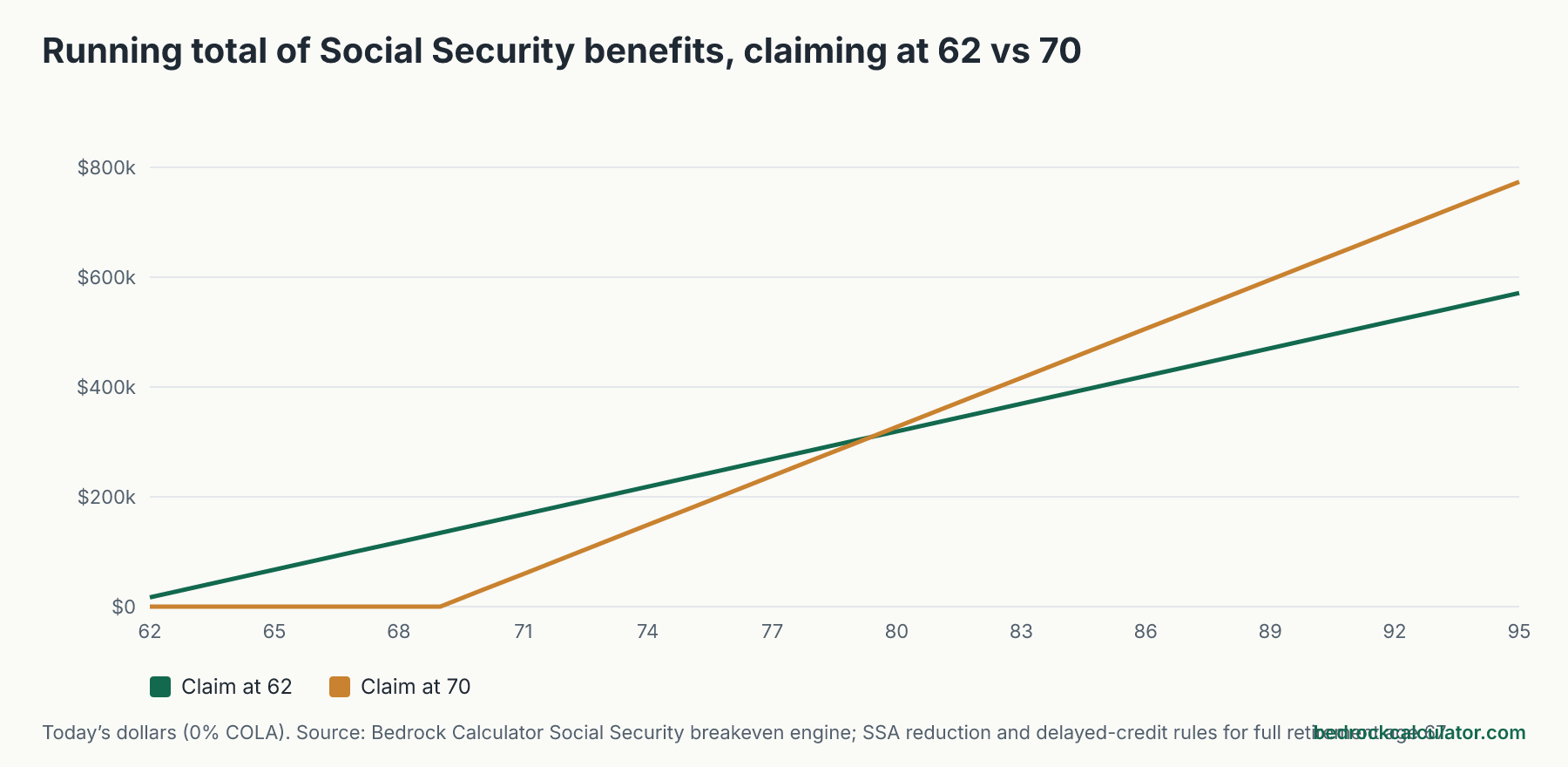
The early claimer has an eight-year head start. By 70, before the late claimer has received anything, they've already collected $151,200 on a $2,000 benefit.
But the age-70 check is 77.1% bigger, every month, for life. That closes the gap steadily. Here's how the running totals compare:
Total benefits collected by age, claiming at 62 vs 70 ($2,000 full benefit)
Download CSVRunning total of monthly checks, 0% COLA (today’s dollars). From the Social Security breakeven calculator.
| 66 | $84,000 | $0 | -$84,000 |
| 70 | $151,200 | $29,760 | -$121,440 |
| 75 | $235,200 | $178,560 | -$56,640 |
| 78 | $285,600 | $267,840 | -$17,760 |
| 80 | $319,200 | $327,360 | $8,160 |
| 85 | $403,200 | $476,160 | $72,960 |
| 90 | $487,200 | $624,960 | $137,760 |
| 95 | $571,200 | $773,760 | $202,560 |
At 75, the 62 claimer is still $56,640 ahead. By 80 the lines cross. At 85 the person who waited has collected $72,960 more, and at 90 the lead is $137,760.
So the real question is how long you expect to live. If you have good reason to think you won't reach your early 80s, claiming early usually collects more. If you're healthy and your parents lived into their 90s, waiting tends to win, and by a lot.
Should you take Social Security at 62 or 70?
The break-even age is a useful number, but it's not the whole decision. A few things push in each direction.
Reasons people wait:
- A bigger check is insurance against living a long time. The years when running out of money hurts most are your late 80s and 90s, and that's exactly when the age-70 claim pays the most.
- For a married couple, the higher earner's benefit becomes the survivor benefit when one spouse dies. Delaying it can raise the widow or widower's income for decades. The spousal benefit calculator shows how the two benefits interact.
- Your benefit keeps getting COLA raises either way, so a bigger starting check means bigger raises in dollars.
Reasons people claim early:
- Poor health or a short family history of longevity.
- No other savings to live on between retirement and 70. Waiting only makes sense if you can afford to.
- You've stopped working and the check is needed now. If you're still working before full retirement age, the earnings test can temporarily withhold benefits, which the earnings test calculator works out.
Many people land in between, claiming at 67 or somewhere from 67 to 70. The break-even against claiming at 62 is about 78 if you take it at 67.
What happens when you add a COLA
Break-even age in nominal dollars at different COLA inputs
Download CSVCOLA applied from age 62 to every claiming age, as SSA does. 0% is the today’s-dollars comparison.
| 0% | 78 | 80 |
| 2.5% | 76 | 78 |
| 3.5% | 76 | 77 |
If you enter a COLA in the calculator, the break-even age moves slightly earlier. With 2.5% it reports 76 for 62 vs 67 and 78 for 62 vs 70.
Under Social Security's rules, COLAs are added to your benefit from age 62 whether or not you've claimed, and the calculator does the same, so every claiming choice gets the same raises. What changes is the yardstick. With a COLA the totals are in nominal dollars, and the later years, when the bigger age-70 check is paid, count for more of them. That's why we used a zero COLA for the main results: it compares the choices in today's dollars, which is how your Social Security statement shows your estimates.
Getting your own number
Find your benefit estimate at full retirement age on your Social Security statement, then enter it in the breakeven calculator with a COLA of zero to compare in today's dollars.
If Social Security is one part of a larger plan, the retirement calculator lets you enter your expected benefit and shows how much your savings need to cover on top of it.