How much term life insurance do you need?
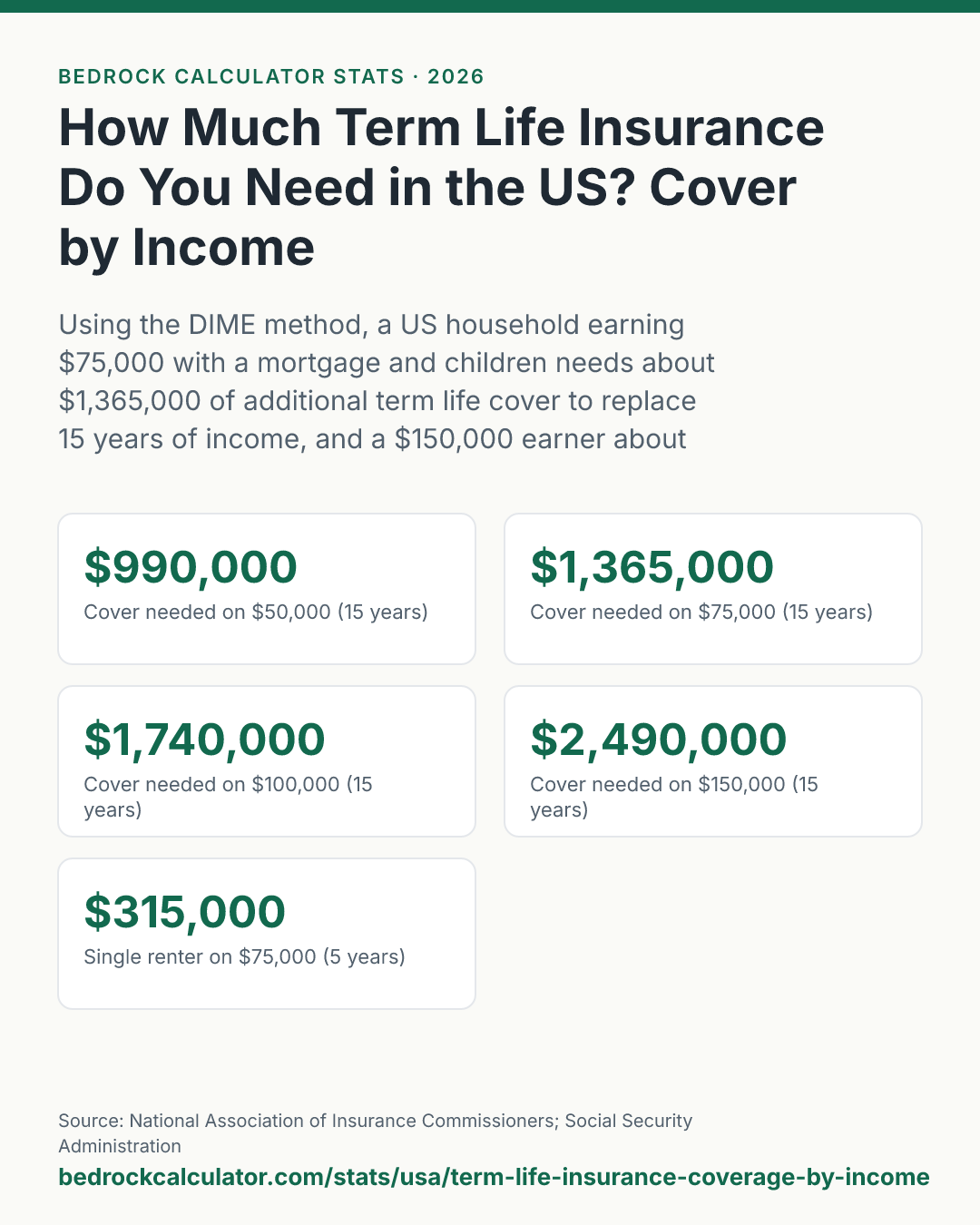
A US household earning $75,000, with a mortgage and children, needs about $1,365,000 of additional term life cover to replace 15 years of income, using the DIME method, a common way to size life cover. At $100,000 the figure is $1,740,000, and at $150,000 it's $2,490,000.
The household matters as much as the salary. A single renter on the same $75,000, with nobody depending on that income for long, needs $315,000.
What the DIME method counts
DIME stands for the four things a life insurance payout usually has to cover if you die while people still depend on you:
- Debt: credit cards, car loans, personal loans and final expenses
- Income: your salary times the number of years your family would need it
- Mortgage: the balance left on the house, so your family can stay in it
- Education: what you'd want set aside for your children's schooling
Add those up, take away the savings your family could use straight away and any life cover you already have, and what's left is the extra cover to buy. That's exactly what the site's term life insurance calculator does, and it's where every figure on this page comes from.
How we worked out these numbers
We used one sample household and changed only the income and the number of years of income to replace. The household is the calculator's default:
- $20,000 of non-mortgage debt and final expenses
- A $240,000 mortgage balance
- $60,000 set aside for education
- $30,000 of savings the family could use right away
- $50,000 of life cover already in place, such as a policy through work
Before income is counted, those fixed parts come to $240,000: the debt, mortgage and education, less the $80,000 of savings and existing cover. Everything else is salary times years.
One thing this page doesn't do is tell you what that cover costs. The calculator works out how much cover you need, not the premium. Premiums depend on your age, health, whether you smoke, the length of the term and the insurer's pricing, and no formula on this site prices them. Once you know the amount, the honest way to get the cost is to get quotes for it.
How much life insurance you need by income
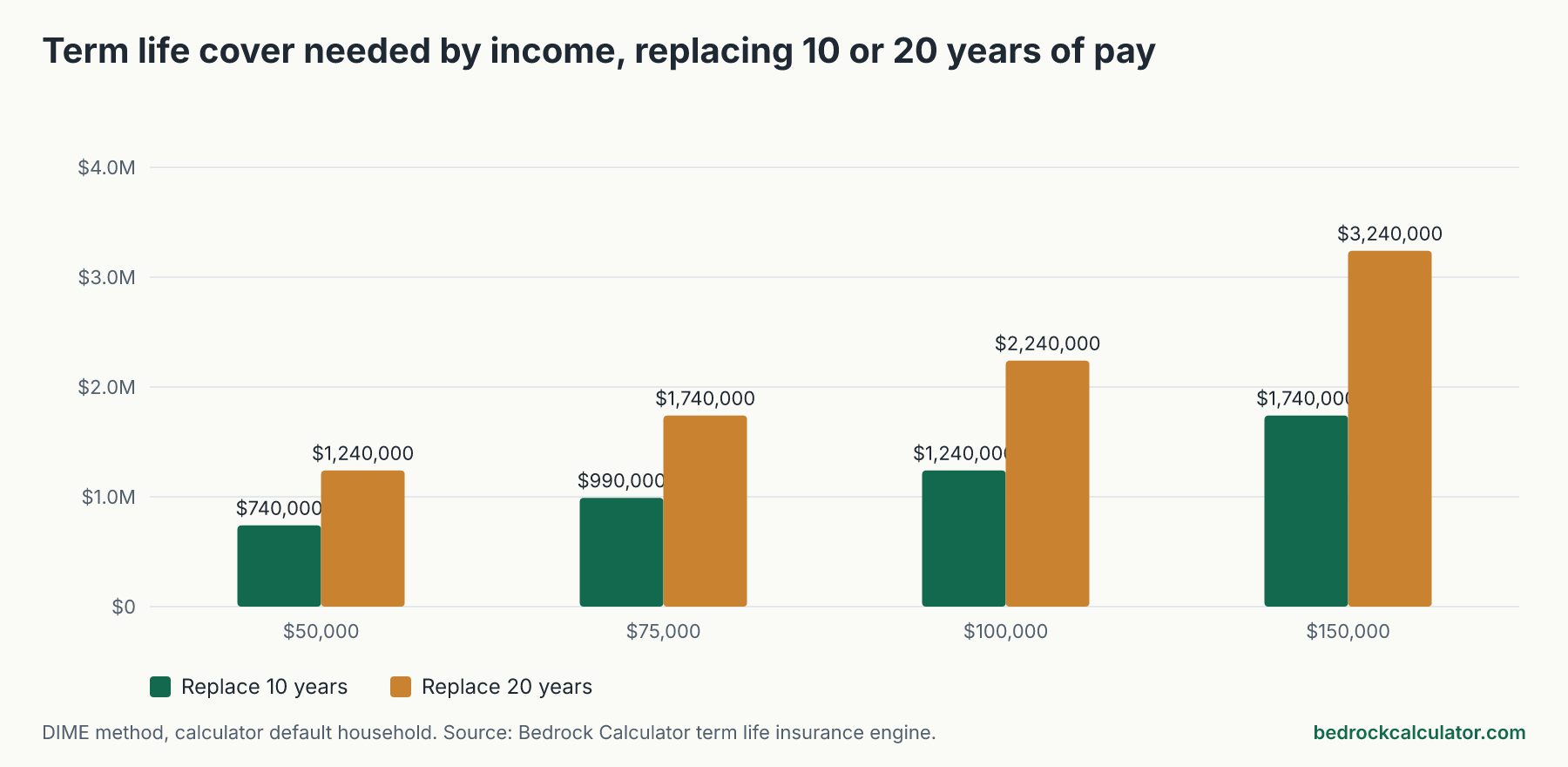
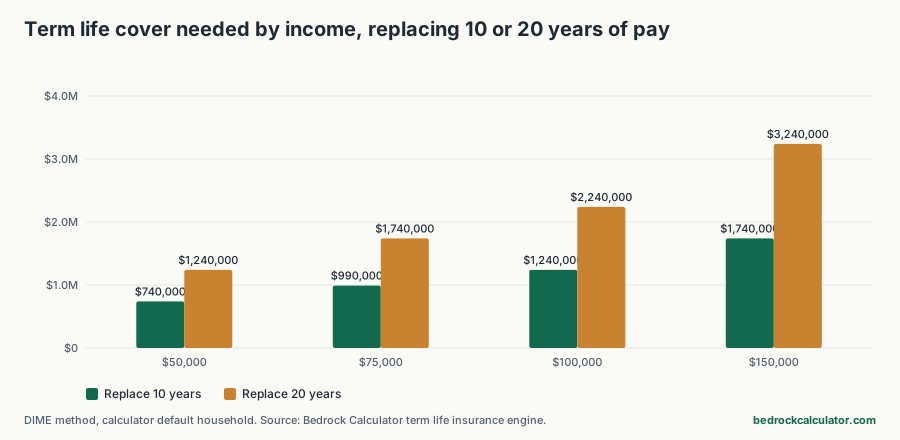
Term life cover needed by income and years of income replaced (US, DIME method)
Download CSVHousehold with $20,000 of other debt, a $240,000 mortgage, $60,000 for education, $30,000 in savings and $50,000 of existing cover. Additional cover needed, after those offsets.
| $50,000 | $740,000 | $990,000 | $1,240,000 | 19.8 |
| $75,000 | $990,000 | $1,365,000 | $1,740,000 | 18.2 |
| $100,000 | $1,240,000 | $1,740,000 | $2,240,000 | 17.4 |
| $150,000 | $1,740,000 | $2,490,000 | $3,240,000 | 16.6 |
The income part dominates. For a $75,000 earner replacing 15 years, income replacement alone is $1,125,000, which is 77.9% of the total before savings and existing cover are taken off.
That's also why the number of years matters so much. Every extra five years of income on $75,000 adds the same $375,000. Going from 10 years to 20 years on $100,000 takes the cover needed from $1,240,000 to $2,240,000.
How many years should you pick? A common answer is until your youngest child is out of school and self-supporting, or until your partner could manage on their own income and savings. For a newborn that can be 20 years or more. For teenagers it might be five to ten.
Is 10 times your salary enough?
The rule of thumb you'll hear most is ten times your income. For the household on this page, replacing 15 years of a $75,000 salary works out to 18.2 times income in additional cover. On $50,000 it's 19.8 times, and on $150,000 it's 16.6 times.
The multiple drops as income rises because the mortgage and education costs are the same dollar amount at every salary, so they're a bigger share of the total for lower earners. A rule based only on salary misses that. A family with a big mortgage on a modest income can need well over ten times pay, and a high earner with no debts and grown children may need far less.
How your household changes the answer
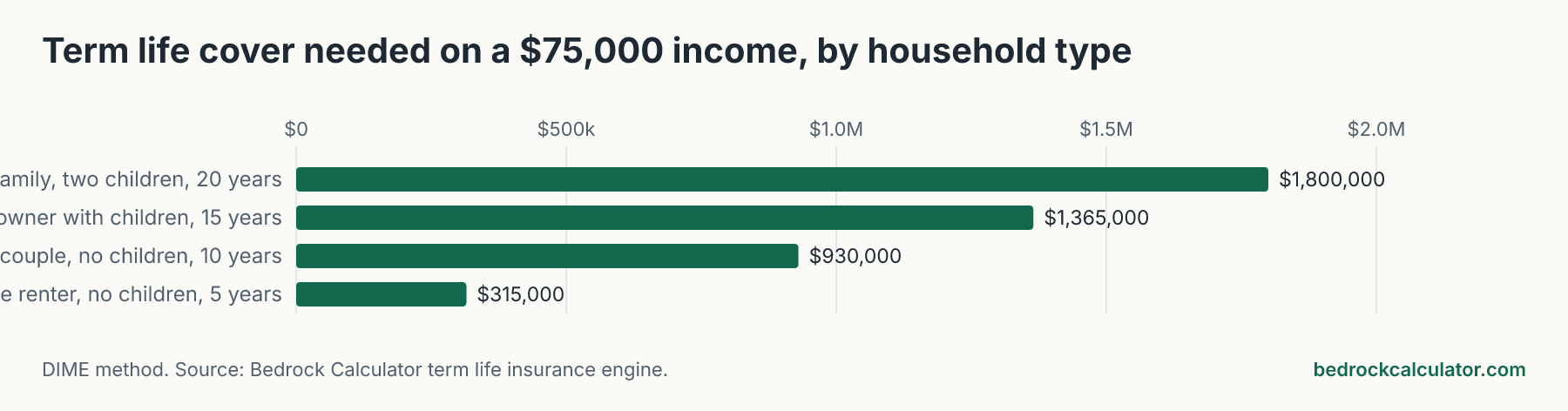
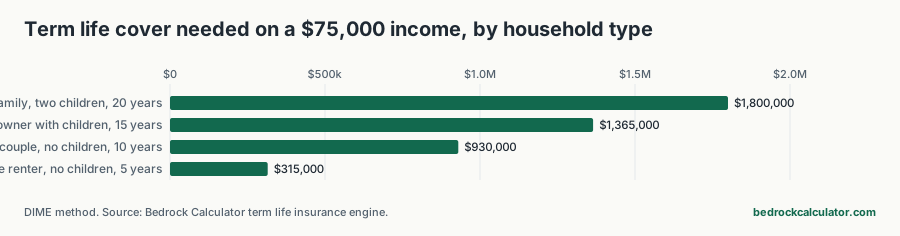
Here's the same $75,000 income across four kinds of household. Each has $20,000 of other debt, $30,000 of savings and $50,000 of existing cover.
Term life cover needed on a $75,000 income, by household
Download CSVEvery household has $20,000 of other debt, $30,000 in savings and $50,000 of existing cover. Mortgage is $240,000 where there is one.
| Single renter, no children, 5 years | $375,000 | $0 | $0 | $315,000 |
| Homeowner couple, no children, 10 years | $750,000 | $240,000 | $0 | $930,000 |
| Homeowner with children, 15 years | $1,125,000 | $240,000 | $60,000 | $1,365,000 |
| Young family, two children, 20 years | $1,500,000 | $240,000 | $120,000 | $1,800,000 |
A single renter with no children replacing five years needs $315,000. Plenty of single people with no dependents choose to buy little or no cover at all, since nobody relies on their income.
A homeowner couple with no children, replacing 10 years, needs $930,000. The mortgage is a big part of that.
A homeowner with children replacing 15 years needs $1,365,000, and a young family with two children to put through college, replacing 20 years, needs $1,800,000.
What this leaves out
DIME is a starting point, and the calculator keeps it simple:
- Social Security survivor benefits. A surviving spouse caring for young children, and the children themselves, can get monthly Social Security survivor benefits. Those can cover part of the lost income, and the calculator doesn't subtract them, so the figures here can run high for families with young kids.
- Inflation and investment returns. Income and education costs are in today's dollars. The calculator doesn't grow them with inflation or assume the payout earns anything once it's invested. Those two effects pull in opposite directions.
- Two earners. The calculator sizes cover for one income at a time. If both partners work, run it once for each.
- Taxes. Life insurance payouts are generally free of federal income tax for the people who receive them. Very large policies can raise estate tax questions the calculator doesn't model.
- Price. As above, no premiums are included. The cover amount is what this page is for.
Working out your own figure
Open the term life insurance calculator and enter your income, the years you want to cover, what's left on your mortgage, your other debts, what you'd set aside for education, your savings and any cover you already have through work.
If you're also thinking about what happens if you can't work rather than if you die, the disability insurance calculator runs the same kind of needs check for lost income. To put a number on the education part, the 529 plan calculator shows what college savings could grow to.